This site is supported by our readers. We may earn a commission, at no cost to you, if you purchase through links.

A mongoose squares off against a king cobra, dodges its strikes, and wins. The cobra’s venom, enough to drop an elephant, barely slows it down.
Mongooses aren’t alone. Opossums, honey badgers, hedgehogs, and even kingsnakes shrug off bites that would kill most animals within minutes. These animals immune to snake venom carry molecular armor built over millions of years: tweaked receptors, venom-hunting blood proteins, and genes sharpened by predation.
Understanding how they do it reveals how venom actually works, where resistance fails, and what it means if you keep snakes. Here’s what these survivors have figured out.
Table Of Contents
- Key Takeaways
- Are Any Animals Immune to Snake Venom?
- Mammals With Documented Snake Venom Resistance
- Kingsnakes and Their Resistance to Snake Venom
- How Animals Resist Snake Venom
- Why Animals Evolve Snake Venom Resistance
- What Venom Resistance Means for Snake Owners
- Frequently Asked Questions (FAQs)
- What animal is most immune to snake venom?
- What animal is immune from snake venom?
- Is there anyone immune to snake venom?
- Are pigs immune to rattlesnake bites?
- Can secretary birds survive venomous snake bites?
- Can humans develop immunity to snake venom?
- Is venom resistance the same as complete immunity?
- Do snake eagles eat venomous snakes safely?
- Conclusion
Key Takeaways
- No animal is truly immune to snake venom; what you see in nature is resistance, which can still fail against a big enough dose or venoms that destroy tissue.
- Animals resist venom in two main ways: reshaped nerve receptors that keep toxins from docking, and blood proteins like the opossum’s LTNF that neutralize toxins before they spread.
- Resistance evolves where snakes are a constant threat or a regular meal, so it’s often local, which is why a kingsnake or ground squirrel may handle nearby vipers but struggle with unfamiliar ones.
- If you keep snakes, none of this protects you, so handle with hooks and tongs, know your snake’s exact species, and head straight to a hospital after any bite.
Are Any Animals Immune to Snake Venom?

Immunity is a tricky word. Strictly speaking, no animal is immune to every snake venom. What you’ll find in nature is venom resistance, a partial and often specific shield against particular toxins.
Mongooses, kingsnakes, and other animals that eat snakes each evolved different defenses, from altered receptors to sheer speed, that tip the odds in their favor.
Mongooses, opossums, honey badgers, and kingsnakes all carry it. Their bodies handle bites that would drop a rat in minutes. Yet even these champions have limits. A massive dose can still overwhelm them, and some venoms wreck tissue no matter how well the nerves hold up.
Resistance comes from evolutionary adaptation, not from your immune system learning on the job. It’s shaped by predator-prey relationships: animals that hunt snakes, or get hunted by them, survive better when toxin neutralization is built into their biology.
Think of it as armor, not invincibility.
Mammals With Documented Snake Venom Resistance

Some mammals shrug off bites that would drop you in minutes. You’re about to meet four groups with documented venom resistance, each with its own trick. Let’s start with the one that made snake-fighting famous.
Mongooses
A mongoose doesn’t flinch when a cobra rears up. Its venom resistance starts with altered nicotinic acetylcholine receptors, which block neurotoxins from docking.
Then comes Lethal Toxin Neutralizing Factor (LTNF), a serum protein that disarms what slips through. Picture yourself:
- Facing a cobra, unarmed and calm.
- Trusting only your blood to save you.
- Winning, thanks to millennia of predator-prey coevolution.
Opossums
play the same game, just quieter. Their blood carries Lethal Toxin Neutralizing Factor (LTNF), and a short 11-amino-acid piece of it, LTNF-11, protects mice from rattlesnake and Russell’s viper venom.
Even so, a snake that stays defensive isn’t a lost cause, and these tips for handling an aggressive or defensive snake can help you build trust at its pace.
Among venom resistance mechanisms, this is one of the natural antivenom compounds researchers study most. Add altered von Willebrand Factor and metalloproteinase inhibitors, and you get snake venom immunity.
Honey Badgers, Hedgehogs, and Pigs
Blood proteins aren’t the only trick. Honey badgers, hedgehogs, and pigs rely on receptor changes instead.
Each swapped in a positively charged amino acid that repels the toxin, a clever form of neurotoxin resistance:
- Honey badgers eat cobras and recover.
- Hedgehogs evolved the same fix independently.
- Pigs share it too.
- Thick skin cushions bites, nothing more.
- Resistance isn’t absolute, though.
California Ground Squirrels
A rattlesnake meets trouble when California Ground Squirrels answer. Snake predation drove coevolution, and their blood now carries a genetic adaptation to venom. Here’s how venom resistance varies:
Ground squirrels aren’t alone in this, since even venomous snakes carry built-in protection against their own venom, including blood proteins that neutralize toxins before they can spread.
| Habitat | Snake density | Serum effect |
|---|---|---|
| Snake-rich | High | Strong inhibition |
| Mixed | Moderate | Partial inhibition |
| Snake-free | None | Weak inhibition |
Stress weakens that protection, so even tough squirrels aren’t invincible. Resistance isn’t immunity. Stay careful.
Since people share trails with rattlesnakes too, a pair of snake guard hiking boots adds a layer of protection that no squirrel’s blood can match.
Kingsnakes and Their Resistance to Snake Venom
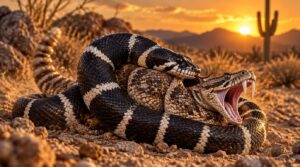
A rattlesnake strikes. The kingsnake keeps squeezing.
That’s the Common kingsnake‘s party trick, and it’s real. Venomous snake predation is routine for this species, since snakes make up roughly 25% of its diet. It constricts with about twice the force of a rat snake, relative to body size, so the fight ends fast.
Blood does the rest. Studies point to venom component degradation by enzymes and antibodies, which blunt snake venom. Receptor site modification may play a part too. Resistance is innate and fixed for life, so a juvenile arrives ready. To learn which vipers share a kingsnake’s home range, a field guide to venomous snakes usually includes range maps for each species.
Here’s your catch, though: protection is local. A Florida kingsnake experiences Florida vipers well, but a snake from a distant region may still hurt it. Never assume blanket immunity.
A regional reptiles and amphibians field guide helps you check which local vipers share a kingsnake’s range before you assume anything.
How Animals Resist Snake Venom
Venom is a lock, and these animals changed the key. You’ll see that resistance comes down to two main strategies, each tackling the toxin at a different stage. Here’s how venom resistance works, starting with the receptors that toxins try to grab and ending with the proteins that catch them in the blood.
Venom is a lock, and resistant animals survive by changing the key, either at the receptors or in the blood
Receptor Changes That Block Neurotoxins

Picture a lock where one tiny swap, a single charged amino acid, turns a deadly key into a useless piece of metal. That’s what happens at nicotinic acetylcholine receptors. Snake neurotoxins normally lock onto them and freeze your muscles. Resistant animals changed the lock through:
- Genetic mutation altering receptor sequence
- Receptor site modification, swapping in charged lysine
- Neurotoxin receptor blockade through electrostatic repulsion
These molecular adaptations leave the nerve signal intact, so a mongoose can shrug off a bite that’d drop you.
Blood Proteins That Inhibit Toxins
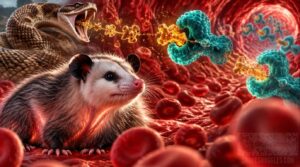
Think of blood as a security checkpoint. Venom inhibitors screen every arriving toxin. Opossum Lethal Toxin Neutralizing Factor LTNF performs serum toxin scavenging, while antivenomlike proteins use toxin binding inhibition.
| Protein | Effect |
|---|---|
| LTNF | Protects mice |
| FETUA | Blocks hemorrhage |
| PLA2 inhibitors | Stop paralysis |
Your takeaway: nature already wrote antivenom recipes, and researchers are reading them closely. Combining FETUA proteins works best.
Why Animals Evolve Snake Venom Resistance

Why would a mongoose shrug off a cobra’s bite? Because death keeps choosing for it.
Resistance doesn’t appear by chance. It spreads when selective pressure from venom is steady and brutal. If snakes are a major cause of death in your habitat, the animals that survive a bite pass on their genes, and the ones that don’t, don’t.
That’s predator-prey coevolution in action. As prey grow tougher, snakes with stronger or more varied venom gain the edge, and the cycle restarts. These evolutionary arms race patterns explain why venom and resistance often match so closely from region to region.
Sometimes the motive flips. Mongooses and hedgehogs gain a safe meal by tolerating venom, and a single receptor mutation is a cheap, efficient form of genetic adaptation to venom.
What Venom Resistance Means for Snake Owners

Mongooses shrug off cobra bites. You won’t.
Venom resistance in wildlife grew out of predator-prey relationships, not anything that transfers to you, so natural immunity is never part of your safety plan. Treat every one of your venomous snake encounters as a real envenomation risk.
Build these habits instead:
- Handle only with hooks and tongs.
- Know your snake’s exact species, since antivenom is species-specific.
- Don’t treat antivenom alternatives as a substitute for real hospital care.
- Post a venom information card for emergency medical personnel.
- Lock the snake room and never handle alone.
Immobilize the limb, skip tourniquets and cutting, and get to a hospital fast. Respect the venom, because your own biology offers no shield.
Frequently Asked Questions (FAQs)
What animal is most immune to snake venom?
Gone in a flash. That’s the opossum’s secret. Its blood carries a peptide that neutralizes rattlesnake venom, so your best pick is the opossum. Mongooses and honey badgers resist too, but they can’t match it.
What animal is immune from snake venom?
Six mammals here resist venom, but none is truly immune. The mongoose is your best answer, thanks to mutated receptors that block cobra toxins. Opossums, honey badgers, hedgehogs, and California Ground Squirrels also resist venom.
Is there anyone immune to snake venom?
Nothing on Earth shrugs off venom like a mongoose, but "immune" is a stretch. Mongooses, opossums, honey badgers and kingsnakes rely on toxin-resistant proteins and genetic adaptation to venom. Humans aren’t on the list, so never test it.
Are pigs immune to rattlesnake bites?
Not quite. Pigs don’t have true natural immunity, but a genetic mutation in their acetylcholine receptors blunts rattlesnake venom’s neurotoxins.
Venomous snake bite survival is likelier in adults, so don’t assume your piglets are safe.
Can secretary birds survive venomous snake bites?
A secretary bird fights with footwork, not chemistry. It has no biochemical defense mechanisms against snake venom, so venomous snake bite survival hinges on speed. In predator-prey relationships, its 15-millisecond stomps land before fangs do.
Can humans develop immunity to snake venom?
Yes, but brutal.
Your immune system adaptation builds internal antitoxin production after hundreds of escalating doses, creating toxin resistant proteins as biochemical defense mechanisms. Venomous snake bite survival improves, yet it’s risky, toxin-specific, and fades.
Is venom resistance the same as complete immunity?
Think a mongoose shrugs off any bite? Not quite.
Venom resistance isn’t immunological resistance. Cross-species venom tolerance varies, and venom protein inactivation or internal antitoxin production only reduces harm; a big enough dose still kills.
Do snake eagles eat venomous snakes safely?
Not quite. Snake eagles aren’t immune. They’ve got no venom resistance at all, so they rely on scaled legs, lightning strikes behind the head, and crushing the spine fast.
Conclusion
Picture a honey badger shrugging off a puff adder bite, napping it off, then wandering back to dinner. That’s not magic. It’s receptors reshaped and blood proteins trained to hunt toxins.
Among animals immune snake venom, none is truly invincible. Resistance has limits, and a big enough dose still wins. If you keep snakes, respect that lesson every time you open the enclosure. Evolution’s armor took millions of years to build. Your caution takes seconds.