This site is supported by our readers. We may earn a commission, at no cost to you, if you purchase through links.

Milk snakes fool predators with a disguise borrowed from one of North America’s most feared reptiles—the coral snake. That mimicry has made them survivors for millions of years, but in captivity, their survival depends entirely on you.
Get the setup right, and a milk snake can thrive for 20 years. Get it wrong, and a hardy animal quietly declines. The difference usually comes down to details most beginners overlook: temperature gradients, prey sized to the snake’s mid-body width, enclosure footprints matched to the animal’s actual length. This care sheet covers all of it.
Table Of Contents
- Key Takeaways
- Milk Snake Species and Characteristics
- Choosing and Setting Up an Enclosure
- Temperature, Lighting, and Humidity Control
- Substrate, Decor, and Environmental Enrichment
- Feeding, Health, and Routine Care
- Frequently Asked Questions (FAQs)
- Are milk snakes easy to keep?
- How often should I feed a milk snake?
- What is the best bedding for milk snakes?
- How do you take care of a milk snake?
- How long do milk snakes typically live in captivity?
- Are milk snakes safe to keep around children?
- What are common color morphs of milk snakes?
- Can milk snakes be housed with other reptiles?
- How often do milk snakes shed their skin?
- Can milk snakes live with other reptiles?
- Conclusion
Key Takeaways
- Match enclosure size to your snake’s current length — hatchlings need 10 gallons, but adults require at least a 40-gallon setup with a 48" × 24" × 24" footprint.
- Keep a thermal gradient with a warm side at 80–90°F and a cool side at 75–80°F, since milk snakes can’t regulate their own body temperature without it.
- Feed frozen-thawed prey sized to your snake’s mid-body width every 5–7 days for hatchlings, 7–10 for juveniles, and 10–14 days for adults — get this right and your snake can live 15 to 22 years.
- Never house milk snakes together — they’re cannibalistic, and solitary housing isn’t just a preference, it’s a necessity.
Milk Snake Species and Characteristics

Milk snakes are one of the most rewarding reptiles you can keep — calm, striking, and surprisingly straightforward to care for.
Their gentle temperament makes them ideal for beginners, and first-time milk snake handling tips show just how quickly you’ll feel at ease with them.
Before you bring one home, it helps to know what you’re actually working with. Here’s a closer look at the most common subspecies, what they look like, how big they get, and what kind of temperament you can expect.
Common Milk Snake Subspecies
Milk snakes are one of North America’s most diverse species, with over 25 subspecies spread across an impressive geographic range. Choosing the right one shapes your entire milk snake care and maintenance approach. Here are five you’ll commonly encounter:
- Eastern Milk Snake – reddish blotches, checkerboard belly, northeastern regional habitat
- Pueblan Milk Snake – vivid candy‑cane banding, central Mexico origins
- Sinaloan Milk Snake – broad red bands, semi‑arid regional habitat
- Honduran Milk Snake – thick‑bodied, striking color morphs available
- Central Plains Milk Snake – compact, subdued banding, grassland native
A minimum enclosure size of 36 L × 18 W × 18 H is recommended for an adult Pueblan milksnake.
Physical Appearance and Patterns
Each subspecies brings its own visual signature, but certain physical traits tie all milk snakes together. Here’s what you’ll consistently see across the Eastern Milk Snake, Pueblan Milk Snake, and even rarer morphs like the Banana Milk Snake or Desert Milk Snake:
- Banded Coloration — red, black, and yellow or white bands encircling the full body
- Blotched Markings — reddish-brown blotches edged in black on tan or gray backgrounds
- Head V‑Shape — a gray or tan Y- or V-shaped mark just behind the head
- Ventral Checkerboard — black-and-white squared blotches running the belly’s length
- Scale Glossiness — 19–23 smooth, unkeeled midbody rows giving that polished sheen
Bright juvenile patterns gradually soften with age.
Their extensive range spans from Canada to Central America, reflecting a wide geographic range.
Lifespan and Adult Size
Beyond those vivid patterns, size and longevity tell their own story.
With solid reptile care and good animal husbandry, your milk snake can live 15 to 22 years — some individuals push past 27.
With proper care and husbandry, a milk snake can live 15 to 22 years — some push past 27
Hatchlings start at around 6 to 10 inches, then grow quickly through key growth milestones, reaching adult size in 3 to 4 years.
Size variation is real: most adults hit 2 to 4 feet, while larger subspecies reach 5 to 6 feet. Adult weight range spans 38 grams to over 1,400 grams.
Pet snake ownership done right makes all the difference for snake health and wellness.
Temperament and Behavior
Size tells you how much space your snake needs — but temperament tells you how life with one actually feels.
Milk snakes are naturally docile, making them a rewarding choice for pet snake ownership at any experience level. That said, younger snakes can show defensive mimicry behaviors: tail vibrating, musking, or the occasional nip. Don’t take it personally. Consistent, gentle snake handling — sessions under five minutes to start — builds trust quickly.
- Nocturnal activity means your snake hides most of the day — that’s completely normal
- Stress indicators include refusing food, hissing, or constant escape attempts
- Social interaction is minimal; milk snakes prefer solitary, undisturbed routines
Respect those boundaries, and you’ll have a calm, predictable companion.
Understanding your snake’s natural environment is the first step, so browsing best snake enclosure options for pet snakes can help you build a setup that truly mirrors home.
Choosing and Setting Up an Enclosure
Getting the enclosure right is one of the most important steps in keeping a milk snake healthy. Size, material, and setup all play a bigger role than most beginners expect.
Here’s what you need to know before picking one.
Enclosure Size Requirements

Not every milk snake needs the same space. Growth-based scaling means your enclosure size should match your snake’s current length — not just its species label. Hatchlings fit in a 10-gallon tank (20" × 10" × 12"), but watch for hatchling upgrade triggers: once your snake nears enclosure length, it’s time to size up.
| Life Stage | Enclosure Size | Volume |
|---|---|---|
| Hatchling | 20" x 10" x 12" | 10 gal |
| Juvenile | 30" x 12" x 12" | 20 gal |
| Adult | 48" x 24" x 24" | 40+ gal |
Adult minimum footprint is 48" × 24" × 24" for most adults. Larger subspecies need more — subspecies volume needs vary widely.
Wooden Vivarium Vs. Glass Tanks

Both options have real trade-offs.
Wooden vivariums shine in heat retention and humidity stability — they hold 85–90°F basking spots with just a 40W bulb and keep humidity steady at 40–60% without constant misting.
Glass terrariums offer better visibility but lose heat fast, driving up energy costs.
For reptile enclosure design focused on temperature control and cost efficiency, wood usually wins long-term.
Ventilation and Screen Top Options

Airflow makes or breaks your milk snake habitat. Good cross vent placement — low on one side, high on the opposite — prevents stagnant air pockets and keeps humidity steady between 40–60%.
- Choose coarse metal mesh for a better draft across the enclosure
- Cover part of the screen top to balance the humidity‑vent balance
- Use mesh modification techniques like foil cutouts for fine control
- Position lamps 9–11 inches above the screen for safe lamp‑screen integration
- Place a hygrometer mid‑tank to track ventilation changes accurately
Secure Lids and Escape Prevention

A loose lid is the #1 escape route for pet snakes. Most enclosures fail because of weak lock mechanism types or gaps wider than 0.25 inches.
- Use silicone gap sealing on all corners and seams
- Fasten screen lid clips evenly across mesh tops
- Add tub lid straps to plastic juvenile setups
- Apply dual locks to your terrarium design
- Schedule routine security audits monthly
Good reptile husbandry means your snake habitat stays sealed — and your snake stays safe.
Temperature, Lighting, and Humidity Control

Getting the temperature, lighting, and humidity right inside your milk snake’s enclosure is just as important as the enclosure itself.
These three factors work together to keep your snake healthy, active, and stress‑free. Here’s what you need to know to get each one dialed in.
Creating a Thermal Gradient
Think of your enclosure as a personal climate map that your snake reads throughout the day. A proper thermal gradient gives your milk snake full control over thermoregulation — moving between zones as needed.
Keep the warm side between 80–85°F and the basking spot optimized at 85–90°F. The cool side should hold 75–80°F.
Nighttime temperature drops to 70–75°F are completely normal.
For accurate thermometer positioning, place one probe at each end near substrate level.
Gradient zone placement works best across a minimum 36‑inch enclosure length, giving your snake real room to regulate naturally.
Recommended Heating Sources
Getting the heat right is half the battle. Every source needs thermostat calibration — unregulated heaters can hit 120°F and cause serious burns.
- Heat Mat Positioning — Place under-tank heaters beneath 1/3 of the floor; cover with 4 inches of substrate for under tank heater safety.
- Halogen Bulb Placement — Two 50W bulbs over a flat stone hit 85–90°F on the basking surface naturally.
- Ceramic Emitter Benefits — Run 24/7 without light disruption, maintaining nighttime warmth steadily.
- Thermostat — A dimming thermostat keeps your thermal gradient locked and safe.
Humidity Levels and Monitoring
Once your heat sources are dialed in, humidity management becomes your next focus. Keep humidity levels between 40% and 60% year‑round. For hygrometer placement, center the probe at substrate level — this gives you the truest reading.
| Situation | Target Humidity |
|---|---|
| Normal daytime | 40–60% |
| Shedding cycle | 70% |
| Winter heating season | Monitor closely |
| Moisture-retaining hides | 70–90% |
| Juvenile enclosures | Never below 30% |
Seasonal humidity adjustments matter — winter heating dries air fast. Daily misting techniques and a leaf litter humidity boost help. Use moisture-retaining hides lined with sphagnum moss during sheds.
UVB Lighting Needs
Humidity sorted? Good. Now let’s talk UV light. Milk snakes don’t strictly need UVB lighting, but offering low‑level UVB helps vitamin D3 synthesis far better than supplements alone. It also sharpens appetite and brightens color over time. If you add it, keep these guidelines in mind:
- Zoo Med T5 HO Reptisun 5.0 or Arcadia Forest 6% UVB bulb types
- Follow a placement distance of 9–12 inches above the basking spot
- Run a photoperiod schedule of 10–12 hours daily
- Stick to temperature requirements by keeping UVB on the warm side only
- Follow bulb replacement timing every six months — potency fades quietly
Substrate, Decor, and Environmental Enrichment

What’s inside milk snake’s enclosure matters just as much as the enclosure itself.
The right substrate, hides, and accessories give your snake a sense of security and keep daily life stress‑free.
Here’s what you’ll want to set up before your snake moves in.
Safe Substrate Options
For a milk snake, underfoot matters more than you’d think. Your substrate choice shapes burrowing depth, moisture retention, and long-term animal health and wellness.
Here’s how the top options compare:
| Substrate | Key Benefit | Watch Out For |
|---|---|---|
| Aspen Shavings | Dust-free bedding, easy cleanup | Replace weekly to prevent mold |
| Coconut Fiber | Strong moisture retention (50–70%) | Can clump when oversaturated |
| Cypress Mulch | Non-toxic materials, odor control | Less ideal for humid setups |
| Paper Towel | Simplest terrarium setup and design | Zero burrowing depth |
| Bioactive Blend | Mirrors reptile habitat design naturally | Requires careful layering |
Aim for 4 inches of depth across non-toxic materials so your snake can burrow comfortably.
Hideouts and Climbing Accessories
Once you’ve settled on substrate, think about environmental enrichment. Hide placement matters—a snug hide box on both warm and cool sides lets your snake thermoregulate and feel secure. Humid hide design with moistened moss helps clean sheds.
Branch diameter should match your snake’s body for safe climbing, and mounting safety prevents falls. Clutter hide benefits include extra cover during movement.
For your terrarium setup and reptile habitat design, include:
- Two tight hide boxes
- Humid hide with moss
- Anchored climbing branch
- Clutter hide (cork tube)
Food and Water Dish Placement
Your cool-side water dish does double duty — it keeps drinking water fresh by avoiding heat source evaporation and gives your snake a spot to soak during shedding. Pack substrate around the base for dish stability so it won’t tip during soaks.
Use a shallow feeding bowl on the opposite side of the enclosure. That separation keeps humidity levels balanced and feeding routines clean and stress‑free.
Enclosure Cleaning Tips
Keeping your enclosure clean is one of the simplest ways to keep your milk snake thriving. Follow the daily Spot Cleaning Routine — remove feces and soiled substrate every day.
Your Deep Cleaning Schedule should run every 3–4 months, covering full Substrate Disposal and Accessory Sterilization. For Disinfectant Choices, a 3% bleach solution works well on glass and plastic.
- Wipe surfaces top-down using reptile-safe cleaners
- Sterilize Hide Boxes and décor before returning them
- Let everything dry fully to support Humidity Control
Feeding, Health, and Routine Care
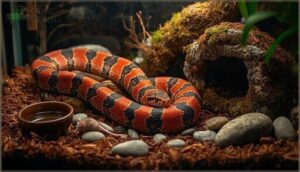
Feeding your milk snake well and keeping it healthy doesn’t have to be complicated.
Once you know the basics, routine care becomes second nature.
Here’s what you need to cover to keep your snake thriving.
Diet and Feeding Guidelines
Frozen or thawed prey is your safest bet — no injury risk, and nutrition stays intact when thawed properly.
Match prey size to your snake’s mid-body width, roughly 10% of its body weight.
Use long tongs and a shallow dish to keep feeding techniques clean and stress‑free.
Fresh water daily covers all water provision rules.
Whole rodents handle dietary variety options naturally, so supplements stay minimal.
Feeding Frequency by Age
Age drives every milk snake feeding schedule. The hatchling meal interval runs every 5–7 days on pinky mice. Juvenile feeding schedule shifts to once every 7–10 days during rapid growth. Adult feeding rhythm settles at every 10–14 days to prevent obesity.
Watch body condition adjustments closely — a sharp spine ridge means feed sooner, visible fat rolls mean wait longer.
Seasonal feeding changes during winter often stretch that gap naturally.
- Hatchlings under three months may eat every 3–5 days
- Skip meals during shedding and resume your normal schedule after
- After any regurgitation, delay the next snake feeding by a full extra interval
Recognizing Health Issues
Your milk snake’s behavior tells the truth before symptoms do.
Respiratory distress shows up as wheezing, nasal discharge, or open‑mouth breathing — usually a sign that temperatures are off.
Mouth rot appears as redness, swelling, or pus around the gums.
Watch for dehydration signs like wrinkled skin or sunken eyes.
External parasites and stuck shed issues need prompt attention.
When in doubt, veterinary care beats waiting.
Handling and Hygiene Best Practices
Your hands are the first line of defense in snake care and maintenance. Wash thoroughly with warm soap and water for 20 seconds before and after every session — that’s non‑negotiable.
- Limit handling to 10–15 minutes daily for adults
- Wait 48 hours post‑feeding before handling
- Wear protective gear and cover open cuts
- Disinfect surfaces after each session
- Keep a hygiene log to track cleaning dates
Frequently Asked Questions (FAQs)
Are milk snakes easy to keep?
Yes, milk snakes are beginner-friendly. They tolerate temperatures between 75–85°F, stay under 4 feet, and eat frozen-thawed mice on a simple schedule — making daily care manageable once your enclosure setup is dialed in.
How often should I feed a milk snake?
Your snake’s feeding frequency depends on age. Hatchlings eat every 5–7 days, juveniles every 7–10 days, and adults every 10–14 days. Always match prey size to your snake’s midsection width.
What is the best bedding for milk snakes?
Aspen shavings rank among the top substrate options — affordable, absorbent, and perfect for burrowing.
Coconut fiber retains 40–60% humidity naturally.
For bioactive builds, Reptisoil nutrients support live plants beautifully.
Aim for a minimum depth of 4 inches.
How do you take care of a milk snake?
Caring for a milk snake means nailing the basics: a proper enclosure size, a steady thermal gradient, weekly feeding with appropriately sized rodents, and consistent humidity control — especially during seasonal shedding.
How long do milk snakes typically live in captivity?
With proper care, your milk snake can live 15 to 20 years — some reach Lifespan genetics, diet, enclosure size, and regular veterinary care all shape how long your pet thrives.
Are milk snakes safe to keep around children?
Yes, captive-bred milk snakes are generally safe around children with adult supervision.
Their bite risk is minimal, but Salmonella prevention matters — always enforce handwashing after handling, and keep children under five away from the enclosure.
What are common color morphs of milk snakes?
Not every milk snake looks the same. The Normal Banding shows red, black, and yellow bands.
An Albino Morph drops the dark pigment entirely. Tangerine Albino shifts red to vivid orange.
Can milk snakes be housed with other reptiles?
No, milk snakes shouldn’t share reptile enclosures. Their cannibalism risks, aggression triggers, and habitat incompatibility make cohabitation dangerous.
Disease transmission and stress management concerns only add to why solitary housing is the only safe choice.
How often do milk snakes shed their skin?
Shedding frequency factors shift with age. Juveniles shed every 6 to 8 weeks during rapid growth. Adults slow to 2 to 6 times yearly.
Humidity control and consistent feeding keep your milk snake on schedule.
Can milk snakes live with other reptiles?
No, milk snakes can’t share a terrarium with other reptiles. Their predatory risks are real — cannibalism included.
Solitary housing isn’t optional; it’s the responsible choice for your snake’s safety and wellbeing.
Conclusion
A coral snake’s warning colors have protected milk snakes for millennia—nature’s proof that the right setup changes everything. Your milk snake can’t borrow that survival strategy from its wild cousins. It relies on the environment you build instead.
Follow this milk snake care sheet online, dial in your temperatures, feed appropriately sized prey, and keep hides accessible. Do those things consistently, and you won’t just keep a snake alive—you’ll watch one genuinely thrive.