This site is supported by our readers. We may earn a commission, at no cost to you, if you purchase through links.
A pit viper can detect a temperature shift of 0.003°C from across a room—no eyes, no nose, just heat-sensing organs reading infrared like a thermal camera. That’s the kind of engineering evolution builds when survival hinges on precision.
Snakes have spent over 100 million years perfecting tricks most animals never needed: venom that maps to specific prey, scales that bend light into rainbow sheens, tails built for swimming or storing fat. Every unique snake species characteristic you’ll find below solves a real problem—hunting blind, avoiding predators, surviving in sand, water, or treetops.
You’re about to see how varied and calculated these adaptations really get.
Table Of Contents
- Key Takeaways
- Most Unique Snake Species Traits
- Colorful Scales and Camouflage
- Specialized Senses and Hunting Styles
- Venom, Defense, and Survival Tricks
- Reproduction and Habitat Adaptations
- Frequently Asked Questions (FAQs)
- What are the unique characteristics of snakes?
- How do snakes communicate with each other?
- What is the lifespan of different snake species?
- Can snakes recognize their owners or handlers?
- How do snakes shed their skin properly?
- What role do snakes play in ecosystems?
- How do snakes move without any legs at all?
- Can snakes hear sounds if they lack ears?
- What are snake scales actually made of?
- How many different snake species exist worldwide?
- Conclusion
Key Takeaways
- Pit vipers use heat-sensing facial pits sensitive to temperature shifts as small as 0.003°C, letting them hunt accurately even in total darkness.
- Snake coloration serves distinct survival purposes, from structural iridescence and camouflage patterns to bold warning colors like coral snake banding that deter predators.
- Snakes rely on a layered defense toolkit—cobra hood displays, rattlesnake buzzing, hognose bluffing, and even cloacal popping—to avoid physical confrontation whenever possible.
- Reproductive strategies vary widely across species, ranging from live-bearing sea snakes to egg-brooding pythons and nest-building king cobras that actively guard their young.
Most Unique Snake Species Traits
With roughly 4,000 known species out there, snakes have evolved some genuinely wild variations on the same basic body plan. Size, color, head shape, tail tricks, scale texture—these details aren’t random, they’re built for survival. Here’s a closer look at what makes certain species stand out from the rest.
Ball pythons alone showcase this diversity beautifully, with breeders documenting hundreds of distinct ball python morphs and color patterns prized by collectors worldwide.
Extreme Size Differences
Some female snakes dwarf their male counterparts many times over, a pattern called sexual dimorphism, driven by resource-driven growth and reproductive payoff.
- Larger females carry bigger clutches
- Ontogenetic size shifts speed juvenile growth
- Island Rule effects shrink or enlarge isolated populations
- Cooler climates favor bigger bodies
- Prey abundance fuels faster maturation
Evolutionary biology rewards size where it counts—survival and eggs, not vanity.
Rare Colors and Patterns
Size isn’t the only trait pushing boundaries—skin pigmentation gets wild too. Structural iridescence creates rainbow sheens through microscopic scale layering, while blue light scattering and guanine crystals produce true blues without blue pigment. Melanin density yields near-black morphs; carotenoid diet influence brings reds and oranges.
Geometric pattern formation builds checkerboard camouflage—proof that unique biological adaptations drive species differentiation as much as sheer scale. Beyond biology, scientists can now create non-permanent thermal patterns through specific chemical reactions.
Specialized Head Shapes
Color’s only half the story—skull architecture tells you exactly how a snake hunts. Cephalofoil vision in hammerheads widens binocular range; Arrowhead heat-sensing aims pit viper sensory pits forward.
- Triangular head = venom storage
- Wedge skull = cobra hood mechanics
- Flattened crown = burrowing skull flattening
- Broad rostrum = snout width evolution for tough prey
Snake morphology never wastes a curve.
Unusual Tail Adaptations
Skulls get the spotlight, but tails work just as hard. Some species pack tail fat storage for lean seasons; others sport defensive tail spines or fin-like paddles for swimming.
Arboreal snakes rely on gripping scale textures to cling to bark, while certain lizards—and a few snakes—use tail autotomy regeneration, shedding the appendage entirely to escape a predator’s grip.
Distinctive Scale Textures
Run your fingers over a snake and you’ll learn more than any field guide tells you. Keeled scales create ridged texture for traction in loose soil, while smooth scales cut friction for quiet gliding. Granular surfaces add subtle grip, and microtextures scatter light into faint iridescence.
Ventral scales grip rough terrain for locomotion—texture reveals as much about biology and identification as color ever could.
Colorful Scales and Camouflage
Snake skin isn’t just protection—it’s a survival tool built from keratin and collagen, tuned to pigments that stretch across the visible spectrum and even into ultraviolet.
That fine-tuned blend of speckled patterning and matte texture is exactly what makes desert-camouflage snake hides so effective at mimicking sun-bleached sand and scattered gravel.
Some species hide in plain sight, others practically shout "stay back," and a few just got lucky with genetics. Here are five standout examples that show what color can really do for a snake.
Iridescent Rainbow Boas
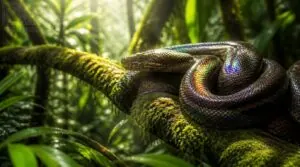
Hold a rainbow boa up to sunlight and it doesn’t just glow—it flickers through the spectrum like an oil slick. This structural coloration comes from prismatic ridges on each scale bending light, with no pigment involved.
Freshly shed skin shows the sharpest sheen; humidity and canopy light intensify it further. Even ultraviolet wavelengths factor into how this reptilian biology plays tricks on predator vision.
Green Tree Python Camouflage
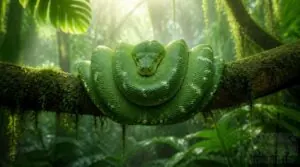
Picture emerald scales dissolving into leaf shadow—that’s a green tree python at rest. Disruptive patterning breaks its outline, while branch contour alignment and coiled posture erase any snake-shaped silhouette.
Juveniles run yellow-orange before shifting green with maturity.
Camouflage tactics:
- Dappled light mimicry
- Foliage shadow blending
- Pale speckling
- Branch-hugging rest poses
Habitat diversity across rainforest canopies shapes this reptile’s identification traits.
Coral Snake Warning Colors
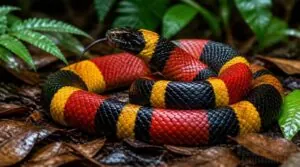
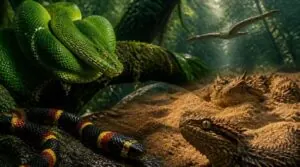
Red touches yellow, kill a fellow—that old rhyme exists because coral snake banding is nature’s clearest warning label. Tri-color bands wrap unbroken around the body, signaling neurotoxic venom through aposematic signal evolution.
Red touches yellow, kill a fellow: coral snake banding is nature’s boldest warning of neurotoxic venom
Predators learn fast after painful encounters, reinforcing avoidance. High color contrast against foliage boosts recognition, making venomous vs. nonvenomous identification critical for wildlife safety in coral snake territory.
Sand Boa Blending
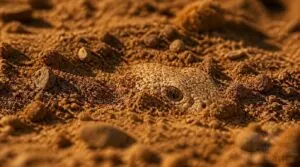
Watch a sand boa vanish mid-strike, and you’ll understand why substrate matters as much as scale color. Pale yellow-to-brown mottling mimics desert soils, but true camouflage depends on soil texture benefits:
A 60-70% topsoil to 30-40% sand mix allows 2-4 inch burrowing while preventing impaction risk—unlike pure sand, which invites both injury and detection.
Albino and Morph Variations
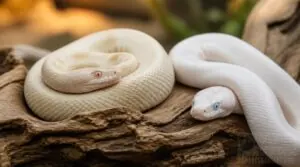
Strip away pigment entirely, and you get nature’s own blank canvas: melanin deficiency produces pink-eyed, pale-bodied morphs prized for sharp pattern contrast. Breeders stack albino genes with hypo or leucistic traits, creating high-contrast hybrids—though ethical selective breeding matters here.
Responsible programs protect genetic diversity, avoiding the health risks that come from chasing extreme morph variations at any cost.
Specialized Senses and Hunting Styles
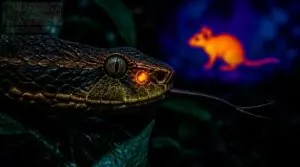
Forget what you know about eyesight and hearing—snakes read the world through heat, chemical trails, and vibration instead.
Every hunting style below evolved to solve a different problem: finding warm-blooded prey in total darkness, tracking scent through dense brush, or striking accurately underwater or up in the canopy. Here’s how five distinct sensory tricks give snakes their edge.
Heat-sensing Pit Organs
How do pit vipers strike accurately in total darkness? A facial cavity with a vascularized membrane detects heat shifts as small as 0.003°C. TRPA1 channels convert warmth into nerve signals, sent via the trigeminal pathway for infrared thermal mapping.
- Sensitivity range: 15–37°C
- Low thermal mass for rapid response
- Located between eye and nostril
- Makes precise, low-light hunting possible
Labial Pits in Pythons
Pit vipers get one heat window per side; pythons take a different route entirely. Instead of a single facial pit, they carry multiple labial pits lining the upper or lower jaw—each a small slit with its own thermoreceptor layer. This distributed sensory area sharpens thermal prey localization across a wider field.
| Pit Viper | Python |
|---|---|
| One facial pit | Multiple labial pits |
| Loreal origin | Independent evolutionary pit origins |
| Narrow field | Broad sensory field |
Tongue-based Scent Tracking
Thermal senses map heat; the forked tongue maps scent, flicking to gather molecules and deliver them to the Jacobson’s organ. This vomeronasal system reads pheromone trails and localizes odor plumes with striking precision.
- The thrill of a predator reading invisible trails
- The tension of prey escaping detection by inches
- The wonder of chemical senses rivaling sight itself
Aquatic Prey Detection
Water muddies things fast, but aquatic hunters compensate with layered senses. Lateral line sensitivity picks up hydrodynamic vortices from struggling prey; infrared thermal imaging tracks warm bodies through murk.
Polarized light vision sharpens surface ripples, while surface olfactory cues drift scent to waiting nostrils. This predator-prey relationship relies on stacked biological traits—each sensory mechanism backing up the others when visibility fails.
Arboreal Ambush Hunting
Picture a coiled predator fused to bark, waiting where branches fork. Perch selection strategies favor sturdy junctions near fruiting trees, offering clean branch strike paths and multiple escape routes.
Vibration trigger sensitivity picks up branch sway from shifting prey; canopy stealth tactics keep posture flat, shadowless. This arboreal energy conservation lets venomous snakes endure lean stretches, striking only when timing’s right.
Venom, Defense, and Survival Tricks
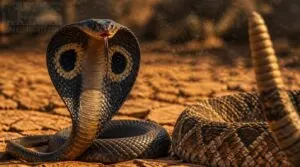
When a predator gets too close, snakes don’t just rely on venom—they’ve built an entire toolkit of bluffs, warnings, and theatrics to avoid a fight altogether. Some flare, some rattle, some just play dead and hope for the best. Here’s a look at the tricks that keep these animals alive without ever throwing a punch.
Cobra Hood Displays
Nothing screams "back off" quite like a cobra’s hood. Rib expansion flattens neck bones into a wide silhouette within a second, paired with hissing that rattles the airway. Eye-spot patterns evolved to startle predators, teaching them to avoid future encounters. Species like king cobras and Naja naja vary in intensity, but the message stays universal:
- Rapid rib flare
- Startling eye-spots
- Warning hiss
- Size-based intimidation
Rattlesnake Warning Rattles
Few sounds trigger instant caution like a buzzing rattle rising from the underbrush. Rattlesnakes vibrate their tails at rates tied to distance—slower when you’re far, faster as you close in—layering this distinctive sound with hollow, keratin segments that boost each pulse.
It’s a multimodal cue: broadband frequencies plus coiled posture. Predators learn fast, associating that buzz with real danger, which keeps future encounters brief.
Hognose Snake Bluffing
Bluffing beats biting, at least if you’re a hognose. Faced with a threat, it inflates its neck into a cobra-like hood, hisses through a closed mouth, and throws mock strikes with jaws shut tight.
If that fails, it commits harder:
- Rolls belly-up
- Gapes its mouth, tongue lolling
- Lies motionless—sometimes over an hour
Recovery’s instant once danger passes.
Coral Snake Mimicry
Red touch yellow, kill a fellow—that old rhyme sums up Batesian mimicry in action. Nonvenomous species copy coral snake banding, fooling predators through learned avoidance rather than perfect accuracy.
Ring order often differs from the model, yet the color contrast still reads as danger. Mimicry strengthens where coral snakes are common, weakens where they’re rare—proof that reptile identification, for predators and humans alike, isn’t always exact science.
Cloacal Popping Defense
Ever heard a snake fart its way to freedom? That’s cloacal popping, a fossorial survival tactic seen in western hook-nosed snakes and Sonoran coral snakes.
Rapid muscle contractions force air through the cloaca, producing sharp pops that trigger predator startle responses. It’s energy-efficient defense—no venom, no rattling, just acoustic deterrence buying seconds to sprint away.
Reproduction and Habitat Adaptations
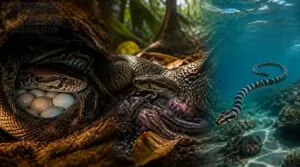
Survival doesn’t stop at defense—snakes have found astonishing ways to reproduce and settle into their environments, from open ocean to underground burrows.
Some carry live young, others guard eggs like devoted parents, and a few barely need a mate at all. Here’s where you’ll see just how varied that strategy gets, species by species.
Live-bearing Sea Snakes
Live-bearing sea snakes skip the nest entirely—true Hydrophiinae species carry embryos internally for 4-9 months, then give birth right in Indo-Pacific waters. Neonates hit the water foraging on small fish almost immediately, no parental coaching required.
This viviparous strategy pays off: precocial pups avoid predation risks eggs face onshore, a survival edge honed by millions of years underwater.
Egg-brooding Pythons
Pythons that lay eggs don’t just walk away: mothers coil tightly around the clutch, using maternal thermogenesis (muscle shivering) to warm eggs while limiting moisture loss.
This posture balances hydration against hypoxic microenvironments—too tight, and oxygen drops.
Postural metabolic costs stay lower than shivering, so mothers shift coils sparingly, directly shaping clutch viability:
- Temperature
- Hydration
- Oxygen
- Energy conservation
Nest-building King Cobras
Cobras take maternal engineering further: females pile leaf litter into mounds nearly a meter tall, compacting them by repeated crawling into waterproof nest chambers. This elaborate leaf mound construction happens before monsoon rains, near well-drained ground.
She guards the 15-50 eggs for roughly two months—unusual parental guarding instincts among reptiles—before abandoning hatchlings entirely once they emerge.
Burrowing Blind Snakes
Not every snake broods eggs in leaf mounds. Some skip parenting altogether, spending life underground instead. Fossorial body design—smooth scales, blunt snouts—drives soil penetration, while underground vibration sensing locates prey.
- Cylindrical bodies
- Reduced eyes
- Broad ventral scales
- Short tails
- Chemical-cue foraging
Blind snake reproduction varies: eggs or live young, depending on lineage.
Tree-dwelling Snake Anatomy
Climbing a tree with no limbs sounds impossible, yet arboreal snakes pull it off daily.
Slender body ratios and lateral trunk compression keep them snag-free among branches, while a prehensile tail anchors like a fifth limb. Ventral scale friction grips rough bark, and spinal flexibility lets them coil tight turns—proof that evolution rewrote the rulebook for life above ground.
Frequently Asked Questions (FAQs)
What are the unique characteristics of snakes?
Think of a snake as evolution’s Swiss Army knife: flexible vertebrae, elastic mandibles, and heat-sensing pits combine with a Jacobson’s organ for scent-tracking, vibration sensing, and diverse body shapes—all wrapped in dry, adapted skin built for survival.
How do snakes communicate with each other?
Snakes rely on pheromone trail tracking, vibrational ground signals, and visual courtship postures like S-coils to communicate.
Males wrestle for dominance, while auditory warning hisses—whether venomous or nonvenomous—signal defensive intent, blending scent, sight, and sound into layered social behavior.
What is the lifespan of different snake species?
Captivity stretches life dramatically: ball pythons reach 20-30 years, corn snakes 15-20, and garter snakes just 8-
That longevity boost isn’t just about captive care—it starts with the flexible, bony skeleton snakes develop as embryos, a topic explored in why snakes have bones and still move so freely.
Size correlates with longevity, while stable temperatures, low stress, and consistent feeding—versus wild predation and disease—explain why captive snakes routinely outlive their wild counterparts.
Can snakes recognize their owners or handlers?
Not quite like a dog greeting its owner at the door—more like a chemistry class that never ends. Your snake learns chemical scent signatures and visual movement cues through repeated handling, forming genuine sensory recognition, though it’s habituation, not affection, driving the calm.
How do snakes shed their skin properly?
A new keratin-collagen layer forms beneath the old one; blue, dulled eyes signal readiness. Proper humidity loosens the shed, which peels from mouth to tail in one piece. Rough surfaces help; check for retained skin afterward.
What role do snakes play in ecosystems?
As mid-level predators, they anchor trophic level stability, deliver rodent population control and pest density regulation, aid nutrient cycling through decomposition, and act as nature’s health indicators—making their conservation essential to healthy, balanced food webs.
How do snakes move without any legs at all?
Snakes rely on lateral undulation, sidewinding, concertina movement, and rectilinear crawling—each using belly scales and rippling spinal muscles to grip surfaces, push against terrain, or glide through water and sand with astonishing precision.
Can snakes hear sounds if they lack ears?
Absolutely—via bone conduction. A movable jawbone picks up ground vibrations, routing them to the inner ear, while low-frequency airborne sounds (80–600 Hz) register too. It’s substrate sensing more than true hearing, but effective nonetheless.
What are snake scales actually made of?
Beta keratin forms the tough outer layer, backed by a collagenous network for strength. Oily secretions boost waterproofing, while regeneration cycles push fresh scales up each molt—keeping your favorite reptile’s skin watertight and armor-ready.
How many different snake species exist worldwide?
Current global species estimates put the count between 3,400 and 3,600, spanning venomous and nonvenomous families worldwide.
Ongoing taxonomic revisions and fieldwork in tropical diversity hotspots keep adding newly described species, hinting at genuine undiscovered species potential still hiding in underexplored regions.
Conclusion
Somewhere in a burrow, a treetop, or a tide pool, another adaptation is quietly proving evolution never stops experimenting. That’s the real lesson behind every unique snake species characteristic you’ve just explored: survival rewards specificity, not brute force.
A rattle, a heat pit, a hood, a coiled bluff—each is a precise answer to a precise threat. Snakes don’t just endure their environments; they read them, exploit them, master them.
Next time you spot one, look closer. You’re watching 100 million years of engineering in motion.
- https://docs.google.com/forms/d/1GAQr3Kn1cURCVHUA82hAga1Wv8DCH0IuqDLRUrOpN7M/viewform?ts=63f4f653&entry.1515682415=https://www.merriam-webster.com/dictionary%2Funique
- https://unabridged.merriam-webster.com/check-redirect-premium?utm_source=mw&utm_medium=inline-def&utm_campaign=evergreen&headword=unique