This site is supported by our readers. We may earn a commission, at no cost to you, if you purchase through links.

A Kenyan Sand Boa spends most of its life buried in two inches of sand, and it’s perfectly content in a 20-gallon tank. Your studio apartment can host a snake. It just can’t host every snake.
Cramped rooms punish bad matches. A Western Hognose needs room to roam, while a Ball Python stays calm in a footprint under 24 inches. Pick wrong, and you’ll fight escapes, mold, and stress for 20 to 30 years.
These snake species profiles for small homes show which six reptiles fit your space, your budget, and your routine. Here’s how to choose one you’ll love.
Table Of Contents
- Key Takeaways
- Choosing a Snake for Your Space
- Best Snake Species for Small Homes
- Adult Enclosure Sizes and Setup
- Feeding, Handling, and Habitat Upkeep
- Lifespan, Costs, and Apartment Rules
- Frequently Asked Questions (FAQs)
- What are some good small house pet snakes?
- What snake is worth $100,000?
- What smell keeps snakes away?
- What snakes need the smallest enclosure?
- What is the smallest friendliest snake?
- Can snakes be kept with other pets safely?
- What should I do if my snake escapes?
- How can I find a reptile veterinarian nearby?
- Are there legal restrictions on snake ownership?
- Do small snakes have specific lighting needs?
- Conclusion
Key Takeaways
- Match the species to your space first: Kenyan Sand Boas, Rosy Boas, and Western Hognoses thrive in modest 20-gallon setups, while Ball Pythons and Corn Snakes need larger 40-gallon enclosures.
- Build the habitat around a secure, latched lid, a warm side near 32°C and a cool side near 24°C with a thermostat-controlled heat mat, steady humidity, and safe substrate, since escapes and mold are the biggest risks in tight quarters.
- Plan for the long haul, because most of these snakes live 15 to 30 years, setup costs $200 to $600, and upkeep runs $100 to $300 a year, with a small fund needed for vet emergencies.
- Check your lease and local laws before buying, then feed adults every 10 to 14 days, avoid handling for 48 hours after meals, and choose a docile species to keep daily care easy.
Choosing a Snake for Your Space
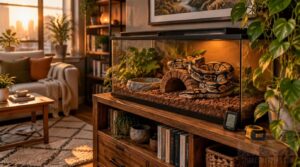
Tight on space but big on snake dreams? Smart species matching keeps your snake healthy, your setup safe, and your landlord happy. Work through these five checkpoints before you commit to any scaly roommate.
For a closer look at which compact species fit apartment life best, browse this guide to types of snakes for small spaces before choosing your pet.
Match Species to Space
A snake that fits your floor plan beats one that merely fits your dreams. For compact living, apartmentfriendly reptiles like Kenyan Sand Boas and Rosy Boas thrive in modest setups.
Check the enclosure footprint first, then confirm you can hold stable temperature gradients and keep secure lids latched. Hognose snakes want more room to roam. Skip big species entirely. Seriously.
Enclosure and Substrate
Smart enclosure design starts with a solid back and a tight, latched lid. A 10-gallon enclosure suits a baby Kenyan Sand Boa, but adults need a bigger enclosure footprint.
Choose fine sand mixed with a little coconut fiber for burrowers, and skip pine or cedar. Aim for a substrate depth of 2 to 4 inches. Spot-clean weekly. Your nose approves.
Heating and Humidity
Burrowers like your sand boa need warmth from below, so pair a heat mat with a thermostat. Build a temperature gradient, cool side near 24°C, warm side near 32°C.
- Check the hotspot with a probe.
- Hold humidity near 40%; soggy sand breeds mold.
- Use ventilation for steady humidity control.
- Keep substrate depth even over the heat mat.
- Log readings daily.
Feeding and Upkeep
Build your feeding schedule around that warmth. Adult sand boas eat every 10 to 14 days; that feeding interval keeps them lean.
Younger snakes need smaller, more frequent meals, so a guide to feeding boa constrictor pinkies can help you size prey correctly as your boa grows.
Choose prey size no wider than 1.5 times girth, and remove leftovers within 24 hours.
| Stage | Feeding interval |
|---|---|
| Hatchling | 7-10 days |
| Adult | 10-14 days |
| Heavy shed | Rest 1-2 weeks |
Pair a weekly spotcleaning routine with your enclosure setup.
Temperament and Lifespan
You’re signing up for a Longterm commitment, so check Temperament and Lifespan first. A Docile temperament makes any Beginner snake species easier to handle, and stable temps keep it calm.
Typical captive lifespans look roughly like this:
- Kenyan Sand Boa: 20-30 years
- Rosy Boa: 20-30 years
- Western Hognose: 15-20 years
- Corn Snake: 15-25 years
- Ball Python: 20-30 years
Best Snake Species for Small Homes
Small space? You’ve still got great snake options. Here are six species that stay manageable, handle apartment life, and won’t demand a whole spare room. Let’s meet them, starting with the sand-loving Kenyan sand boa.
Whichever species you choose, feeding time can occasionally go wrong, so it helps to know how to handle a snake struggling to swallow large prey before it happens.
Kenyan Sand Boa
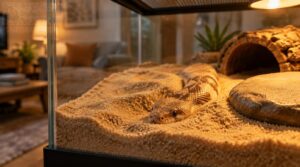
Want a snake that mostly vanishes? Meet the Kenyan Sand Boa, a docile desert dweller whose burrowing behavior means you’ll often see only a nose. A 10gallon enclosure suits juveniles, but adults need 20 to 30 gallons of floor space.
Keep 28 to 32°C warm, humidity near 30 to 40%, and secure lids on everything. Stick to a feeding schedule.
Rosy Boa
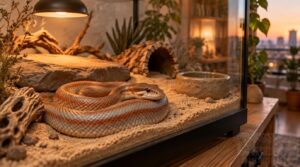
Calm as a sleeping cat, the Rosy Boa suits compact living beautifully. Adults reach 2 to 3.5 feet, so enclosure size stays modest.
Your substrate choice matters: go dry and sandy. Keep air at 78 to 88°F, cooler at night.
A temperature gradient isn’t required, but a 90°F basking spot is common and wise. Your Rosy Boa will happily approve.
Western Hognose Snake
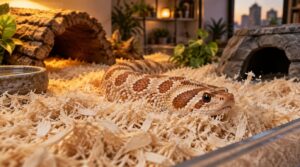
Picture a tiny bulldozer with an upturned nose, plowing through loose aspen like it owns the place. That’s the Western Hognose Snake, and it’s a gem for compact living.
A tiny bulldozer with an upturned nose, the Western Hognose Snake plows through loose substrate like it owns the place
Its burrowing behavior shapes your enclosure design: a shallow tub, deep substrate, one warm hide, one cool. Expect dramatic hood-flaring bluffs, but rarely a bite.
Keep it warm, dry, and unfussy.
Children’s Python
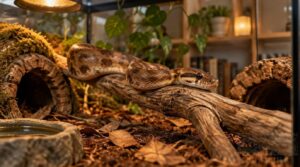
Small snake, big personality. The Childrens Python suits compact living beautifully, since its modest adult size means a 60 to 80 cm enclosure works. Smart enclosure design matters: add secure hides on both ends and a climbing branch.
Its temperament is docile but sometimes skittish, so handle gently. Expect 15 to 20 years together. Feed juveniles pinky mice every week.
Corn Snake
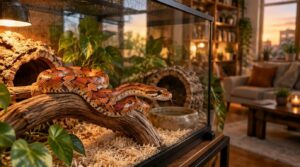
Corn Snakes are the friendly gateway reptile for apartment living.
Adult size tops out around 4 feet, and the gentle temperament forgives beginner mistakes. Expect a 15 to 20 year lifespan.
Proper habitat setup, simplified:
- Pick a 40 to 75 gallon tank.
- Add two hides, warm and cool.
- Keep humidity at 40 to 60%.
- Feed every 7 to 14 days.
Ball Python
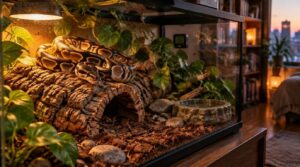
Ready for a step up? The Ball Python is a gentle, shy classic, and its mellow temperament makes handling easy once it trusts you.
Plan a 40 to 60 gallon enclosure size for adults up to 4 feet. Nail temperature regulation with an 88 to 92°F warm side. Feed juveniles every 5 to 7 days, adults every 7 to 14.
Adult Enclosure Sizes and Setup
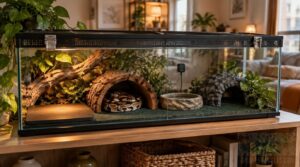
Time to build their homes. Enclosure size comes first: aim for 1.5x the snake’s length across every dimension, and keep the footprint under 60 cm (24 in) if your room is tight. Most compact adults thrive in 20 to 40 L (5 to 10 gal), while bigger ones need 60 to 120 L.
Go horizontal, not tall. Your terrarium setup needs a secure lid with locking clips, because snakes test every gap. Secure escapeproof enclosures use pressure-fit seals and tiny ventilation holes.
Stick with reptile carpet or tile; loose substrate types risk impaction. Add two hides covering 25 to 40% of the floor. For temperature regulation, run a thermostat-controlled heat mat to a 28 to 32°C (82 to 90°F) hotspot.
Feeding, Handling, and Habitat Upkeep
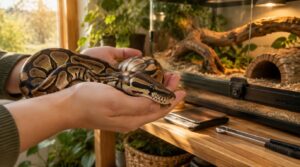
Now comes the daily rhythm. Your feeding frequency depends on age: juveniles eat weekly, adults every two to four weeks. Weigh monthly and look for a 2 to 5% gain. Skip handling for 48 hours after meals, or you’ll risk regurgitation. A small digital kitchen scale in grams makes monthly weigh-ins quick and precise, so you’ll spot a healthy 2 to 5% gain.
Handling techniques are simple. Support the whole body, never squeeze near the neck, and keep sessions to once or twice weekly.
Here’s what steady care earns you:
- A snake that stops flinching when you reach in.
- A calm, curious animal climbing your hands.
- A healthy shed, intact from nose to tail.
- The quiet pride of knowing you got it right.
Add habitat enrichment like fresh hides and a sturdy branch. Keep safe substrate types and check escapeproof enclosures weekly.
Lifespan, Costs, and Apartment Rules

Lifespan shapes every decision here. A ball python can reach 20 to 30 years, a Kenyan sand boa often matches it, and a corn snake averages 15 to 20. Plan your cost of ownership accordingly.
Setup runs $200 to $600 per animal. After that, expect $100 to $300 yearly for food, heat, and substrate. Vet care costs are routine at $50 to $150 per checkup, but emergencies can hit $600, so keep a small fund.
Apartment living adds its own rules. Read your lease first, since many ban large or venomous reptiles. Use escapeproof enclosures with locking lids, seal them well to control humidity and odor, and ask your landlord in writing. A calm, happy neighbor is the best insurance.
Frequently Asked Questions (FAQs)
What are some good small house pet snakes?
Kenyan sand boas, rosy boas, and western hognoses are beginner pet snakes. They make small space snake care easy: docile snake temperament, modest enclosure size, and a feeding frequency of every 7 to 14 days.
What snake is worth $100,000?
A $100,000 snake is a living lottery ticket.
Ball python color morphs, backed by documented genetic inheritance, sell for six figures. Among snake morphs, these morph variations are prized, though the feeding interval stays ordinary.
What smell keeps snakes away?
Zero scents have proven to repel snakes in controlled trials. Skip ammonia and vinegar, since disinfectant safety matters around pets. Focus on escape prevention, a snug enclosure size, and clean substrate for odor control instead.
What snakes need the smallest enclosure?
Roughly 20 gallons is enough for Rosy Boas and Western Hognoses, making them beginner snake species. A 1020 gallon tank suits juveniles, while compact enclosures and low maintenance care keep small space pet care easy.
What is the smallest friendliest snake?
Picture a studio apartment with a 20-gallon tank on the dresser.
The winner is the Kenyan Sand Boa: a beginner snake species with docile temperament, perfect for small space pet care and light handling frequency.
Can snakes be kept with other pets safely?
A snake rolled into a ball is defensive, not cozy. Yes, snakes and pets can coexist if you use separate locked enclosures, respect temperament, limit handling frequency, watch stress signals, and keep proper habitat maintenance.
What should I do if my snake escapes?
Close doors, then sweep room by room, flashlight low along baseboards. Once it’s recovered, build escapeproof setups for snake escape prevention: weighted lids or aftermarket locks, a solid secondary barrier, and reptile enclosure ventilation checks.
How can I find a reptile veterinarian nearby?
Reptile enthusiast, try the ARAV Find-A-Vet tool: enter your zip code, set a radius.
Responsible reptile ownership means checking ACZM or ABVP credentials before emergencies hit, covering reptile care, reptile husbandry, and reptile enclosure setup.
Are there legal restrictions on snake ownership?
Yes, and legal restrictions differ by state, county, and city. Always check local rules first. Even beginner-friendly snakes can need permits.
Some states, such as California, rely on restricted reptile lists that bar private pet ownership of certain species altogether.
Responsible reptile ownership means weighing owner lifestyle fit and maintenance level before you buy.
Do small snakes have specific lighting needs?
Twelve hours of light, twelve of dark: that’s the lighting schedule most small snakes need. UVB lighting is optional, so skip the glare.
Prioritize your temperature gradient, a reliable thermostat, and steady humidity levels instead.
Conclusion
One keeper I know measured her studio, bought a 40-gallon tank, and brought home a Corn Snake. Eleven years later, it still curls up in the same corner. That’s what a good match looks like.
Use these snake species profiles for small homes as your shortlist, then match the animal to your floor space, budget, and patience. Do that, and your apartment won’t just hold a snake. It’ll hold a companion you’ll enjoy for decades.