This site is supported by our readers. We may earn a commission, at no cost to you, if you purchase through links.

Pull two carpet pythons from clutches born the same week, and you might swear they’re different species. One shows olive-brown saddles fading into tan, quiet as bark. The other flashes black-on-yellow jungle banding so sharp it looks painted on.
That’s the wild magic of carpet python colors and patterns: locality, genetics, and age all pull the same base blueprint in wildly different directions. Add in decades of selective breeding, and you’ve got morphs like albino, granite, and jaguar layering even more variety onto an already diverse species.
Whether you’re chasing a specific look or just want to understand what’s happening in your snake’s tank, knowing how these colors form (and change) makes every shed a little more fascinating.
Table Of Contents
- Key Takeaways
- Wild-Type Carpet Python Colors by Locality
- Common Carpet Python Color Morphs and Genetics
- Carpet Python Pattern Morphs and Designer Combinations
- How Carpet Python Colors Change With Age
- Do Carpet Python Morphs Need Special Care?
- Frequently Asked Questions (FAQs)
- Can carpet python colors change as they age?
- Are certain morphs more prone to health issues?
- Which carpet python colors are most in demand?
- How do lighting conditions affect python coloration?
- Are color mutations linked to temperament or behavior?
- Can carpet pythons change color as adults?
- Are colorful carpet python morphs more expensive?
- Can different carpet python morphs be bred together?
- How do you tell carpet python morphs apart?
- Conclusion
Key Takeaways
- Your carpet python’s colors come from a mix of locality, genetics, and age, which is why hatchlings from the same clutch can look wildly different as they grow.
- Popular morphs like albino, axanthic, granite, and jaguar all follow specific inheritance patterns, so knowing whether a trait is recessive or dominant helps you predict what a breeding pair might produce.
- Don’t panic if your snake’s bold juvenile colors start fading with age or dulling before a shed, since ontogenetic fading and temporary shed-cycle dullness are both totally normal.
- No matter how flashy the morph, your python’s day-to-day care needs stay the same, though proper UVB lighting and biannual eye checks matter more for low-melanin morphs like albinos and axanthics.
Wild-Type Carpet Python Colors by Locality
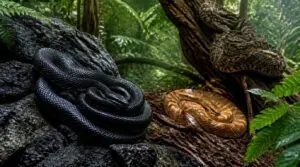
Ever notice how a carpet python’s colors seem to shift depending on where it’s from? That’s no accident—Australia and New Guinea’s varied climates shaped some seriously distinct looks over generations. Let’s break down what makes each locality’s wild-type pattern its own.
From the golden hues of Jungle Carpets to the muted tones of Coastals, this carpet python care guide breaks down what each locality needs to thrive in captivity.
Wild-Type Colors and Chain Markings
Ever spot a carpet python and wonder why no two look quite alike? Wild types run olive-brown to tan, with pale cream underlayers peeking through.
Their signature chain marking patterns form a loose lattice down the spine, dark saddles aligning right along those links. Lateral stripes often fade out, letting the chain take center stage, especially on bigger, arid-region snakes.
Jungle Carpet Python Contrast
Now crank the contrast up. Jungle Carpets flaunt sharp black-on-yellow banding, a subspecies adaptation for dappled rainforest lighting effects. Juveniles show the boldest contrast in juvenile patterns, darker blacks against brighter grounds, aiding visual tracking advantages among foliage.
- Crisp scale edges
- Bold dorsal chevrons
- Habitat-based contrast variation by locality
Marking clarity in shedding may dull briefly, genetic inheritance keeps that vivid pattern intact. This species is recognized as one of the most widespread Australian python species, found across forests, woodlands, and even suburban areas throughout its range.
Diamond Python Spots and Bands
Trade that chevron banding for something bolder: the Diamond Python (Morelia spilota harrisoni) wears glossy black scales scattered with bright yellow diamonds. Spot size varies from tight rosettes to sprawling shapes, and density shifts too, sometimes stippled, sometimes sparse. Faint bands often weave through the diamonds, creating pattern variations breeders prize. That color stability holds strong under natural light, whether spotted or banded.
Coastal and Inland Color Variations
Geography shapes color just as much as genetics does. Coastal Carpet pythons often show pale tan to yellow tones from sandy substrate influence, with sharper contrast against dark bands.
Inland Carpet populations lean olive to bronze, shaped by drier, rocky terrain that favors camouflage over flash, proof that habitat leaves its fingerprint on every scale.
Irian Jaya and Darwin Patterns
When two islands split a species, patterns drift apart too. Irian Jaya Papuan pythons flaunt bold dorsal diamond motifs on deep, saturated ground color that intensifies with age. Darwin locality snakes run narrower chain marking width in a continuous belt instead. That’s geographic isolation effects at work, proof pattern inheritance follows locality as closely as any pigment mutation does.
Common Carpet Python Color Morphs and Genetics
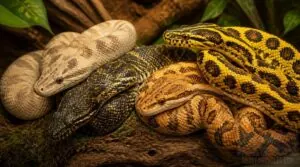
So how does a wild-type carpet python end up looking nothing like its ancestors? Blame genetics — specific mutations turn off or dial up certain pigments, and breeders have been chasing those combos for decades. Here’s a rundown of the morphs you’ll run into most often, from ghostly pale to deep charcoal.
Albino: Yellow, Cream, Red Eyes
Ever seen a snake that looks bathed in sunlight? That’s your albino carpet python.
This pigment mutation is tyrosinase negative, blocking melanin production entirely, so you get creamy yellow bodies with those striking pink to red eyes. It’s a recessive trait, meaning both parents need the gene. Bright light intensifies that ruby glow, honestly, it’s mesmerizing to watch.
This albino trait pairs fascinatingly with jaguar patterning too, and this guide to carpet python morph identification breaks down how those combinations shift color and contrast.
Axanthic: Silver, Charcoal, Black
Strip away yellow pigment and what’s left? Pure Silver Charcoal Contrast, a cool gray-to-slate palette that’s genuinely striking.
This recessive Axanthic trait pairs deep charcoal with bold Black Accent Patterns along the saddles. Black holds tight through molts, while Age Color Consistency keeps that palette recognizable from hatchling to adult.
Gentle handling and moderate UV Exposure Impact both help that metallic sheen stay vivid for years.
Caramel: Gold and Amber Tones
Picture honey dripping down a python’s back, that’s caramel morphs in short. This incomplete dominant trait creates amber warmth deepening toward the dorsum, with:
- Gold hue localization along the midline
- Pale ventral-to-amber dorsum gradient
- Pattern retention beneath the golden glaze
Lighting shifts the glow toward honey or olive gold, proving genetics and environment work hand-in-hand.
Granite: Speckled Mosaic Patterning
Ever seen a snake that looks like polished stone come to life? That’s the granite morph for you, a recessive trait from Irian Jaya lines producing broken speckles instead of bold bands.
Grain size effects create bold or fine flecks, while color contrast variability ranges from silvery to charcoal. Expression varies wildly, and pattern stability shifts across individual snakes.
Recessive and Dominant Inheritance
Genetics here follow basic Mendelian inheritance, and it’s simpler than it sounds. Recessive traits, like albino or granite, only show up with two copies (homozygous expression). One copy makes you a heterozygous carrier, invisible but breedable. Dominant alleles mask recessives entirely.
Caramel and jaguar work differently, showing effects from just one allele. Know your pairings, and you’ll predict clutches like a pro.
Carpet Python Pattern Morphs and Designer Combinations
Ever wonder how breeders turn a simple wild-type snake into something that stops people in their tracks? It’s all about pattern genetics stacking on top of each other, morph by morph, to create combinations you won’t find in the wild.
Let’s break down the coolest pattern morphs and designer pairings making waves in carpet python collections right now.
Jaguar Swirls and Broken Saddles
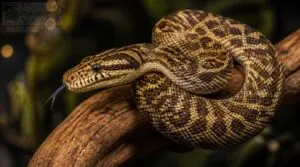
A lattice of gold and brown swirling across pale scales, that’s your first clue you’ve got a jaguar morph on your hands. Broken saddles interrupt the bands, varying in size and density between individuals.
- Dense, net-like swirls vs. open, spoke-style patterns
- Larger saddles at mid-body, smaller near the tail
- Consistent midline pattern with flank variation
- Sharper contrast retained in juveniles
Zebra Bands and Super Zebra
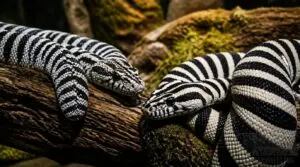
Where jaguar morphs swirl, zebra carpet pythons snap into crisp lines.
Zebra Band Inheritance works as dominant or co-dominant, so pairing two banded animals boosts your odds. Watch for band width variation and locality zebra traits, inland lines often edge sharper.
Push selective zebra morph combinations far enough and Super Zebra expression emerges: patternless, high-contrast striped bodies that turn heads.
Albino and Axanthic Granite
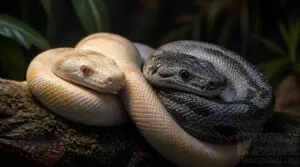
Zebra stripes are bold, but granite pairings play a subtler game. Albino granite washes out to cream and yellow with red eyes, while axanthic granite stays silver-charcoal with dark irises.
- Albino granite genetics need two albino copies
- Granite pattern expression varies by locality
- Axanthic granite traits mute mid-tones
- Albino axanthic combination boosts contrast further
Multi-Gene Designer Combinations
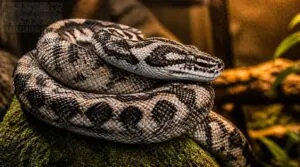
Two-gene combos are one thing, but why stop there? Stack three or four traits, like a Jaguar Albino Granite triple, and you get extreme visual impact through layered gene interaction.
| Combo | Effect |
|---|---|
| Albino + Granite | Cream speckling |
| Axanthic + Granite | Monochrome pattern |
| Jaguar + Albino + Granite | Bold triple contrast |
Predictability shrinks as genes multiply, so documentation matters more than ever.
Line Breeding for Stronger Contrast
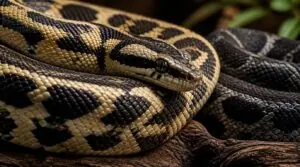
Ever wonder how breeders get that jaw-dropping contrast? Line breeding is the answer, pairing dark-patterned animals against light ground colors for maximum pop.
- Sharp black saddles on cream backgrounds
- Deep charcoal axanthics with silvery gaps
- Bold granite speckling that jumps off the scales
Pedigree-based pairing and generational contrast tracking stabilize results, while balanced gene flow keeps the lineage healthy over time.
How Carpet Python Colors Change With Age
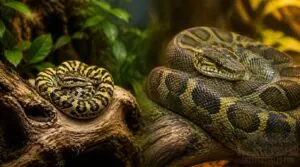
Ever bought a jaw-dropping juvenile only to wonder, years later, where all that color went? Carpet pythons aren’t static art pieces—they shift, mellow, and sometimes surprise you as they grow. Here’s what’s actually driving those changes, from shedding cycles to the lighting in your reptile room.
Carpet pythons aren’t static art pieces—their colors shift and mellow with age, shaped by shedding cycles and light
Juvenile Versus Adult Coloration
Ever notice how a hatchling carpet python looks nothing like its parents? That’s ontogenetic color change in action: juveniles flaunt crisp yellows, tight chain markings, and bold contrast.
| Trait | Juvenile |
|---|---|
| Base tone | Bright yellow/orange |
| Markings | Thin, defined |
| Contrast | High |
| Symmetry | Strong |
| Ground color | Light, crisp |
Adults trade that vibrancy for camouflage-driven phenotype variation.
Ontogenetic Fading and Contrast Loss
Where’d that fire-engine yellow go? Pigment degradation kicks in early, dulling intensity up to 30% within two years. Melanin and carotenoid balance shifts, scale texture roughens, and UV fading effects hit sun-loving individuals hardest. Blame temperature-dependent pigmentation and humidity too.
Edges blur, saddles merge, and that razor contrast your hatchling flaunted softens into something moodier, more matte, more grown-up.
Shedding and Temporary Dullness
That milky-eyed, hazy look before a shed? Totally normal. Your snake isn’t fading, it’s just prepping.
Good humidity gradients mean clean, full sheds instead of patchy ones. Watch for:
- Blue-eye phase cloudiness
- Dulled scale clarity
- Reduced appetite
Skip stressful handling here. Once shed, that scale-deep contrast comes roaring back.
Lighting and Color Appearance
Ever notice how your carpet python looks different under sunlight versus your living room lamp? That’s spectrum balance at work.
High CRI lighting (90+) renders true colors, while incandescent bulbs warm reds and browns, and uneven fluorescent or LED peaks skew blues and greens.
Proper UVB, in Ferguson Zone 2-3, helps with accurate hue perception and healthy pigment expression.
Locality Effects on Adult Color
Where your snake hatched matters as much as its genes. Coastal adults lean toward amber and chestnut, jungle locality carpets sharpen their saddle contrast, and Irian Jaya specimens settle into olive-bronze with bold side rings. Darwin populations often mature charcoal-olive with heavy midline banding.
This geographic color variation reflects habitat adaptation, so don’t expect a textbook wild-type look from every subspecies.
Do Carpet Python Morphs Need Special Care?
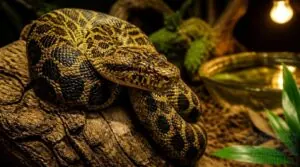
So does that stunning axanthic or jaguar setup mean you need to rethink your whole setup? Not really—but a few things do shift once color genetics enter the picture. Here’s what actually matters when caring for these gorgeous morphs.
Morph-Neutral Enclosure Requirements
Whether you’ve got a jet-black axanthic or a classic wild-type jungle, the setup stays the same. Focus on:
- Enclosure size: 40-60 gallon for juveniles, 75-125 for adults
- Substrate depth of 4-6 inches for adult burrowing
- Two opposite-facing hides for stress-free security
- A steady thermal gradient with a locking lid
Genetics don’t dictate husbandry, good habitat setup does.
Temperature, Humidity, and Shedding
Good habitat setup means nothing without the right numbers dialed in.
Keep the cool side between 78-88°F and the warm side 88-92°F for digestion, with a 92-95°F basking spot for active days.
Nighttime drops promote regular shedding, while humidity climbs during ecdysis to loosen skin.
Dip below 75°F and feeding responses stall out fast.
UVB and Natural Color Viewing
Once temps and humidity are dialed in, lighting seals the deal. UVB isn’t just about calcium, it drives pigment pathways that sharpen reds, oranges, and yellows. Skimp on it and colors dull fast. Pair UVB with daylight-simulating bulbs for true color rendering accuracy, stimulating photoreceptors so your python’s saddles and bands show up exactly as nature intended.
Morph-Linked Health Considerations
Getting the lighting right won’t fix everything. Some morphs carry baggage tied to their genetics. Albinos and axanthics need biannual eye checks, since reduced melanin raises infection risk around the conjunctiva. Watch for jaw alignment issues affecting feeding, and track genetic lines closely, catching hereditary problems early. Damp skin post-shed invites dermatological trouble too.
Ethical Breeding and Genetic Diversity
Since chasing flashy morphs can tempt shortcuts, ethical breeding matters more than ever. Responsible breeders use genetic testing, open studbooks, and diverse founder stock to preserve genetic diversity in captive bred morphs.
- Healthy pythons living pain-free lives
- Trustworthy breeders you can rely on
- Preserved bloodlines for future generations
- Confident, informed purchasing decisions
Selective breeding paired with genetic documentation keeps this hobby thriving responsibly.
Frequently Asked Questions (FAQs)
Can carpet python colors change as they age?
Time really does change the game. Yes, colors shift with age: ontogenetic fading softens juvenile brightness, shedding cycles briefly sharpen or dull hues, and locality genetics decide how long that bold contrast sticks around into adulthood.
Are certain morphs more prone to health issues?
Yes. Jaguars carry a neurological wobble, Leucistics face 100% lethality, Desert females risk fatal infertility, Caramel Albinos show fertility drops, and Super morphs often develop microphthalmia.
Ethical breeding and regular health monitoring keep these risks in check.
Which carpet python colors are most in demand?
Bright colors sell, bold patterns sell, rare genetics sell best of all.
Albinos, Jaguars, and Axanthics dominate demand, driven by striking visual appeal, strong breeder preferences, and genetic diversity, while emerging Caramels signal where morph popularity heads next.
How do lighting conditions affect python coloration?
Lighting shifts everything you see. Warm 2700K bulbs boost ambers, cool 5000K brings out greens, and full spectrum LEDs show true colors best, while UVB aids natural pigmentation and healthy chromatophore activity across morphs.
Are color mutations linked to temperament or behavior?
Here’s a myth worth busting: color doesn’t dictate personality. Temperament links to genetics, handling, and enrichment, not pigment. Whether albino or wild-type, your snake’s attitude comes from breeding lines and how you raise it, not its hue.
Can carpet pythons change color as adults?
Absolutely, though it’s more subtle than dramatic. Expect ontogenetic contrast loss, muted backgrounds, and smoother pattern edges as your snake matures, with locality, genetics, and even seasonal shedding cycles all playing a role in that gradual transformation.
Are colorful carpet python morphs more expensive?
Yes, rarity and demand drive it. Designer gene premiums, IJ lineage value, and breeder reputation all push prices up, with axanthic and granite morphs often costing far more than plain wild-type carpets.
Can different carpet python morphs be bred together?
Sure, just toss any two snakes in a tub and hope for magic, right? Not quite. Crossing morphs works when lineage documentation and matching subspecies exist, guiding predictable offspring trait prediction through careful, ethical selective breeding practices.
How do you tell carpet python morphs apart?
Check ground tone, band shape, and eye color first. Albinos show red eyes on cream bodies, axanthics stay silver-gray, and granites reveal speckled mosaics.
Compare marking symmetry, too, since genetic inheritance shapes each phenotype’s visual signature distinctly.
Conclusion
Every scale tells a story written by genes, geography, and time. Once you learn to read carpet python colors and patterns, you’ll never glance at a plain saddle or a blazing jungle band the same way again.
Morphs may catch your eye, but solid husbandry keeps that color vibrant for decades. Feed your snake well, watch its sheds closely, and let each new pattern remind you why this hobby never gets old.