This site is supported by our readers. We may earn a commission, at no cost to you, if you purchase through links.
A ball python hatchling emerges from its egg weighing roughly 60–80 g—small enough to coil inside your fist, yet wired with instincts sharp enough to detect a temperature shift of 2 °F. Most new owners misread that intensity.
A tight defensive coil isn’t hostility; it’s a hatchling processing a world it hasn’t mapped yet.
Tongue flicks, strike attempts, hide preference—every behavior carries a signal.
Read those signals correctly and you’ll sidestep the feeding refusals, stress responses, and bad sheds that trip up most first-time keepers.
Ball python hatchling behavior follows predictable patterns once you know what to look for.
Table Of Contents
- Key Takeaways
- Normal Hatchling Ball Python Behaviors
- Stress and Defensive Behavior Signs
- Feeding Response and Hunting Behavior
- Shedding and Pre-Shed Behavior
- Handling Reactions and Socialization
- Activity, Growth, and Health Clues
- Top 10 Ball Python Hatchling Supplies
- 1. Leoterra Reptile Hide Snake Lizard Gecko
- 2. BSRESIN Reptile Thermometer Humidity Gauge
- 3. Venicor Ball Python Aluminum Sign
- 4. WOLEDOE Snake Feeding Tongs
- 5. MiceDirect Frozen Hopper Mice Food
- 6. MiceDirect Frozen Hopper Mice for Snakes
- 7. RunXF Extra Large Simulation Rock Reptile Bowl
- 8. FCALIVV Reptile Hide Box
- 9. Ball Python Care Log Book
- 10. Ball Python Graphic T Shirt
- Frequently Asked Questions (FAQs)
- How often should I feed a hatchling ball python?
- Can a baby snake survive without its mother?
- How to tell if a baby snake is hungry?
- Do hatchlings recognize their owners over time?
- Can hatchlings cohabitate safely in one enclosure?
- How do morphs affect hatchling temperament or behavior?
- Do hatchlings behave differently during seasonal changes?
- When do hatchlings start exploring their enclosure independently?
- Conclusion
Key Takeaways
- A hatchling’s tight coil, rapid tongue flicking, and repeated strikes aren’t aggression — they’re stress signals that point directly to a husbandry problem you need to fix.
- Feed every 5–7 days using prey sized to your hatchling’s midsection width, and skip handling for at least 48 hours post‑meal to prevent regurgitation.
- Keep warm‑side temps at 88–92°F and humidity at 60–80% normally, bumping to 90–95% during shed cycles — those numbers aren’t suggestions, they’re the floor.
- Hold off on handling for the first two weeks and let your hatchling map its enclosure on its own terms; that early restraint builds the trust that makes every session easier later.
Normal Hatchling Ball Python Behaviors
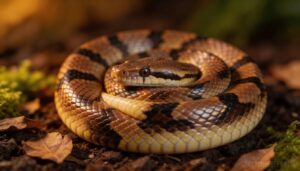
Most of what a hatchling does in those first weeks looks strange until you understand what’s driving it. These snakes aren’t being difficult — they’re running on instinct, and every behavior has a purpose.
Once you recognize that even the defensive nipping is just instinct kicking in, it becomes easier to handle them with the calm confidence that helps milk snake hatchlings settle down.
Here’s what you’ll actually see and what it means.
Hiding and Emerging at Dusk
At dusk, your hatchling isn’t being lazy — it’s running an ancient script. Ball pythons emerge 30–60 minutes after sunset, guided by environmental cues like dropping temperatures and shifting light levels.
Your Hide Placement Strategy and Nighttime Temperature Shift matter here.
- Warm hides sit near the temperature gradient’s peak
- Dusk Light Cues trigger cautious first movements
- Microclimate Hide Selection reduces Predator Avoidance stress
- Substrate texture anchors secure resting posture
Tongue Flicking and Scent Exploration
Once your hatchling starts moving, watch its tongue. Every rapid flick pulls scent particles into the vomeronasal organ for processing — that’s Vomeronasal Processing in real time.
Environmental Humidity Effects determine how long those particles cling to the tongue.
Temperature Gradient Influence shapes where scents concentrate.
Substrate Scent Reservoirs hold chemical data the tongue reads like a map.
Ventilation Impact can scatter those cues fast.
Curling, Coiling, and Resting Posture
After scent-mapping the enclosure, your hatchling shifts to rest — and how it coils tells you a lot.
Tight Coil Tightness Indicators signal insecurity; loose radiating Radiating Coil Patterns near the warm zone mean it feels safe. Tail Position Significance matters too — a tucked tail minimizes exposure.
Humidity Influence Coiling is real: drier air produces more compact shapes. Flat, stable Substrate Surface Preference helps deeper, restful sleep.
Thermoregulating Between Warm and Cool Zones
Once your hatchling settles into a resting coil, it won’t stay still long. Zone Preference Shifts happen fast — hatchlings actively shuttle between the 88–92 °F warm zone and the 78–80 °F cool zone within minutes.
This Temperature Gradient Utilization is instinctive. Mid-Zone Resting often signals thermal satisfaction. Your Heat Source Selection and Cooling Retreat Behavior setup either facilitates this cycle or fights it.
How Hatchling Behavior Differs From Adults
Adults roam wide and stay out longer. Hatchlings don’t.
Their Nighttime Foraging Window is short, their Microhabitat Selection stays tight, and Heat Source Proximity drives every move they make.
Scent Sensitivity runs high — they react to stimuli adults ignore.
Activity Burst Duration is brief, hatchling temperament is defensive, and prey size selection, feeding frequency, handling stress reduction, and behavioral observation all demand a smaller-scale approach.
Stress and Defensive Behavior Signs
A stressed hatchling doesn’t suffer quietly — it tells you exactly what’s wrong through its body. Learning to read these signals early can mean the difference between a thriving snake and a chronic problem you can’t trace back to its source.
A stressed hatchling speaks through its body — learn to listen before the problem becomes untraceable
Here are the key defensive behaviors every new owner needs to recognize.
Head Bobbing and Tight Defensive Coiling
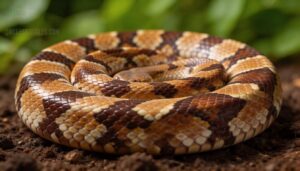
When a hatchling tucks its head and pulls into a tight coil, that’s not random — it’s a clear stress indicator. Think of it as a vertical slip with knee bend balance: the snake reduces its surface area and creates a counter angle for a defensive strike.
This behavioral observation signals overstimulation. Recognize it early, apply proper stress reduction through calm handling techniques, and you’ll improve hatchling temperament fast.
Restrained Strikes and Repeated Lunges
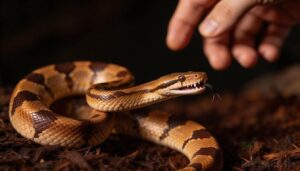
When a hatchling strikes repeatedly, it’s not random aggression — it’s a controlled defensive response. Each lunge follows predictable strike timing: a brief pause, then full extension with posture alignment locked on your hand as the threat.
These are your behavioral observation checkpoints:
- Lunge frequency increases as you close distance
- Energy recovery gaps shorten under sustained stress
- Defensive triggers reset after each failed contact
- Repeated strikes signal failed lunge mechanics, not hunger
- Posture alignment stiffens with each escalation
Apply stress reduction through minimal handling techniques immediately.
Rapid Tongue Flicking and Gaping

Rapid tongue flicking isn’t always curiosity — in hatchling ball pythons, Stress-Induced Flick Frequency spikes when the animal feels cornered or threatened.
Normal Exploratory Scent Sampling is slow and rhythmic.
Defensive flicking runs faster, often paired with Defensive Gaping Displays — an open mouth meant to warn, not feed.
Thermal Gaping Behavior looks similar, so always rule out overheating first.
These are clear stress indicators.
Behavior Changes After Enclosure Disturbances
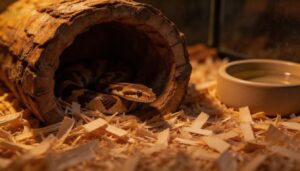
Even a brief disturbance — a dropped lid, sudden light, or unexpected movement — resets a hatchling’s behavioral baseline fast.
Expect a Zone Preference Shift toward deeper hides, Exploration Delay lasting 24–48 hours, and tightened Shelter Selection patterns. Feeding Latency increases noticeably within that window. Thermal Gradient Avoidance also spikes; time in the warm zone drops 12–25%. Recovery usually takes 1–3 days.
Complex enclosures promote higher behavioral diversity in captive reptiles, supporting smoother recovery after disturbances.
When Defensive Behavior Signals Husbandry Problems

Defensive behavior that doesn’t ease up after two weeks isn’t a personality quirk — it’s a symptom.
Temperature Gradient Issues top the list: Bulb Failure Indicators, like persistent hiding or tight coiling, signal your warm zone has failed. Humidity Imbalance Effects and Substrate Irritation trigger similar responses.
Waste Odor Stress compounds everything.
Track these through stress indicators and behavioral observation before problems escalate into respiratory infections or metabolic issues.
Feeding Response and Hunting Behavior
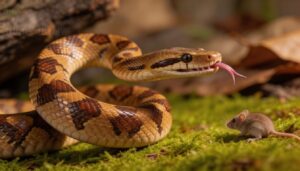
Feeding time tells you a lot about your hatchling’s health and comfort level. A snake that’s eating well is a snake that’s thriving — and understanding the behaviors behind that feeding response helps you catch problems early.
Here’s what to watch for, from hunger cues to safe prey presentation.
How to Tell if a Hatchling is Hungry
Hunger in a hatchling isn’t subtle once you know what to watch for. An Activity Surge before scheduled meals is your clearest signal — this is Feeding Time Anticipation in action.
- Posture Shift: Looser coil, head angled outward instead of tucked
- Prey Tracking: Head orients immediately toward the prey source
- Increased tongue flicking near enclosure edges and hide openings
- Weekly weight monitoring catches Weight Fluctuation before refusal becomes a pattern
- Feeding schedule consistency makes hunger cues more predictable and readable
Strike-and-constrict Behavior at Feeding Time
Once you’ve spotted those hunger cues, feeding time moves fast. A hatchling’s strike-and-constrict sequence is instinctive and precise — the head straightens, the mouth opens, and contact happens in under a second.
Coil Timing matters here: the first loop forms within 2–4 seconds post‑strike, driven partly by Temperature Influence. A warm snake is a responsive snake.
| Phase | What Happens | Timeframe |
|---|---|---|
| Strike | Bite Force lands on prey’s head/neck | Under 1 second |
| Prey Assessment | Tongue flicks confirm prey position | 2–4 seconds |
| Post‑Strike Recovery | Coils tighten; swallowing begins headfirst | Under 60 seconds |
Your Feeding Practices and Diet for Hatchling Ball Pythons depend on getting this sequence right every time.
Common Reasons Hatchlings Refuse Meals
Not every hatchling strikes on cue. A Low Temperature Gradient — hot side under 88°F — kills the feeding response before prey even hits the enclosure.
Improper Humidity throws off pre-shed comfort, triggering prey refusal. Inadequate Hide Security leaves them too exposed to relax.
Watch Disturbance Timing; offering food mid‑afternoon rarely works.
Feeding Frequency for Steady Growth
Once your hatchling starts eating reliably, lock in a feeding schedule every 5–7 days. Meal Timing Consistency drives steady gains — nighttime is best. A Nighttime Feeding Routine aligns with natural activity peaks.
- Track hatchling weight weekly
- Monitor hatchling size monthly
- Apply Feeding Cadence Adjustment if growth stalls
- Use Growth Rate Monitoring and Weight Tracking logs
- Scale prey with Prey Size Scaling as the snake grows
Prey Size and Safe Presentation Methods
Match prey width to the widest point of your hatchling’s midsection — that’s your Prey Width Guidelines in practice. Start with pinky mice, then progress to small mice or rats as hatchling size and hatchling weight increase. Use the Tongs Presentation Technique to control distance and motion safely.
| Feeding Stage | Prey & Method |
|---|---|
| First feedings | Pinky mice, head-first with tongs |
| Growth phase | Small mice or rats, fully thawed |
Thawing and Hydration matter: always present prey completely thawed. Distance Safety Rules keep your fingers clear. Follow Feeding Frequency and Prey Size Selection Guidelines — adjust with Adjusted Feeding Size if swallowing looks strained.
Shedding and Pre-Shed Behavior
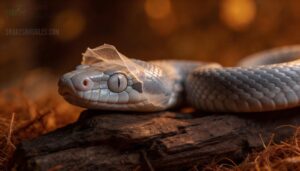
Shedding is one of the clearest windows into your hatchling’s health — and one of the easiest things to misread. Before that first shed happens, your snake will tell you exactly what it needs if you know what to watch for.
Here’s what to look out for at every stage.
Cloudy Eyes and Dull Coloration
Cloudy eyes and a sudden dull coloration are classic pre-shed signals—not cause for panic. outer cornea turns milky as old skin separates from new.
low environmental humidity and temperature fluctuation effects that slow normal skin turnover. Keep your humidity range at 60–80% and your temperature gradient stable.
eye opacity diagnosis warrants veterinary eye examination.
Increased Hiding Before The First Shed
Before the first shed, your hatchling will disappear — and that’s expected. Pre-shed hide preference intensifies as activity drops noticeably.
Hide duration trends longer each day, sometimes exclusively in one spot. That chosen hide’s substrate moisture influence and temperature gradient hide placement matter here.
Minimize handling stress and human interaction. Don’t force it out. Let the process run.
Appetite Changes During Shed Cycles
Expect a pre-shed hunger dip — it’s one of the most consistent behavioral shifts you’ll observe. Appetite drops as eyes cloud and skin loosens. Don’t panic or force feed.
Watch for these appetite patterns during the shedding process:
- Selective prey refusal increases as cloudiness peaks
- Hydration influence rises — hatchlings drink more
- Temperature-driven appetite drops if warm zones slip low
- Post-shed feeding surge usually follows a clean shed
- Missed meals resolve within days if husbandry holds
Humidity Support for Clean Sheds
Humidity is the difference between a clean shed and a retained one. Keep your enclosure at 50–60% during normal periods, then push it to 90–95% as the shedding process peaks.
Use a hygrometer calibration check weekly — drift happens quietly. Passive moisture control through substrate and a water dish covers most of it, but tighten ventilation placement when readings drop below range.
Retained Shed Warning Signs to Watch
A retained shed doesn’t announce itself loudly — it hides in the details. Watch for these warning signs before minor issues become circulation problems:
- Toe ring swelling from constricting old skin loops
- Banding patches where dull and shiny scales alternate mid-body
- Skin lifting at scale edges that won’t lay flat
- Mouth sticking near the lips, leaving uneven closures
- Partial shed remnants with an opaque, glossy texture on new skin
Handling Reactions and Socialization
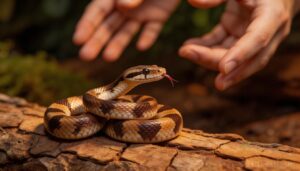
Hatchlings don’t come pre-socialized — they’re defensive by default, and that’s completely normal. How you handle them in the first few weeks shapes how they respond to you for years.
Here’s what you need to know to build trust without setting things back.
Why New Hatchlings Dislike Frequent Handling
New hatchlings aren’t being difficult — they’re overwhelmed. Every touch triggers a cortisol spike within minutes, and their small bodies aren’t built for sustained contact.
Sensory overload kicks in fast: grip pressure, temperature transfer, and unpredictable movement all register as threats. Add thermal disruption from leaving their warm zone, and you’ve stacked multiple stressors at once.
Fear conditioning sets in quickly when handling feels inconsistent or forced.
Minimal Handling During The First Two Weeks
The first two weeks set the tone. Skip handling entirely — monitor through the glass instead.
Observation From Outside lets you track tongue flicks, posture, and first shed coloration shifts without triggering stress.
Maintain Heat Humidity Stability, offer Feeding Without Removal, and make sure Water Bowl Access stays undisturbed.
Enclosure Disturbance Avoidance now builds the trust that makes every future interaction easier.
How to Hold a Hatchling Safely
Once you’re past those first two weeks, technique matters. Cup the full body — Hand Position Support means lifting from underneath, keeping the spine level. No Head Grip, no tail lifting. Hold over a stable surface for Fall Prevention Techniques.
Keep sessions short in a Calm Handling Environment.
If the hatchling stiffens or lunges, put it back immediately.
Signs of Growing Tolerance Over Time
tolerance builds slowly — but the signs are clear. You’ll notice a reduced startle response first: less flinching when your hand enters the enclosure.
Over weeks, calm handling acceptance replaces defensive coiling.
Watch for longer basking periods, increased zone exploration, and consistent feeding latency after sessions.
When a hatchling resumes eating within a day of handling, that’s trust earned.
When to Pause Handling to Reduce Stress
Even earned trust has a pause button. Skip handling for at least 48 hours post-feeding — the post-feeding interval is non‑negotiable for regurgitation prevention.
Run a temperature gradient check before every session; a cool snake is a defensive snake.
Watch for stress signal detection cues: tight coiling, rapid tongue flicking, repeated writhing.
Hydration status and handling duration limit matter too.
Keep sessions under five minutes until behavior confirms readiness.
Activity, Growth, and Health Clues
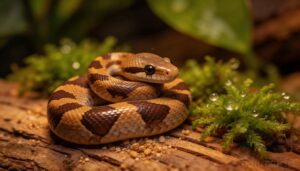
A hatchling that’s thriving will tell you — if you know what to look for. Growth rate, activity timing, and small physical details are your most reliable checkpoints between vet visits.
Here’s what to watch as your snake settles in and develops.
Normal Sleep and Nighttime Activity Patterns
Hatchling ball pythons run on a tight internal clock. Their Circadian Rhythm Indicators are easy to read once you know what to watch.
- Nighttime Rest Length often stretches several hours, with the snake curled tight — head tucked, coils compact — conserving Nighttime Energy Conservation between dusk activity bursts.
- Ambient Light Sensitivity triggers movement at dusk; sudden light causes defensive head lifts.
- Nighttime Moisture Preference peaks after dark; humidity aids calm resting behavior.
Healthy Size and Weight Milestones
Most hatchlings emerge weighing 40–120 g and measuring 10–16 inches.
Track Weekly Weight Gain with a digital scale accurate to 1 gram — expect 2–5 g per week during steady feeding. Target Hatchling Mass climbs fastest when your Ideal Feeding Ratio stays near 10–15% of body weight per meal.
Flat or falling numbers signal a husbandry problem worth fixing immediately.
Weekly Growth and Behavior Tracking
Numbers alone don’t tell the full story. Pair your Weight Trend Charts with a Behavioral Baseline Metrics log — note activity levels, hide preferences, and exploration patterns alongside weekly weights.
Growth Ledger Templates simplify this: one column for grams, one for behavior.
Weekly Activity Log and Correlation Analysis will reveal whether a weight plateau matches increased hiding or stress indicators, making Growth Rate Monitoring genuinely actionable.
Bright Eyes, Alertness, and Body Tone
A healthy hatchling ball python practically announces itself. Eye Brightness is your first checkpoint — clear, moist pupils that constrict promptly under light, confirm proper hydration and nervous system function.
Pair that with Alert Posture and firm Muscle Tone along the neck: these signal strong Body Condition.
Consistent Pupil Reaction and deliberate movement patterns are your best real-time health monitoring and disease prevention tools.
Lethargy, Swelling, and Other Red Flags
When something’s wrong, your hatchling won’t send a memo — it’ll show you. Watch for:
- Lethargy paired with gaping signals Respiratory Issues or severe Dehydration Signs requiring immediate intervention.
- Joint Swelling or Skin Abnormalities — especially post-shed retained skin — indicate hatchling welfare emergencies.
- Weight Loss exceeding 5% weekly demands enclosure reassessment and veterinary consultation.
Consistent health monitoring and disease prevention starts with catching these red flags early.
Top 10 Ball Python Hatchling Supplies
Getting your hatchling’s setup right from day one makes everything else easier. The right supplies aren’t just convenient — they’re what keeps temperatures stable, feeding consistent, and stress low.
Here’s what belongs in every new ball python owner’s kit.
1. Leoterra Reptile Hide Snake Lizard Gecko
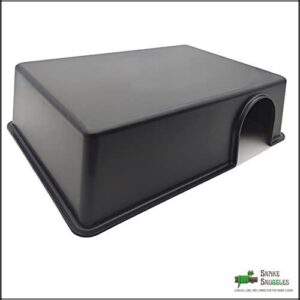
The Leoterra Reptile Hide gives your hatchling exactly what it needs — a secure, enclosed retreat it can claim as its own. At 10.23" × 7.48" × 2.75", it fits comfortably inside a standard 40-gallon setup.
The top-seal design helps retain localized humidity, which matters during shed cycles. Rounded edges and smooth plastic mean no abrasions.
Just note: snakes over 200 g will need a larger size. At $12.99, it’s a practical first hide.
| Best For | Reptile keepers with hatchlings or small snakes and lizards who want an affordable, easy-to-clean hide that helps hold humidity during sheds. |
|---|---|
| Price | $12.99 |
| Material | Plastic |
| Primary Use | Reptile Hide |
| Ball Python Suitable | Yes |
| Quantity Included | 1 |
| Easy to Clean | Yes |
| Additional Features |
|
- Top-seal design locks in moisture, which is great for species that need a humid microclimate
- Smooth plastic with rounded edges keeps your animal safe from cuts or scrapes
- Easy to clean — just rinse or wipe down, and you’re done
- Not ideal for snakes over 200 g; the entrance can be too tight for bigger animals
- Lightweight enough that a larger snake can push or flip it without much effort
- Some buyers feel the actual size runs a bit smaller than the listed dimensions suggest
2. BSRESIN Reptile Thermometer Humidity Gauge
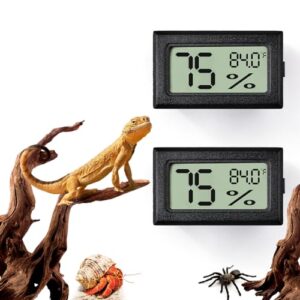
Once the hide is placed, your next job is knowing exactly what’s happening inside that enclosure. The BSRESIN dual thermometer and hygrometer ships as a two-pack — one for the warm side, one for the cool.
That matters, because ball python hatchlings need an 88–92 °F warm zone and 75–80 °F cool side. Accuracy holds at ±1 °F and ±5 % RH, with readings updating every five seconds.
At this price point, there’s no excuse for guessing.
| Best For | Reptile hobbyists who want an affordable, no-fuss way to monitor temperature and humidity across multiple enclosures at once. |
|---|---|
| Price | $9.99 (2-pack) |
| Material | Resin |
| Primary Use | Enclosure Monitoring |
| Ball Python Suitable | Yes |
| Quantity Included | 2 |
| Easy to Clean | Yes (wipe down) |
| Additional Features |
|
- Comes as a two-pack, so you can cover both the warm and cool sides of a single enclosure right out of the box.
- Reads both temperature and humidity on one screen, updating every five seconds — no guesswork, no switching between devices.
- Budget-friendly price makes it easy to stock multiple habitats without breaking the bank.
- Humidity readings can drift up to 10% between the two units, which is a problem if your species needs tight environmental control.
- The adhesive backing tends to be weak, and there’s no suction cup included as a backup.
- Battery isn’t always included, and even when it is, you’re looking at roughly three months before you need a replacement.
3. Venicor Ball Python Aluminum Sign
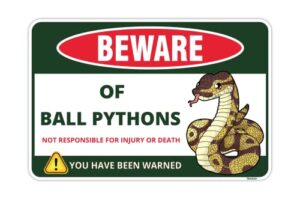
Not every supply needs to be functional. The Venicor Ball Python Aluminum Sign is a straightforward nod to the hobby — a 7.95 × 12 inch aluminum sign printed with a "Beware of Ball Python" design.
It won’t regulate temperature or assist with feeding, but it marks your space as intentional. Pre-drilled holes make mounting simple. The rust-proof finish holds up in humid reptile rooms.
Consider it the finishing touch that tells visitors exactly what kind of keeper you are.
| Best For | Ball python owners who want to add a fun, personal touch to their reptile space or grab a unique gift for a fellow reptile enthusiast. |
|---|---|
| Price | $8.99 |
| Material | Aluminum |
| Primary Use | Decoration |
| Ball Python Suitable | No (decorative) |
| Quantity Included | 1 |
| Easy to Clean | Yes (wipe down) |
| Additional Features |
|
- Rust-proof aluminum holds up in humid reptile rooms without corroding
- Pre-drilled holes make hanging it quick and painless
- A fun, affordable gift idea for anyone obsessed with their ball python
- The thin aluminum can feel a bit cheap compared to heavier signs
- Small size means it won’t grab attention from across the room
- Color may fade if it gets a lot of direct sunlight over time
4. WOLEDOE Snake Feeding Tongs
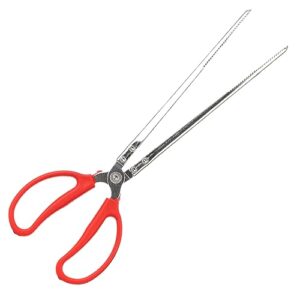
Once your space is marked, your tools need to work just as hard.
The WOLEDOE Snake Feeding Tongs keep your fingers 15 inches away from a hatchling mid-strike — and at feeding time, that distance matters.
The stainless steel build resists rust and prey fluids, while the serrated tip grips frozen-thawed pinkies without dropping them mid-presentation.
At $7.99, it’s a low-cost fix for a high-stakes moment.
Present prey at eye level, move slowly, and let the tongs do the work.
| Best For | Snake keepers feeding ball pythons, corn snakes, or similar small-to-medium species who want a safe, affordable feeding tool that works for adults and kids alike. |
|---|---|
| Price | $7.99 |
| Material | Stainless Steel / Plastic |
| Primary Use | Feeding Tool |
| Ball Python Suitable | Yes |
| Quantity Included | 1 |
| Easy to Clean | Yes (rinse) |
| Additional Features |
|
- 15-inch length keeps your hand well out of strike range during feeding
- Serrated tip holds prey firmly — no fumbling or dropping mid-presentation
- Stainless steel build won’t rust or absorb prey fluids over time
- Spring mechanism can feel stiff, especially for younger or smaller hands
- Serrated edge may tear delicate thawed prey if you squeeze too hard
- A bit bulky compared to slimmer tongs — might feel like overkill for tiny feeders
5. MiceDirect Frozen Hopper Mice Food
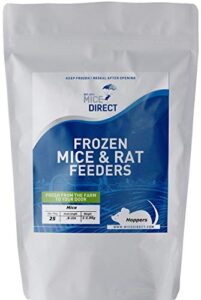
Your hatchling won’t care about premium branding — but it will notice the difference in prey quality.
MiceDirect Frozen Hopper Mice are CO₂-euthanized, raised on Mazuri zoological-grade diet, and sized at 1.5–2 inches, which aligns cleanly with most hatchling ball python mouth openings. Each mouse weighs 7–14 g, well within the safe 0.3–0.5x girth guideline.
Thaw overnight in the fridge or use warm water in a sealed bag. Don’t microwave.
At roughly $4 per mouse, you’re paying for consistency, not convenience.
| Best For | Owners of hatchling ball pythons, baby red-tail boas, or small juvenile snakes who want a reliable, consistently sized frozen feeder. |
|---|---|
| Price | $179.97 (25-pack) |
| Material | Frozen Rodent |
| Primary Use | Snake Food |
| Ball Python Suitable | Yes |
| Quantity Included | 25 |
| Easy to Clean | N/A |
| Additional Features |
|
- Raised on Mazuri zoological-grade diet, so you know exactly what your snake is eating
- CO₂-euthanized and shipped on dry ice — fresh from farm to door in about a week
- Sized right for hatchlings at 1.5–2 inches and 7–14g, which fits the standard girth guideline
- At around $4 per mouse, it’s one of the pricier options compared to bulk frozen suppliers
- Some buyers have reported size inconsistency, with a few mice running smaller than expected
- Only works for small/juvenile snakes — your python will outgrow these faster than you think
6. MiceDirect Frozen Hopper Mice for Snakes
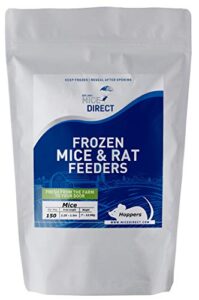
Same product, different pack size — and that distinction matters for how you plan your supply.
MiceDirect Frozen Hopper Mice for Snakes ship directly from their Georgia facility, packed with dry ice via FedEx to keep every mouse frozen solid in transit. Each hopper runs 7–13 g and about 1.25–1.5 inches — right-sized for hatchling ball pythons without the regurgitation risk that comes from oversized prey. The bulk format suits multi-snake keepers well. Thaw in warm water, present with tongs, and keep handling minimal after the meal.
| Best For | Small snake owners — especially those raising baby ball pythons, red-tail boas, or milk snakes — who want a reliable bulk supply of frozen prey without dealing with live rodents. |
|---|---|
| Price | $179.97 (150-pack) |
| Material | Frozen Rodent |
| Primary Use | Snake Food |
| Ball Python Suitable | Yes |
| Quantity Included | 150 |
| Easy to Clean | N/A |
| Additional Features |
|
- Ships straight from the farm on dry ice, so the mice arrive fresh and frozen without any middleman delays.
- CO₂ euthanized and fed a clean zoological diet — no sketchy additives, just straightforward, nutritious prey.
- Buying 150 at once keeps your freezer stocked and cuts down on reorder hassle, great if you’re running multiple snakes.
- At around $1.20 per mouse, the price is noticeably higher than what you’d find locally or through private sellers.
- Some buyers have reported size inconsistency, with a portion of mice coming in smaller than a true hopper — which can mess with feeding schedules.
- 150 mice is a big commitment; if you’ve only got one or two snakes, you might struggle to work through them before freezer burn becomes a concern.
7. RunXF Extra Large Simulation Rock Reptile Bowl
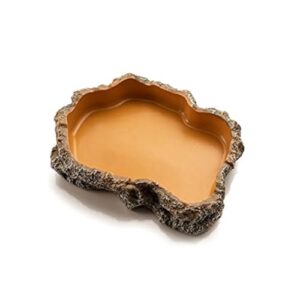
Water and feeding bowls aren’t glamorous, but they matter more than most keepers admit.
RunXF Extra Large Simulation Rock Reptile Bowl pulls double duty — water dish and feeding station — in a 9.06 x 6.69 x 1.97-inch footprint that fits snugly into standard hatchling enclosures. resin construction resists bites and cracking, and the smooth interior won’t harbor bacteria if you clean it regularly. rough exterior edge also aids shedding. Stable base, no tipping.
Rinse before first use.
| Best For | Owners of large or medium reptiles like bearded dragons, iguanas, snakes, or turtles who want a feeding and bathing bowl that blends naturally into a desert-style tank. |
|---|---|
| Price | $12.99 |
| Material | Resin |
| Primary Use | Water Dish |
| Ball Python Suitable | Yes |
| Quantity Included | 1 |
| Easy to Clean | Yes |
| Additional Features |
|
- Extra large size handles big reptiles comfortably without feeling cramped
- Smooth interior is easy to clean and won’t trap bacteria between uses
- Rough exterior edges double as a shedding aid — a nice bonus you don’t always get with basic bowls
- Needs a freshwater rinse before first use to clear off any manufacturing dust
- Color description is inconsistent across the listing (brown vs. yellow), so what you picture might not match what arrives
- Only practical for reptiles and small animals — not a versatile pick if you have mixed pets
8. FCALIVV Reptile Hide Box
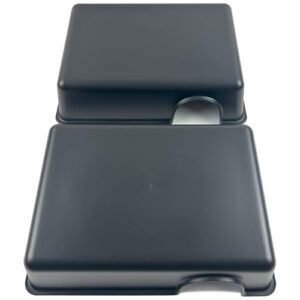
A hatchling without a proper hide is a stressed hatchling — and stress kills feeding response fast.
The FCALIVV Reptile Hide Box is compact at 9.45 × 6.89 × 2.17 inches, sized right for juveniles without crowding the enclosure. PVC construction holds up to humidity and wipes clean easily between shed cycles. The removable lid gives you access without tearing apart the setup. Pair it with damp sphagnum moss inside and you’ve got a functional humid hide that facilitates clean sheds.
| Best For | Juvenile reptiles and small invertebrates like leopard geckos, hognose snakes, and tarantulas that need a secure, stress-reducing hide. |
|---|---|
| Price | $14.99 (2-pack) |
| Material | Plastic |
| Primary Use | Reptile Hide |
| Ball Python Suitable | Yes |
| Quantity Included | 2 |
| Easy to Clean | Yes |
| Additional Features |
|
- Comes as a two-pack, so you can cover both the warm and cool sides of the enclosure without buying extra
- Easy to clean — just pull it out, rinse it off, and you’re done
- Works in humid or dry setups, so it’s flexible across different species’ needs
- The entrance opening runs small, so adult ball pythons or larger snakes will likely outgrow it fast
- Plastic doesn’t have the natural look of cork or wood, which can feel out of place in a naturalistic build
- The black color blends into dark substrate, making it easy to lose track of the entrance at a glance
9. Ball Python Care Log Book
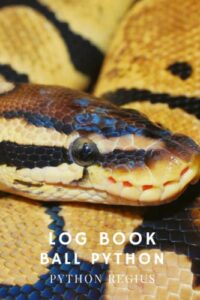
Memory fades fast — and a missed feeding entry or skipped weight log can cost you weeks of progress data. The Ball Python Care Log Book ($9.99) gives you structured space for over 300 feeding entries, 100 shed records, and 12 monthly growth charts.
At 140 pages, it’s built to last 8–10 years. Log prey type, prey weight, humidity readings, and vet visits all in one place.
For hatchling tracking, that consistency isn’t optional — it’s how you catch problems before they compound.
| Best For | Ball python owners who want a no-fuss, long-term paper log to track feedings, sheds, growth, and vet visits all in one place. |
|---|---|
| Price | $9.99 |
| Material | Paper |
| Primary Use | Care Tracking |
| Ball Python Suitable | Yes |
| Quantity Included | 1 |
| Easy to Clean | N/A |
| Additional Features |
|
- Covers everything in one book — feeding, shedding, growth charts, breeding, and habitat maintenance
- Built for the long haul at 8–10 years of use with room for 300 feeding entries
- Great for spotting patterns early, like slow growth or irregular sheds, before they become real problems
- No digital backup, so if the book gets damaged, that data is gone
- The 6×9 size can feel cramped if you have a lot to write
- Capacity limits mean heavy breeders with large collections might outgrow it faster than expected
10. Ball Python Graphic T Shirt
Not every supply is a thermostat or a feeding log — sometimes it’s a shirt.
The Ball Python Graphic T-Shirt ($18.99) is a lightweight, casual tee built for reptile keepers who want to wear their interest openly.
The coiled ball python graphic spans the chest with bold outlines and natural colorways.
It’s a low-stakes gift for a fellow keeper, a conversation starter at a reptile expo, or just something comfortable to wear on feeding day.
| Best For | Ball python owners and reptile enthusiasts who want a casual, affordable tee to show off their hobby or give as a low-key gift. |
|---|---|
| Price | $18.99 |
| Material | Fabric |
| Primary Use | Apparel |
| Ball Python Suitable | Yes (themed) |
| Quantity Included | 1 |
| Easy to Clean | N/A |
| Additional Features |
|
- Priced at $18.99, it’s an easy, no-stress gift for any occasion
- Lightweight and comfortable for everyday or at-home wear
- Great conversation starter at reptile expos or pet-related hangouts
- The graphic may look duller in person than it does in product photos
- No material composition listed, so it’s hard to know what you’re actually getting
- Sizing info is vague — "classic fit" doesn’t tell you much on its own
Frequently Asked Questions (FAQs)
How often should I feed a hatchling ball python?
Feed your hatchling every 5 to 7 days. Start closer to 5 days for the first few meals, then settle into a weekly rhythm once it’s eating consistently.
Can a baby snake survive without its mother?
Yes. Baby ball pythons are fully independent at birth — no maternal care, no guidance.
In the wild, disperse within hours.
In captivity, consistent temps, humidity, and prey are all they need to thrive.
How to tell if a baby snake is hungry?
Hunger speaks through motion.
Watch for frequent tongue flicking, pacing along the enclosure front, and a raised, alert head. Those restless laps aren’t anxiety — they’re your hatchling scanning for its next meal.
Do hatchlings recognize their owners over time?
Not exactly — but something close happens.
Over the first few weeks, hatchlings begin associating your scent, warmth, and calm movements with safety. Consistent handling builds familiarity that looks a lot like recognition.
Can hatchlings cohabitate safely in one enclosure?
Cohabitation isn’t recommended. Hatchlings compete for hides, basking spots, and food — stress escalates fast. Separate enclosures are the only reliable way to monitor individual health, weight, and feeding success.
How do morphs affect hatchling temperament or behavior?
Morphs have minimal impact on temperament.
Individual care, handling, and feeding consistency matter far more than color or pattern genetics when shaping how a hatchling reacts to you and its environment.
Do hatchlings behave differently during seasonal changes?
Yes, hatchlings shift behavior with the seasons. Cooler months trigger more nocturnal movement, reduced appetite, and longer hide use.
Stable enclosure temperatures and consistent feeding schedules to offset these natural responses and keep growth on track.
When do hatchlings start exploring their enclosure independently?
Most hatchlings begin exploring independently within 4–7 days, though cautious individuals may take up to 2–3 weeks.
Expect slow, deliberate movement at first — usually during evening hours when the enclosure feels familiar and safe.
Conclusion
Nearly 70% of ball python hatchlings experience stress-related feeding issues within the first month of ownership. Understanding ball python hatchling behavior can drastically reduce this statistic.
By recognizing subtle cues and responding to their needs, you create a supportive environment that fosters healthy growth. As you continue on this journey, stay vigilant, adapt to your hatchling’s evolving signals, and you’ll be rewarded with a thriving, well-adjusted companion that brings joy for years to come, naturally.