This site is supported by our readers. We may earn a commission, at no cost to you, if you purchase through links.
The iridescent scales and striking patterns that make ball python morphs so enchanting come with a hidden price—one measured in neurological tremors, skeletal malformations, and lifelong suffering. While breeders have created over 4,000 distinct color and pattern variations through selective genetics, some of these mutations carry serious health consequences that compromise quality of life.
The Spider morph’s characteristic head wobble, the Scaleless morph’s vulnerability to skin infections, and the Super Fire morph’s severe neurological deficits aren’t occasional flukes—they’re predictable outcomes of specific genetic combinations.
Understanding ball python morph health concerns isn’t just academic knowledge; it’s essential information that determines whether you’re selecting a thriving companion or inheriting years of veterinary interventions and ethical dilemmas.
Table Of Contents
Key Takeaways
- Over 4,000 ball python morphs exist today, but specific genetic combinations—including Spider, Champagne, Scaleless, Super Fire, and certain Blue-Eyed Leucistic lines—carry predictable health consequences like neurological disorders, skeletal deformities, skin vulnerabilities, and reproductive failure that compromise quality of life.
- Spider and Champagne morphs consistently exhibit wobble syndrome due to documented inner ear malformations, causing head tremors, balance issues, and feeding incoordination that range from mild to severely debilitating throughout the snake’s lifetime.
- Responsible breeding practices require prioritizing genetic diversity, avoiding high-risk morph pairings, conducting regular veterinary examinations with morph-specific health screening, and recognizing early warning signs like respiratory clicking, skin discoloration, feeding refusal, or behavioral changes before they progress to serious illness.
- The ethical debate centers on whether aesthetic appeal justifies breeding morphs with guaranteed suffering—progressive breeders now advocate for genetic testing before pairing, transparent health records, and welfare-focused standards that value neurological soundness and longevity over visual novelty.
What Are Ball Python Morphs?
Ball pythons display an impressive range of colors and patterns through selective breeding, resulting in what we call morphs. These variations can occur naturally in the wild, but most morphs you’ll encounter today are the product of deliberate genetic selection by breeders.
Understanding what morphs are—and how they develop—gives you the foundation you need to recognize potential health concerns linked to specific genetic traits.
Definition of Morphs and Their Origins
A ball python morph represents a heritable color or pattern variation that differs from the standard West African wild-type phenotype. These variations result from discrete genetic mutations affecting pigmentation and patterning—your snake’s appearance stems from breed history spanning mutations discovered in wild imports since 1989.
Morph classification organizes thousands of documented variants by inheritance patterns: dominant, recessive, or incomplete dominant. Understanding reptile genetics underlying morph development helps you recognize potential ball python morph health implications tied to specific color patterns and ball python morph characteristics.
Studying the genetic blueprint is essential for comprehending the intricacies of ball python morphs.
Common Types of Ball Python Morphs
Morph classification breaks into single-gene color variation (Pastel, Albino, Axanthic), pattern genetics (Pinstripe, Clown, Piebald), co-dominant types (Yellow Belly, Enchi, Banana), and scale morphs (Scaleless).
You’ll encounter Spider morphs, Champagne morphs, and Super Fire morphs in hybrid breeding projects, though these carry documented health risks.
Over 4,000 distinct ball python morphs exist globally, reflecting decades of selective genetic work since 1989. Ball python enthusiasts can learn more about popular morph types to better understand their pets.
Popularity and Appeal Among Enthusiasts
You’re stepping into a reptile hobby that moves more than 50,000 ball pythons annually through international trade alone, with online platforms like MorphMarket hosting upward of 40,000 listings at any given time.
Enthusiast communities prize the species’ manageable size, calm temperament, and remarkable genetic diversity—over 4,000 documented morphs fuel breeder networks and hobbyist preferences, though pet ownership benefits must be weighed carefully against inherited health risks.
Genetic Health Concerns in Morphs
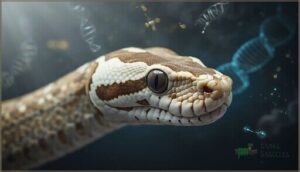
When you breed for specific colors and patterns, you’re also shuffling genes that can carry unintended consequences. Some morphs come with neurological issues, skeletal problems, or reproductive challenges that affect quality of life.
Let’s walk through the main genetic health concerns you need to understand before choosing or breeding a morph.
Neurological Disorders (Wobble Syndrome)
When your python’s head twists sideways or corkscrews during feeding, you’re witnessing wobble syndrome—a vestibular disorder rooted in inner ear abnormalities. Clinical imaging reveals that spider morphs consistently show widened semicircular canals and enlarged ampullae, directly causing balance disorders and neurological signs like tremors and impaired righting reflexes.
Recognizing neurological issues in your ball python:
- Head tilting, side-to-side movements, or corkscrewing that worsens with stress
- Reduced striking accuracy and difficulty coordinating prey capture
- Delayed or absent righting reflex when gently turned upside down
Skeletal Deformities and Physical Malformations
Certain genetic lines of pythons carry skeletal deformities that can be both seen and felt. Caramel Albino and homozygous Cinnamon or Black Pastel pythons often hatch with spinal kinking—vertebral malformations ranging from slight tail curvature to severe multi-segment distortion that displaces internal organs. Craniofacial deformities, such as “duckbill” snout flattening, appear in 8-Ball combinations, sometimes interfering with feeding.
| Morph Combination | Common Skeletal & Structural Abnormalities |
|---|---|
| Caramel Albino | Spinal kinking, vertebral malformations, rib cage abnormalities |
| Super Cinnamon / Super Black Pastel / 8-Ball | Craniofacial deformities (“duckbill”), spinal kinking, body proportion issues |
| BEL complex (Lesser × Butter) | Ocular anomalies (“bug eyes”), microphthalmia when combined with Piebald |
Palpate your hatchling’s spine gently—any deviation from a straight dorsal contour signals potential genetic disorders that may compromise long-term reptile health and wellness.
Fertility Issues in Specific Morphs
Reproductive failure haunts certain ball python morphs in ways that surprise even experienced keepers. Desert females face near-total infertility—clutches become entirely slugs or trigger fatal egg binding. Caramel Albino females show subfertility with reduced viable eggs. Lethal morphs like Super Champagne produce nonviable hatchlings, collapsing breeding strategies.
When selecting genetic mutations for reptile breeding and genetics projects, you must weigh these morph care challenges against aesthetic appeal to avoid devastating reproductive losses.
Inherited Eye and Skin Conditions
Ocular anomalies and skin lesions represent critical ball python morph health issues beyond neurological issues and skeletal deformities. Genetic mutations in pigment pathways and developmental genes produce visual impairment and compromised integument:
- Blue-eyed leucistic morphs (Super Lesser, Super Butter) exhibit “bug eyes”—enlarged globes prone to trauma and vision loss.
- Super dark morphs (Super Cinnamon, 8 Ball) show microphthalmia—abnormally small or absent eyes.
- Albino-complex morphs suffer extreme light sensitivity from reduced ocular melanin.
- Scaleless morphs experience frequent burns, abrasions, and shedding complications due to absent protective scales.
Prioritizing morph genetics and ocular health safeguards welfare.
High-Risk Ball Python Morphs
Not all ball python morphs carry the same level of risk, but certain genetic combinations consistently show troubling patterns you need to recognize. Some morphs present with neurological dysfunction, while others struggle with skin integrity or structural abnormalities that affect quality of life.
Let’s examine the specific morphs that raise the most significant health concerns and what you should watch for if you’re considering one.
Spider Morph and Associated Wobble
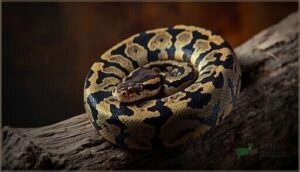
The Spider Morph stands as perhaps the most controversial variant in the ball python world. This single dominant mutation creates striking web-like patterns but simultaneously causes neurological signs known as Ball Python Wobble Syndrome.
Research has documented inner ear malformations in affected animals, producing symptoms ranging from mild head tremors to severe incoordination. The genetic basis links beauty directly to suffering, raising profound welfare impacts you can’t ignore.
Champagne and Wobble-Pattern Morphs
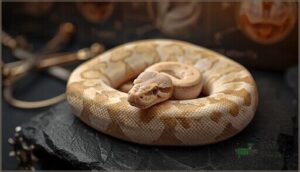
The Champagne Morph presents a diagnostic challenge you need to understand. Like Spider, this dominant mutation causes Wobble Syndrome through suspected inner ear malformation, though severity varies from subclinical tremors to pronounced feeding-time incoordination.
Champagne Genetics create additional risk when combined with other WobblePattern Morphs—particularly Spider, Hidden Gene Woma, or Spotnose.
Morph Inheritance means single-copy champagne Ball Python offspring inherit both beauty and Neurological Issues, demanding careful assessment of Ball Python Health and Breeding Ethics before any pairing decision.
Scaleless Morphs and Skin Health
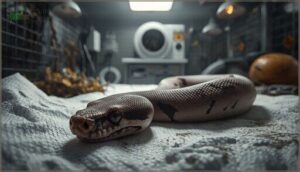
Scaleless Morphs lack the protective armor your Ball Python needs, exposing bare skin to constant injury risk. These recessive-mutation animals present serious Skin Health challenges that compromise Barrier Function and require specialized Morph Care.
- Skin Lesions from substrate friction and cage furnishings
- Thermal Burns from unprotected contact with heat sources
- Dysecdysis requiring elevated humidity protocols
- Hydration Issues increasing dehydration susceptibility
You’ll face persistent Reptile Health management demands with these high-maintenance Ball Python Health cases.
Super Fire and Super Spotnose Syndromes
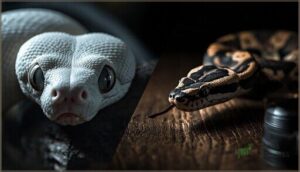
While scaleless animals demand intensive skin-focused management, Super Fire Morphs and Super Spotnose introduce distinct genetic vulnerabilities rooted in developmental disruption.
Super Fire, a BEL-complex homozygote, frequently produces Eye Abnormalities including macro-ophthalmia (“bug eyes”), increasing corneal injury risk.
Super Spotnose, viable alone but lethal when paired with other spider-complex genes, triggers severe Neurological Issues like wobble and disorientation.
Both challenge Morph Viability standards, demanding rigorous Breeding Ethics scrutiny and ongoing Genetic Research into Snake Health outcomes.
Blue-Eyed Leucistic and “Bug Eyes”
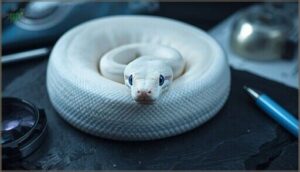
Blue-Eyed Leucistic (BEL) Morphs captivate enthusiasts with white scales and blue irides, but specific Leucistic Genetics combinations—particularly Super Lesser and Super Butter—often cause exophthalmos (“bug eyes”). These Ocular Abnormalities expose corneas to desiccation and trauma, demanding careful Exophthalmos Treatment and Bug Eye Prevention:
- Avoid Super Lesser × Super Lesser pairings
- Prefer Lesser × Mojave crosses for healthier BELs
- Monitor for corneal injury and adjust lighting intensity
Morph Welfare Impacts require veterinary oversight and responsible breeding to protect Snake Health.
Preventing and Managing Health Issues
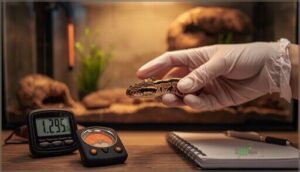
You can’t eliminate every genetic risk, but you can take meaningful steps to protect your ball python’s health and well-being. Prevention starts with informed decisions before you bring a snake home, and management relies on consistent care and vigilance once they’re in your care.
Here’s what you need to focus on to minimize health issues and catch problems early.
Responsible Breeding Practices
Ultimately, responsible breeding practices hinge on breeder accountability and rigorous health screening. You should select only clinically normal, behaviorally stable animals for your breeding program, avoiding high-risk morph pairings that propagate genetic disorders in animals.
Morph selection must prioritize animal welfare and ethics over aesthetics. Genetic testing, written health records, and consultation with experienced veterinarians guarantee breeding ethics align with documented reptile breeding and husbandry standards for ball python morphs.
Importance of Genetic Diversity
Maintaining genetic variation across your breeding population reduces the risk of genetic disorders in animals by preventing the fixation of harmful hereditary traits. Population dynamics studies confirm that inbred lines experience higher rates of neurological disorders, reproductive failure, and congenital defects.
Strategic breeding strategies—introducing unrelated bloodlines, avoiding sibling pairings, and documenting pedigrees—preserve allelic diversity and buffer against morph-linked health syndromes in ball python morphs, supporting both reptile morphology and genetics research and long-term conservation genetics goals.
Regular Veterinary Examinations
Even with attentive husbandry, annual or semiannual veterinary examinations remain your most reliable tool for detecting subclinical disease in ball pythons. Wellness visits allow your reptile veterinarian to perform thorough diagnostics—physical exams, fecal screening, bloodwork, and imaging—customized to your snake’s morph-specific risks and life stage. Though veterinary costs for exotic pets average $70–100 per visit, preventive care consistently reduces long-term expenses by catching neurological issues, infections, and metabolic disorders before they advance.
- Exam frequency should increase for high-risk morphs prone to wobble or skeletal anomalies
- Health monitoring establishes baseline weight and behavior records for tracking subtle changes
- Reptile diagnostics detect parasites, respiratory infections, and inclusion body disease early
- Veterinary medicine for ball python care includes oral exams to identify stomatitis before systemic illness
- Preventive care assists informed breeding decisions and individualized health plans for vulnerable animals
Recognizing Early Signs of Health Problems
Your ball python’s survival depends on spotting trouble early. Respiratory issues like wheezing, skin infections beginning as soft discolored scales, and feeding problems persisting beyond two weeks demand immediate attention. Watch for shedding difficulties, behavioral changes such as increased escape attempts, and neurological issues including subtle wobbling—these common health issues in snakes often progress rapidly without intervention.
| System | Early Warning Signs | Urgent Action Needed |
|---|---|---|
| Respiratory | Clicking sounds, mild open-mouth breathing | Bubbling nostrils, severe lethargy |
| Integumentary | Dull skin between sheds, retained eye caps | Reddened scales, visible ulceration |
| Digestive | Two-week appetite loss, weight decline | Regurgitation, skeletal deformities visible |
| Behavioral | Excessive hiding, increased soaking | Persistent unresponsiveness, seizures |
Ethical and Welfare Considerations
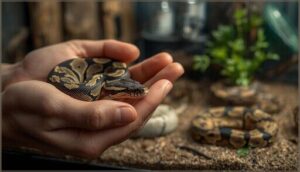
Breeding ball pythons with known genetic health risks isn’t just a technical question—it’s an ethical one that directly affects the animals in your care. You need to weigh the appeal of certain morphs against the real suffering some of these snakes experience throughout their lives.
Breeding ball pythons with known genetic defects is an ethical choice, not just a technical one—morph appeal must be weighed against real animal suffering
Let’s examine the key welfare debates, practical steps you can take to prioritize animal health, and where responsible morph breeding is headed.
Debates on Breeding High-Risk Morphs
Should you continue breeding morphs that guarantee neurological defects? The debate intensified after the International Herpetological Society banned spider morph sales in 2018, prompting questions about breeding ethics and morph regulation across the reptile community.
Some hobbyists worry that restricting high-risk ball python morphs might trigger broader regulations, yet welfare advocates argue that prioritizing appearance over quality of life contradicts responsible ownership principles and genetic testing recommendations essential for animal welfare.
Promoting Animal Welfare in The Hobby
You can advance the entire hobby by modeling responsible ownership and advocating for welfare education. Support rescues through adoption rather than impulse purchases, share accurate reptile care guidance online, and prioritize ethical breeding over appearance.
When you emphasize health issues in your community, you contribute to broader reptile conservation efforts and normalize animal welfare as the standard for pet ownership and responsibility.
Future Directions in Ball Python Morph Care
You’ll see the field moving toward genetic testing before pairing morphs, screening for harmful alleles that underlie wobble or skeletal defects. Progressive breeding will prioritize longevity and neurological soundness over pure aesthetics.
Enriched housing with UV, climbing structures, and substrate will become standard, not optional. Health screening, transparent lineage records, and sustainable practices will define responsible morph care and veterinary care for exotic pets going forward.
Frequently Asked Questions (FAQs)
Can ball pythons live together in one tank?
While you could technically house two ball pythons together with careful enclosure design and space, cohabitation risks outweigh any perceived benefit.
Chronic stress, disease transmission, feeding competition, and diagnostic complications make single housing the safer standard.
How often should I feed my ball python?
Feed hatchlings every 5–7 days, juveniles every 7–10 days, and adults every 10–21 days based on body condition.
Adjust meal frequency using body weight tracking to prevent obesity while supporting healthy growth rates throughout your snake’s life.
What humidity level prevents respiratory infections best?
Many keepers miss this: wild ball pythons breathe air near saturation nightly. Your enclosure needs 60–70% humidity consistently to prevent respiratory infection—don’t let it drop below that threshold.
Do ball pythons need UVB lighting for health?
Ball pythons don’t require UVB lighting for calcium metabolism when fed whole prey, but low-level UVB (UVI 0–0) promotes natural behaviors, circadian rhythms, and overall welfare in properly enriched enclosures.
How can I tell if my python is dehydrated?
Studies show dehydrated reptiles lose approximately 10% of body mass in days. You’ll notice wrinkled, sagging skin with reduced elasticity, sunken eyes, incomplete sheds, decreased appetite, lethargy, and yellow-orange urates instead of white—all requiring immediate humidity adjustments.
Conclusion
Your snake’s beauty shouldn’t be a genetic burden disguised as aesthetic appeal. When evaluating ball python morph health concerns, remember that vibrant patterns mean nothing if they come with tremors, deformities, or chronic suffering.
The most responsible choice isn’t always the most visually striking—it’s the one that prioritizes neurological stability, structural integrity, and long-term welfare.
Choose morphs backed by evidence, not hype, and you’ll build a relationship founded on thriving health rather than managing preventable complications.
- https://pmc.ncbi.nlm.nih.gov/articles/PMC9377635/
- https://pubmed.ncbi.nlm.nih.gov/36008042/
- https://www.biorxiv.org/content/10.1101/2022.03.24.485672.full
- https://community.morphmarket.com/t/morph-issues-ball-pythons/114
- https://www.petco.com/content/petco/PetcoStore/en_US/pet-services/resource-center/caresheets/ball-python.html