This site is supported by our readers. We may earn a commission, at no cost to you, if you purchase through links.

A 900-gram female locked with an enthusiastic male doesn’t mean much if she’s underweight and unready. Breed her too soon and you’re rolling dice with failed ovulation, thin clutches, or worse. I’ve seen it happen to breeders who skipped the basics chasing a new morph.
Breeding ball python snakes rewards patience more than luck. Weight thresholds, vet screenings, lineage tracking, none of it’s optional if you want healthy clutches year after year.
Get the fundamentals locked in now, and the rest, from pairing to hatchling care, falls into place.
Table Of Contents
- Key Takeaways
- Prepare Healthy Ball Pythons for Breeding
- Cycle Temperature, Humidity, and Lighting
- Introduce and Pair Ball Pythons Safely
- Monitor Ovulation and Egg Laying
- Incubate Eggs and Raise Hatchlings
- Frequently Asked Questions (FAQs)
- How easy is it to breed ball pythons?
- How many babies do ball pythons have at once?
- Do ball pythons need a male to reproduce?
- How long do ball pythons take to mate?
- What morphs should beginners avoid breeding together?
- How long between breeding attempts for females?
- When do ball pythons reach sexual maturity?
- What causes egg binding in female pythons?
- How to prevent inbreeding in small collections?
- How long do ball pythons live in captivity?
- Conclusion
Key Takeaways
- Don’t rush a pairing based on weight alone—males need 800-1,500 g and 2-3 years, while females need 1,200-1,500 g and 3-4 years, since breeding too soon risks failed ovulation and thin clutches.
- Run pre-breeding vet screening (PCR for Nidovirus and Cryptosporidiosis, bloodwork, fecal floatation) and track lineage to avoid inbreeding, since skipping these steps is what tanks hatch rates for first-timers.
- Trigger breeding behavior by gradually cycling temperature, humidity, and light over several weeks—dropping daytime temps 6-10°F and shifting photoperiod toward 14 hours—rather than forcing sudden changes that stress your snakes.
- Once a lock happens, watch for ovulation swelling and the milky-eyed pre-lay shed (28-35 days out), then keep incubation locked at 88-90°F and 65-70% humidity so your clutch hatches in that 50-60 day window.
Prepare Healthy Ball Pythons for Breeding
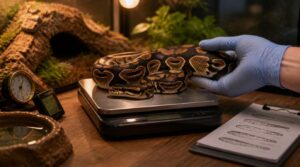
Breeding success starts long before any pairing happens. Your snakes need to hit real benchmarks—weight, health, genetics—before you even think about introductions. Here’s what to check off first.
If you’re aiming for particular morphs, understanding how to breed ball pythons for specific traits can help you pick pairings that actually get you there.
Confirm Breeding Age and Weight
Before anything else, get honest about age and weight, because weight matters more than age here. Males hit readiness around 2-3 years, minimum 800 g, ideal 900-1,500 g. Females need 3-4 years and 1,200-1,500 g.
Confirm growth history with your breeder’s records. Rushing an underweight female risks failed ovulation and thin clutches.
Schedule Pre-Breeding Veterinary Screening
Weight’s confirmed, so book the vet. A full exam covers body condition, respiratory check, and oral cavity. Insist on PCR screening for Nidovirus ($25-60) and Cryptosporidiosis, plus fecal floatation.
Baseline bloodwork matters too, hematology and biochemistry panels catch issues before they wreck a clutch. Positive Nidovirus means lifelong quarantine. Cheap insurance against a ruined season.
Review Feeding and Health History
Bloodwork’s clean? Good. Now pull the paper trail. Check feeding frequency logs, hatchling-to-adult intervals, any refusals and what caused them.
Review weight monitoring records for slow growth or unexplained loss over 10%. Cross-reference nutrition assessment notes and prior parasite screening results.
No red flags in twelve months means she’s ready. Past litters, vet visits, illness history, all of it shapes this call.
Proper feeding frequency is essential for healthy development and breeding readiness in ball pythons, as stated in the ball python feeding guide.
Track Lineage and Genetic Traits
Clean history in hand, now check the genetic history behind her. Line breeding without records is just guessing.
Lineage tracking tools like Cltch map full family trees and flag inbreeding risk automatically. Pair that with genetic morph testing (shed-based, definitive) and allele interaction charts before locking in any morph genetics decisions. Record keeping isn’t optional here.
Avoid Inbreeding and Risky Pairings
Once lineage’s mapped, run an inbreeding risk assessment before locking anything in. Skip pairs within two generations, no exceptions.
Relatedness DNA testing catches what pedigrees miss. Favor an outcross pairing strategy over aggressive line breeding, since diversity beats convenience.
That’s ethical genetic planning: protecting immune strength and hatch viability across every breeding pair you build for the season ahead.
Cycle Temperature, Humidity, and Lighting

Your snakes are healthy and at breeding weight—now it’s time to trick their bodies into thinking winter’s coming. Ball pythons breed on cues, not calendars, so your thermostat and light timer do a lot of the heavy lifting here. Here’s exactly how to set up that gradient, drop those temps, and dial in the rest.
Establish Safe Temperature Gradients
Get the thermal zone setup right, or nothing downstream works. Aim for 88 to 92°F basking and 78 to 82°F on the cool end, checked with three thermometers placed at different heights.
Shield ceramic emitters, thermostat every heat mat, and never park a hide directly under a heat source. Recalibrate seasonally, since ambient room temps shift and drag your gradient with them.
Begin Seasonal Temperature Cycling
October kicks off the real work. Start dropping daytime temps 6-10°F over 4-6 weeks, ramping gradually so your thermal gradient shifts without shocking anyone’s system.
Program your thermostat to handle the ramp automatically. Consistency beats guesswork here. Watch ambient humidity too, holding steady around 50-60% RH during this cooler phase keeps respiratory issues off your radar entirely.
Manage Nighttime Temperature Drops
Nights make or break the cycle. Keep drops to 2-5°F below daytime basking, never below 72°F.
- Calibrate thermostats weekly
- Watch cool zone stability
- Use ceramic heat emitters, no light
- Check temps twice nightly
Night temp stability protects fertility. Sudden swings stress snakes and stall follicle development, so steady gradients matter more than flawlessness.
Adjust The Breeding Photoperiod
Light drives the whole cycle, not just heat. Shift photoperiod gradually, 15-30 minutes daily, moving from 12/12 baseline toward 14 hours light.
For a full walkthrough of timing photoperiods alongside temperature, moisture, and lay box prep, see this snake breeding lighting and setup guide.
Pair longer days with warm basking temps for pheromone signaling. Sudden 4-6 hour jumps trigger stress and skipped locks. When winding down, reduce light the same gradual way to protect breeding chemistry.
Maintain Stable Humidity Levels
Humidity’s the quiet variable breeders overlook. Target 50-60% year-round, spiking to 70-80% pre-lay.
Place your digital hygrometer at snake height, not near vents. Screened lids improve airflow; damp cypress mulch at 2-4 inches stabilizes microclimates without trapping stagnant air. Check substrate depth weekly, adjust ventilation before humidity drifts outside your target window.
Introduce and Pair Ball Pythons Safely
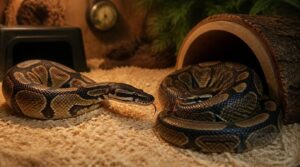
Once your snakes are cycled and conditioned, pairing time is where the real work begins. This is the stage where patience and observation matter more than anything else. Here’s what to watch for, step by step.
Confirm Each Snake’s Sex
Before pairing anyone, confirm sex with certainty, not guesswork.
Cloacal probing by an experienced handler reveals hemipene depth reliably. Popping works too, briefly everting hemipenes in males. Visual tail exams help: males run longer, thicker, with hemipenal bulges near the vent.
DNA testing via blood or shed settles inconclusive cases fast. Vets offer probing, popping, or ultrasound. Accuracy improves with age, so confirm sex before hitting weight minimums.
Recognize Courtship and Successful Locks
Once sex is confirmed, watch behavior. Males circle slowly, tongue-flicking to gauge interest, then tap or nudge the female’s sides. Receptive females stay still, sometimes lifting their heads instead of fleeing.
Lock initiation looks like the male lifting his anterior third, aligning ventrally. A successful lock lasts 5-40 minutes, both snakes motionless, breathing slowed, coiled together calmly.
Schedule Pairings and Recovery
A good lock earns rest. Give females 2 to 4 weeks recovery before the next session, males just 1 to 2 weeks.
- Cap pairings at 2-3 days weekly
- Run morning sessions, snakes are sharpest then
- Watch 30 minutes before and after
Log every date, participant, and outcome. Defensive behavior resets the clock, no exceptions.
Avoid Common Pairing Mistakes
Even solid recovery plans fall apart if the pairing itself was flawed from the start. Never breed mismatched seasonal cycles or unconfirmed sexes. Skip pairs with recent illness, retained fat, or parasites. Rotate partners only after quarantine and health checks clear them.
Document every combination, siblings included, to dodge repeated genetic pairings and inbreeding risk down the line.
Monitor Ovulation and Egg Laying
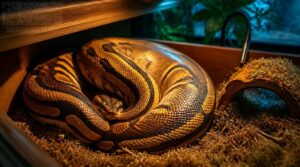
Once that lock’s done, your female’s body starts telling you a story — you just need to know how to read it. Follicles swell, colors shift, and that belly starts changing shape long before an egg ever shows up. Here’s what to watch for, step by step, from first flush to the moment she’s ready to lay.
Once the lock ends, a female’s body starts telling a story of swelling follicles and shifting color long before any egg appears
Recognize Follicles and Female Glow
Watch her water bowl behavior first. Increased time curled around it, paired with hugging the cool end, signals follicle development ramping up.
Then check for the glow, a yellow-to-orange ventral flush from rising hormones. Skin looks taut, fuller under midventral scales. She’ll eat less, stay stiller. That’s your cue ovulation’s approaching.
Identify Ovulation Swelling
That firm bulge two-thirds down her body? That’s ovulation swelling, and it’s your green light.
Palpate gently along the midline. You’ll feel:
- Rounded firmness, not squishy
- Peak swelling within 24-48 hours
- Gradual reduction pre-lay
Track progression daily. Unchanged swelling past a few days isn’t ovulatory, get her checked.
Track The Pre-Lay Shed
Once ovulation swelling fades, watch for the pre-lay shed, milky blue eyes and dull skin, roughly 28-35 days out. Her glow deepens now.
Keep humidity locked at 60-70%, offer a snug nesting tub, and skip handling. She’ll go sedentary, seeking tight hides.
Shed marks your countdown, eggs usually follow within one to two weeks.
Estimate Clutch Size
So how many eggs should you expect? Most clutches land between 4 and 10, with 6 to 8 eggs typical under solid conditions.
Heavier females past 1,500 g, good hydration, and calcium-rich feeding push counts higher. Genetic lineage matters too, some lines run 8-10 consistently.
Weigh each egg during collection for a real baseline from now on.
Prevent and Recognize Egg Binding
Egg binding turns deadly fast, so know the signs. Palpate gently for firm, asymmetric masses low in the body, and watch for straining without progress past 24-48 hours.
Warm soaks (85-89°F) plus a moist laying box often ease passage.
- Straining without eggs
- Food refusal
- Panting
- Vent discharge
- Lethargy
Call your vet immediately.
Incubate Eggs and Raise Hatchlings
Your female just laid a clutch — now the real precision work starts. Every step from here, from egg placement to that first hatchling meal, runs on tight margins. Here’s exactly what you need to get right, in order.
Collect and Position Eggs Safely
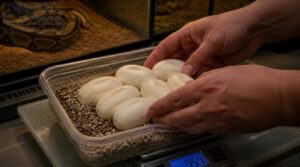
Speed matters here. Collect eggs right after laying, gently cradling the clutch to prevent rolling, and tare-zero your scale for accurate weights.
Position eggs on their side, air cell up, in a stable tray with even spacing.
| Step | Action |
|---|---|
| Timing | Collect promptly |
| Handling | Cradle gently |
| Orientation | Air cell up |
| Spacing | Even, no stacking |
| Cushioning | Humidity-safe substrate |
Candle Eggs for Fertility
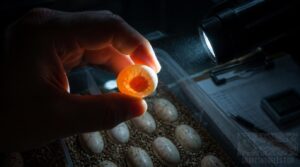
Once eggs are weighed and settled, grab a bright flashlight and darken the room. Around day four, hold the light near the shell. Fertile eggs show fine vein networks; infertile ones look clear or yellow, no embryo visible.
Mark each egg, log results, and pull nonviable slugs so they don’t risk the healthy clutch.
Control Incubator Temperature and Humidity
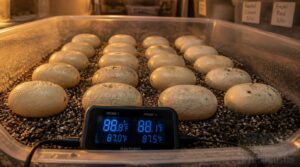
Once fertile eggs are sorted, thermal stability control becomes your job. Set the incubator to 88-90°F ±0.5°F, humidity at 65-70%, using damp vermiculite-perlite.
- Steady heat protects fragile embryos
- Proper humidity prevents dehydration
- Dual sensors catch drift early
- Alarms flag danger fast
- Calibration keeps readings honest
Space eggs 1 cm apart. Check sensor placement near the egg mass, not just ambient air.
Monitor Hatching and Clutch Outcomes
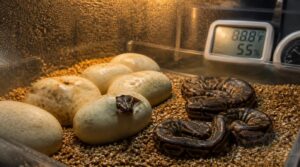
Once conditions hold steady, the countdown begins. Hatching usually arrives 50-60 days post-lay, though humidity swings can shift that window by days.
Track clutch outcomes methodically: log hatch counts against your original 4-10 egg estimate, weigh each hatchling on emergence, and flag any stragglers. Consistent monitoring catches problems early, before they become losses you can’t recover from.
House and Feed Hatchlings
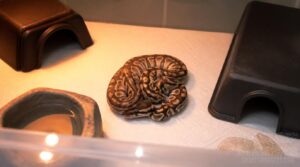
Once hatchlings emerge, house each in a 20-30 L tub with paper towel substrate, two hides, and shallow water. Keep gradients at 78-88°F.
Wait for the first shed (7-10 days), then one more week before offering pinkies sized 1.0-1.5x the snake’s width. Feed weekly, monitor closely, and quarantine separately.
Frequently Asked Questions (FAQs)
How easy is it to breed ball pythons?
Don’t buy the "set and forget" myth. Success hinges on correct weights (900g males, 1,500g females), proper cycling, and patient ovulation monitoring, not luck. First-timers who skip screening see higher clutch failure rates.
How many babies do ball pythons have at once?
Expect 3 to 11 eggs per clutch, usually 5 to Female weight and condition drive the count, most above 1,500 g. A few slugs are normal; hatch rate runs 75-90% under solid incubation humidity.
Do ball pythons need a male to reproduce?
Usually, yes. But nature has surprises. Females can store sperm for years, and rare cases show parthenogenesis, virgin births producing female-only clones. Still, for reliable clutches, pair a healthy male and female through confirmed locking and copulation.
How long do ball pythons take to mate?
Courtship starts fast, often within minutes, and locks run 5 to 40 minutes. Pairing sessions last 24 to 72 hours with rotation. Full mating, from lock to laying, spans 35 to 50 days.
What morphs should beginners avoid breeding together?
Don’t put all your eggs in one basket." Skip Spider, Champagne, and Leopard combos, wobble syndrome shows fast. Black pastel and cinnamon pairings tank hatchling viability too, protect genetic diversity and long-term vigor.
How long between breeding attempts for females?
Give her 6 to 8 weeks minimum post-lay, then track weight gain toward 1,400–1,800 g before rebreeding. Lost condition? Push recovery to 8–12 months. Her follicle cycle waits until body condition and weight recovery period fully rebound.
When do ball pythons reach sexual maturity?
Ready to slither into the mating game? A male ball python hits breeding weight (~700g) around 16-18 months; females need 1,500g, often taking 2-3 years. Weight matters more than age, always.
What causes egg binding in female pythons?
Egg binding strikes when a gravid female can’t push eggs out, usually from low humidity, calcium deficiency, unstable temperature, oversized eggs, or hormonal timing problems disrupting normal oviduct contractions during her gravid timeline.
How to prevent inbreeding in small collections?
Keep a breeding log tracking lineage back three generations, rotate sires across dams each season, and bring in unrelated stock every few generations. This keeps relatedness low and protects long-term genetic diversity in your collection.
How long do ball pythons live in captivity?
Forget goldfish math, your ball python might outlive your car loan, your marriage, or your mortgage. With solid husbandry, expect 20 to 30 years, sometimes 40-plus, and rare vets confirm cases past
Conclusion
Funny enough, the breeders who lose clutches and the ones who lock down perfect hatch rates follow the same calendar. They just respect different numbers on it. That’s the real secret behind breeding ball python snakes: nothing mystical, just discipline applied to weight, temperature, and timing. Hit your thresholds. Track your lineage. Trust the process instead of rushing it. Do that, and next season’s clutch won’t be luck. It’ll be proof you learned the craft.