This site is supported by our readers. We may earn a commission, at no cost to you, if you purchase through links.

One day your female shows a sudden bulge behind her midsection, and the clock starts. Roughly 30 days later, she lays a clutch that represents months of pairing, quarantine, and follicle monitoring. All of that work funnels into a single make-or-break window: ball python breeding egg incubation.
Get temperature, humidity, and egg handling right, and you’ll watch healthy hatchlings pip through their shells at day 55 or so. Get it wrong, and a fuzzy patch of Aspergillus can wipe out the clutch in days. This guide walks you through every step, from pairing your breeders to feeding your first hatchlings.
Table Of Contents
- Key Takeaways
- Prepare and Pair Healthy Ball Pythons for Breeding
- Recognize Gravidity and Prepare for Egg Laying
- Collect, Mark, and Candle Ball Python Eggs Safely
- Set Up The Incubator at 88–90°F and 90–100% Humidity
- Monitor Eggs Through Hatching and Early Hatchling Care
- Frequently Asked Questions (FAQs)
- How easy is it to breed ball pythons?
- How to tell if a ball python is ready to breed?
- Can you reuse incubation substrate between clutches?
- How do you dispose of infertile eggs?
- What causes egg binding in female pythons?
- Do ball python morphs affect incubation success?
- Should you incubate eggs if female abandons?
- Can ball python eggs be incubated without an incubator?
- How long can eggs survive outside ideal conditions?
- When should a second clutch be expected after breeding?
- Conclusion
Key Takeaways
- Successful incubation hinges on a stable environment: hold eggs at 88–90°F and 90–100% humidity on a suspended tray above water-saturated perlite, with redundant calibrated probes at egg level to catch hot spots and drift.
- Timing is everything: collect eggs within 2–4 hours of laying, mark the top so they’re never flipped, candle at 7–14 days to confirm red veins (viability) versus yellow slug-like infertiles, and remove any moldy eggs immediately.
- The countdown starts at ovulation—a sudden one-day mid-body bulge—with the pre-lay shed about 30 days later and hatching around day 55, so prepare a humid lay box with damp sphagnum moss before the shed, not after.
- Patience beats intervention at hatch: pipping to emergence takes 24–72 hours, and opening an egg too early can cost the whole clutch—only assist if a hatchling struggles past 4–6 hours, widening the pip slightly with a sterile blade while keeping membranes moist.
Prepare and Pair Healthy Ball Pythons for Breeding
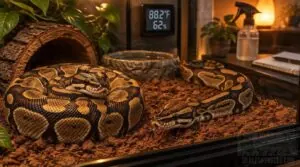
A successful clutch starts months before you ever pair your snakes. Confirm breeding readiness first: females should be 2–4 years old, weigh 1,200–1,800 grams, and show a healthy body condition with a normal shed history. Males need proven fertility or solid weight and age. Complete a full 90-day quarantine with two negative fecal checks, and get vet clearance for both animals.
For a full walkthrough of pairing, brumation, and egg care, this guide to breeding corn snakes for beginners covers each stage in detail.
Avoid pairing anything with chronic infections, mites, or poor body condition. Temperature cycling in temperate climates, dropping nighttime lows into the mid-70s°F, then warming again, stimulates fertility. Introduce pairs in short sessions, watch courtship behavior daily, and separate at any sign of aggression. Keep humidity management tight and diets stable for 6–8 weeks beforehand. Track lineage, keep inbreeding coefficients under 1%, and document every pairing. Solid preparation here protects clutch viability later.
Recognize Gravidity and Prepare for Egg Laying
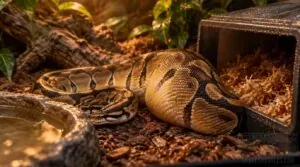
After pairing, watch for follicle development on ultrasound or via the pre-ovulation shed. You’ll notice mild appetite loss 1–2 weeks before ovulation, then a distinct mid-body swell. The ovulation itself looks dramatic: a sudden, one-day bulge behind the midsection. Don’t miss it; it’s your countdown clock.
Post-ovulation, expect a pre-lay shed roughly 30 days later, with eggs arriving 4–5 weeks after ovulation. Your gravid female will often refuse food for weeks and show increased nighttime activity as nesting behavior begins. Because gravid females sometimes breathe heavily from the strain of carrying eggs, it’s worth knowing the difference between normal exertion and actual respiratory distress.
If you’re still unsure whether she’s carrying eggs, this guide to telling if your female ball python is gravid walks through the physical and behavioral signs to check.
Prepare now. Set up a humid lay box with damp sphagnum moss before the pre-lay shed, not after. Keep her warm, hydrated, and undisturbed. Separate the male once you confirm ovulation; extended cohabitation during late gravidity risks stress and injury.
Collect, Mark, and Candle Ball Python Eggs Safely
The pre-lay shed is your cue. Once eggs arrive, start collecting ball python eggs within 2–4 hours; delays invite desiccation. Wear sterile gloves and use dedicated tools, never bare hands, because skin oils transfer fungi to the shell.
Our ball python breeding program guide walks through the full timeline from pre-lay shed to hatchling care.
For marking ball python eggs, apply a non-toxic, fade-resistant mark to the top third with a fine micro-marker. Keep the mark facing up; flipping kills the embryo. Log mother ID, date, and egg number in your clutch record.
Begin candling ball python eggs at 7–14 days post-laying. Use a high-intensity, cool light and tilt the marked end slightly higher. Egg viability testing reveals red veins and a healthy embryo; infertile egg identification shows yellow, sluggy mass with no vasculature. Candle over a tray, then reseal the incubator promptly.
Set Up The Incubator at 88–90°F and 90–100% Humidity
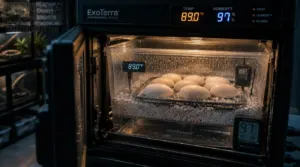
Candled, viable eggs go straight into a stable environment. Your incubator setup determines whether those red veins become hatchlings.
Target 88–90°F temperature with a thermostatically controlled heat source and over/under-temperature alarms. Place a calibrated digital probe at egg level, not on the shelf, and add a second probe on the opposite side to catch hot spots. Ambient room swings of more than 2–3°C will fight your thermostat, so stabilize the room first.
For humidity regulation in incubators, suspend eggs on a suspended egg tray above, never touching, a water reservoir or water-saturated perlite mixed 1:1 by weight. Seal the tub to hold 90–100 humidity; a secondary hygrometer near the egg cartons confirms local readings. Add adjustable vent plugs for gentle air exchange. If RH dips below 85%, mist the walls, not the eggs. Log readings hourly.
The same hygiene discipline that keeps a ball python’s water bowl safe—regular cleaning and replacement—applies to incubator water reservoirs, which can harbor bacteria just as quickly.
Monitor Eggs Through Hatching and Early Hatchling Care
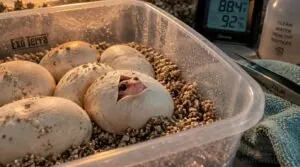
You’ve made it this far, so don’t drop the ball now. The final stretch demands daily vigilance: spotting mold and egg failure, handling temperature emergencies, and knowing when to assist a pip. Then comes the reward: setting up your hatchlings for a strong start. Here’s what to watch for, step by step.
Mold and Egg Failure
Mold kills fast. Fuzzy gray-green or lime-green fuzz means Aspergillus colonization, usually from condensation or damaged shells.
Candle at day 7–14 and remove moldy eggs immediately; discard any that smell foul or liquefy. Sanitize with a 1:10 bleach solution, then 70% ethanol. Watch neighbors closely, since one bad egg spreads spores.
Egg deflation is normal late-term, but sudden collapse signals failure.
Temperature and Humidity Emergencies
Act fast when your incubator drifts. Temperature control failures kill clutches quickly.
- Above 92°F for 2+ hours: expect deformities.
- Humidity below 85%: eggs desiccate within 6–12 hours.
- High temp plus low humidity levels: dehydration doubles.
- Power outage: restore your temperature range within 1–2 hours.
- Sensor drift: cross-check readings every 4–6 hours.
Check gaskets, verify temperature fluctuations hourly, and trust redundant sensors over single readings.
Pipping and Assisted Hatching
A breeder once opened an egg an hour early and lost the clutch; patience is your best instrument.
Opening an egg too early can cost an entire clutch, so patience is a breeder’s best instrument
During the pipping process, the neonate’s eggtooth breaches the air cell, then hatching takes 24–72 hours. Hold 88–90°F and 90–100% humidity.
If a hatchling struggles past 4–6 hours, assisted hatching techniques help: widen the pip 0.5–1.0 mm with a sterile blade. Egg cutting is entirely up to the breeder. Keep membranes moist with sterile saline, never torn, and minimize handling during hatching aftercare.
Post-hatch Housing and Feeding
Picture it: a palm-sized python slipping from its shell, tongue flicking, already probing the air. Your job now is simple.
Move it to a secure hatchling enclosure with vertical hides, a shallow water dish, and a heat gradient of 88–92°F warm side, 78–82°F cool side. Hold humidity at 60–70%.
Wait until after the first shed, then start hatchling feeding protocols: appropriately sized frozen/thawed mice, 2–3 times weekly. Weigh weekly, track defecation, and keep handling minimal.
Solid hatchling aftercare drives your hatchling survival rate.
Frequently Asked Questions (FAQs)
How easy is it to breed ball pythons?
Easier than most snakes. With healthy adults, proper breeding season preparation, and consistent temperature control, ball pythons breed readily. Success depends on patience, condition, and disciplined husbandry.
How to tell if a ball python is ready to breed?
You’ll know she’s ready when follicle development shows on ultrasound, she’s well-conditioned, and seasonal breeding triggers like cooler nights kick in. Pair only after 90–120 day quarantine, during her late winter-to-spring cycle.
Can you reuse incubation substrate between clutches?
You can, but you shouldn’t. Even sterilized vermiculite loses predictable water-holding capacity, and hidden mold or bacteria survive heat treatment. Fresh substrate preparation before each egg box preparation keeps your substrate moisture levels stable.
How do you dispose of infertile eggs?
Remove infertile eggs within 24–48 hours of laying. Double-bag them, freeze for 24 hours to kill bacteria, then trash them. Skip composting; it attracts pests. Wash hands thoroughly after egg handling.
What causes egg binding in female pythons?
Egg binding stems from calcium deficiency, dehydration, low temperatures disrupting muscle function, malformed or oversized eggs, oviduct infections, obesity, and stress. Prevent it with proper nutrition, hydration, temperature cycling, and suitable nesting sites for your gravid female.
If egg binding occurs, supportive care such as warm water soaks three times a day, along with diluted Pedialyte to maintain electrolyte and fluid balance, is essential for uterine health.
Do ball python morphs affect incubation success?
Mostly, no. Incubation success depends on your temperature control and humidity levels, not color genetics. But morph lethal alleles matter: Super Spider kills 100% of embryos, and Desert females produce no viable eggs.
Should you incubate eggs if female abandons?
Should you incubate eggs if female abandons? Absolutely, and quickly. Transfer viable eggs within 24 hours, verify egg viability by candling, then maintain 88–90°F and 90–100% humidity. Document the abandonment and reassess husbandry.
Can ball python eggs be incubated without an incubator?
Yes, but you’ll need a DIY incubator: a sealed tub with a thermostat-controlled heat mat, damp substrate, and daily venting. Without precise temperature control and humidity levels, expect mold, desiccation, and poor egg viability.
How long can eggs survive outside ideal conditions?
How long can eggs survive outside ideal conditions? Expect only 24–48 hours at room temperature. Below 50% humidity, dehydration kills viability in 6–12 hours. Above 28°C, embryonic mortality strikes within 12–24 hours.
When should a second clutch be expected after breeding?
Expect a second clutch roughly 4 to 8 weeks after the first clutch’s eggs are laid, though healthy, well-fed females sometimes range from 4 to 12 weeks depending on condition, temperature, and genetics.
Conclusion
Fifty-five days. That’s the average incubation stretch standing between your clutch and a box full of hatchlings, and every one of those days rewards consistency over cleverness.
Ball python breeding egg incubation isn’t complicated; it’s disciplined. Hold your temperatures steady, keep humidity near saturation, resist the urge to fuss with viable eggs, and let the shells do their work. Master that patience, and your first pips will feel less like luck and more like proof.