
This site is supported by our readers. We may earn a commission, at no cost to you, if you purchase through links.

A ball python can look perfectly healthy on a Monday and show the early signs of scale rot by Friday.
That’s how fast bacterial infections move once the conditions are right.
Most cases don’t start with neglect—they start with a humidity gauge that crept too high, a wet patch of substrate that sat too long, or a tiny scrape that went unnoticed.
Ball python scale rot causes are often hiding in plain sight, buried in the daily details of enclosure care.
Understanding what actually triggers this condition puts you in a far stronger position to stop it before it starts.
Table Of Contents
Key Takeaways
- Excessive humidity above 70% and temperatures outside the 75–92°F range are the two fastest ways to break down your ball python’s skin defenses and invite bacterial infection.
- Even a 1–2mm scrape from rough substrate or sharp décor can be colonized by bacteria like Pseudomonas within hours, so enclosure design matters as much as cleaning habits.
- Stress from over-handling, noise, or irregular light cycles suppresses your snake’s immune system, meaning a snake under chronic stress is already losing the fight before any wound appears.
- Over 70% of scale rot cases are preventable through consistent husbandry — keeping substrate dry, temperatures stable, and wounds treated promptly stops most infections before they start.
What is Scale Rot in Ball Pythons?
Scale rot is a bacterial skin infection that affects the scales of ball pythons, often starting as discoloration or small blisters before getting worse. Ball pythons are especially vulnerable because they spend a lot of time on the ground in direct contact with their enclosure environment.
A vet typically confirms the diagnosis when blisters and red ulcerations appear on the belly scales, which you can read more about in this guide to ball python scale rot and red discolouration.
Here’s what you need to know about what puts them at risk.
Overview of Scale Rot
Scale rot is a bacterial skin infection that can quietly take hold before you notice anything’s wrong. It starts with discoloration — your ball python’s ventral scales may darken or turn red, yellow, or even greenish-black.
Left unchecked, small blisters form, fill with pus, and damage deeper tissue. Early symptoms are easy to miss, but catching them fast shapes your treatment options. Think of it as a wound gone wrong — bacteria get in, and things escalate quickly.
unsanitary living conditions greatly increase the risk of scale rot.
Why Ball Pythons Are Susceptible
Ball pythons are ground dwellers, and that’s exactly what puts them at risk. Their ventral scales rest flat against substrate all day, trapping moisture and bacteria against the skin for hours. Ventral moisture exposure is constant, and thin scale structure — just 50–100 micrometers thick — offers little defense.
A weak immune response from stress or cold temperatures allows bacteria to find an easy opening.
Poor husbandry practices, unbalanced humidity levels, and captive stress factors all quietly stack the odds against your snake.
Their native western African habitat includes semi‑arboreal environments that can increase exposure to moisture.
Key Causes of Scale Rot

Scale rot doesn’t just appear out of nowhere — something in the environment is almost always driving it.
Most cases come down to a handful of conditions that are well within your control.
Here are the key causes you need to know.
Inappropriate Temperature Ranges
Temperature is one of the most overlooked causes of scale rot — and getting it wrong in either direction puts your snake at risk.
Here’s what poor temperature control actually does:
- Cold Zone Effects — Areas consistently below 75°F slow your snake’s metabolism, weakening its ability to fight off skin bacteria.
- Basking Spot Insufficiency — Without a proper 88–92°F warm zone, damp substrate never dries out, creating a bacterial breeding ground.
- Flat Gradient Issues — No temperature variation forces your snake to stay on cool, moist surfaces far too long.
- Overheating Burns — Spots above 95°F crack and dry scales, opening direct entry points for infection.
Temperature Fluctuation Stress compounds everything. Daily swings disrupt your snake’s skin barrier and stall healing. Consistent temperature control isn’t optional — it’s your first line of scale rot prevention and treatment.
Excessive Humidity Levels
Just as cold temperatures break down your snake’s defenses, excessive moisture does the same — only faster. When humidity climbs above 70%, skin softening begins within hours, making scales easy targets for bacterial proliferation. Poor ventilation traps that moisture, encouraging mold growth in the substrate.
| Humidity Level | Effect on Ball Python |
|---|---|
| Below 40% | Incomplete sheds, scale gaps |
| 50–60% | Ideal for health and wellness |
| Above 70% | Skin softening, moisture retention risk |
| Consistently high | Rapid scale rot progression |
Keep humidity between 50–60% with steady airflow.
Poor Cage Hygiene
Think of your snake’s enclosure like a kitchen — leave dirty dishes long enough, and bacteria take over.
Regular cleanings are the backbone of keeping your snake healthy — these snake disease prevention and enclosure hygiene tips walk you through exactly what to clean and how often.
Feces, uneaten prey, and soiled substrate create hidden moisture pockets where harmful bacteria multiply quickly.
Unwashed decor and improper disinfection between cleanings allow pathogens to linger, and cross‑contamination from your hands can introduce new bacteria each time you reach inside.
Clogged drainage traps waste fluids, keeping the substrate damp even when temperature control is on point.
That constant wetness is what turns a small nick into a full bacterial infection — and eventually, scale rot.
Substrate and Enclosure Issues
What goes inside the enclosure matters just as much as how often you clean it. Moisture‑retaining substrate like soaked coconut fiber or wet sphagnum moss stays damp for days, especially when ventilation flow patterns are poor and temperature stays too low to dry things out. Chemical off‑gassing materials — cedar or pine — irritate tissue directly. Substrate particle size matters too: coarse chunks scrape belly scales repeatedly, creating open wounds.
- Hide box material choice: Wood absorbs urine and stays wet inside, feeding bacteria
- Enclosure size: Cramped spaces trap humidity and make full cleaning nearly impossible
- Substrate depth: Deep, damp layers hold moisture close to your snake’s skin
Right substrate. Right humidity. Right temperature. That combination protects your python more than anything else.
Trauma and Skin Damage
Even a small cut can open the door to serious bacterial infections. Sharp décor hazards — broken hides, chipped rocks, or poorly secured climbing branch injuries — slice through scales and expose raw tissue underneath.
Water bowl trauma happens when bowls tip and drag the snake across rough surfaces.
Improper handling adds pressure sores to the mix.
| Injury Source | Scale Rot Risk |
|---|---|
| Sharp décor hazards | Immediate scale punctures |
| Climbing branch injuries | Pressure necrosis along ribs |
| Water bowl trauma | Scale tears, skin infections |
Good snake care and smart husbandry practices eliminate most of these risks entirely.
How Dirty Enclosures Lead to Infection
A dirty enclosure doesn’t just look bad — it actively works against your snake’s health.
Waste, old substrate, and moisture create the perfect environment for harmful bacteria and fungi to thrive. Here’s what’s actually happening inside a neglected tank.
Bacterial and Fungal Growth in Waste
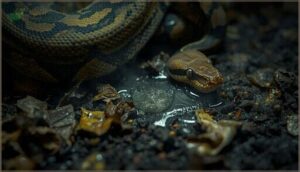
Waste left in your ball python’s enclosure isn’t just unpleasant — it’s a factory for infection. Bacteria like Pseudomonas and Aeromonas multiply rapidly in feces and uneaten food, forming biofilm that resists basic cleaning. Pathogen synergy between bacteria and fungi amplifies the damage, with lesions spreading up to 2–3 mm daily. Poor husbandry practices turn environmental factors against your snake quickly.
Watch for these warning signs of bacterial and fungal infections:
- Discolored or raised ventral scales
- Pus-filled blisters appearing near waste contact points
- A sharp ammonia smell signaling dangerous ammonia toxicity
High waste moisture levels accelerate spore dispersal from fungi like Aspergillus, seeding scale rot before you notice anything visible.
Effects of Soiled and Wet Substrate
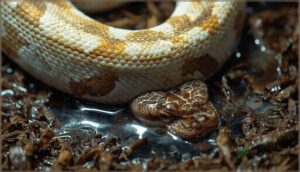
Soiled, wet substrate is one of the fastest paths to scale rot in a ball python. When bedding stays damp, normal white belly scales can darken to deep brown within a week. That’s discoloration progression happening in real time. Blister formation follows closely — clear fluid pockets appear on the ventral surface within 3–5 days of exposure, then fill with pus as bacterial infections take hold.
Watch for these early warning signs:
- Yellowish belly scales from soiled moisture contact
- Raised 2–5mm blisters clustering along the underside
- Skin softening where scales feel mushy or rough
- Reduced movement and appetite — behavioral impact from pain
- Infection spread reaching 2–3cm daily along the belly
Importance of Regular Cleaning

Think of your enclosure as a living space — let it get dirty, and bacteria move in quickly. Daily spot cleaning removes feces, shed skin, and uneaten food before pathogens multiply. Weekly bleach disinfection cuts bacterial load by roughly 90%. Replace substrate monthly to eliminate deep colonies that survive surface cleaning.
| Task | Frequency | Why It Matters |
|---|---|---|
| Spot cleaning | Daily | Stops bacterial growth early |
| Bleach disinfection | Weekly | Kills 99% of residual germs |
| Substrate replacement | Monthly | Removes deep pathogen colonies |
Always maintain enclosure dryness and follow a hand hygiene protocol before and after handling. These steps are your frontline disease prevention.
Role of Humidity and Temperature

Humidity and temperature aren’t just comfort settings — they’re the difference between a healthy snake and a sick one.
Get either wrong, and your ball python’s immune system starts to crack under the pressure. Here’s what you need to know about each factor and how it affects your snake’s health.
Ideal Humidity for Ball Pythons
For your ball python, keeping humidity between 60 and 80 percent is the foundation of good reptile care and maintenance.
A humidity gradient design helps — the warm side stays around 50 to 60 percent, while the cool side reaches 70 percent. Use these tools and habits to stay on track:
- Calibrate your hygrometer monthly for accurate monitoring tools calibration
- Practice moss hide maintenance by replacing sphagnum moss weekly
- Make seasonal humidity adjustments during shedding, boosting levels to 80 percent
- Follow humidifier usage tips — mist evenings, not mornings
Substrate choice also affects humidity and directly impacts ball python health and wellness.
Dangers of High or Low Temperatures
Temperature works hand in hand with humidity to protect your ball python’s skin.
Too cold — below 75°F — triggers cold-induced immunosuppression, slowing metabolism and letting bacterial proliferation take hold in damp substrate.
Too hot — above 92°F — causes heat-induced burns that crack the scale barrier open.
Thermal gradient failure means your snake can’t escape either extreme, making scale rot almost inevitable.
Impact on Immune System and Shedding
Getting temperature wrong doesn’t just stress your ball python — it quietly dismantles its ability to fight back. Cortisol immunosuppression kicks in when temperatures fluctuate chronically, blunting immune cell activity and leaving bacterial infections unopposed on damaged scales.
Poor husbandry practices also disrupt shedding frequency decline, trapping retained shed infections under fragile skin layers.
- White blood cells struggle to contain early scale rot
- Warm, moist pockets create for bacteria
- Shedding frequency decline signals the body is under real strain
- Systemic septicemia can result from unchecked bacterial infections
Physical Injuries and Scale Rot Risk
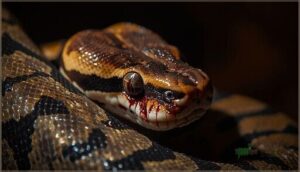
Scale rot doesn’t always start with bad husbandry — sometimes a small injury is all it takes. Broken or scraped scales create an open door for bacteria to move in fast.
physical risks you’ll want to watch closely.
Abrasive Substrate and Sharp Decor
Your substrate choice matters more than most owners realize. Rough bedding like coarse bark or compacted wood chips acts like sandpaper against your ball python’s belly scales — and those tiny abrasions become easy entry points for bacteria.
Sharp decor edges make it worse, turning a squeeze past a broken hide into an open wound. Pressure points form wherever the snake rests on uneven surfaces for hours.
Safe enclosure design — smooth hides, soft substrate, no jagged edges — is one of the simplest husbandry practices you can use to prevent scale rot.
Bites From Live Prey and Mites
Live prey don’t just resist — bite back. A rat can puncture your ball python’s skin up to 2 millimeters deep, and bacteria from rodent saliva starts multiplying in that wound within 24 hours.
Mites cause a different but equally serious problem: their bites lift scales and break the skin barrier, opening pathways for scale rot.
Switch to frozen-thawed feeders and check regularly for mites.
Small Wounds as Bacterial Entry Points
Even the smallest cut on your ball python is a doorway for bacteria. Micro‑abrasions caused by substrate contact can measure just 1–2 mm, but Pseudomonas can colonize those wounds within hours. Sharp edge punctures from broken hides or jagged seams go even deeper — up to 3 mm — and can contact contaminated flooring daily. Airflow‑induced friction cuts form silently on flanks in poorly ventilated enclosures. Vitamin‑deficiency skin weakness thins keratin, making tears more likely and slower to heal. Cold‑stress crack formation slows tissue repair, leaving wounds open longer.
Even a tiny scrape on your ball python’s belly can become a bacterial invasion within hours
Watch for these small wounds entry points in your ball python:
- Micro-abrasions from coarse bedding
- Sharp edge punctures from broken décor
- Friction cuts along the flanks
- Cracks from cold temperatures
- Tears worsened by nutritional deficiencies
Treat every injury promptly to stop scale rot and bacterial infections before they start.
Additional Risk Factors for Scale Rot

Humidity and temperature get a lot of attention, but a few other factors can quietly tip the scales toward infection.
Things like diet, stress, and how many snakes share a space matter more than most owners realize.
Here’s what else puts your ball python at risk.
Poor Nutrition and Vitamin Deficiencies
Nutrition and diet for ball pythons matter more than most owners realize.
A vitamin A deficiency weakens your snake’s skin barrier, making scales crack and bacteria slip right in. Vitamin C deficiency slows wound healing and leads to fluid-filled blisters — a direct path to scale rot.
Frozen prey nutrition also drops after six months of storage.
Rotate prey variety and add a monthly multivitamin supplement regimen to close those nutritional deficiencies before they become a reptile health issue.
Stress and Immune Suppression
Stress is one of the sneakiest scale rot causes in ball pythons — and it’s easy to miss. When your snake experiences chronic stress, corticosterone floods the bloodstream and shuts down white blood cell activity. That opens the door to infection. Four main triggers hurt reptile health this way:
- Handling Frequency — More than 2–3 sessions weekly suppresses immunity
- Temperature Fluctuations — Drops below 88°F slow bacterial clearance
- Noise Pollution — Vibrations raise stress hormones continuously
- Light Cycle Disruption — Irregular schedules impair shedding and skin repair
Transport stress compounds everything. Post-transport pythons need two full weeks before handling resumes.
Overcrowding and Poor Ventilation
Keeping two ball pythons in one tub might seem harmless, but crowd stress and space restriction quietly erode your snake’s defenses. Airflow stagnation lets humidity climb past 80%, and moisture accumulation soaks the substrate — creating ideal conditions for scale rot.
Poor ventilation design means pathogens never flush out.
| Environmental Factor | Poor Conditions | Reptile Health Issues |
|---|---|---|
| Airflow | Stagnant, trapped air | Humidity spikes, bacterial growth |
| Waste removal | Ammonia buildup | Respiratory irritation, stress |
| Disease control | Limited air exchange | Faster pathogen spread |
Frequently Asked Questions (FAQs)
Can scale rot spread from snake to snake?
Think of bacteria like hitchhikers — they’ll ride anything moving between enclosures. Scale rot isn’t airborne, but it spreads through shared tools, contaminated water baths, and mite vectors.
Quarantine protocols and tool disinfection stop cross-infection fast.
How long does scale rot take to heal?
Mild cases of scale rot clear up in 3 to 6 weeks. Severe infections need 2 to 3 months. Each shed cycle helps reveal new, healthy skin underneath.
What antibiotics treat severe scale rot cases?
Severe scale rot isn’t just a skin problem — it can turn septic fast.
Enrofloxacin dosing at 5 mg/kg daily, a ceftazidime regimen every 48 hours, or silver sulfadiazine used topically are your vet’s main tools.
Is scale rot painful for ball pythons?
Yes, scale rot is painful for ball pythons. Bacterial invasion activates pain nociceptors, triggering clear pain behavior — biting, lethargy, and appetite loss.
Veterinary medicine confirms handling stress worsens discomfort, so minimize contact until healed.
Can scale rot cause permanent scarring?
Scarring mechanisms depend on how deep the bacterial infection goes.
Mild dermatitis caught early heals cleanly within two to three months. Severe scale rot left untreated can leave permanent long-term skin effects across ventral scales.
Can scale rot spread to other snakes?
Scale rot can spread to other snakes through direct contact, shared equipment, and mite vectors.
Strong quarantine protocols and strict handler contamination prevention stop transmission pathways before infection reaches your healthy snakes.
Can scale rot cause permanent scale damage?
Sadly, shedding won’t fix everything. Scale rot can leave permanent scarring mechanisms and dermal fibrosis beneath new growth.
Regeneration limits mean deformed snake scales may never fully recover, making this bacterial infection one of the costliest snake health issues.
Conclusion
over 70% of scale rot cases are entirely preventable with consistent husbandry alone.
That number should feel encouraging, not discouraging.
Most ball python scale rot causes come down to small, fixable habits—substrate that stays too wet, temperatures that drift, wounds that go unnoticed.
Your snake can’t tell you something’s wrong until it already is.
But you can build an environment where problems rarely get that far.
- https://www.wilbanksreptiles.com/blogs/ball-pythons/common-ball-python-health-issues-and-how-to-prevent-them
- https://www.wildlifedemonstrations.com/post/scale-rot-how-to-identify-and-treat
- https://vetericyn.com/blogs/vetericyn/how-to-treat-scale-rot-on-reptiles
- https://vcahospitals.com/know-your-pet/snakes-diseases
- https://creative.science/education/yikes-is-this-scale-rot-on-my-pet-python-how-do-i-treat-ball-python-scale-rot