
This site is supported by our readers. We may earn a commission, at no cost to you, if you purchase through links.
A wild-type ball python costs maybe $50. A standard morph? You’re looking at $200 to $500. But here’s where it gets wild—designer ball python snake morphs can fetch $10,000 or more, and some rare combos have sold for six figures.
This price explosion isn’t random. It’s driven by genetics. Back in the 1990s, breeders discovered they could selectively breed these snakes for specific colors and patterns that reliably pass to offspring. That discovery cracked open a whole new world.
Today, there are literally thousands of morph combinations—from electric yellows to pure white ghosts to black-and-white pandas. Understanding how these morphs work isn’t just fascinating. It’s your ticket to appreciating why your friend’s snake cost as much as a used car.
Table Of Contents
- Key Takeaways
- What Are Ball Python Morphs?
- Genetic Basics of Ball Python Morphs
- Common Ball Python Morph Types
- Rare and Designer Ball Python Morphs
- Breeding and Caring for Morph Ball Pythons
- Frequently Asked Questions (FAQs)
- What is the rarest morph of ball python?
- What is the best ball python morph?
- Is a 75 gallon tank too big for a ball python?
- What permits are needed for breeding morphs?
- How do morphs affect ball python lifespan?
- Which morphs have feeding difficulties or preferences?
- What temperature requirements do different morphs need?
- How do you quarantine new morph purchases?
- Do certain morphs have specific health problems?
- How much do rare ball python morphs cost?
- Conclusion
Key Takeaways
- Ball python morphs are genetic variations that breeders selectively reproduce to create thousands of color and pattern combinations, with prices ranging from $50 for wild types to six figures for rare designer morphs.
- Understanding the three inheritance types—dominant (shows with one gene copy), co-dominant (creates “super” forms with two copies), and recessive (needs both copies to express)—lets you predict breeding outcomes with precision.
- Popular foundation morphs like Albino, Pastel, and Piebald serve as building blocks for designer combinations, while rare morphs like Scaleless and multi-gene stacks push breeding boundaries despite requiring specialized care.
- Ethical breeding demands prioritizing snake health over aesthetics by avoiding lines with genetic issues like Spider wobble or Desert egg-binding problems, since responsible practices trump profit and trends.
What Are Ball Python Morphs?
Ball pythons weren’t always the living works of art you see today. In the wild, they sport earthy browns and tans—beautiful, but nothing like the electric yellows, pure whites, and jet blacks that breeders have unlocked through selective breeding.
Let’s break down what morphs actually are, how they’re different from their wild cousins, and why keepers can’t get enough of them.
These genetic variations create stunning patterns and colors that don’t exist in nature, and understanding how co-dominant traits express themselves helps breeders predict what their clutches will look like.
Definition and History of Morphs
A morph is a heritable twist in color, pattern, or scale type that breeds true in offspring. Ball python morphs exploded in the 1990s when breeders discovered they could lock in gorgeous genetic variations through selective breeding. Before that? Most captive ball pythons looked identical to their wild cousins.
- Morphs aren’t accidents—they’re strategic genetic variations isolated and reproduced through controlled pairings
- Early pioneers like axanthic and albino lines became the foundation for today’s thousands of designer combinations
- Species development took off once hobbyists realized specific traits could be predictably passed down
- Color patterns and genetics work together, giving you total control over creating your perfect snake
Understanding the genetic basis of morphs requires careful consideration of methodological rigor in scientific studies.
How Morphs Differ From Wild Types
Wild types blend into their natural habitat with earthy browns and blacks. Morphs? You’re flipping the script. These intentional genetic variations give you vibrant yellows, stark whites, and patterns that pop—phenotype differences you control through captive breeding.
Wild type traits follow nature’s playbook; morph expression follows yours. That genetic variation means predictable color morphs when you pair the right ball python genetics together. Understanding the basics of language patterns can help in identifying and creating new morphs.
Why Morphs Are Popular Among Keepers
You’re chasing aesthetic value—and morphs deliver. Visual appeal drives collector demand: striking patterns and bold colors dominate online culture, where your “banana” or “piebald” ball python morphs rack up thousands of views.
Corn snake morphs showcase a similar breeding strategy, where combining recessive and dominant traits creates visually stunning patterns that rival ball python varieties.
Market trends show reptile enthusiasts paying premium prices for designer combinations, treating pet snake ownership as both hobby and investment.
Snake morphs turn heads, spark conversations, and let you own living art that reflects your taste.
Genetic Basics of Ball Python Morphs
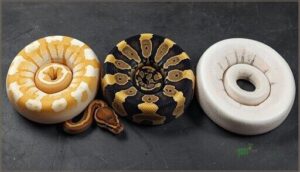
Understanding ball python genetics isn’t as complicated as it sounds. Once you know the three main trait types—dominant, co-dominant, and recessive—you can predict what babies you’ll get from any pairing.
Some morphs like spider or scaleless also come with unique behavioral and care considerations that go beyond basic genetics.
Let’s break down how these genes work and why they matter for your breeding projects.
Understanding dominant, recessive, and co-dominant inheritance patterns is essential when you breed ball python morphs to predict offspring outcomes.
Dominant, Co-Dominant, and Recessive Traits
Understanding genetics unlocks your breeding power. Dominant traits like Pinstripe show up with just one copy of the gene—you’ll see the same thin-striped pattern whether your ball python carries one or two.
Co-dominant morphs like Pastel and Mojave are different. They create a basic look with one copy but produce stunning “super” forms when you stack two copies together.
Recessive traits like Albino and Piebald need both copies to visually express—that’s why breeding two hets gives you roughly 25% visual offspring.
Inheritance and Alleles in Ball Pythons
Allele interactions determine how your ball python’s morphs express themselves. When breeding, you’re manipulating gene dosage—one copy creates hets, two copies reveal visuals.
Most ball python breeders near you work with these common morphs because they’re proven, marketable, and easier to pair for predictable outcomes.
Inheritance patterns follow predictable paths: dominant traits need just one allele, recessive traits demand two.
Understanding genetic expression gives you control over outcomes. Master morph genetics and you’ll predict exactly which dominant traits and recessive traits appear in your clutches.
Common Ball Python Morph Types
Now that you’ve got the genetics down, let’s talk about the morphs you’ll actually see at expos and online. These are the foundational morphs that launched the ball python breeding world—and they’re still incredibly popular today.
You’ll find everything from glowing yellows to pure whites, each with its own striking visual punch.
Albino, Piebald, and Pastel Morphs
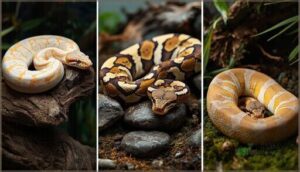
These three morphs dominate the ball python trade and reveal countless designer combinations. They’re your gateway to understanding morph genetics and breeding techniques:
- Albino – Bright yellow and white with stunning red eyes, this recessive morph eliminates all melanin for maximum contrast.
- Piebald – Random white patches interrupt normal color patterns in this recessive beauty, with expression varying wildly between individuals.
- Pastel – The co-dominant favorite brightens any snake with golden tones and reduced browns, creating a super form when doubled.
Pastel topped market listings in 2020, while Piebald ranked second. You’ll see these base morphs everywhere because they stack beautifully with other genes.
Mojave, Axanthic, and Enchi Morphs
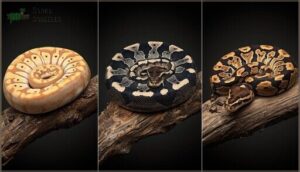
Level up your morph game with these three powerhouses that breeders can’t resist mixing into designer combos:
| Morph | Genetics | Key Features | Origin |
|---|---|---|---|
| Mojave | Co-dominant | Split keyholes, vibrant yellows, white belly | Proven ~2000 by The Snake Keeper |
| Axanthic | Recessive | Black/grey/white only, no yellows or reds | VPI line established 1990 |
| Enchi | Co-dominant | Golden sides, bronze alien heads, cleaner patterns | West Africa Enchi region |
Mojave patterns feature those signature teardrops with single black dots—you’ll spot them instantly. Axanthic genetics block yellow pigments completely, creating grayscale stunners. Enchi colors intensify with age, getting more golden after each shed!
Visual Traits and Pattern Variations
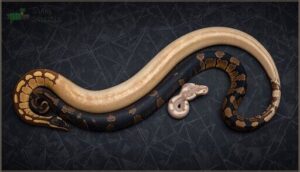
Pattern genetics create visual magic you can actually see and touch on your snake. Watch for these five pattern variations across different color morphs:
- Striped morphs like Pinstripe run continuous lines down the spine with clean sides
- Blushing lightens saddle centers in Pastels and combo morphs
- Head markings range from bold stamps to nearly invisible
- Belly patterns show everything from clean white to heavy checkering
- High white expression in Piebalds creates dramatic unpigmented patches
Scale variations and morph combinations reveal endless designer possibilities!
Rare and Designer Ball Python Morphs
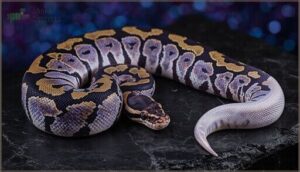
You’ve seen the basics, but now it’s time to meet the showstoppers. These rare and designer morphs push the boundaries of what’s possible with selective breeding.
From snakes with no scales to mind-bending color combos, you’re about to discover the most sought-after morphs in the hobby.
Scaleless, White, and Stormtrooper Morphs
You’ve seen standard morphs—now meet the rebels. Scaleless Ball Python Morphs ditch dorsal scales entirely, giving you smooth, ultra-sensitive skin that demands precise humidity control and gentle handling. White morphs strip out melanin for ghostly, pattern-free bodies.
Stormtrooper Breeding combines high-contrast black markings on white bases—think designer armor.
These Designer Morphs require expert Scaleless Care, but their jaw-dropping looks? Worth every bit of effort.
Bumblebee, Panda Pied, and Monsoon Morphs
Bumblebee Ball Python Morphs combine Spider and Pastel genetics for electric yellow stripes—but here’s the catch: all Spider-complex snakes carry wobble, a neurological issue ranging from mild head tremors to feeding struggles.
Panda Pied Morphs pair Super Black Pastel with recessive Piebald for bold black-and-white contrast.
Monsoon Morphs, a 2013 recessive discovery, deliver chaotic rain-pattern speckling.
Master these Breeding Strategies, and you’ll access premium Snake Morphs and Genetics—just respect Morph Health realities first.
Morph Combinations and New Trends
Multi-gene stacks dominate today’s Morph Market—you’re witnessing Ball Python genetics evolve through strategic hybridization techniques. Breeders combine Axanthic-Enchi for contrast fireworks, while scaleless crosses expand morph variations despite health trade-offs. Here’s what’s reshaping breeding trends:
- Bumblebee-Monsoon pairings (12+ documented 2023–2025)
- Panda Pied crosses yielding new color patterns
- Stormtrooper-themed stacks (3 competition entries)
- Axanthic-Enchi backcrosses with measured colorimetric shifts
- Scaleless integrations across diverse snake morphs and genetics
Genetic research fuels progress—but responsibility determines longevity in these morph combinations.
Breeding and Caring for Morph Ball Pythons
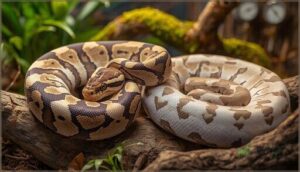
Breeding morphs isn’t just about pairing pretty snakes together. You need solid genetics knowledge, proper care setups, and a real commitment to ethical practices.
Let’s break down the breeding techniques, care adjustments, and health considerations that’ll set you up for success.
Selective Breeding Techniques
Smart breeding strategies start with genetic testing—you’ll identify known morph alleles before pairing your snakes. Heritability analysis helps with morph prediction, so you’re not just guessing outcomes.
Plan matings that optimize desired traits while tracking lineage across generations. Backcrossing stabilizes those gorgeous patterns you’re after.
Master allele identification and you’ll control exactly what your split-litter crosses produce!
Care Considerations for Different Morphs
Most morphs share basic Ball Python Care and Snake Husbandry needs, but some demand special attention:
- Wobble-prone morphs (Spider, Champagne) need stress-free Morph Safety setups—skip tall climbing structures to prevent dangerous falls
- Albinos thrive with dimmer lighting during Snake Handling and feeding
- Scaleless morphs require spotless substrates and precise humidity for Reptile Health and Wellness
- Super combos need vigilant Health Monitoring for skeletal issues
- All morphs benefit from consistent Environmental Enrichment and proper Morph Nutrition
Reptile Care and Husbandry gets customized—Animal Care adjusts to genetics!
Ethical and Health Factors in Morph Breeding
Beyond husbandry, Morph Welfare demands serious Breeding Ethics. Spider and Champagne genetics carry genetic risks—wobble isn’t cosmetic; it’s neurological. Desert females often die from egg binding. Health impacts matter more than aesthetics.
Breeding ethics demand prioritizing snake health over aesthetics—wobble and egg binding aren’t cosmetic flaws, they’re serious genetic risks
| Morph Issue | Responsible Practices |
|---|---|
| Spider wobble | Don’t breed affected lines |
| Desert females | Avoid breeding entirely |
| Super combos | Screen for deformities |
Herpetology and Animal Welfare beat profit. Always prioritize Reptile Breeding health over Ball Python Morphs trends!
Frequently Asked Questions (FAQs)
What is the rarest morph of ball python?
The hardest morphs to find sometimes aren’t visibly special—scaleless ball pythons top the list, requiring precise genetic testing and snake breeding to confirm their ultra-rare recessive traits.
What is the best ball python morph?
You’ll find the “best” ball python morphs depend on your goals—Banana and Blue Eyed Leucistic blend stunning color pattern genetics with strong pet owner preferences, while breeders target morph investment strategies balancing market trends and ethics.
Is a 75 gallon tank too big for a ball python?
You can absolutely use a 75-gallon tank for your ball python—just make sure you nail those temperature gradients and add enough hides.
Space utilization and proper humidity management matter way more than size alone.
What permits are needed for breeding morphs?
You’ll need breeding licenses and reptile permits depending on your state’s wildlife regulations. Some areas require animal registration for commercial licensing, while others demand facility inspections before you start producing gorgeous ball python genetics.
How do morphs affect ball python lifespan?
Does picking a flashy morph mean sacrificing years with your pet? Not really—morphs don’t directly shorten ball python lifespan.
Proper husbandry, breeding ethics, and health screening matter way more than genetics alone.
Which morphs have feeding difficulties or preferences?
Most ball python morphs eat just fine, but spider and bumblebee combos sometimes wobble during strikes. Scaleless snakes occasionally skip meals during sheds. Axanthic Mojaves can be picky as babies.
What temperature requirements do different morphs need?
Consistency is key. All morphs thrive with identical ambient temperatures: a warm side at 88-92°F and a cool side at 78-80°F. Proper thermal gradients with reliable heat sources trump genetics every time.
How do you quarantine new morph purchases?
Set up a separate enclosure with paper substrate for at least 30 days. Watch for mites, respiratory issues, and dehydration. Follow strict biosecurity measures—dedicated tools prevent cross-contamination with your collection.
Do certain morphs have specific health problems?
Spider morphs struggle with neurological wobble. Scaleless lines face skin infections more easily. Super forms like Super Cinnamon often die in the egg. Some piebalds show spinal kinks too.
How much do rare ball python morphs cost?
Rare breed costs can blow your mind—exotic pet pricing ranges from $500 for basic combos to $50,000+ for jaw-dropping designer lines.
Market demand and morph price factors drive snake investment values sky-high!
Conclusion
Think ball python snake morphs are just about flashy looks? Think again. You’re tapping into a genetic toolkit that’s still evolving—new combinations drop every breeding season.
Whether you’re chasing that electric banana pastel or a pure ivory ghost, you’re not collecting pets. You’re curating living art.
Master the genetics, respect the ethics, and you’ll discover possibilities most keepers never see. Your next snake could rewrite the whole game.
- https://www.researchgate.net/publication/339918500_Searching_for_snakes_ball_python_hunting_in_southern_Togo_West_Africa
- https://www.9news.com.au/world/snake-with-smiley-faces/d121de50-5fa5-4d98-8839-c5d59e35dcb9
- http://basicgenetics.ansci.cornell.edu/lethal_alleles.php?section=mratios
- https://www.youtube.com/watch?v=hlkabXX3KVs
- https://www.pitt.edu/~dash/snake.html