This site is supported by our readers. We may earn a commission, at no cost to you, if you purchase through links.

Your snake’s eyes turn a strange, milky blue—and if you didn’t know better, you’d assume something was wrong.
That cloudy gaze isn’t a health crisis; it’s one of the most fascinating biological events in reptile care.
Blue phase snake shedding marks a precise window in the ecdysis cycle, when lymphatic fluid floods between old and new skin layers, temporarily robbing your snake of clear vision and triggering a cascade of behavioral shifts.
Knowing what drives this phase—and how to support your snake through it—separates keepers who get clean, complete sheds from those who don’t.
Table Of Contents
- Key Takeaways
- What is The Blue Phase in Snake Shedding?
- Recognizing Blue Phase Shedding Signs
- Stages of Snake Shedding and Timeline
- Creating an Ideal Shedding Environment
- Common Blue Phase Shedding Problems
- Frequently Asked Questions (FAQs)
- How long after blue do snakes shed?
- What is the blue phase of shedding?
- How does diet affect shedding frequency and quality?
- Can stress trigger premature or irregular shedding cycles?
- Do different snake species shed at different rates?
- How do I safely handle my snake post-shed?
- What role does age play in shedding duration?
- Conclusion
Key Takeaways
- The blue phase isn’t a health scare — it’s lymphatic fluid separating old from new skin, temporarily clouding your snake’s eyes and triggering natural hiding and appetite loss for roughly 2–4 days.
- Keeping humidity between 70–80% and maintaining a proper temperature gradient (72–90°F) is the single biggest factor in whether your snake sheds cleanly or ends up with retained eye caps.
- Your snake isn’t fully blind during the blue phase — it still navigates using heat sensing and chemical detection, but you should still avoid handling it to prevent unnecessary stress during this vulnerable window.
- If the blue phase stretches past 10 days, your snake refuses food for more than two weeks post-shed, or you spot retained eye caps after the old skin comes off, those are your cues to call a vet.
What is The Blue Phase in Snake Shedding?
If you’ve noticed your snake’s eyes turning a milky blue-gray, you’re witnessing one of the most fascinating stages of the shedding cycle.
This shift typically happens around days 7–10 of the cycle, and you can check out pre-shed symptoms in snakes to know exactly what else to watch for.
The blue phase is a distinct biological window that tells you exactly where your snake is in the process — and what it needs from you right now.
Here’s what’s actually happening beneath the surface, why it matters, and what most owners get wrong about it.
Biological Purpose of The Blue Phase
The blue phase isn’t just a visual quirk — it’s ecdysis doing serious biological work. Lymphatic fluid separates old and new skin layers, enabling growth accommodation without adding new scales. That same fluid aids parasite removal by dislodging bacteria at the surface.
Meanwhile, vision impairment from cloudy eyes triggers a behavioral adaptation: your snake hides instinctively, protecting itself during this vulnerable window of skin regeneration and ocular health renewal. This aligns with the fact that snakes shed their skin regularly for growth and health.
Differences Between Blue Phase and Other Stages
Each shedding stage tells a different story. During the blue phase, cloudy eyes and skin fluid dynamics mark a clear visual shift — vision impairment peaks, appetite fluctuations intensify, and activity patterns slow noticeably.
The preshed phase shows subtler signs, while the clearing phase restores eyesight gradually.
Shedding duration averages 9–14 days total, with retained eye caps signaling problems only when the process stalls. The shedding cycle duration(https://www.beginnersnakes.com/snake-shedding-process-explained/) usually spans 7 to 14 days.
Common Myths About The Blue Phase
Once you understand the blue phase, myths and facts about snake shedding become easier to separate.
Handling myths suggest snakes are fine to pick up — they’re not.
Vision myths overstate blindness; your snake still navigates using heat and chemical senses.
Feeding myths, frequency myths, and even albino myths all distort the same truth: *leave your snake alone, and the process manages itself.
*
Recognizing Blue Phase Shedding Signs
Once your snake enters the blue phase, it sends out some pretty clear signals — you just need to know what to look for. These signs show up in how your snake looks and how it acts, often all at once. Here are the key indicators that tell you the blue phase has begun.
The eyes are usually your first clue — that distinctive cloudy look is explained well in this guide on milky eye caps in snakes.
Cloudy or Blue-Tinted Eyes
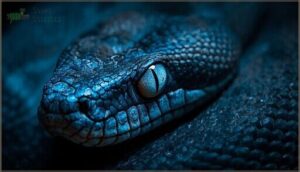
Those milky blue eyes aren’t a cause for alarm — they’re biology doing exactly what it should.
Eye fluid buildup between the old and new spectacle layers creates that signature cloudy tint, temporarily causing vision impairment that lasts roughly 5–9 days.
Watch for these preshedding signs:
- Symmetrical eye cloudiness in both eyes simultaneously
- Milky blue eyes appearing 1–3 days before clearing
- Defensive striking due to compromised sight
- Hiding behavior as your snake avoids perceived threats
Dull and Faded Skin Appearance
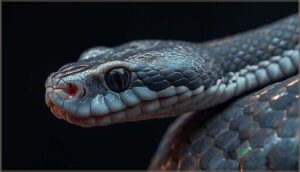
Your snake’s skin tells a story before the shed ever begins. Fluid accumulation between old and new layers triggers a color fading mechanism — vibrant patterns fade to dull, grayish tones, and scales lose their glossy sheen.
The belly pinkish tint is a classic pre‑shedding sign. These shedding timing indicators usually appear 1–2 weeks out, with scale texture shift peaking during the blue phase.
Changes in Behavior and Activity
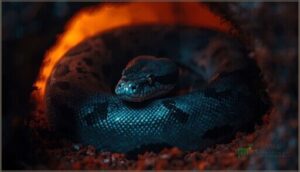
blue phase is like observing a completely different animal.
Lethargy increase is dramatic — activity drops by half as impaired vision forces a movement slowdown.
Hiding Frequency spikes to nearly 80% of the day, while appetite decline means most snakes refuse food entirely.
Irritability Spike peaks within the first two days, so reduced appetite and increased hiding are your clearest snake shedding signs to watch.
Stages of Snake Shedding and Timeline
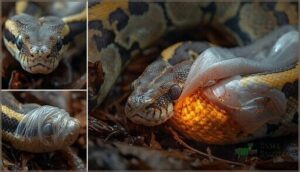
Shedding doesn’t happen all at once — it unfolds in distinct stages, each with its own timing and signals worth knowing.
Once you can read those stages, you’ll stop guessing and start responding with real confidence. Here’s how the whole process breaks down, from the earliest warning signs to the moment your snake finally slips free of its old skin.
Pre-Blue Phase Indicators
Before the in-blue stage arrives, your snake sends subtle signals worth catching early.
Fine skin wrinkles around the neck, a pink belly tint, and a noticeable appetite drop often appear days before eye clouding begins. These preshedding snake shedding signs and symptoms tell you to start your humidity adjustment now — preventing retained eye caps before they become a problem.
The Opaque or Blue Phase Explained
This is the moment everything changes. Fluid Accumulation beneath the scales — a mucus‑like secretion driving Scale Separation Mechanics — triggers the inblue stage, causing Eye Opacity Duration to span 2–4 days in ball pythons, longer in hognoses.
During this opaque phase, Feeding Appetite Decline and a Thermal Preference Shift toward warmer zones are classic snake shedding signs and symptoms across all snake shedding stages.
Post-Blue Phase and Actual Shedding
Once your snake’s eyes clear — that’s the clear phase — the clock is ticking. Within 1 to 3 days, actual ecdysis begins.
The old skin rolls backward like a sock, revealing vibrant new scales underneath: skin color restoration is almost immediate.
eye cap removal happens automatically. Expect an activity surge and feeding resumption within 48 hours.
Keep humidity fine‑tuned to prevent retained eye caps or incomplete sheds.
Creating an Ideal Shedding Environment

The blue phase is your snake’s most vulnerable window, and what you do with the enclosure during this time matters more than most keepers realize.
Getting the environment right isn’t complicated, but it does require attention to a few specific factors.
Here’s what to focus on to keep your snake comfortable and set up for a clean shed.
Optimal Humidity and Temperature
Think of your enclosure as a climate system, not just a box.
During the blue phase, humidity targets of 70–80% give your snake the moisture management it needs to loosen old skin effectively.
Pair that with a gradient balance — warm side at 86–90°F, cool side at 72–78°F — and consistent climate monitoring with a digital hygrometer ensures heat regulation stays dialed in.
Hydration and Shedding Aids
Humidity optimization sets the stage, but hydration is what carries your snake through the blue phase.
- Warm water soaks — 85–90°F for 20–30 minutes — softens skin and encourages drinking.
- Damp sphagnum moss in a hide maintains localized moisture around 80%.
- Rough surface aids like cork bark help loosen old scales naturally.
- Shedding sprays condition dry skin before preshedding signs escalate.
Terrarium Setup for Blue Phase Support
Your terrarium’s physical setup is what ties hydration and humidity together into a truly ideal shedding environment for snakes.
| Element | Specification |
|---|---|
| Cypress Substrate | 4–6 inches deep |
| Mossy Hide / Humidity Box | Moist sphagnum moss inside |
| Branch Textures | 1.2–1.8 cm diameter |
| Temperature Gradient | 72–90°F warm-to-cool range |
A proper shedding box with moist sphagnum moss, combined with Humidity Monitoring via digital hygrometers, gives your snake everything it needs to shed cleanly.
Common Blue Phase Shedding Problems
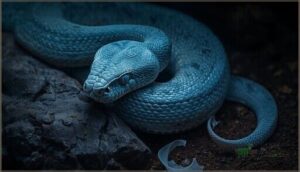
Even with the best setup, the blue phase can still throw a few curveballs your way. Some problems are subtle enough to miss until they’ve already caused real harm to your snake.
Here are the most common issues to watch for during this stage.
Incomplete Sheds and Retained Eye Caps
Incomplete sheds and retained eye caps are among the most frustrating outcomes of poor humidity hydration management.
When humidity requirements drop below 50 percent during the blue phase, the old spectacle won’t separate cleanly.
Eye cap inspection after every shed is non-negotiable — check for missing holes in the discarded skin.
Shedding aids like damp moss boxes and mite management reduce recurrence substantially.
Health Risks During The Blue Phase
Beyond retained eye caps and incomplete sheds, the blue phase brings real health risks you shouldn’t overlook.
Vision impairment leaves your snake practically blind for up to 14 days, while predation vulnerability spikes sharply in wild or multi-animal setups.
Nutritional deficits from fasting, infection risk from retained fluid, and handling stress all compound quietly — making this phase far more medically significant than it first appears.
The blue phase is far more medically significant than it appears, with fasting, fluid retention, and stress compounding silently
When to Seek Veterinary Assistance
Some shedding issues simply can’t wait.
Retained eye caps, a prolonged blue phase lasting beyond 10 days, respiratory distress with open-mouth breathing, appetite refusal stretching past two weeks post-shed, or repeated incomplete sheds — each signals that your snake’s health needs professional care.
Don’t second-guess these signs. Veterinary care for shedding snakes exists precisely for moments like these, so act early.
Frequently Asked Questions (FAQs)
How long after blue do snakes shed?
Most snakes shed 1 to 7 days after the blue phase clears. Species-specific timing and humidity impact this window — ball pythons average 3 to 5 days, while corn snakes often shed within 24 hours.
What is the blue phase of shedding?
The blue phase happens when fluid buildup separates old and new skin layers, temporarily clouding your snake’s eyes and causing vision impairment — a natural preshedding signal lasting roughly two to four days.
How does diet affect shedding frequency and quality?
What you feed your snake is half the battle. Protein balance, calcium levels, vitamin A, hydration sources, and fat content all directly shape shedding frequency and healthy shed quality.
Can stress trigger premature or irregular shedding cycles?
Yes—stress absolutely can.
Elevated corticosterone levels, handling frequency, and humidity fluctuations all accelerate shedding cycle acceleration, causing irregular patterns, aggression indicators, and shedding problems that compromise snake health and post-shedding care.
Do different snake species shed at different rates?
species growth cycles and age play a huge role.
Juveniles shed every 4–6 weeks, while adults average every 2–3 months.
Habitat influence and metabolic rate effects shape each snake’s unique shedding timeline considerably.
How do I safely handle my snake post-shed?
Wait at least 24 hours before handling. Use a gentle grip, keep short sessions under 15 minutes, prioritize hand washing, and watch stress signals closely — postshedding care sets the tone for recovery.
What role does age play in shedding duration?
Snake age directly shapes shedding duration. Hatchling Frequency peaks at every 2–4 weeks, while Adult Intervals stretch to months. Growth Rate Impact explains it all — slower growth, longer cycles.
Conclusion
What separates a confident keeper from a worried one? Understanding that blue phase snake shedding isn’t a warning sign—it’s a biological masterpiece unfolding on schedule.
That milky gaze signals your snake is building a brand-new skin beneath the old one, layer by layer.
Support the process with proper humidity, leave your snake undisturbed, and trust the cycle.
When that fresh, gleaming scale pattern finally emerges, you’ll know your care made the difference.
- https://enviroliteracy.org/animals/how-long-does-it-take-for-a-ball-python-to-shed-after-blue-eyes/
- https://www.iowadnr.gov/news-release/2015-08-25/why-do-snakes-shed-their-skin
- https://www.braeunerd.com/born-again-reptile-body-scrub-molting-shedding/
- https://www.oreateai.com/blog/the-fascinating-process-of-snake-skin-shedding/57a9237154150feceaa156a163f8d8d7
- https://pmc.ncbi.nlm.nih.gov/articles/PMC3655483/