
This site is supported by our readers. We may earn a commission, at no cost to you, if you purchase through links.

Most snake species mate in predictable windows, but boa constrictors defy that pattern—they can breed nearly year-round in captivity when conditions align. In the wild, rainfall and temperature shifts synchronize breeding, driving courtship activity up by 60–70% during wet months.
Understanding boa constrictor mating habits isn’t just academic curiosity; it’s the difference between failed attempts and healthy clutches. Captive breeding flips this script entirely, letting you manipulate environmental cues to trigger mating on your schedule.
Whether you’re a breeder refining your methods or a keeper considering your first pairing, knowing what actually initiates reproductive behavior—from temperature drops to humidity thresholds—gives you control over outcomes that would otherwise feel unpredictable.
Table Of Contents
- Key Takeaways
- Boa Constrictor Mating Season and Timing
- Age and Size Requirements for Breeding
- Pre-Breeding Health and Preparation
- Environmental Factors in Breeding Success
- Courtship and Mating Behaviors
- Reproductive Biology and Fertilization
- Conservation and Responsible Breeding Practices
- Frequently Asked Questions (FAQs)
- Conclusion
Key Takeaways
- Boa constrictors can breed nearly year-round in captivity when you manipulate environmental triggers like temperature drops (2–4°C), humidity levels (60–80%), and photoperiod adjustments, giving you control over timing that wild populations lack.
- Your breeding success hinges on meeting minimum maturity requirements—males need 3–4 years and 1,000–1,200 mm length, females require 3.5–4.5 years with body condition scores of 3.5–4.0—since rushing immature snakes cuts reproductive outcomes significantly.
- Environmental precision matters more than you’d expect: maintaining thermal gradients between 75–90°F, stable humidity at 60–75%, and gradual seasonal light shifts (12–14 hours daylight) can boost reproductive success by 10–25% in captive programs.
- Female boas store viable sperm for weeks to months after mating, enabling multiple fertilization opportunities and varied paternity within single clutches—a biological adaptation that dramatically improves breeding outcomes when you time pairings strategically.
Boa Constrictor Mating Season and Timing
Timing is everything regarding breeding boa constrictors. Whether you’re working with wild populations or captive animals, understanding when these snakes naturally mate—and what triggers that behavior—makes all the difference in your success.
Let’s look at how breeding seasons vary and what environmental factors you need to take into account.
Wild Vs. Captive Breeding Seasons
In the wild, boa constrictor breeding cycles follow seasonal shifts tied to rainfall and temperature—courtship behavior peaks during wet months, with activity surging 60–70%. Captive synchronization uses controlled environmental cues and photoperiod adjustments to trigger mating year-round, boosting reproductive adaptation by 25–40%. You’ll find regional timing varies, but understanding these patterns improves your snake breeding success.
Key breeding insights:
- Wild populations time mating rituals to prey abundance and favorable microclimates
- Captive programs achieve higher fecundity through optimized seasonal manipulation
- Extending breeding windows by 1–2 months enhances conception rates markedly
- Interannual variation can shift wild mating onset by 4–6 weeks
- Controlled regimes yield 10–25% increases in clutch frequency compared to natural cycles
Researchers often explore research study topics to better understand animal behavior and breeding patterns.
Environmental Triggers for Mating
Temperature fluctuations of 2–4°C around baseline trigger courtship behavior and mating rituals in boa constrictor breeding programs. Humidity levels between 60–80% and photoperiod changes—16 hours light, 8 hours dark—stimulate gonadal activity. Seasonal cues mimicking natural climate influence, especially temperature control above 26°C, reliably initiate reproductive readiness. These environmental triggers directly shape breeding success in captive populations.
Understanding the theme development process is essential for creating effective breeding programs.
Regional Differences in Mating Periods
Beyond environmental controls, you’ll notice striking geographic variance in boa constrictor breeding cycles. Climate effects shape mating rituals across their range:
- Coastal rainforest populations peak in January–February
- Savanna-adapted boas show later peaks around February–March
- Subtropical zones delay clutching until March versus January in tropical areas
These seasonal shifts reflect regional adaptation, making breeding tips less universal than you’d expect.
Age and Size Requirements for Breeding
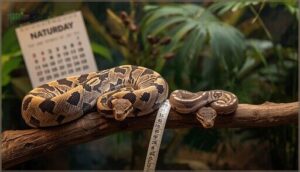
Breeding boa constrictors isn’t something you rush into—timing matters as much as the snakes themselves. Your animals need to hit certain benchmarks in both age and size before they’re physically ready for reproduction.
Let’s break down what those requirements look like and why they’re not just suggestions but genuine necessities for successful breeding.
Minimum Age for Males and Females
Before you jump into boa constrictor breeding, you need to hit specific age thresholds. Males typically reach reproductive readiness around 3–4 years when their snout-vent length reaches 1000–1200 mm. Females mature later—around 3.5–4.5 years—with similar size requirements. These maturity signs guarantee proper genetic diversity and breeding success. Growth monitoring helps you track reproductive readiness, making breeding preparation more predictable and effective.
| Sex | Minimum Age | Snout-Vent Length (SVL) |
|---|---|---|
| Male | 3–4 years | 1000–1200 mm |
| Female | 3.5–4.5 years | 1000–1200 mm |
| Peak Activity | Synchronized season | Adequate body condition required |
Importance of Body Condition
Your boa’s body condition directly shapes reproductive success. Females with a body condition score around 3.5–4.0 on a 5-point scale show ideal follicular development and clutch size. Poor scoring below 2.5 cuts breeding outcomes markedly.
Weight management through nutrition planning and conditioning strategies keeps your snakes healthy and ready. Regular body scoring catches problems early, improving boa constrictor breeding by 12–18% in controlled programs.
Growth Rates and Sexual Maturity
Patience defines successful boa constrictor breeding. Your juveniles grow 20–40 cm yearly until maturity, then slow considerably. Males generally reach reproductive readiness at 2–3 years and 1.0–1.3 meters, while females need 2.5–3.5 years and 1.3–1.5 meters to support viable clutches.
Key Growth Patterns and Maturation Thresholds:
- Juveniles gain 2.0–3.5 cm monthly in ideal conditions
- Females require body mass index above 0.75 for follicle development
- Males show increased spermatogenesis at 90–110% maintenance calories
- Cooler temperatures extend maturation by 6–18 months
- Size requirements guarantee clutch viability exceeds 80%
Pre-Breeding Health and Preparation
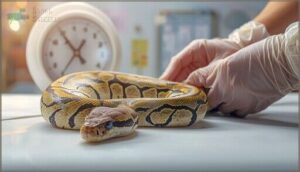
Before you even think about pairing your boas, you need to make sure they’re in top shape—think of it as getting athletes ready for competition.
A few smart health checks now can save you from heartbreak later when eggs fail or hatchlings struggle.
Let’s walk through the three key areas you should focus on to set your breeding pair up for success.
Veterinary Checkups and Parasite Prevention
Before you pair your boas, a veterinary checkup is your safety net. Sixty-eight percent of captive boas harbor intestinal parasites despite routine care, so fecal testing every 6–12 months cuts detection failures by 32%. Anthelmintic treatments guided by lab results succeed in over 78% of cases.
Pair testing with diagnostic imaging to catch hidden health issues—this boosts detection by 21% in breeding females.
Genetic Screening for Breeding Success
Managing genetic diversity with molecular markers can push hatchling viability up by 12–28% in breeding programs. DNA-based kinship matrices cut mean coancestry from 0.04–0.08 down to 0.01–0.03, preserving rare alleles above 85%.
Heritability analysis with multi-locus panels costs $150–$400 per breeder but delivers 5–15% savings across your program.
Genetic testing aids boa constrictor breeding by maintaining diversity and improving breeding tips for long-term success.
Nutrition and Conditioning of Breeders
You’ll see the best breeding results when your females maintain body condition scores between 3.5 and 4.5 out of 5—this correlates with 10–25% larger clutches.
Feeding strategies that deliver 2–3% of body mass daily during the pre-breeding window boost male spermatogenesis by 8–12%.
Calcium balance at 1.2–1.5:1 ratios reduces metabolic issues and improves fertilization by 5–9%, making dietary supplements and breeder nutrition core boa constrictor breeding techniques for reptile health and wellness.
Environmental Factors in Breeding Success

Getting the environment right can make or break your breeding success with boa constrictors. Temperature, humidity, and lighting all work together to trigger those natural reproductive behaviors you’re hoping to see.
Let’s look at the key environmental factors you’ll need to dial in before introducing your boas for breeding.
Optimal Temperature and Humidity Levels
Temperature control makes or breaks boa constrictor breeding success. Maintain a thermal gradient between 82°F and 90°F on the warm side, with cooler zones around 75°F to 79°F. Humidity levels should stay between 60% and 75% throughout the breeding season, supporting proper shedding and reproductive tract hydration.
Keep temperature fluctuations gradual—no more than 2–3°C daily—to mimic natural environmental cues your snakes recognize for mating.
Housing and Cage Setup for Mating
Once you’ve nailed temperature control and humidity levels, turn your attention to the enclosure itself. Aim for at least 3–4 feet by 2–3 feet of floor space per adult female, with vertical enrichment encouraging natural climbing during courtship.
Use smooth plastic or coated metal to prevent injury, add 2–4 inches of substrate for burrowing comfort, and install secure locks for escape prevention—vigorous mating attempts can test any cage’s integrity.
Photoperiod and Seasonal Adjustments
Beyond housing setup, you’ll want to manipulate light cycles and seasonal shifts to trigger breeding. Extend daylight to 12–14 hours with gradual dawn/dusk transitions—circadian rhythms matter. Combine this with temperature fluctuations (nighttime drops of 2–6°C) to advance follicular development by 1–3 weeks.
- Simulate natural photoperiod changes 4–8 weeks before breeding
- Use 11–12 hours of daylight for peak mating activity
- Pair daylight manipulation with thermal gradients
- Employ full-spectrum lighting for ideal hormonal responses
- Tailor protocols to your boa’s regional origin
This approach boosts reproductive success by 10–25% in captive programs.
Courtship and Mating Behaviors
Regarding breeding, boa constrictors don’t just mate on a whim—they follow specific behavioral patterns you’ll need to recognize and encourage. Understanding these courtship rituals gives you the insight to know when your snakes are ready and how to create conditions that support successful reproduction.
Let’s break down the key behaviors you’ll observe and the techniques that help stimulate mating activity.
Male Courtship Displays and Tactics

When you’re breeding boas, watch for your male’s powerful displays—he’ll use body postures, head movements, and tail-rattling to show stamina and court females. These courtship tactics can last 15–60 minutes per bout.
Larger, well-fed males show brighter visual signals and dominate the mating hierarchy. Some even emit low-frequency vocalizations during close encounters, speeding up successful copulation.
Female Receptivity and Follicle Development
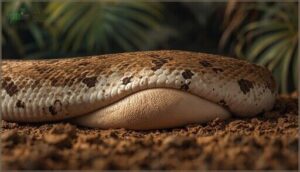
Once your male courts, you’ll notice female receptivity signals tied to follicle maturation—look for lower abdomen swelling and visible body contour changes. Ovarian cycles drive hormone regulation, with estrogen peaking as follicles reach 8–12 mm before ovulation.
These fertility indicators mean she’s ready for boa constrictor breeding. Track receptivity signals during this 2–3 week window, because proper timing separates successful snake breeding from missed opportunities and ensures healthy gravidity.
Stimulating and Monitoring Courtship

You’ll accelerate courtship triggers by fine-tuning your boa constrictor breeding setup with proven mating cues. Watch for these breeding enrichment strategies to improve pair bonding and reproductive health during snake breeding:
- Simulate seasonal photoperiod shifts—10–12 hour light cycles mimic natural courting behavior
- Maintain 85–90°F basking zones with appropriate humidity gradients
- Introduce male scent via substrate transfer before pairing
- Monitor tongue-flicking frequency and wrapping attempts during mating
- Separate pairs after 5–7 days, then reintroduce to stimulate renewed interest
These breeding tips support successful copulation while respecting animal welfare.
Reproductive Biology and Fertilization
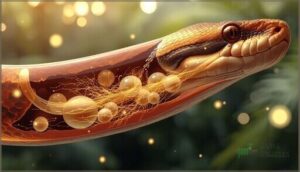
Once courtship succeeds and mating occurs, the real biological work begins inside the female’s body. Understanding how fertilization happens, what determines clutch size, and why timing varies so much will help you manage expectations during the breeding process.
Let’s break down the key reproductive mechanisms that turn successful mating into viable offspring.
Copulation Process and Sperm Transfer
During copulation, you’ll observe intromission mechanics lasting anywhere from 1.5 to 6 hours as the male engages both hemipenes to deliver millions of spermatozoa in a single transfer. Hemipene function involves spiny structures that stimulate the female’s cloaca, potentially triggering ovulation cues.
What’s striking about boa constrictor breeding is the female’s capacity for sperm storage—she can retain viable sperm for weeks, dramatically improving fertilization success across multiple mating opportunities and even enabling varied paternity within one clutch.
Female boa constrictors store viable sperm for weeks, enabling multiple fertilization opportunities and varied paternity within a single clutch
Fecundity and Clutch Size Variation
Your female’s size and condition fundamentally shape her reproductive output—you can expect clutches ranging from 6 to 20 eggs, with larger, healthier snakes producing markedly more. Fertility factors like body length correlate strongly (r ≈ 0.4–0.7) with total clutch size across snake breeding populations.
Maternal investment directly affects egg viability and clutch variation, especially when you maintain ideal nutrition and genetic diversity in your boa constrictor breeding program.
Delayed Oviposition and Environmental Influence
You’ll notice oviposition delays of 1–4 weeks when your temperature drops below 24°C or humidity falls under 60%—environmental stress directly disrupts reproductive timing in boa constrictor breeding.
Photoperiod influence matters too: abrupt light shifts can extend delays by 5–10 days.
Maintaining stable warmth (28–32°C), controlled humidity (75–85%), and gradual seasonal adjustments in snake breeding and reproduction programs reduces these delays markedly.
Conservation and Responsible Breeding Practices

Breeding boa constrictors isn’t just about pairing snakes and waiting for babies. If you’re serious about working with these animals, you need to think beyond your collection and consider the bigger picture.
Let’s look at three critical areas that separate responsible breeders from those just producing more snakes.
Maintaining Genetic Diversity in Captivity
You’ll want to prioritize genetic diversity in your captive breeding program to prevent inbreeding depression—a real threat that reduces clutch size and hatch success. Genetic testing helps you track hereditary traits and maintain population genetics across your breeding stock.
Diversity management isn’t optional; it’s essential for responsible breeding that mirrors conservation goals. By carefully selecting unrelated pairs, you’re protecting the long-term health of captive boa constrictor populations.
Health Risks Impacting Reproduction
Health Surveillance is your first line of defense against reproductive failures in Boa Constrictor Breeding. Parasite Control reduces endoparasitism by 50–70%, improving clutch success by 8–15%.
Disease Transmission through herpes-like viruses and mycotic infections can slash mating success by 5–10%. Reproductive Pathologies like follicular cysts cut clutch size by 20–30%, while meeting Metabolic Demands during gestation prevents the 4–9% rise in follicular resorption from dehydration or poor nutrition.
Conservation Status and Ethical Considerations
Boas carry Least Concern status globally, but regional declines from habitat loss and pet trade extraction demand targeted Wildlife Legislation and Conservation Efforts.
Ethical Breeding in captivity hinges on Genetic Diversity, avoiding founder effects and inbreeding. Habitat Preservation bolsters wild mating cycles, while Environmental Ethics guide Reptile Conservation against threats.
Your compliance with CITES, welfare standards, and studbook management directly advances Species Survival and Conservation—protecting populations for generations ahead.
Frequently Asked Questions (FAQs)
How long does boa constrictor copulation last?
The brief encounter might surprise you—copulation usually lasts 45 to 90 minutes in captivity, though some pairs extend beyond two hours. Wild boas often complete mating in under 60 minutes.
Can female boas store sperm for later?
Yes, female boa constrictors can store sperm in specialized oviduct tubules for six to twelve months, allowing fertilization during later ovulations without repeated mating—a vital adaptation in reproductive biology.
What sounds do boas make during mating?
During close contact, you might hear males produce soft hisses or brief rasping sounds—fleeting vocalizations lasting under two seconds.
These acoustic behaviors aren’t consistent across all pairs, so don’t expect reliable courtship signals through sound alone.
Do boas show aggression after mating occurs?
After mating, you’ll sometimes see aggression—around 12-28% of pairings show it. Males may guard females, while females often become defensive, especially near egg-laying, driven by post-mating stress and male competition.
How many times do boas mate yearly?
You’d think boas keep calendars—but no. Wild individuals usually mate once per breeding season, while captive boas under optimized conditions may engage in one to three annual reproduction cycles depending on health and environmental management.
Conclusion
Like calibrating a microscope to bring cells into focus, mastering boa constrictor mating habits sharpens your ability to anticipate reproductive outcomes rather than react to them.
You’ve now got the environmental levers—temperature drops, humidity spikes, photoperiod shifts—that convert guesswork into predictable results.
Apply these principles with precision, monitor your animals’ responses closely, and you’ll transform breeding from a hopeful experiment into a controlled process that consistently yields healthy offspring.
- https://www.science.gov/topicpages/i/identify+key+research
- https://reptilesmagazine.com/tips-for-breeding-boa-constrictors/
- https://virologyj.biomedcentral.com/articles/10.1186/s12985-023-02237-2
- https://health.howstuffworks.com/wellness/natural-medicine/herbal-remedies/aloe-vera-herbal-remedies.htm
- https://science.howstuffworks.com/environmental/earth/geology/t-rex-predator-or-scavenger.htm