
This site is supported by our readers. We may earn a commission, at no cost to you, if you purchase through links.

A regurgitated meal isn’t just unpleasant—it’s a warning sign that you’ve miscalculated prey size, potentially triggering a cascade of health complications including esophageal damage, dehydration, and dangerous stress responses in your snake. The margin for error is surprisingly narrow: prey that exceeds approximately 1.25 times your snake’s mid-body girth can cause mechanical impaction, while undersized feeders lead to malnutrition and stunted growth over time.
Choosing correct feeder size requires precise measurement techniques, species-specific growth rate calculations, and careful monitoring of feeding responses. Your snake’s age, weight trajectory, and metabolic demands all factor into a sizing equation that shifts as the animal matures, making this one decision point where guesswork can compromise years of careful husbandry.
Table Of Contents
Key Takeaways
- Prey should measure approximately 80% of your snake’s widest mid-body girth, with juvenile snakes requiring proportionally smaller meals (10–20% of body weight) than adults to prevent regurgitation, impaction, and esophageal damage.
- Weekly weight tracking using a precise digital scale (±0.1 g accuracy) is essential for adjusting feeder size as your snake grows, particularly during rapid juvenile growth phases when weight can double within 2–3 months.
- Oversized prey triggers immediate health risks including regurgitation, oral injuries, and impaction requiring veterinary care, while undersized prey causes long-term malnutrition, stunted growth, and disrupted feeding behavior.
- Increase prey size only after your snake’s girth grows 10–15% and following two consecutive successful feedings without regurgitation, using detailed feeding logs to track weight gain and digestion patterns across each growth phase.
Key Factors in Choosing Feeder Size
Choosing the right feeder size for your snake isn’t guesswork—it’s a calculated decision based on specific, measurable factors that directly affect your animal’s health and safety. Getting this wrong can lead to regurgitation, impaction, or refusal to feed, so you need to understand what drives the sizing process before you even place an order.
Choosing the right feeder size is a calculated decision based on measurable factors that directly affect your snake’s health and safety
Three primary factors will guide every feeding decision you make: your snake’s species and age, its current weight and growth trajectory, and the feeding schedule you’re maintaining.
Species and Age of Your Snake
Your snake’s species and age form the foundation of safe feeder selection. Juvenile snakes require proportionally smaller prey—usually 10–20% of body weight—to support rapid growth without overwhelming their digestive systems. Species variations matter considerably: fast-growing colubrids tolerate different prey size guidelines than slower pythons. Adults shift to larger, less frequent meals—proper frozen snake food preparation ensures you’re meeting those 2–6% body mass targets safely.
Consider these age factors when determining feeder capacity:
- Growth stage classification dictates baseline prey size increments for animal health
- Species-specific feeding schedules influence feed intake frequency and feeder design
- Juvenile appetite patterns require closer monitoring than established adult feeding responses
- Age-related prey size tolerance varies substantially across snake species variations
These fundamentals directly impact your feeder size decisions moving forward. Ensuring the accuracy of scientific study summaries is essential, and utilizing methodological rigor can greatly improve the reliability of such summaries.
Snake’s Current Weight and Growth Rate
Accurate weight tracking forms the backbone of proper feeder capacity decisions. You’ll want to weigh your snake weekly using a precise digital scale (±0.1 g accuracy), recording each measurement alongside feeding dates to establish reliable growth patterns. Juveniles often double their weight within 2–3 months during rapid growth phases, demanding frequent feeder size adjustments to maintain ideal feed intake and animal health. As your boa grows, you’ll need to adjust prey size accordingly—our guide on choosing the right prey for boa constrictors walks you through matching feeder dimensions to your snake’s current weight and girth.
| Measurement Window | Recommended Action |
|---|---|
| 1–2 weeks | Track weight changes; verify consistency |
| Monthly intervals | Calculate percent growth; adjust prey size |
| Rapid gain (>15%/week) | Reassess feeder size; monitor feeding strategies |
| Growth plateau | Evaluate snake nutrition; consult health monitoring protocols |
Consistent growth aligned with species benchmarks signals correct feeder size and feeding strategies, while sudden fluctuations or prolonged plateaus warrant veterinary assessment to rule out health issues affecting livestock health and nutrition.
Feeding Frequency and Schedule
Feeding cycles directly shape feeder design and meal frequency requirements. You’ll generally feed juveniles weekly, adjusting to every 1–2 weeks as they mature, aligning feeding operations with digestion time of 24–72 hours between meals. Younger snakes grow quickly and may shift feeding schedules faster than expected, so tracking individual growth patterns by species size helps you adjust meal timing as they transition from juvenile to adult stages.
Consistent feeding frequency stabilizes growth patterns and feed intake, supporting ideal snake nutrition while preventing stress-related refusals that compromise livestock management goals.
Understanding Feeder Prey Size Options

Selecting the right feeder prey starts with understanding what’s actually available and how different options stack up against your snake’s needs. The prey market offers several species and size categories, each with distinct characteristics that affect feeding safety and nutritional value. Most keepers start by following the general guideline that prey should roughly match the snake’s girth at its widest point, though individual metabolism and feeding response can shift these recommendations slightly.
Let’s break down the common prey types, sizing terminology you’ll encounter, and how mice compare to rats in practical feeding situations.
Types of Common Feeder Prey
You’ll encounter a surprising variety of options when selecting feeder prey for your snake diet, each affecting prey nutrition and feeding habits differently. Mice remain the benchmark—available in multiple age classes from pinky to adult—while rats offer substantial meals for larger species.
Pre-killed (frozen-thawed) prey improves safety and prey availability, and alternative feeders like chicks provide feeder variety when matching your snake’s specific nutritional needs.
Sizing Terminology (Pinkies, Fuzzies, Hoppers, Etc.)
Understanding the progression of feeder terminology—pinkies (newborns under 0.2 g), fuzzies (0.2–0.5 g), hoppers (0.6–1.5 g), and weaners (1.5–3 g)—lets you match Prey Size Classification to your snake’s gape width and Feeding Response.
These Feeder Animal Types follow clear Prey Measurement Guidelines, though Feeder Quality Standards vary by supplier. Always verify exact weight and length specs, because breeder labels can differ regionally, affecting Feeder Size accuracy.
Size Differences by Prey Species (Mice Vs. Rats)
Rats pack more fat and protein per gram than mice, so your Prey Type Comparison shifts both Caloric Intake and Feeding Frequency—you’ll feed less often but monitor Snake Digestion closely to prevent obesity.
Rat Prey Benefits include faster juvenile growth when you match Feeder Size to gape width, though independent sizing charts remain essential because mouse-based references underestimate rat dimensions and compromise Animal Health and Nutrition.
Matching Feeder Size to Snake Size
Getting the prey-to-snake ratio right isn’t guesswork—it’s a measurable calculation that keeps your snake healthy and feeding consistently. The width of the feeder at its widest point should match or slightly exceed your snake’s body width at the thickest section, usually around the mid-body area.
Here’s how to apply this principle across different life stages, along with the visual cues that confirm you’ve nailed the correct size.
Guidelines for Prey-to-Snake Width Ratio
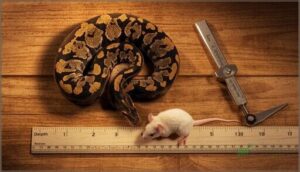
The golden rule of snake feeding safety is straightforward: your prey width should measure approximately 80 percent of your snake’s widest mid-body girth. This prey width guideline prevents constriction risks and regurgitation while ensuring proper swallowing mechanics.
Consult reputable feeder size charts to verify measurements, and always monitor the initial strike—comfortable feeding means no pauses, no distress, just smooth reptile nutrition without complications.
Adjusting Size for Juveniles Vs. Adults

Juveniles need proportionally smaller prey than adults—no larger than 25–35 percent of mid-body girth—to protect developing digestive health and prevent regurgitation. Your prey selection must shift gradually as snake development progresses, guided by weight gain and feeding frequency.
- Escalate feeder size by 10–20 percent weight milestones, not calendar dates
- Faster-growing juveniles tolerate slightly larger prey relative to body width
- Monitor feeding response weekly; refusals signal incorrect feeder capacity and design
- Track weight over 4–6 weeks to confirm your choosing the right feeder strategy
Signs Your Feeder Size is Correct

You’ll know your feeder safety and prey quality are on target when your snake strikes smoothly, swallows without excessive maneuvering, and shows consistent weight gain over multiple feeds.
Normal feeding response includes brief rest followed by activity within 24 hours, with zero digestion issues or regurgitation.
These observable snake health markers confirm you’ve mastered proper sizing.
Risks of Incorrect Feeder Size

Feeding your snake prey that doesn’t match its body size can trigger serious health complications, from regurgitation and injury to long-term nutritional deficiencies. When the feeder-to-snake ratio falls outside safe parameters, you’re basically gambling with your animal’s well-being and feeding behavior.
Let’s examine three critical risks that arise when feeder size misses the mark, so you can avoid these preventable problems entirely.
Health Issues From Overly Large Prey
Feeding prey that’s too large can trigger serious digestive problems and gastric distress in your snake. When the meal exceeds your snake’s capacity, you’re risking:
- Regurgitation risks from overwhelming the digestive system, leading to dehydration and stress
- Feeding trauma including oral injuries and esophageal tearing
- Impaction requiring veterinary intervention when prey size exceeds processing ability
- Prolonged lethargy that compromises overall snake nutrition and growth
Problems Caused by Prey That is Too Small
While oversized meals create immediate danger, prey that’s too small won’t meet your snake’s metabolic demands.
You’ll notice nutrient deficiency affecting growth rates, feeding difficulties as strikes fail to trigger proper ingestion, and increased feeding stress from repeated attempts.
Small prey can even cause airway obstruction when swallowing mechanics falter, leaving your snake undernourished and behaviorally frustrated.
How Improper Size Impacts Feeding Response
Beyond meeting nutritional needs, mismatched prey disrupts your snake’s entire feeding behavior. When prey size is off—whether too large or too small—you’ll observe irregular strike patterns, suppressed tongue flicking, and increased hesitation before meals.
This behavioral disruption affects digestion issues and feeding response consistency, making prey selection critical for maintaining healthy feeding operations and management.
Proper sizing ensures rapid, confident strikes that support stable snake nutrition and predictable feed management and storage routines.
Practical Tips for Safe Feeder Selection

Getting the feeder size right isn’t guesswork—it’s a methodical process that starts with accurate measurements and continues through every feeding cycle. You’ll need to assess your snake’s dimensions, track its response to each meal, and adjust accordingly as it develops.
The following strategies will help you establish a safe, consistent feeding routine that keeps your snake healthy from hatchling to full-grown adult.
Measuring Your Snake for Accurate Sizing
Accurate snake girth measurement forms the foundation of proper feeder size calculation and safe feeding techniques. You’ll need a soft measuring tape wrapped around your snake’s widest mid-body point—this prey width guideline ensures comfortable swallowing without stress or injury.
- Use a flexible fabric tape at the snake’s thickest section, recording in millimeters for precision
- For juveniles, reassess measurements every 1–2 weeks as rapid growth demands frequent feeder size adjustments
- If no tape is available, wrap string around the body, then measure against a ruler for reliable results
- Take measurements when your snake is calm, not constricting, to capture true girth dimensions
Compare your recorded circumference against a reputable feeder sizing guide or electrical feeder size chart adapted for reptiles—the prey should match your snake’s width within 10% tolerance. Choosing the right feeder, combined with consistent snake growth tracking, prevents regurgitation and promotes healthy digestion across all life stages.
Monitoring Feeding and Adjusting as Needed
Once you’ve measured your snake and selected a prey size, systematic feed management is essential to keep your reptile thriving. Keep detailed feeding logs, recording prey type, date, and your snake’s acceptance, to spot digestion issues early. Track weight every 1–2 weeks, watching for rapid growth or stalls that signal a need to adjust feeder size.
| Observation Window | Action Required |
|---|---|
| 24–48 hours post-feed | Monitor snake behavior and activity levels |
| 72 hours post-feed | Check for regurgitation or slow gut transit |
| After 3 consecutive meals | Reassess prey size based on feeding cycles |
If regurgitation occurs, drop the prey size one step and extend intervals. Choosing the right feeder means respecting your snake’s digestive capacity, not rushing livestock nutrition principles. For juveniles showing consistent prey acceptance and steady weight gain, you can incrementally increase the prey size. Always compare current feeding cycles to previous meals, ensuring feed efficiency without overloading your animal’s system.
Consulting Reputable Feeder Size Charts
Trustworthy feeder guidelines anchor your snake nutrition plan in real-world reptile care, just as ampacity tables and conductor sizing anchor electrical feeder size chart compliance with NEC requirements to prevent voltage drop. Cross-reference prey measurement standards from accredited herpetology groups, verifying chart validation through peer-reviewed sources that specify prey-to-girth ratios and feeding intervals.
- Use established feeding guides from recognized reptile associations or veterinary sources
- Prioritize charts that specify prey width relative to snake girth and jaw structure
- Confirm that charts define prey sizes using standardized terms (e.g., pinky, fuzzy, hopper)
- Prefer charts published by accredited herpetology groups or university extension services
- Check citations within charts to primary research on prey sizing and snake growth rates
When to Change Feeder Size as Your Snake Grows
Progression defines safe feeding cycles: increase prey selection when your snake’s girth grows 10–15%, typically after two consistent meals without regurgitation.
Document each feeding to track snake growth rates and prey size milestones, adjusting feeder size when the current prey width falls below your snake’s mid-body measurement.
Gradual advancement aids proper snake nutrition while preventing stress, injury, or feeding aversion during feeder maintenance transitions.
Frequently Asked Questions (FAQs)
Can I feed frozen prey directly to my snake?
You shouldn’t feed frozen prey directly to your snake. Thawing prey to room temperature prevents mouth injuries from ice crystals, ensures proper feeding response, and promotes safe reptile health through appropriate feeding techniques.
How do I safely thaw frozen feeder prey?
Thaw frozen prey in your refrigerator for 12–24 hours, never at room temperature. This refrigerator safety method prevents bacterial control issues. Always sanitize surfaces after prey handling to maintain feeding hygiene.
What if my snake refuses appropriately sized food?
A snake’s appetite loss often signals environmental stress, shedding cycles, or illness—like a red flag waving.
Check temperature, humidity, and recent handling first; persistent refusal warrants veterinary care to rule out underlying health issues.
Should I feed pre-killed or live prey?
Pre-killed prey eliminates injury risk and ethical concerns about prey distress, while live options can stimulate natural hunting instincts.
However, live feeding requires stringent prey handling protocols and heightened attention to snake nutrition and animal welfare throughout the feeding process.
How long can thawed feeders stay at room temperature?
Timing is absolutely critical here—thawed feeders shouldn’t exceed two hours at room temperature before bacterial growth risks spike.
Beyond that window, you’re gambling with your snake’s health through potential contamination and spoilage.
Conclusion
Like calibrating a circuit under load, choosing the correct feeder size demands continuous measurement and adjustment as your snake’s power requirements shift through each growth phase. Track weight weekly, photograph body condition monthly, and recalculate prey dimensions whenever feeding response changes.
The precision you apply now—measuring girth accurately, selecting appropriately-sized prey, monitoring post-feeding behavior—directly determines whether your animal thrives or merely survives. Your snake’s health operates on margins you control.