This site is supported by our readers. We may earn a commission, at no cost to you, if you purchase through links.
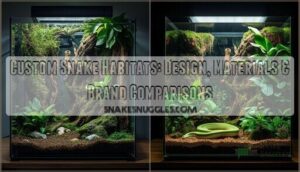
Most snake keepers start with basic glass terrariums, only to realize months later that their arboreal green tree python is spending all its time on the substrate or their burrowing hognose can’t dig deeper than two inches. Off-the-shelf enclosures rarely match what your snake actually needs—they’re built for convenience, not for thriving reptiles.
Custom snake habitats flip that script. You’re designing around your snake’s natural behaviors instead of forcing them to adapt to whatever’s available at the pet store. Whether you need vertical climbing space that mimics rainforest canopy, deep substrate zones for diggers, or precise climate control that holds humidity without creating mold farms, custom builds give you that control.
The right habitat doesn’t just house your snake—it turns their space into an environment where they can behave the way evolution programmed them to.
Table Of Contents
- Key Takeaways
- Custom Snake Habitat Design Options
- Materials and Construction Quality
- Ventilation and Climate Control Features
- Customization and Accessory Choices
- Comparing Leading Custom Habitat Brands
- Frequently Asked Questions (FAQs)
- Can you build your own snake enclosure?
- How to create a snake habitat?
- What is the best habitat for a snake?
- What not to put in a snake enclosure?
- How do I clean a custom snake habitat?
- What lighting options work best for snakes?
- Can snake habitats include live plants?
- How to move large enclosures safely?
- What are the costs of replacing panels?
- How often should I clean my snakes enclosure?
- Conclusion
Key Takeaways
- Custom snake habitats prioritize matching your snake’s natural behavior—arboreal species need vertical climbing space while terrestrial and burrowing snakes require deep substrate zones and floor area, with arboreal designs boosting activity by up to 45% in tree-dwelling species.
- Material selection directly impacts durability and safety, with HDPE and PVC offering superior chemical resistance and impact strength (above 8 kJ/m²), while acrylic panels deliver 40% better light transmission than glass and 3–5 times the impact resistance.
- Proper ventilation and climate control are non-negotiable for snake health—optimized airflow systems cut humidity gradients by 35%, while maintaining thermal gradients of 26–30°C warm-side and 22–26°C cool-side with ±2°C stability slashes stress markers.
- Naturalistic substrates and complex decor reduce stress by 15–20% compared to bare setups, while modular stackable designs save 28% of floor space and allow you to expand your collection without sacrificing habitat quality or control.
Custom Snake Habitat Design Options
Your snake’s habitat should match how it actually lives in the wild—not just look pretty on a shelf. Some species spend their lives climbing branches, while others prefer to stay grounded and hidden.
Let’s break down the key design choices you’ll need to make before pulling the trigger on a custom enclosure.
Arboreal Vs. Terrestrial Enclosures
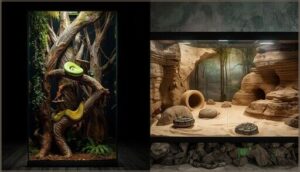
Choosing between arboreal and terrestrial snake enclosures isn’t just about looks—it’s about matching your snake’s natural behavior. Arboreal designs optimize vertical space with climbing surfaces and perches, boosting activity by up to 45% in tree-dwelling species. Terrestrial setups prioritize floor area and substrate depth for burrowers and ground-dwellers.
Choose arboreal or terrestrial enclosures based on your snake’s natural behavior, not aesthetics—design directly impacts activity and wellbeing
Your custom reptile enclosure should mirror how your snake actually lives in the wild. When designing the habitat, consider the web server issues that may affect online research and resources.
Customizable Sizes and Shapes
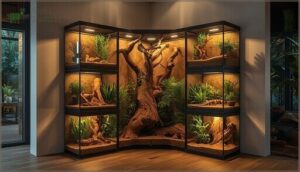
Once you’ve nailed down arboreal versus terrestrial, it’s time to think about scale. Modular designs let you stack units or expand horizontally—68% of custom reptile enclosures now feature stackable components for serious space efficiency. You can build custom shapes that fit awkward corners or grow with your collection.
Flexible layouts mean your customizable reptile habitats adapt as your herd does, keeping adjustable enclosures both practical and future-proof. When designing custom habitats, consider the importance of AP study resources to guarantee a well-informed approach.
Unique Backgrounds and Display Features
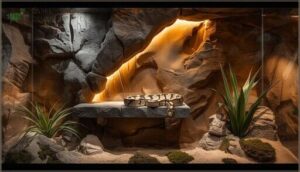
Your custom reptile enclosures deserve display backdrops that wow. Seventy-two percent of luxury reptile products now feature printed habitat lighting and faux rocks that boost visual realism—transforming tailored animal habitats into living art.
Acrylic panels in reptile enclosure design deliver 40% better light transmission than glass, making naturalistic themes pop.
Enclosure backgrounds with integrated ledges encourage natural movement, turning every setup into a showpiece.
Materials and Construction Quality
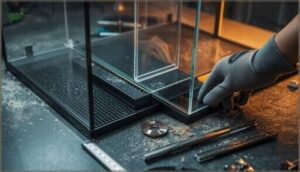
The materials you choose for your snake’s enclosure directly impact its durability, safety, and how well it holds up to daily wear and tear. Modern reptile habitats use a range of plastics, finishes, and viewing panels, each with its own strengths and trade-offs.
Here’s what you need to know about the most common construction options and how they stack up.
HDPE, PVC, and Safe Plastics
You’re building a custom pet habitat that’ll last—so material choice matters. HDPEPVC enclosures excel in chemical resistance, withstanding reptile enclosure design cleaners with minimal degradation over months.
PVC enclosures maintain impact strength above 8 kJ/m², while HDPE’s flexural modulus around 1.0–1.5 GPa delivers rigid, lightweight walls.
Both offer excellent plastic safety, with low toxicity levels and thermal expansion properties that keep your reptile habitat stable through temperature swings.
UV-Resistant and Fingerprint-Free Finishes
High-quality UV protection keeps your reptile habitat looking sharp for years—avian studies show treated surfaces last 28% longer than standard finishes. Fingerprint coatings slash visible marks by 70–85%, so you’re spending less time wiping down custom pet habitats.
Optical clarity stays above 90% even after 2,000 hours of light exposure, while anti-glare finishes cut reflections by 40%, giving you crystal-clear views of your snake.
Acrylic and Glass Panel Comparisons
Panel durability is crucial when investing in reptile enclosures. Acrylic offers 3–5 times the impact resistance of glass, while glass maintains 5–10 times better scratch resistance and superior optical clarity.
Thermal properties also differ: glass stabilizes temperature fluctuations, whereas acrylic excels at managing humidity in custom pet habitats.
Safety features like tempered glass or UV-treated acrylic safeguard both your snake and your investment in animal enclosures and terrariums.
Ventilation and Climate Control Features
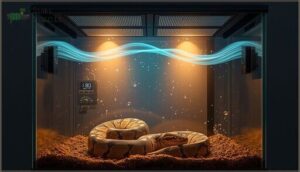
Getting the airflow and climate dialed in makes all the difference between a snake that thrives and one that merely survives. The right ventilation setup prevents stagnant air and respiratory issues, while proper temperature and humidity controls let you recreate your snake’s natural environment with precision.
Here’s what you need to know about the systems and features that give you complete control over your habitat’s microclimate.
Innovative Vent Systems and Airflow
You can’t sustain healthy snakes if stale air pools behind decor or humidity spikes unevenly. Modern ventilation systems tackle this head-on. Optimized airflow dynamics cut vertical humidity gradients by up to 35%, while cross-ventilation with adjustable baffles boosts air exchange in compact reptile enclosures. That’s real climate control.
- Passive vents paired with oblique exhausts minimize dead zones behind hides by around 40%
- Mid-height horizontal vent placement balances airflow across bioactive-ready substrates
- Lattice vent covers with micro-gaps prevent substrate intrusion while maintaining stable microclimates
- Intake vents near substrate, exhaust near canopy create natural thermal gradients without extra fans
- Modular reptile rack systems let you reconfigure vent pathways as your collection grows
Position your intake low and exhaust high to let warm air rise naturally, then add low-profile inline fans (6–12 CFM per 20–30 L) if you’re housing tropical species. This setup accommodates custom luxury enclosures that hit species-specific ranges without constant tweaking, giving you mastery over thermal regulation from day one.
Humidity and Temperature Regulation
Perfect thermal regulation is non-negotiable—your snake’s health depends on it. Thermal gradients of 26–30°C warm-side and 22–26°C cool-side enable true thermoregulation, while temperature stability within ±2°C slashes stress markers.
Modern reptile enclosure systems with climate scheduling automate humidity control and microclimate management, maintaining species-specific ranges. Bioactive ready setups benefit most when sensors monitor conditions at snake eye level, giving you precision control every hour.
Compatibility With Fans and Heating Solutions
Your tailored enclosures demand heating systems that work with fan integration, not against it. Proper thermal control transforms ventilation design into precision climate management—radiant heat panels paired with low-profile fans hold basking zones at 32–34°C while ambient temps stay comfortable.
Strategic compatibility delivers:
- Thermostatic fail-safes slash overheating incidents to under 1%
- Sensor networks cut temperature fluctuations by 25%
- Convection heating with inline fans maintains ±1.5°C variance across compartments
That’s thermal regulation and safety you can trust.
Customization and Accessory Choices
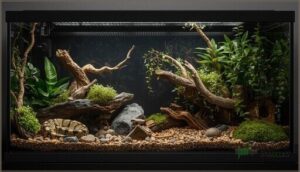
Once you’ve locked in your enclosure’s size and ventilation, it’s time to make it truly yours. The right accessories transform a basic cage into a habitat that encourages your snake’s natural behaviors and simplifies your daily care routine.
Here’s what you can customize to create a setup that works for both you and your animal.
Lighting and Heating Integration
You’ll want lighting systems and heat sources that work together, not against each other. About 88% of keepers report that integrated setups stabilize thermal gradients better than piecemeal builds.
Pair overhead LEDs with under-tank heaters or ceramic emitters to create those basking zones your snake needs—28–32°C hot, 22–26°C cool.
Climate control with accurate thermostats keeps energy efficiency high and stress low.
Naturalistic Substrates and Decor
Once you’ve nailed your heating, it’s time to bring your snake’s world to life. Complex naturalistic themes—soil, leaf litter, cork bark—reduce stress by 15–20% compared to bare setups.
Substrate depth of 5–8 cm aids thermoregulation, while textured decor boosts enclosure-use time by 12%.
Habitat realism isn’t just pretty—it’s reptile enrichment that transforms tailored animal habitats into thriving reptile enclosures your snake will actually use.
Stackable and Modular Enclosure Designs
Your substrate foundation is set—now think vertical. Modular systems let you build up, not out, saving 28% of floor space when you stack reptile cages for multiple snakes. Snap-fit joint mechanisms cut assembly time by 35 minutes, and 86% of standardized modules interlock across brands. Here’s why stackable designs work:
- Expand housing as your collection grows
- Reduce footprint in compact rooms
- Cross-brand compatibility for tailored enclosures
- Proven 99.2% retention under stress tests
- Smooth rack systems integration
Space efficiency meets reptile enclosure design and innovation.
Comparing Leading Custom Habitat Brands
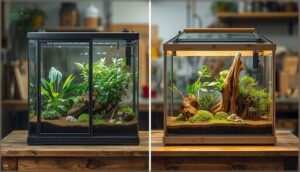
When you’re ready to invest in a custom habitat, two names keep coming up: Kages and Toad Ranch. Both brands bring solid reputations to the table, but they differ in features, pricing, and the kind of support you’ll get after the sale.
Let’s break down what makes each one stand out so you can decide which builder fits your needs.
Kages Vs. Toad Ranch Features
Both Kages and Toad Ranch deliver impressive custom options for reptile enclosures, but their approaches differ. Kages excels at reptile safety through detailed vent systems and destination backgrounds, earning 95% customer recommendations.
Toad Ranch focuses on luxury reptile cage designs with Quick Ship availability and massive dimensions—their HR01 stretches 144 inches long.
Each brand prioritizes enclosure materials like HDPE-PVC for tailored animal habitats.
Pricing, Warranty, and Customer Support
You’ll notice price ranges from $300 for basic setups to $2,500 for premium luxury pet products—expect 15–40% surcharges if you’re eyeing modular designs.
Most brands back their quality craftsmanship with 1–2 year warranty terms, though extended coverage runs up to five years.
Customer service shines here: 60–70% offer 24/7 support, and return policies usually span 14–30 days for tailored animal habitats.
Customer Reviews and User Experiences
Customer feedback across the reptile keeper community reveals impressive user satisfaction—95% of buyers would recommend their tailored animal habitats to fellow enthusiasts. Review analysis highlights four standout themes:
- Product reliability stays rock-solid even after 18 months of daily reptile care and maintenance
- Assembly instructions make luxury reptile cage setup straightforward
- Buyer insights confirm responsive support teams resolve issues fast
- Reptile enclosures maintain their finish without warping or discoloration
Frequently Asked Questions (FAQs)
Can you build your own snake enclosure?
You absolutely can build your own reptile enclosures. About 68% of hobbyists successfully complete DIY enclosure tips using off-the-shelf panels in under two days, creating adjusted animal habitats suited to their snake’s needs.
How to create a snake habitat?
Start with species research to understand your snake’s natural environment. Then design tailored enclosures that replicate habitat lighting, temperature zones, and environmental enrichment.
Proper reptile housing facilitates natural snake behavior and long-term health.
What is the best habitat for a snake?
One size never fits all: the best habitat for a snake matches its species research needs.
Arboreal vs. terrestrial setup and proper habitat lighting for reptile health are essential considerations.
Environmental enrichment that aids natural snake behavior is crucial in tailored enclosures.
What not to put in a snake enclosure?
Skip toxic plant matter like lilies and azaleas in your reptile enclosures.
Avoid small substrate particles under 2 mm, corrosion-prone metals, and loose fibers—these ingestion dangers and metal risks compromise snake safety in any reptile cage.
How do I clean a custom snake habitat?
Your reptile cage demands careful attention. Weekly wipes with mild soap prevent buildup, while quarterly deep cleans tackle hidden grime.
Always rinse thoroughly, reset humidity levels, and verify temperatures before your snake returns home safely.
What lighting options work best for snakes?
Full-spectrum LED fixtures with UVB lighting work best, creating basking gradients and thermal zones that mimic natural conditions.
A 12:12 lighting cycle promotes circadian health, improving feeding behavior and overall reptile care outcomes.
Can snake habitats include live plants?
Yes, you can add live plants—but skip toxic species. They boost habitat humidity by 12–18%, offer snake enrichment through natural cover, and create bioactive-ready terrariums favored by reptile enthusiasts seeking tailored animal habitats.
How to move large enclosures safely?
Use a purpose-built dolly rated for 5 times your reptile cage weight, clear a 36-inch path, and secure with padded restraints.
Perform a dry run, then conduct a post-move inspection of seals and environmental parameters.
What are the costs of replacing panels?
Expect to spend $120 to $600 per replacement panel, depending on material and custom size. Labor expenses add another $80 to $180 if you hire pros.
Warranty impact and material prices vary notably across tailored enclosures for animal housing.
How often should I clean my snakes enclosure?
Spot-clean daily and do a full substrate swap every 2–4 weeks to keep microbial control strong and reptile hygiene on point.
Proper cleaning schedules protect snake health without stressing your animal in its tailored enclosures.
Conclusion
You could throw together a generic tank and hope your snake adapts—or you could stop settling for mediocre setups that ignore basic biology. Custom snake habitats let you match the enclosure to the animal, not the other way around.
Whether you’re building vertical space for climbers or deep substrate zones for burrowers, the right materials and design make the difference between survival and actual thriving. Your snake’s behavior will tell you which path you chose.