This site is supported by our readers. We may earn a commission, at no cost to you, if you purchase through links.

Your ball python hasn’t eaten in three weeks, and you’re wondering if those cool nighttime temperatures in your living room might be to blame. Many snake owners wrestle with the same question, particularly during colder months when room temperatures can drop below the 70°F mark after sunset.
The answer depends on your specific species, your home’s ambient temperature, and how well your enclosure retains warmth throughout the night. While some tropical species absolutely require supplemental heat around the clock to maintain proper metabolic function, others tolerate—and even benefit from—a slight nighttime temperature drop that mimics their natural habitat.
Getting this balance right means understanding your snake’s thermal biology, choosing appropriate heat sources that won’t disrupt their day-night cycle, and setting up a system that maintains consistent temperatures without creating dangerous hot spots.
Table Of Contents
- Do Snakes Need Heat Lamps at Night?
- How Snakes Regulate Body Temperature
- Species-Specific Nighttime Heating Needs
- Risks of Not Providing Nighttime Heat
- Choosing The Right Nighttime Heat Source
- Setting Up a Safe Nighttime Heating System
- Maintaining Proper Enclosure Temperatures
- Top Nighttime Heat Products for Snakes
- Common Nighttime Heating Mistakes to Avoid
- Frequently Asked Questions (FAQs)
- Conclusion
Do Snakes Need Heat Lamps at Night?
Whether your snake needs a heat lamp at night depends on several factors, including the species you’re keeping, the ambient temperature in your home, and the specific thermal requirements of your pet. Most snakes don’t require bright heat lamps during nighttime hours, but they often do need some form of supplemental warmth to maintain proper body temperature and metabolic function.
Understanding your snake’s nocturnal heating needs requires looking at three key considerations that will help you create a safe and comfortable environment.
Nocturnal Temperature Requirements for Snakes
Generally, your snake needs a stable nighttime thermal gradient within its species-specific preferred body temperature range to support normal metabolism and nocturnal behavior. Temperature fluctuations shouldn’t drop below the minimum ideal temperature, as sudden cooling disrupts digestion and immunity in snake care.
Proper reptile heating maintains a day-night cycle through nighttime thermoregulation, ensuring your snake habitat facilitates behavioral temperature regulation across both warm and cool zones. This process involves careful scientific study methods to create an ideal environment.
Factors Influencing Nighttime Heating Needs
Whether your snake needs a heat lamp at night depends on several variables working together, including ambient temperatures in your home, your snake’s species needs, and how well your enclosure design retains warmth during the evening hours.
Consider these factors when planning reptile heating: Accurate monitoring tools like digital thermometer-hygrometers designed for reptile habitats help you catch dangerous fluctuations before they compromise your snake’s health.
- Room temperature during nighttime hours
- Enclosure insulation and substrate depth
- Species-specific thermal gradients required
- Seasonal fluctuations affecting heat sources
- Size and material of your snake’s habitat
Proper temperature regulation balances all these elements for ideal snake care.
Common Misconceptions About Nighttime Heating
Many snake keepers believe their pets don’t need any nighttime heat, but this oversimplifies thermal regulation and can compromise snake care. Here’s what you should understand about common nighttime heating myths: Understanding how to tell if your snake is getting the right temperature helps you spot thermal stress before it affects your pet’s health.
| Misconception | Reality |
|---|---|
| All snakes self-regulate without heat sources | Species from tropical climates need consistent warmth even after dark |
| Heat lamps always cause overheating | Proper temperature control with thermostats prevents thermal stress |
| Temperate snakes never need nighttime heating | Captive environments often lack natural heat retention |
| Visible heat sources mean adequate warmth | Hidden temperature drops affect digestion and immune function |
| Snake behavior alone indicates proper temperatures | Environmental control requires monitoring, not guesswork |
Understanding these facts helps you create appropriate thermal gradients and heat source options for your snake’s specific needs.
How Snakes Regulate Body Temperature

Understanding how your snake regulates its body temperature is the foundation for creating a safe, comfortable enclosure. Unlike mammals, snakes can’t produce their own warmth, which means they depend entirely on their environment to stay healthy and active.
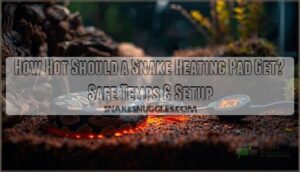
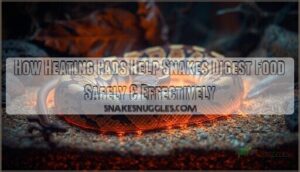
Let’s explore the three key aspects of snake thermoregulation and why getting nighttime heat right matters so much for your pet’s well-being. Understanding how to set up a heating pad for your snake tank is the foundation for creating a safe, consistent temperature environment year-round.
Ectothermic Nature of Snakes
Unlike mammals that produce their own warmth, snakes are ectothermic creatures that depend entirely on external heat sources for temperature regulation. Their bodies can’t generate heat internally, which means your snake’s activity, digestion, and overall health directly reflect the environmental thermoregulation you provide through proper snake care:
- Body temperature mirrors the enclosure’s thermal gradient, rising or falling with ambient conditions rather than staying constant.
- Metabolic processes slow dramatically when temperatures drop, affecting digestion efficiency and immune response in cold-blooded reptiles.
- Behavioral adaptations like basking under a heat lamp or retreating to cooler zones enable your snake to self-regulate throughout the day.
- Ectothermic metabolism requires less energy than warm-blooded animals, allowing snakes to thrive on infrequent meals when temperature adaptation is properly supported.
Role of Environmental Heat Sources
Through strategic placement of heat lamps, ceramic emitters, or heat mats, you create the thermal gradient your snake needs to move between warm basking zones and cooler retreats. Environmental control tools like thermostats guarantee precise heat distribution across the enclosure, allowing your snake to select temperatures that match its metabolic needs while temperature monitoring devices confirm the gradient remains within species-appropriate ranges throughout day and night. Choosing the right combination of heat sources requires understanding how each option affects your enclosure’s temperature stability and your snake’s behavior, which is why reviewing all heating options for your snake enclosure helps you make the best decision for your specific setup.
| Heat Source Options | Primary Function |
|---|---|
| Heat Lamps | Direct radiant warmth for basking spots |
| Ceramic Emitters | Nighttime heating without visible light |
| Heat Mats | Substrate-level warmth for belly heat |
| Radiant Heat Panels | Ambient air temperature elevation |
Consequences of Inadequate Heat at Night
Cold stress from inadequate nighttime warmth creates cascading health problems that compromise your snake’s survival, as metabolic slowdown reduces digestion efficiency and immune suppression leaves the animal vulnerable to respiratory issues.
Inadequate nighttime warmth triggers cold stress in snakes, slowing digestion and weakening immunity, which can lead to life-threatening health problems
Without proper temperature control through heat lamps or alternative sources in the snake enclosure, you’ll observe shedding problems, including retained skin, and prolonged temperature regulation failures can ultimately result in weight loss and reproductive complications.
Species-Specific Nighttime Heating Needs

Not all snakes share the same nighttime heating requirements, as each species evolved in distinct environments with varying thermal conditions. While some tropical species demand consistent warmth throughout the night to maintain proper metabolic function, others from temperate regions can tolerate significant temperature drops without adverse health effects.
Understanding your snake’s natural habitat and its specific thermal needs will guide you in creating an appropriate nighttime heating setup that ensures long-term health and well-being.
Ball Pythons and Boa Constrictors
Your ball python thrives when nighttime temperatures stay between 79–90°F, while boa constrictors need a slightly cooler 75–82°F range—both relying on a thermal gradient within the snake enclosure for behavioral thermoregulation.
Use a ceramic heat emitter or heat mat as your heat source options instead of bright lamps, since light disrupts their natural rhythms. Proper temperature control aids digestion, metabolism, and overall reptile care.
Corn Snakes and Cooler-tolerant Species
Corn snakes tolerate nocturnal drops down to 70–75°F without compromising digestion or snake metabolism, since these cooler species evolved in environments with natural temperature fluctuations. You can maintain proper reptile care by focusing on three essentials:
- Use thermal gradients instead of uniform heat lamps across the snake habitat
- Monitor cool zones with digital thermometers for temperature control
- Allow nighttime cooling to support circadian rhythms while keeping temps above 70°F
Researching Your Snake’s Natural Habitat
Your snake’s geographic range and climate zones define its heating needs, so you should consult species profiles from field guides and IUCN databases to identify native habitat parameters. Matching naturalistic enclosures to ecological context ensures proper temperature regulation for ectothermic creatures, since desert species require different nighttime warmth than forest dwellers.
Effective habitat research transforms reptile care from guesswork into evidence-based husbandry.
Risks of Not Providing Nighttime Heat
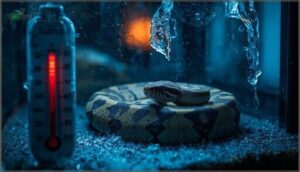
When your snake’s enclosure drops too cold at night, the consequences extend far beyond simple discomfort, affecting multiple body systems that depend on consistent warmth to function properly. Cold exposure doesn’t always show up immediately, which makes it easy to overlook until your snake starts displaying signs of serious health decline.
Understanding these risks helps you recognize warning signs early and take action before minor temperature issues become life-threatening problems.
Health Problems From Cold Exposure
When your snake’s thermal environment drops too low, you’re not just risking discomfort—you’re opening the door to serious health complications. Hypothermia risk becomes real as core temperatures fall below species-specific thresholds, triggering a cascade of problems including respiratory issues, digestive problems, and immune suppression.
This leaves ectothermic creatures vulnerable to infections, which is why proper reptile care with consistent heat lamp use matters.
Impact on Digestion and Immune Function
Beyond visible sickness, inadequate nighttime warmth disrupts your snake’s digestive health and immune response in ways that quietly compound over time. When thermal stress persists, you’ll see:
- Slowed gastric emptying reducing digestion efficiency
- Metabolism prioritizing temperature regulation over nutrient absorption
- Altered gut microbiome composition affecting digestive health
- Dampened immune function increasing infection susceptibility
- Energy diverted from immune defense to coping with cold
A heat lamp prevents these hidden consequences.
Signs of Temperature Stress in Snakes
You can spot trouble before it spirals by watching for telltale stress signals—reduced appetite, sluggish movement, or repetitive glass surfing reveal thermal imbalance disrupting your snake’s temperature regulation.
Failed sheds, respiratory noise, and altered basking behavior serve as health indicators that your reptile heating and lighting setup isn’t meeting nighttime needs, prompting immediate temperature monitoring and adjustment.
Choosing The Right Nighttime Heat Source
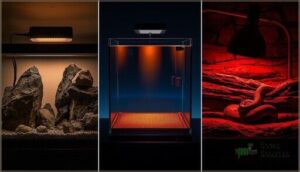
Selecting the right nighttime heat source depends on your snake’s species, enclosure setup, and whether you need to maintain warmth without disrupting their natural day-night cycle.
Heat lamps, ceramic emitters, and heat mats each offer distinct advantages and limitations that affect temperature control, energy efficiency, and your snake’s comfort during darker hours.
Understanding these differences helps you create a heating system that keeps your snake healthy while avoiding common pitfalls like light pollution or uneven heat distribution.
Heat Lamps Vs. Ceramic Heat Emitters
Choosing between a heat lamp and ceramic heat emitter depends on whether nighttime light disrupts your snake’s natural rhythms. Heat lamps provide both visible light and radiant warmth, while ceramic emitters deliver heat-only output for undisturbed nocturnal rest.
Ceramic heat emitters require reflective fixtures to direct heat effectively and operate at higher surface temperatures, making emitter safety and thermal control critical for proper temperature regulation in your reptile heating and lighting setup.
Benefits and Drawbacks of Heat Mats
While ceramic heat emitters work from above, heat mats offer ground-level warmth that mimics sun-heated rocks your snake would seek in nature. You’ll appreciate their energy efficiency and silent operation, but thermal control becomes more challenging since heat distribution through substrate takes longer than radiant warmth, and without proper thermostat regulation, mat placement errors can create dangerous hot spots or inadequate temperature zones.
Avoiding Light Disruption at Night
When selecting your nighttime heating systems, circadian rhythm preservation requires thermal regulation without visible light that can disrupt natural dark cycle management. To maintain a proper day-night cycle while supporting temperature regulation, you should implement these nocturnal lighting strategies:
- Choose ceramic heat emitters or heat mats instead of standard heat lamps that emit visible light
- Install blackout curtains around enclosures to eliminate external light contamination
- Use red-spectrum bulbs below 5 lux for nighttime observations without disturbing sleep states
- Select thermostats with dim indicators rather than bright displays near the enclosure
Understanding language patterns is vital, and utilizing language tools can improve overall knowledge.
Setting Up a Safe Nighttime Heating System
Once you’ve selected the right heating equipment for your snake’s nighttime needs, the next step is ensuring that system operates safely and maintains stable temperatures throughout the dark hours.
A well-designed heating setup relies on three critical components: accurate temperature regulation through thermostats, strategic placement of heat sources to create proper thermal zones, and safeguards that prevent direct contact burns or dangerous overheating.
Understanding how to implement each of these safety measures will help you create an enclosure environment where your snake can thermoregulate comfortably without risk of injury or temperature-related stress.
Using Thermostats for Temperature Control
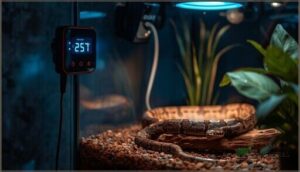
A reliable thermostat acts as your snake’s safety net, maintaining precise temperature regulation by modulating heat source output based on continuous sensor readings. Digital thermostats with probe sensors deliver consistent thermal monitoring, preventing dangerous spikes or drops that compromise your reptile’s health. Proper sensor placement away from direct heat ensures accurate temperature gradient control, while regular thermostat calibration checks safeguard against equipment drift that could endanger your snake.
| Thermostat Feature | Benefit for Nighttime Safety |
|---|---|
| Digital probe sensors | Accurate thermal monitoring without light disruption |
| Proportional control | Prevents temperature spikes during heat source cycling |
| Calibration alerts | Maintains heat source safety through verified readings |
Proper Placement of Heat Sources
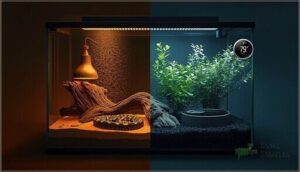
Beyond securing a reliable thermostat, you’ll need strategic heat source placement to create that essential thermal gradient your snake depends on for temperature regulation.
Position your heat lamp or heat mat on one side of the enclosure, establishing a warm zone while the opposite side remains cooler, allowing your snake to thermoregulate naturally through enclosure design that mimics wild conditions with precision.
Preventing Burns and Overheating
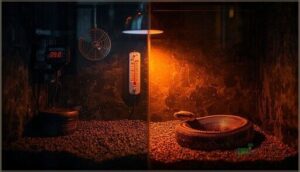
Heat source safety starts with a thermostat that prevents temperatures from spiking beyond your snake’s tolerance, protecting against overheating and burns that can damage tissue before you notice.
Position heat lamps outside the enclosure using protective guards, place heat mats beneath only one section of the habitat, and monitor multiple temperature points with calibrated digital thermometers to catch dangerous thermal drift during nighttime hours.
Maintaining Proper Enclosure Temperatures

Getting your nighttime heating system up and running is only half the battle, because maintaining stable temperatures requires ongoing attention and the right monitoring tools.
You’ll need to establish a proper thermal gradient, keep close tabs on temperature fluctuations with reliable equipment, and make adjustments as the seasons change throughout the year.
Here’s how to maintain ideal enclosure temperatures for your snake’s health and comfort.
Creating a Nighttime Thermal Gradient
Your snake won’t thrive with a single nighttime temperature—it needs a temperature range from warm to cool so it can self-regulate naturally.
Position your heat source, whether a heat lamp or ceramic emitter, on one end of the enclosure to create this temperature gradient, letting your snake move between zones as needed.
Use a thermostat to maintain stable conditions and prevent dangerous overheating overnight.
Monitoring With Digital Thermometers
Digital thermometers with data logging capabilities give you continuous temperature readings and high-low alarms to catch dangerous swings before they harm your snake.
Place sensors at both basking and cool zones—not directly under heat lamps—to track your thermal gradient accurately, and calibrate annually against a known standard to verify the readings you’re relying on stay precise and trustworthy over time.
Adjusting for Seasonal Temperature Changes
Your enclosure doesn’t exist in a vacuum—seasonal shifts in your home’s ambient temperature mean you’ll need to tweak nighttime setpoints to preserve consistent temperature gradients.
During winter, gradually reduce nighttime temps by 2–5°C over several weeks for temperate species like corn snakes, while tropical ball pythons stay near 24–26°C year-round; pair your thermostat adjustments with humidity control to support healthy thermal cycles and environmental adaptation.
Top Nighttime Heat Products for Snakes
Choosing the right nighttime heating equipment can make the difference between a thriving snake and one that struggles with temperature-related health issues, so you’ll want to invest in reliable products that maintain consistent warmth without disrupting your snake’s natural light cycle.
The following products represent some of the most effective and widely trusted options for nighttime heating, each offering distinct advantages depending on your enclosure setup and species requirements.
These recommendations combine safety features with proven performance to help you create an ideal thermal environment for your snake after dark.
1. Exo Terra Reptile Dome Light Fixture
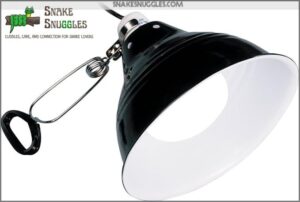
When you’re considering reptile heating and lighting options for nighttime warmth, the Exo Terra Reptile Dome Light Fixture offers versatility that many keepers appreciate, though it requires careful setup to guarantee heat lamp safety. This compact dome fixture accepts ceramic heat emitters or low-wattage bulbs, giving you multiple heat source options depending on your snake’s needs.
You’ll want to pair it with a reliable thermostat for thermal control, as the reflective interior concentrates heat efficiently but can lead to overheating without monitoring. Always position reptile heating lamps outside the enclosure to prevent burns.
| Best For | Reptile owners who need a versatile heating solution that works with multiple bulb types and want precise temperature control when paired with a thermostat. |
|---|---|
| Primary Use | Reptile heating & lighting |
| Material | Porcelain |
| Color | Blacks & Grays |
| Brand | Exo Terra |
| Target Animals | Reptiles & amphibians |
| Setup Difficulty | Easy clamp installation |
| Additional Features |
|
- Accepts ceramic heat emitters, incandescent, and halogen bulbs, giving you flexibility to match your reptile’s specific heating needs
- Built-in reflector directs heat downward efficiently, maximizing warmth in the basking area
- Durable aluminum and porcelain construction handles high temperatures without degrading over time
- Gets extremely hot during operation, requiring careful placement and handling to avoid burns
- Clamp mechanism can be difficult to adjust and secure properly on some terrarium setups
- Needs a separate thermostat purchase to prevent dangerous overheating, adding to the overall cost
2. Fluker’s Reptile Daylight Bulb
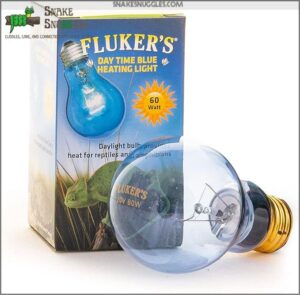
While the Fluker’s Reptile Daylight Bulb offers UVA benefits that stimulate feeding and radiant heat emission during daytime hours, its bulb lifespan and suitability for night use raise concerns. Unlike ceramic alternatives, this heat lamp emits visible light, which can disrupt your snake’s rest cycle after dark.
Pairing it with a thermostat improves safety, but for nighttime reptile heating and lighting, you’ll want dedicated heat sources without light. UVB lighting remains a daytime necessity, not a nighttime solution for most species.
| Best For | Reptile owners looking for a daytime heat and UVA light source to encourage feeding behavior in species like ball pythons, chameleons, and aquatic turtles. |
|---|---|
| Primary Use | Reptile heating |
| Material | Cordierite |
| Color | Blue |
| Brand | Fluker’s |
| Target Animals | Reptiles & amphibians |
| Setup Difficulty | Simple screw-in |
| Additional Features |
|
- Provides UVA rays that stimulate natural feeding responses in reptiles
- Delivers radiant heat through infrared light for daytime basking
- Affordable option for creating a proper daytime temperature gradient
- Not suitable for nighttime heating since the visible light disrupts nocturnal rest cycles
- Mixed reports on lifespan, with some bulbs burning out within a month
- May arrive damaged due to inadequate packaging during shipping
3. iPower Reptile Heat Mat Thermostat Combo
 View On Amazon
 If you’re searching for a reliable nighttime heat source, the iPower Reptile Heat Mat Thermostat Combo stands out for its consistent temperature control and safety features. Unlike reptile heating lamps that emit light, this heat mat provides gentle warmth beneath the tank, helping maintain surface temperatures without disturbing sleep cycles.
With adjustable thermostat settings and LED indicators, you can fine-tune your reptile heating routine, ensuring safe, stable temperature regulation. Just remember, verifying heat mat safety and monitoring with a digital thermometer keeps your snake comfortable all night.
| Best For | Snake owners who need consistent nighttime warmth without light disruption and want precise temperature control for ground-dwelling reptiles. |
|---|---|
| Primary Use | Reptile heating |
| Material | PTC heating material |
| Color | Black |
| Brand | iPower |
| Target Animals | Reptiles & amphibians |
| Setup Difficulty | Easy adhesive setup |
| Additional Features |
|
- Digital thermostat with adjustable range (40°F-108°F) lets you dial in the exact temperature your snake needs
- No light emission means it won’t mess with your reptile’s natural day-night cycle
- Low-profile design fits under tanks without taking up extra space or creating visual clutter
- Temperature can fluctuate by about 4°F, so you’ll want a backup thermometer to monitor accuracy
- Heat may max out around 75°F for some setups, which might not work for species needing warmer temps
- Adhesive backing doesn’t always hold up long-term, so repositioning might be tricky
4. Zoo Med Reptile Cave Shelter
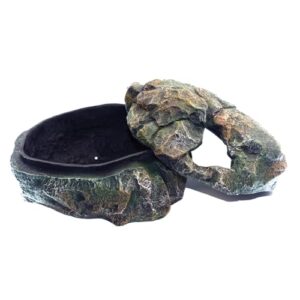
Thermal buffers matter when you’re maintaining nighttime warmth, and the Zoo Med Reptile Cave Shelter offers a sturdy retreat that complements heat sources like ceramic emitters or under-tank heaters.
These ceramic shelters measure around 4–6 inches tall, fitting most snake enclosures while providing heat-insulating protection that reduces temperature loss during cooler nights.
Reptile hides like this work alongside heat lamps or mats to support effective temperature regulation without bright light disruption, and their durable construction withstands repeated cleanings, making them practical additions to well-designed reptile enclosure setups for nocturnal thermoregulation.
| Best For | Snake owners looking for a heat-retaining hide that works with heating mats or ceramic emitters to maintain stable nighttime temperatures without bright lighting. |
|---|---|
| Primary Use | Reptile habitat |
| Material | Ceramic |
| Color | Black |
| Brand | Generic/Unspecified |
| Target Animals | Reptiles |
| Setup Difficulty | Simple placement |
| Additional Features |
|
- Ceramic or resin construction insulates heat effectively, reducing temperature drops during cooler nights
- Compact 4–6 inch design fits most enclosures and can be positioned near heat sources for optimal thermoregulation
- Durable and easy to clean, with vented openings that allow airflow while maintaining a secure retreat
- Ceramic versions can break if dropped, creating sharp edges that might injure your snake
- The lid may be too light on some models, allowing larger snakes to push it off
- Size may not accommodate full-grown larger snake species comfortably
Common Nighttime Heating Mistakes to Avoid
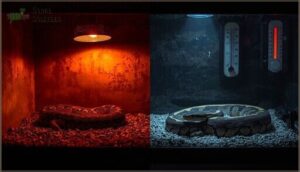
Even experienced keepers sometimes overlook critical aspects of nighttime heating, which can lead to serious health issues for your snake or create safety hazards in the enclosure. Understanding these common pitfalls will help you avoid mistakes that compromise your pet’s well-being, since proper temperature management requires more than just installing a heat source and walking away.
Let’s examine the most frequent errors that occur with nighttime heating setups and how you can prevent them.
Overheating The Enclosure at Night
Overheating the enclosure at night happens when your heat source pushes temperatures beyond your snake’s comfort zone, creating thermal stress that disrupts essential processes. Too much heat retention during nighttime hours compounds the problem, leading to humidity control issues and temperature regulation failures.
Watch for these nighttime risks:
- Dehydration from prolonged exposure to elevated temperatures and reduced moisture levels
- Disrupted shedding cycles and appetite changes from unstable thermal environments
- Impaired digestion caused by altered gastric function during overheating periods
Using Bright Lights After Dark
Bright lights disrupt circadian rhythms and nocturnal behavior in snakes, creating light pollution that interferes with dark environments they need for rest. Your heat source shouldn’t emit visible light after dusk, as thermal cues should come from heat alone, not illumination.
Use ceramic heat emitters or heat mats to meet heat requirements without disturbing the day-night cycle, avoiding UVB lighting entirely at night.
Neglecting Regular Temperature Monitoring
You can’t assume your heat source is working perfectly without checking—temperature drift and heat source failure happen silently, leading to thermal stress before you notice lethargy or appetite loss.
Use monitoring tools like digital thermometers and infrared guns to track enclosure conditions daily, logging temperature data to catch gradual shifts in temperature regulation that compromise your snake’s health and comfort.
Frequently Asked Questions (FAQs)
Can snakes survive winter without any heat source?
Like bears retreating to caves, some temperate snakes enter winter brumation, surviving cold dormancy strategies without heat sources by lowering metabolism.
Tropical species still require thermal regulation for ectothermic creature care and species survival.
Do baby snakes need different nighttime temperatures?
Yes, baby snakes need stable nighttime temperatures within species-specific ranges—often 70–85°F—to support digestion, growth, and immune function.
This makes thermostat-controlled heat sources essential for hatchling care and prevents temperature-related health issues.
How does humidity affect nighttime heating requirements?
Humidity levels modify evaporative cooling rates in snakes, so higher moisture reduces heat loss and may allow slightly lower nighttime temperatures.
Dry conditions demand more stable heat retention and careful thermal gradients.
What temperature drop is safe during power outages?
During power outages, you can safely allow a nighttime temperature drop of 5–10°F from your snake’s established baseline, depending on species tolerance. However, prolonged drops beyond this range increase thermal stress and immune vulnerability.
Are heat rocks safe for nighttime snake heating?
Heat rocks pose serious thermal burn risks to snakes because they create dangerous hot spots, malfunction unpredictably, and fail to provide adequate ambient warmth.
Heat mats, ceramic emitters, and properly controlled heat lamps are far safer alternatives for nighttime snake thermoregulation.
Conclusion
Think of your snake’s enclosure as a carefully calibrated ecosystem where every degree matters, especially when darkness falls and their metabolic processes depend entirely on external warmth. Whether snakes need heat lamps at night hinges on species origin, ambient room temperature, and your chosen heat source, but maintaining consistent thermal gradients without light pollution ensures your reptile thrives rather than merely survives.
Monitor temperatures religiously, invest in quality thermostats, and your snake will show you the difference proper nighttime heating makes.
- https://academichelpexpress.blog/2024/08/please-use-the-bulleted-points-and-the-rubric-below-to-guide-your-work-your-pa/
- https://x.com/godofprompt/status/1990526288063324577
- https://www.sciencedirect.com/science/article/pii/S0749208123000268
- https://pmc.ncbi.nlm.nih.gov/articles/instance/9553038/bin/pone.0275964.s005.docx
- https://www.unusualpetvets.com.au/thermal-burns-in-reptiles/