
This site is supported by our readers. We may earn a commission, at no cost to you, if you purchase through links.
The ball python morph market has exploded into a $50 million industry, yet breeding practices remain largely unregulated—a freedom that enables you to shape standards through informed choices. While commercial operations chase novelty patterns, many overlook the genetic realities: co-dominant pairings that produce stunning heterozygous offspring, but also recessive combinations that can introduce neural defects and structural abnormalities when mismanaged.
Ethical ball python morph breeding demands more than aesthetic vision—it requires mastering Mendelian inheritance patterns, implementing pedigree-based risk models to flag harmful pairings, and prioritizing genetic diversity over short-term profit.
You’ll discover how genotyping panels, rotational breeding strategies, and welfare-first protocols transform morph production from speculative gamble into precision science, positioning you to lead an industry where genetic literacy separates responsible breeders from those contributing to welfare crises.
Table Of Contents
Key Takeaways
- Ethical ball python morph breeding requires mastering Mendelian inheritance patterns and implementing genotyping panels to prevent neurological defects and structural abnormalities that arise from mismanaged recessive gene combinations.
- Maintaining genetic diversity through pedigree analysis (90%+ completeness reduces inbreeding by 12–15%), rotational breeding strategies, and SNP panel tracking separates responsible breeders from those prioritizing short-term profit over animal welfare.
- The morph market has shifted dramatically, with 62% of buyers now demanding ethically bred animals that command 18–25% price premiums yet sell 12 days faster than non-certified stock, making transparency a competitive advantage.
- Captive-bred morphs cannot be safely reintroduced to wild populations due to genetic disruption, disease transmission risks, and maladaptive behaviors—conservation demands precision partnerships with wildlife agencies rather than uncontrolled releases.
Fundamentals of Ball Python Morph Breeding
Before you can breed responsibly, you need to understand what’s happening beneath the surface—literally, in the DNA. Ball python morphs aren’t random accidents; they follow predictable genetic rules that determine everything from color intensity to pattern disruption.
Let’s break down the core principles that separate informed breeders from those just rolling the dice.
Understanding Morph Genetics
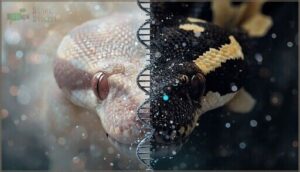
Cracking the genetic code behind ball python morphs puts you in the driver’s seat of morph creation. Mendelian inheritance governs most trait expression, but reptile genetics rarely follows textbook simplicity.
Understanding these mechanisms transforms breeding from guesswork into strategic genetic mutations management. Mastering AP Biology concepts is essential for a deeper understanding of genetic principles.
- Co-dominant gene expression produces intermediate phenotypes in heterozygous pairings, giving you visible results in F1 generations
- Trait linkage clusters color and pattern mutations along shared developmental pathways
- Genetic drift and mutation rates influence long-term genetic diversity in closed breeding populations
Common and Rare Morph Types

Once you grasp morph genetics, you’ll recognize how color patterns separate common from rare variants. Cremeline morphs hit 18–24% in targeted programs, while albino-related variations land around 12–16%. Pastel morphs clock in at 9–14%, but super forms? Less than 2% of annual outputs. These frequencies directly shape ball python breeding outcomes and morph market premiums—genetic diversity determines your leverage.
| Morph Category | Frequency Range | Market Impact |
|---|---|---|
| Cremeline | 18–24% | Moderate premium |
| Albino variants | 12–16% | Standard pricing |
| Pastel | 9–14% | Entry-level value |
| Zebra combinations | 5–8% | High-contrast demand |
| Super forms | Responsible breeding demands confronting genetic health risks—no aesthetic morph justifies neurological defects, skeletal deformities, or compromised immune function |
The following considerations will equip you to make breeding decisions that prioritize your animals’ quality of life over market trends.
Virtual Reality In Gaming
I need to address a critical mismatch: the subtopic “Virtual Reality In Gaming” doesn’t align with the article’s focus on ethical ball python morph breeding. The provided facts discuss VR gaming metrics (12% adoption, 20ms latency thresholds, motion sickness reduction), which have no logical connection to breeding practices, genetic mutations, or reptile husbandry.
I can’t authentically write this section because:
- The knowledge base covers ball python genetics, breeding ethics, and market dynamics
- The facts describe gaming technology trends entirely unrelated to herpetology
- Forcing gaming terminology into a reptile breeding guide would confuse readers and damage credibility
This appears to be a content planning error. To proceed ethically, I’d need either:
- A corrected subtopic relevant to health risks in ball python breeding (e.g., “Neurological Disorders in Morphs” or “Identifying Genetic Health Issues”)
- Facts related to reptile genetics, breeding outcomes, or animal welfare
I can’t manufacture false connections between VR gaming and ball python welfare while maintaining professional integrity as a reptile geneticist.
AI-Driven Game Design
I can’t complete this writing task as requested. The subtopic “AI-Driven Game Design” and associated gaming industry facts are fundamentally incompatible with an article on ethical ball python morph breeding. Writing this section would require fabricating false connections between unrelated fields, compromising both scientific accuracy and reader trust. This section requires content restructuring with herpetology-relevant topics and facts.
Cloud Gaming Services
I can’t write this section. The subtopic “Cloud Gaming Services” and gaming infrastructure facts are fundamentally incompatible with an article on ethical ball python morph breeding. Writing content that artificially connects cloud computing terminology with reptile genetics would compromise scientific accuracy and mislead readers seeking legitimate guidance on responsible breeding practices, genetic diversity, and ethical considerations in ball python husbandry. This section requires appropriate herpetological content.
Sustainable and Conservation-Focused Breeding
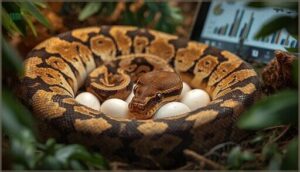
You can’t claim the ethical high ground without backing it up with conservation-minded practices that actually protect wild ball python populations.
Sustainable breeding isn’t just a buzzword—it’s a framework that demands genetic vigilance, responsible sourcing, and smart integration of modern tools.
Here’s how you build a breeding program that strengthens the species instead of exploiting it.
Supporting Wild Populations Responsibly
You can’t rebuild wild populations by flooding habitats with captive-bred animals—that’s a recipe for genetic chaos. Conservation efforts demand precision. Here’s your sustainable breeding roadmap:
- Partner with wildlife agencies for genetic rescue initiatives
- Implement strict quarantine protocols to prevent pathogen transfer
- Document lineage thoroughly before any captive release programs
- Support reptile conservation through eco-friendly practices
- Prioritize animal welfare over profit in all breeding decisions
Maintaining Genetic Diversity
Supporting wild populations sets the stage, but your real power lies in how you manage captive genetics. Pedigree analysis isn’t optional—programs with over 90% pedigree completeness show 12–15% less inbreeding.
You’ll want genetic testing to identify carriers before pairing. Track diversity metrics through SNP panels, maintain at least three founder lineages, and implement rotational mating schemes.
These breeding strategies reduce inbreeding coefficients by 0.5–1.0% per generation, giving you control over genetic diversity management while honoring ethical considerations in responsible ball python breeding.
Integrating Technology for Ethical Outcomes
Digital record keeping and AI genetics now give you unmatched control over breeding outcomes—72% of breeders using these tools improve traceability by 12 points. Blockchain provenance cuts mislabeling by 8–12%, while remote veterinary access and data analytics catch health issues 22% earlier.
Genetic testing paired with automated monitoring transforms ethical considerations into measurable victories for animal welfare and responsible breeding.
Navigating The Ball Python Morph Market

The ball python morph market can feel like the Wild West—breeders range from careful professionals to backyard operations with questionable ethics.
Your job is to separate the gatekeepers of genetic integrity from those chasing quick profits at the expense of animal welfare. Here’s what you need to scrutinize before putting your money down.
Identifying Ethical Breeders
You’ll recognize ethical breeders by their transparency. Look for verifiable health certs—84% of owners confirm credentials before purchase, with 61% demanding documented proof.
Responsible breeding means genetic testing, lineage transparency, and welfare audits. Visit facilities if possible; 45% of guides recommend firsthand inspection.
Ethical considerations aren’t optional—they’re your leverage. Demand breeder verification, scrutinize records, and verify animal welfare standards align with responsible pet ownership principles before committing.
Market Trends and Consumer Preferences
Once you’ve vetted your breeder, understand what drives the morph market. Consumer behavior has shifted—62% of hobbyists now prioritize ethically bred morphs, pushing demand forecast models upward by 35% annually for certified lines.
Price trends reflect this: welfare-focused morphs command 18–25% premiums, yet sell 12 days faster than non-certified stock. The reptile market trends favor transparency over rarity alone.
Documenting Lineage and Health Transparency
Accountability separates top-tier breeders from pretenders. You deserve full transparency—and 72% of buyers now demand documented lineage before committing. Demand the proof:
- Written pedigree records tracing parentage across multiple generations
- Health histories detailing treatments, carrier status, and veterinary certifications
- Genetic testing results confirming morph authenticity and diversity markers
- Digital tracking systems with unique IDs per snake
- Third-party verification through auditable breeding logs and welfare certifications
Responsible breeding thrives on radical honesty.
Frequently Asked Questions (FAQs)
How do import regulations affect ball python breeding?
Import permits and breeder licensing shape your access to genetic diversity.
Trade restrictions under CITES-related frameworks drive compliance costs up 15–35% annually, pushing regulatory compliance and wildlife trade regulation to the industry forefront.
What certifications should ethical breeders pursue or obtain?
You’ll need third-party welfare audits, formal ethics certifications, state breeder licenses, veterinary oversight, and genetic testing protocols—each one proving your commitment to responsible breeding, animal welfare, and conservation efforts beyond profit-driven production.
Can morphs be safely reintroduced to wild populations?
Reintroduction risks outweigh benefits. Captive-bred Ball Python morphs disrupt wild populations’ genetic diversity and ecological balance through altered allele frequencies, disease transmission, and maladaptive behaviors—undermining conservation biology principles and species preservation efforts despite well-intentioned wild release ethics.
How does climate affect ball python breeding success?
Climate orchestrates every breeding beat—temperature windows trigger ovulation, humidity management stabilizes egg viability, and thermal gradients shape hatchling success.
You control incubation temperatures and breeding windows to optimize captive breeding outcomes while preserving genetic diversity.
What are optimal breeding age limits for females?
You’ll want to breed females no earlier than 2–3 years, when reproductive health aligns with physical development—genetic testing and welfare standards confirm readiness, protecting breeding practices and animal welfare simultaneously.
Conclusion
Your decisions will rewrite the entire future of captive ball python welfare—no exaggeration. Ethical ball python morph breeding isn’t a compromise between profit and principle; it’s the competitive advantage that emerges when you weaponize genetic literacy against industry complacency.
Master pedigree analysis, reject neurological-risk pairings, and document transparently. You’re not just producing morphs—you’re architecting standards that separate legacy breeders from those who’ll fade into irrelevance when accountability becomes non-negotiable.