This site is supported by our readers. We may earn a commission, at no cost to you, if you purchase through links.
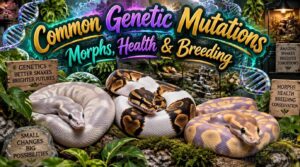
A single nucleotide swap in a pigment-pathway gene can transform a wild-type ball python into a ghost-white animal with pink eyes before it ever leaves the egg. Common genetic mutations in snakes drive a morph catalog now exceeding 200 named variants in ball pythons alone, each traceable to replication errors, transposable elements, or environmental mutagens acting on germline cells.
Understanding this biology matters beyond aesthetics. Pleiotropic mutations can silently compromise immune function or neurological development while the animal looks outwardly healthy. Breeders who grasp the center genetics protect their animals and make selection decisions grounded in science, not guesswork.
Table Of Contents
- Key Takeaways
- What Are Genetic Mutations in Snakes, and How Do They Occur?
- How Snake Morph Genetics and Inheritance Work
- Common Snake Color and Pattern Mutations
- Genetic Morph Examples in Ball Pythons, Corn Snakes, and Boas
- Mutation-Linked Health Risks, Ethical Breeding, and Genetic Diversity
- Frequently Asked Questions (FAQs)
- What are the 7 types of mutations?
- What snake is worth $100,000?
- What is the most common genetic mutation?
- Which snake has a 100% fatality rate?
- What are the most common genetic mutations?
- What are the most common diseases in snakes?
- What are the genetics of a snake?
- Do snakes have mutations?
- What are the 4 major types of genetic mutations?
- What are 5 genetic mutations?
- Conclusion
Key Takeaways
- A single nucleotide change in a pigment-pathway gene is enough to produce a visually distinct morph, which means even small replication errors have large, heritable consequences for color and pattern.
- Whether a trait appears in offspring depends on whether its allele is dominant, recessive, or codominant — mastering these inheritance patterns lets you predict breeding outcomes instead of guessing at them.
- Some mutations that create striking visual morphs also silently disrupt immune function or neurological development, so selecting purely for appearance without screening for pleiotropic effects puts your animals at risk.
- Maintaining at least four to six unrelated founders and tracking pedigrees carefully is essential to prevent genetic drift from eroding diversity and compounding hereditary health problems across generations.
What Are Genetic Mutations in Snakes, and How Do They Occur?
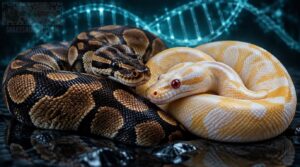
How do the striking color and pattern variations you see in captive snakes actually originate? At the cellular level, genetic mutations in snakes arise from three primary sources: replication errors during cell division, environmental mutagens like UV radiation, and the activity of transposable elements that move around within the genome, disrupting existing coding or regulatory sequences.
These mutations translate into the dazzling array of morphs seen in captive collections, many of which are catalogued in this corn snake morph identification and genetics guide.
Point mutations are particularly significant. A single-nucleotide variant in a pigment-pathway gene can reroute melanin production entirely, producing visible phenotype changes within one generation. Only germline mutations, those occurring in reproductive cells, transmit to offspring and become heritable. Somatic mutations affect only the individual and don’t pass to the following generation.
These genetic variations form the molecular foundation for the morphs you’re working with.
How Snake Morph Genetics and Inheritance Work
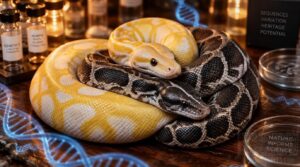
Understanding how morphs are inherited starts with a few foundational genetic principles. Whether you’re planning a breeding project or evaluating a hatchling’s potential, these concepts directly shape your outcomes.
The following sections cover dominant and recessive traits, heterozygous and homozygous states, codominance, probability modeling, and multi-gene combinations.
Dominant and Recessive Traits
Your snake’s visible traits are governed by allele dominance. A dominant allele needs only one copy to shape phenotype expression, while a recessive allele requires two copies before it can manifest. Both follow classical Mendelian inheritance patterns, predicting which morphs appear and which stay hidden. You’ll know exactly which mutations are dominant versus recessive to predict what any pairing produces.
A good snake genetics morphs breeding guide book walks you through Punnett squares step by step, so planning your first pairing feels far less intimidating.
Homozygous and Heterozygous States
Beyond which allele dominates, allele copy count is what separates a visual morph from a hidden carrier. A snake carrying two identical alleles at a locus is homozygous; two different alleles make it heterozygous.
In captive breeding, you’ll use both states to:
- Spot hidden carrier morphs
- Predict offspring genotype ratios
- Avoid pairing homozygous defects
- Track genetic mutations in snakes accurately
Codominance and Super Forms
Allele dosage separates codominant traits from carrier states and recessive hets.
In practice, you can see exactly how allele dosage plays out across combinations — the ball python morph combination odds calculator breaks down everything from single hets to that elusive 6.25% Blue Eyed Leucistic.
Heterozygotes show a recognizable intermediate. Pair two copies of the same allele and you’ll get a super form like the super pastel, which shows deeper yellow saturation than a single pastel. Unlike double hets, these color morphs are visually confirmed without test breeding, making codominant identification far more direct.
| Genotype | Phenotype | Morph |
|---|---|---|
| +/+ | Normal base color, standard pattern | Wild type |
| Pa/+ | Enhanced yellow, reduced melanin | Pastel |
| Pa/Pa | Deep yellow, near-white head | Super pastel |
| Mo/+ | Faded pattern, blue-tinted belly | Mojave |
| Mo/Mo | White body, blue eyes, no pattern | Super mojave |
Punnett Squares and Probabilities
Four possible genotypic outcomes define every simple recessive cross you’ll run. A Punnett square maps these outcomes by arranging parental alleles across a two-by-two grid, giving you a clear visual of genetic probability before you breed. Crossing two carriers (Aa x Aa) under Mendelian inheritance yields 25% homozygous normal, 50% carrier status, and 25% homozygous recessive, which expresses the morph.
Multi-gene Morph Combinations
When you combine multiple loci, allele combinations introduce epistasis, where one gene won’t simply add to another’s expression but suppress or override it.
This is especially visible across corn snake morphs available from breeders, where epistatic interactions produce striking patterns that neither parent gene alone could predict.
- Super pastel results from stacking codominant alleles
- Modifier genes adjust saturation, contrast, and pattern width
- Epistasis can mask or boost expected phenotypic traits
- Genetic background shifts penetrance each generation
Tracking these interactions carefully shapes your breeding outcomes.
Common Snake Color and Pattern Mutations
Picture a snake with ghost-white scales and pink eyes glowing under a heat lamp. That’s albinism expressing fully, where melanin production halts entirely, stripping protective pigment and leaving vivid pink or red coloration across the whole body.
Full albinism halts melanin production entirely, leaving snakes ghost-white with vivid pink or red coloration
Hypomelanistic animals take a subtler route, reducing dark pigment without eliminating it and producing specimens that look faded yet retain pattern contrast. Anerythristic individuals lose red tones entirely, leaving cool grays and near-blacks. Axanthic mutations remove yellow pigment through a separate chromatophore pathway, making these two gray-toned morphs genuinely easy to confuse in the field.
Piebald patterning operates quite differently from the others. Irregular white patches emerge wherever melanocytes failed to migrate during embryonic development, creating the distinctive depigmented interruptions you’ll recognize immediately.
Genetic Morph Examples in Ball Pythons, Corn Snakes, and Boas
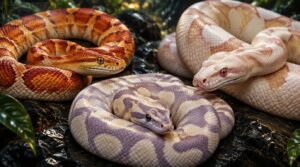
Understanding morph genetics becomes clearer when you look at specific species and their documented traits. Ball pythons, corn snakes, and boa constrictors each carry distinct mutation sets that illustrate recessive, co-dominant, and dominant inheritance in practice. A ball python morph identification guide can help you cross-reference visual traits with known genetics across hundreds of documented mutations.
The following breakdowns cover the most established morphs in each species.
Ball Python Morphs
Ball pythons hold the record for documented morphs among captive reptiles, with over 200 named variants now catalogued by breeders worldwide. Single gene mutations account for most, shifting pigmentation and pattern in ways visible from hatching.
From the melanin-absent Albino to the white-patched Piebald, each morph follows inheritance rules you’ll need to understand before you select any given breeding pair.
Corn Snake Morphs
Corn snakes have something most captive species don’t: a deeply mapped genetic library, with over 40 named morphs developed through selective breeding. Most express through recessive inheritance patterns, so you’ll need two copies of an allele to see traits like Snow or Anerythrism appear.
Knowing a snake’s carrier status before pairing isn’t optional; it’s the foundation of sound breeding strategy.
Boa Constrictor Morphs
Boas carry some of the most layered color mutation genetics in captivity. Five morphs worth knowing:
- Albino: recessive, eliminates melanin entirely
- Hypo: reduces dark pigmentation across scales
- Anery: removes red pigment from chromatophores
- Leopard: disrupts dorsal saddle pattern distribution
- Snow: stacks albino and anery traits together
Each demands careful mate selection to avoid compounding deleterious recessives in your breeding program.
Mutation-Linked Health Risks, Ethical Breeding, and Genetic Diversity
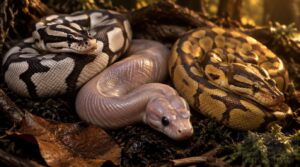
Selecting for striking visuals doesn’t always come without cost, and some mutations carry serious mutations carry serious health consequences you need to understand before breeding. Responsible practice means weighing genetic screening, welfare considerations, and population diversity alongside aesthetics. The following sections break down each of these factors.
Pleiotropic Health Risks
When a single genetic mutation alters an embryonic developmental pathway, it rarely stops at coloration. That same allele can trigger immune deficiencies, neurological dysfunction, or organ abnormalities, creating pleiotropic health risks you won’t detect from visual appearance alone.
In tight founder lines, inbreeding depression and accumulated genetic load intensify these effects, making hereditary diseases in reptiles much harder to predict.
Welfare-Based Breeding Decisions
Those pleiotropic risks demand you treat every pairing as a risk-benefit calculation, not a visual exercise. Prioritize observable welfare indicators, like growth consistency and the absence of skeletal deformities, over pattern novelty.
If a line carries hereditary diseases in reptiles, pull it from your captive breeding program. Inbreeding depression compounds these risks, so maintaining genetic diversity protects animal welfare long-term.
Genetic Screening Practices
Backing those decisions with data is where genetic screening practices become indispensable. PCR-based assays detect known variants with sensitivity above 95%, so you’re not guessing at carrier status. Pair those results with rigorous pedigree tracking to build a complete picture of your breeding lines.
In herpetoculture, non-invasive buccal swabs are the standard first step, confirming genotypes before any pairing proceeds.
Maintaining Genetic Diversity
Screening results only help when you’re acting at the population level. Genetic diversity erodes quickly in small collections, and genetic drift removes rare alleles silently.
Breed from at least four to six unrelated founders, keeping effective population size above 50. In ex situ breeding, pedigree tracking across lineages limits relatedness in inbreeding snakes. Introduce unrelated stock before Ne reaches 30. A reptile breeding record logbook helps managers log each pairing, track lineage relatedness, and flag when it’s time to introduce new founders.
Frequently Asked Questions (FAQs)
What are the 7 types of mutations?
The categories overlap, but seven mutation types cover the field: color, pattern, structural, regulatory, olfactory, patched, and sex-related. Color mutations, like hypomelanism and axanthic, disrupt the melanin pathway through point mutations in key pigment-regulating genes.
What snake is worth $100,000?
Rarity stacks on rarity. **Ball python triple-recessive morphs combining axanthic, clown, and pied genetics have reached six-figure private sales, where documented lineage and perfect pattern symmetry consistently drive the final price well beyond species alone.
What is the most common genetic mutation?
Male snakes have a 03-fold higher mutation rate than females.
Hypomelanistic mutations top the list, disrupting the melanin pathway and reducing dark pigment without fully eliminating color, making them the most common in breeding snakes.
For example, axanthic and hypomelanistic traits can be combined to produce high-value phenotypes like Triple Homozygous animals that showcase exaggerated color and pattern reductions.
Which snake has a 100% fatality rate?
Field records show there’s no 100% fatality rate for any snake species across natural populations. Even the most potent elapid neurotoxins yield variable outcomes. Your survival ultimately depends on venom dose, species, and antivenom access.
What are the most common genetic mutations?
Albinism, hypomelanism, and axanthism are the genetic mutations you’ll encounter most often in captive-bred snakes. Each one disrupts pigment production through a distinct biochemical pathway, targeting melanin, xanthophore, or erythrophore expression in developing epidermal cells.
What are the most common diseases in snakes?
Snakes can decline with terrifying speed. Respiratory infections, stomatitis, dysecdysis, parasitic infestations, and septicemia top the list of concerns, while hereditary diseases in reptiles from certain morph lines can further compound your animal’s systemic vulnerability.
What are the genetics of a snake?
Like a blueprint coded into every cell, reptile genetics pairs chromosomes that carry alleles governing coloration, pattern, and physiology. Your snake’s basic genotype ultimately determines the observable phenotype, producing every distinct morph breeders select for.
Do snakes have mutations?
They absolutely do, and if you’re surprised by that, you clearly haven’t been paying close attention. Genetic mutations in snakes arise from DNA replication errors, producing the genetic variations that drive morphs through genetic inheritance.
What are the 4 major types of genetic mutations?
Picture DNA as a molecular code that any copying error can rewrite. Point mutations swap single bases, frameshift mutations shift the reading frame, chromosomal rearrangements restructure large segments, and copy number variations alter gene dosage.
What are 5 genetic mutations?
There are five genetic mutations in snakes you’ll encounter most: point mutations, frameshift errors, nonsense mutations, missense mutations, and copy number variations, each capable of disrupting protein function and driving morphs like albinism and hypomelanism.
Conclusion
A breeder who pairs two Spider ball pythons without fully understanding codominance may hatch a litter riddled with wobble syndrome, only to discover that visual appeal and long-term animal welfare are never truly separate concerns.
The science behind common genetic mutations in snakes isn’t academic trivia; it’s the practical framework separating responsible selection from expensive regret. Know your inheritance patterns, screen for pleiotropic risks, and your entire collection becomes both healthier and far more defensible.