
This site is supported by our readers. We may earn a commission, at no cost to you, if you purchase through links.

Most first-time reptile keepers get bitten not because their animal is aggressive, but because they handed over a mouse with their fingers. It’s an easy mistake—one that a pair of feeding tongs for first-time reptile keepers fixes almost immediately.
Reptiles hunt by heat, movement, and scent, and your hand checks all three boxes.
The right tongs keep you outside that strike zone while giving your reptile a clean, confident feeding experience.
Choosing the correct length, tip, and material makes the difference between a smooth feeding session and a stressed animal that won’t eat.
Table Of Contents
- Key Takeaways
- Choose The Right Feeding Tongs
- Why Feeding Tongs Are Safer Than Hand-feeding
- Best Uses for Snakes, Lizards, and Insect-eating Reptiles
- Stainless Steel Feeding Tongs for Durability and Sanitation
- Angled Vs Straight Feeding Tongs for Beginners
- When Soft-tipped Tongs Are Better Than Bare Metal
- Features That Make Feeding Tongs Beginner-friendly
- Pick The Best Length and Tip
- Why 8- to 12-inch Tongs Suit Most First-time Keepers
- How Tong Length Affects Safety and Feeding Accuracy
- Best Tong Size for Small Snakes and Young Reptiles
- Soft-tip Vs Hard-tip Tongs for Frozen-thawed Prey
- Jaw Shape and Grip for Insects, Roaches, and Rodents
- Signs Your Current Tongs Are Too Short or Too Large
- Prepare Food and Feeding Area
- Use Tongs Safely During Feeding
- Clean and Store Tongs After Use
- Frequently Asked Questions (FAQs)
- What is the best reptile for a first time owner?
- How long should snake feeding tongs be?
- What should you not feed a lizard?
- Are you supposed to feed lizards every day?
- Can feeding tongs double as enclosure maintenance tools?
- How do tongs help with supplementing prey before feeding?
- Are feeding tongs safe for hatchlings and juveniles?
- Conclusion
Key Takeaways
- Using feeding tongs keeps your hand out of the strike zone, since reptiles hunt by heat, movement, and scent — and your fingers check all three boxes.
- Stainless steel tongs in the 8–12‑inch range hit the sweet spot for most beginners, giving you enough reach without losing control over prey placement.
- Soft-tipped tongs are the smarter choice for fast strikers and hatchlings, since bare metal can injure your reptile’s jaw on a missed strike.
- Always wash, sanitize, and dry your tongs after every session — skipping cleanup spreads bacteria between animals and shortens the life of your equipment.
Choose The Right Feeding Tongs
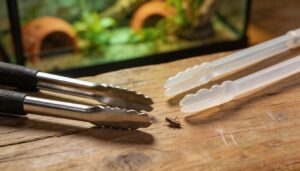
The tongs you pick matter more than most beginners expect.
The right pair can make feeding sessions safer and less stressful, so it’s worth knowing what features to look for in feeding tongs for boa constrictors before you buy.
A poor choice can spook your reptile, injure your pet, or leave your fingers way too close to a fast strike. Here’s what to look for before you buy.
Why Feeding Tongs Are Safer Than Hand-feeding
Hand-feeding feels natural at first, but it puts your fingers right in the strike zone. Feeding tongs give you consistent prey placement and a safe distance between your hand and your reptile’s bite.
That means reduced bite risk, lower contamination exposure, and minimized hand fatigue during longer sessions. With the right reptile feeding tools, you’ll build improved keeper confidence from day one. Using tongs provides precise prey placement for accurate feeding.
Best Uses for Snakes, Lizards, and Insect-eating Reptiles
Tongs aren’t one-size-fits-all. For snakes, they let you mimic erratic prey movement without risking your fingers.
For lizards and insect-eating species, stainless steel feeding tongs help you deliver gut-loaded prey at the right distance, supporting pet feeding safety and enclosure enrichment.
Even within a proper temperature gradient and humidity control setup, consistent hand feeding technique with tongs reduces stress and improves health monitoring over time.
Stainless Steel Feeding Tongs for Durability and Sanitation
Stainless steel feeding tongs hold up where plastic fails. Their non-porous surface resists bacteria buildup, making them genuinely hygienic animal feeding equipment.
Most are dishwasher safe, so cleanup after a messy feeding is simple.
The stainless steel grade used also gives you solid heat tolerance and corrosion resistance — meaning these durable reptile feeding accessories won’t rust or warp with regular use.
Angled Vs Straight Feeding Tongs for Beginners
Beyond the material, the shape of your feeding tongs matters more than you’d think. Here’s how the two styles compare:
- Wrist Angle – Angled stainless steel feeding tongs 10 inches long naturally tilt prey downward, reducing your wrist strain.
- Prey Visibility – Angled tips let you watch the prey clearly during presentation.
- Grip Stability – Straight or angled tips both hold prey securely; straight tongs feel more instinctive for beginners.
- Strike Safety – Angled designs keep your hand farther from the reptile’s head.
- Learning Curve – Easy-to-use reptile feeding accessories with straight tips suit stationary prey; angled ones shine with fast insects.
When Soft-tipped Tongs Are Better Than Bare Metal
Soft-tipped tongs aren’t just a comfort upgrade — they’re a real safety tool. When you’re feeding skittish or fast-striking reptiles, soft-tipped tongs offer better prey stress reduction by distributing pressure evenly, so prey moves less and provokes fewer defensive strikes.
You also get natural bite prevention, surface protection for enclosure walls, heat insulation for your fingers, and hygiene advantages since silicone tips resist staining and rinse clean fast.
Features That Make Feeding Tongs Beginner-friendly
When you’re just starting out, the right design makes all the difference.
Look for ergonomic handholds with a non-slip grip so your hand stays steady mid-feed. A lightweight design reduces fatigue during longer sessions.
Angled feeding tongs are easy to use because they improve your sightline. A soft tip, comfortable grip, and easy to clean stainless steel construction round out the must-haves.
Pick The Best Length and Tip

Picking the right tong length and tip type makes a bigger difference than most beginners expect. Get it wrong, and feeding time becomes stressful for both you and your reptile.
Beyond fit and function, keeping a dedicated set of snake feeding tongs for frozen prey for each animal helps prevent cross-contamination that can silently compromise your collection’s health.
what to look for before you buy.
Why 8- to 12-inch Tongs Suit Most First-time Keepers
Most beginners do best with feeding tongs in the 8- to 12-inch range, and it’s not complicated to see why. That length gives you a comfortable reach into standard terrariums without crowding your reptile.
It’s an easy to use, cost-effective choice that covers a broad species range — from small snakes to lizards — while keeping your grip steady and reducing hand fatigue over time.
How Tong Length Affects Safety and Feeding Accuracy
Tong length is a quiet balancing act between reach vs control — go too long, and precision placement suffers; go too short, and your hand enters the strike zone.
- Wrist alignment stays natural with moderate-length stainless steel feeding tongs
- Prey size matching determines how much reach you actually need
- Hand fatigue management improves with two sizes on hand
- Safe handling of live prey demands improved feeding accuracy
Best Tong Size for Small Snakes and Young Reptiles
For small snakes and young reptiles, eight to ten inches hits the sweet point between reach vs control. Prey size matching matters here — small prey items need precision and control, not brute length.
Terrarium layout impact and angle of approach also shape your choice.
Weight balance considerations favor lighter tongs for delicate work. Keep two sizes handy, and consider soft tipped tongs for the smallest snakes.
Soft-tip Vs Hard-tip Tongs for Frozen-thawed Prey
The tip you choose matters more than you’d think when handling thawed rodents.
Here’s how soft-tipped vs hard tongs compare as reptile feeding accessories:
- Tip Flexibility Effects soften impact when prey is seized
- Bite Risk Reduction is higher with soft tips during aggressive strikes
- Prey Temperature Control stays intact — neither tip affects thaw temperature
- Cleaning Complexity is lower with stainless steel hard tips
- User Comfort Differences favor soft tips for nervous first-timers
Jaw Shape and Grip for Insects, Roaches, and Rodents
Jaw shape does more work than most people expect.
Serrated jaw benefits kick in fast — those tiny ridges grip a cricket’s exoskeleton without crushing it. Curved jaw mechanics let you angle the prey naturally, triggering a strike response.
Narrow jaw precision suits single insects, while wide jaw capacity accommodates roaches or thawed rodents securely.
Good jaw pressure control means no squishing.
Signs Your Current Tongs Are Too Short or Too Large
Even with the right jaw shape, wrong-sized feeding tongs quietly sabotage every session.
Watch for these warning signs:
- Handle wobble or excessive flex when gripping prey means the shaft is too thin or worn.
- Prey slipping repeatedly signals the tongs are too short for controlled delivery.
- Arm strain after a few minutes points to uneven weight from an oversized design.
- Your hand drifts too close — animal feeding safety demands more reach.
Prepare Food and Feeding Area
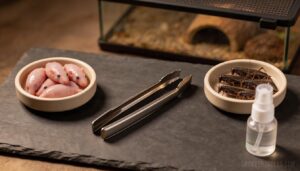
Before you pick up the tongs, a little prep goes a long way. Getting the food ready and the space set up correctly makes feeding safer for both you and your reptile.
Here’s what to have in order before you start.
Choosing Prey That Matches Your Reptile’s Diet
Before you grab your feeding tongs, make sure you’ve matched the prey to your reptile’s specific needs.
Carnivores need prey no wider than their bodies’ widest point. Insectivores thrive on gut-loaded insects packed with calcium-rich nutrients.
A balanced prey mix covering live prey feeding and frozen options keeps your reptile’s diet complete. Species-specific prey choices are where good reptile nutrition starts.
Preparing Live Insects Vs Frozen-thawed Prey
Once you’ve matched the prey to your reptile, prep matters just as much. Live insects need gut-loading 24 hours before feeding — this boosts nutrient retention and hydration levels naturally. Frozen-thawed prey maintains storage longevity well, but warm it slightly first for better scent acceptance. Both options support parasite management when sourced responsibly.
Your feeding tongs make safe handling invertebrates and thawed prey equally straightforward.
Positioning Food to Avoid Stress and Missed Strikes
Where you place the prey matters as much as what you’re offering. Use your feeding tongs to practice Distance Consistency — hold prey at a steady height in the center of the enclosure, away from reflections or tank edges.
Enclosure Corner Targeting works well for shy feeders, while Temperature Gradient Positioning near the basking zone encourages a calm, natural strike response.
Keeping Hands Outside The Strike Zone
Staying safe starts with your Keeper Stance. Tuck your elbows in, keep your feeding tongs angled at roughly 45 degrees, and use a slow Wrist Pivot to guide prey sideways into the strike zone — never straight toward you.
That Arm Angle creates a natural Strike Buffer between your hand and the reptile’s head. A quick Visual Distraction, like tilting prey slightly downward, keeps their focus on the food, not your fingers.
Setting Up a Calm Enclosure Before Feeding
Before you reach for your stainless steel feeding tongs, the enclosure itself needs to be ready.
Quiet Lighting keeps your reptile relaxed — harsh overhead brightness raises stress fast. Temperature Stability between 24 and 27°C facilitates a confident feeding response. Scent Management means no fresh cleaners nearby.
Noise Reduction and smart Feeding Station Placement away from decorations complete the setup, making every session smoother.
Tools to Keep Nearby During Tong Feeding
Having the right setup within arm’s reach makes every session smoother. Keep a damp paper towel nearby to wipe your stainless steel feeding tongs between grabs.
A prey container keeps insects from escaping. Protective gloves add an extra level of animal feeding safety if you’re still building confidence.
A digital thermometer confirms temps are feeding-ready, and a fresh water dish rounds out your reptile feeding accessories.
Use Tongs Safely During Feeding
Now that everything’s prepped, it’s time to actually feed your reptile — and how you use those tongs matters more than most beginners expect. few simple techniques can be the difference between a smooth feeding and a stressful one for both of you.
Here’s what to keep in mind when tongs meet feeding time.
Step-by-step Tong Feeding for First-time Reptile Keepers
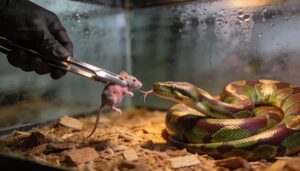
Your feeding tongs setup doesn’t need to be complicated. Warm thawed prey to near room temperature — cold food triggers refusal and disrupts feeding frequency guidelines.
Approach slowly, hold the prey steady at your reptile’s natural strike distance, and stay calm. These simple stress reduction techniques make a real difference.
Watch for feeding behavior observation cues like tongue-flicking — that’s your green light.
How to Hold Prey Securely Without Crushing It
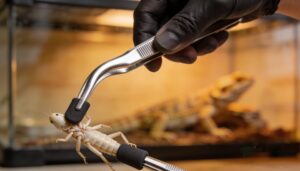
Your grip matters more than you think. Use the Pinch Grip Technique — hold prey firmly at the thorax, never the limbs.
Mind your Wrist Neutral Position to avoid uneven pressure that could crush soft tissue. Proper Prey Orientation keeps jaws facing away from you.
With stainless steel feeding tongs or soft‑tipped Zoo Med Angled Stainless Steel Feeding Tongs, Gentle Pressure Control and Edge‑Free Tips minimize risk and won’t damage its teeth.
Presenting Food Naturally to Encourage a Feeding Response
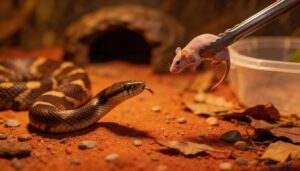
Once you’ve got a secure hold, how you move the prey matters just as much. Reptiles respond to motion, not stillness.
To Simulate Hunting Cues and trigger a natural strike:
- Mimic Prey Movement with short, slow bursts across the Natural Substrate
- Vary Prey Angles slightly so it doesn’t approach head-on
- Match Prey Temperature to enclosure ambient warmth
- Pause between movements to prompt a confident, deliberate strike
Your stainless steel feeding tools do the rest.
Preventing Accidental Bites on Metal Tongs
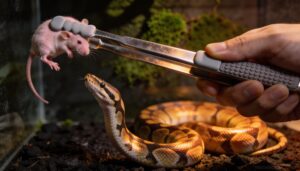
Even a perfect prey presentation can go sideways if your reptile catches metal instead of food. Hard tongs without Metal Edge Rounding can break its jaw on a missed strike.
Keep Prey Distance Control consistent — never dangle prey too close. Use an Anti-slip Handle with Grip Texture Design for steady control.
Run a quick Inspection Checklist before each session, checking for burrs.
Soft-tipped Zoo Med Angled Stainless Steel Feeding Tongs win the SoftTipped vs Hard Tongs Comparison when accuracy isn’t guaranteed yet — a smart part of safe feeding practices.
Safe Feeding Techniques for Shy, Defensive, or Fast Strikers

Not every reptile strikes with confidence. Shy, defensive, or lightning-fast feeders each need a slightly different approach.
- Shy feeders respond well to Gradual Exposure — dim Calm Lighting, a Low-Noise Environment, and spot-feeding near their hide.
- Defensive reptiles need slow, predictable movements and Prey Size Matching to reduce overstimulation.
- Fast strikers need Controlled Release — drop prey quickly using your Herpetology feeding tools before they lunge at the tongs.
What to Do if Your Reptile Refuses Food

Sometimes a refusal isn’t about your feeding techniques for reptiles and birds — it’s a signal.
Start with a quick Temperature Check and Humidity Adjustment, since digestion shuts down outside the ideal range. Then consider Diet Compatibility and Stress Reduction by minimizing handling.
If refusals continue despite solid reptile husbandry and nutrition basics, schedule a Veterinary Evaluation. One skipped meal isn’t panic-worthy, but a pattern always means something.
One skipped meal is not a crisis, but a pattern always means something
Clean and Store Tongs After Use
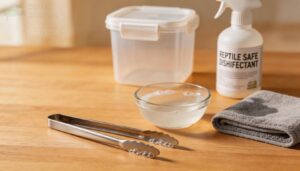
Feeding time isn’t over when your reptile swallows the last bite — your tongs still need attention. Skipping cleanup is one of the easiest ways to spread bacteria between animals or let your equipment wear out faster than it should.
Here’s what to do after every session to keep your tongs safe, clean, and ready for next time.
Washing Feeding Tongs After Every Feeding Session
Wash your tongs right after every feeding — don’t let prey residue sit and harden. Rinse them under warm soapy water for 15 to 20 seconds, then do a quick 60-second wipe-down.
Your tongs are dishwasher safe, which makes cleaning and sanitation simple. Keep a cleaning frequency log to build a consistent habit and support truly hygienic reptile feeding.
How to Sanitize Stainless Steel Tongs Properly
Washing removes the gunk, but sanitizing is what actually keeps your reptile safe. Here’s how to do it right:
- Use a food-grade sanitizer at the correct sanitizer concentration — too weak won’t work.
- Maintain proper contact time before rinsing or air-drying.
- Try boiling disinfection — five minutes in boiling water kills most pathogens.
- Run them through the dishwasher — these are dishwasher-safe feeding tools.
- Do a quick joint inspection after every sanitation cycle.
Preventing Cross-contamination Between Reptiles and Prey
Think of your tongs as one reptile’s tool — not a shared utensil. Dedicated enclosure tools stop bacteria, parasites, and mites from traveling between animals.
Use separate prey containers for thawing, and never bring feeding equipment near your kitchen sink. Hand hygiene practices matter too — wash up after every session.
Stainless steel feeding tools for reptiles make disinfecting surfaces simple, keeping hygiene in reptile care consistently high.
Checking Tips for Burrs, Bends, or Wear
Before your next feeding session, take thirty seconds to inspect jaw edges for burrs — tiny metal curls that can nick your reptile’s mouth. Detect burr formation by running a gloved finger along the tip.
Assess joint alignment by opening and closing the tongs smoothly. Check surface wear and test handle tightness too.
Even durable feeding tools built to last a lifetime need a quick look.
Drying and Storing Tongs to Prevent Rust and Damage
Damp tongs are a rust magnet, even with high quality stainless steel.
After washing, wipe them dry with a lint-free cloth, hold them open to reach the hinge, then let them finish with a 5–10‑minute Air Drying Technique on a Ventilated Drying Rack.
These durable feeding tools are Dishwasher safe feeding tools, but Moisture-Free Storage still matters — use a Protective Tip Sheath and skip humid drawers.
When to Replace Feeding Tongs for Safer Reptile Care
Even incredibly sturdy, rust resistant stainless steel feeding tools don’t last forever. Watch for corrosion signs, handle cracks, or spring fatigue that causes prey escape — those signal that replacement timing has arrived.
Replace your Reptile Feeding Tongs every 12 to 24 months under regular use, or sooner if grip fails. Dishwasher safe feeding tools hold up well, but worn metal still puts your reptile at risk.
Frequently Asked Questions (FAQs)
What is the best reptile for a first time owner?
Leopard geckos and bearded dragons are beginner friendly species that thrive in compact terrariums, tolerate easy handling, and have low humidity needs — making them cost effective, ideal first reptiles.
How long should snake feeding tongs be?
For most snakes, 12 to 14 inches is the sweet spot. It keeps your hand outside the strike zone while giving you solid control over the prey.
What should you not feed a lizard?
Avoid avocado toxicity, onion garlic, rhubarb oxalates, caffeinated snacks, and fruit seeds entirely.
Wild Wild insects carry pesticides too. Stick to safe, species-appropriate feeder insects and greens your lizard can actually digest.
Are you supposed to feed lizards every day?
Not every lizard eats daily — that’s a daily feeding myth worth breaking early. Age-based frequency and metabolic rate matter most.
Match your schedule to your species, or ask for veterinary guidance.
Can feeding tongs double as enclosure maintenance tools?
Yes, feeding tongs can handle light maintenance tasks, but keep separate sets for feeding and cleaning.
Cross-contamination between enclosures is a real risk if you skip proper Tool Sterilization Steps between uses.
How do tongs help with supplementing prey before feeding?
Tongs aren’t just for grabbing prey — they’re surprisingly handy during supplementing.
Use them for Gut-Load Transfer, Vitamin Powder Application, and Prey Hydration Boost without getting your hands messy or stressing your reptile.
Are feeding tongs safe for hatchlings and juveniles?
Feeding tongs are safe for hatchlings and juveniles when used correctly.
They reduce bite risk, maintain hand distance, prevent jaw injury, and support stress reduction — making them ideal reptile feeding equipment for young, sensitive animals.
Conclusion
Like a master chef wielding their trusty tongs, you’re now equipped to serve up a stress-free feeding experience for your reptile. By choosing the right feeding tongs for first-time reptile keepers, you’ll keep your fingers safe and your pet thriving.
As you practice, you’ll develop a rhythm that works for both you and your scaly friend. With patience and the right tools, you’ll open up a world of confident, enjoyable interactions that strengthen your bond and foster a lifelong connection.
- https://abuipet.com/products/abu-i-pet-18cm-plastic-luminous-tweezer-feeding-tongs-straight-for-reptile-white
- https://todayshomeowner.com/pest-control/reviews/best-snake-tongs/
- https://www.komodoproducts.com/komodo-angled-stainless-steel-feeding-tongs.html
- https://www.furrycritter.com/pages/articles/snakes/feeding_tongs_use.htm
- https://aestoney.com/products/snake-tongs/