This site is supported by our readers. We may earn a commission, at no cost to you, if you purchase through links.

Your snake doesn’t care that your hand smells like a thawed mouse. It cares that a warm, wiggling shape just appeared, and it strikes first and asks questions never. Bare fingers are a bad plan.
The fix costs less than a pizza. Snake feeding tongs for frozen prey keep your hand out of the strike zone, grip slippery food without crushing it, and survive months of rodent juice and bleach soaks. Cheap tongs bend, rust, or drop dinner mid-wiggle.
Below are seven tested picks, plus the length, material, and grip details that separate a reliable tool from a bent spoon. Choose well, and feeding night gets boring.
Table Of Contents
- Key Takeaways
- Top 7 Snake Feeding Tongs for Frozen Prey
- How to Choose Snake Feeding Tongs: Materials, Length, and Grip
- Why Use Feeding Tongs for Frozen-Thawed Snake Prey?
- How to Safely Thaw, Warm, and Offer Snake Prey With Tongs
- How to Clean, Disinfect, and Store Snake Feeding Tongs
- Frequently Asked Questions (FAQs)
- What are the best feeding tongs for snakes?
- Do snake tongs work?
- What is the best frozen food for snakes?
- Is it better to feed snakes live or frozen?
- How to feed a snake frozen food?
- How to force feed a snake that won’t eat?
- How to warm up frozen rats for snakes?
- Can I use feeding tongs for live prey?
- How often should I replace my feeding tongs?
- Can feeding tongs cause injury to the prey?
- Conclusion
Key Takeaways
- You’ll want stainless steel tongs at least 12 inches long (longer for adult pythons, boas, and deep enclosures) with serrated or soft-coated tips, because they keep your hand out of the strike zone and grip slippery thawed prey without crushing it.
- Every tong in the lineup has a trade-off, such as bending under pressure, sharp edges, flimsy grip, or short-lived rubber tips, so check the edges and sand off burrs before first use.
- You’ll get safer, calmer feedings by thawing prey in the fridge, warming it to about 98–100°F in sealed-bag water (never the microwave), and pulling uneaten prey after 30 minutes.
- You’ll make your tongs last for years by scrubbing them after each feeding, soaking them in a 1:32 bleach solution for five minutes, drying them completely, and replacing them the moment they bend, rust, or lose grip.
Top 7 Snake Feeding Tongs for Frozen Prey
Frozen prey is safe, cheap, and easy to store, but it still puts your hand near a snake that can’t tell dinner from fingers.
Using long tongs or forceps and a calm, consistent routine can help, and this guide to feeding snakes without getting bitten walks through the safest techniques.
The seven picks below are the snake feeding tongs worth your money, from budget tweezers to full-length stainless options. Read on and match one to your snake’s size, because a wrong choice is a bad day waiting to happen.
1. Snake Feeding Tongs Tool
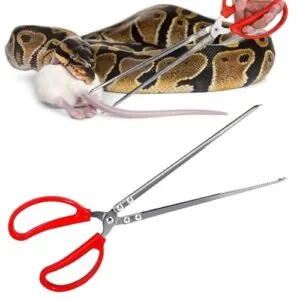
Tongs at 15 inches put real distance between your hand and a hungry ball python. That matters when your snake can’t tell dinner from fingers. The serrated jaws grip frozen-thawed rodents without much hand pressure, and the silicone sleeve keeps your hold non-slip.
At 6.74 ounces, they won’t tire your wrist during a multi-snake feeding night. The stainless steel body grips rodent fluids without trouble, and they’re easy to rinse clean.
Know the trade-offs. Some keepers say these bend under pressure, and the metal edges can be sharp. The grips may also close too easily, so grip with intent.
| Best For | Keepers who want safe distance with fast strikers or several snakes |
| Material | Silicone, stainless steel |
| Length | 15 inches |
| Dimensions | 15.51 x 4.49 x 0.75 inches |
| Tip Design | Serrated |
| Handle Type | Non-slip silicone |
| Weight | 0.19 kg |
| Use Case | Reptile feeding |
| Extras | Silicone sleeve grip |
Best For: Reptile keepers who want a safe distance when feeding fast-striking snakes or several snakes in one session.
| Material | Silicone, stainless steel |
|---|---|
| Length | 15 inches |
| Tip Design | Serrated |
| Handle Grip | Non-slip silicone |
| Weight | 6.74 oz (0.19 kg) |
| Use Case | Reptile feeding |
| Additional Features |
|
- The 15-inch length keeps your hand well away from a hungry snake.
- The serrated jaws grip frozen-thawed rodents without much hand pressure.
- The silicone sleeve gives a non-slip hold, and the 6.74-ounce weight is easy on your wrist.
- Some users report the tongs bend easily under pressure.
- The metal edges may be sharp and pose a cutting risk.
- The handles may close too easily, which can reduce control for some users.
2. Stainless Steel Reptile Feeding Tongs
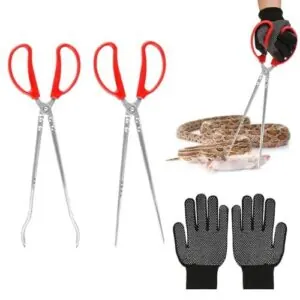
Your corn snake lunges at a thawed mouse. Where are your fingers? Behind 15 inches of 410 stainless steel, that’s where.
This set gives you two jaw styles, straight and elbow, both serrated and reinforced with rivets. Frozen-thawed rodents stay put mid-shake. That matters when you’re feeding several snakes back to back.
The red anti-slip handle keeps control in your hand, even when it’s wet. Jaws run 100 mm, the handle 110 mm, and the whole tool stretches 380 mm. The steel is rust-resistant, so rodent fluids won’t wreck it. Nylon gloves come in the box, an extra layer between you and a defensive snake.
Check the edges. Some keepers report sharp spots that could cut a snake’s mouth. Run a fingertip along the jaws before first use. Sand burrs smooth. Cheap fix, big payoff.
| Best For | Snake keepers who feed frozen-thawed rodents and need safe distance from defensive strikes without losing grip control |
| Material | 410 stainless steel |
| Length | 15 inches (380 mm) |
| Jaw Length | 100 mm |
| Handle Length | 110 mm |
| Color | Red |
| Tip Design | Serrated, riveted |
| Handle Type | Anti-slip ergonomic |
| Use Case | Reptile feeding |
| Additional Features | Includes nylon gloves, straight and elbow jaw design, dual pliers set |
Best For: Reptile keepers feeding bearded dragons, geckos, aquatic turtles, or ball pythons who want a safe distance from bites while keeping precise control.
| Material | 410 stainless steel |
|---|---|
| Length | 15 inches (380 mm) |
| Tip Design | Serrated, riveted |
| Handle Grip | Anti-slip ergonomic |
| Weight | N/A |
| Use Case | Reptile feeding |
| Additional Features |
|
- Durable 410 stainless steel resists rust.
- Straight and elbow serrated jaws reinforced with rivets suit different feeding and handling tasks.
- The anti-slip ergonomic handle gives a secure grip, and the 15-inch length keeps your hands away from bites.
- Some users report sharp edges that could injure reptiles.
- Sizes may vary slightly because the measurements were taken by hand.
- The color may look slightly different from the product images, depending on your monitor settings.
3. Reptile Feeding Tongs Stainless Steel
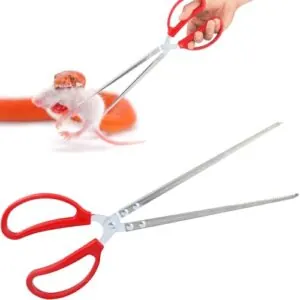
Same 15 inches of reach as the last pair, but WORFACE keeps it simpler. Your ball python strikes hard. Your fingers stay out of range.
If you feed frozen-thawed rodents, our guide to feeding tongs for frozen-thawed prey explains how to pick the right length and tip style for a safer, calmer mealtime.
The wide serrated jaw grips a frozen-thawed mouse firmly, and the stainless steel shrugs off rust. The red non-slip handle stays put in your palm. Pick straight or curved.
Now the caveats. Grip gets mixed reviews on small rodents and prey with skinny legs. Some keepers call the tongs flimsy. Rinse the jaw teeth right after feeding, because organic gunk packs into them fast. Hand-wash only.
| Best For | Keepers feeding frozen prey to defensive snakes in medium to deep enclosures |
| Material | Stainless steel |
| Length | Approx. 15 inches (38 cm) |
| Color | Red handle |
| Tip Design | Wide, blunt, serrated |
| Handle Type | Non-slip |
| Use Case | Reptile feeding |
| Additional Features | Rivet construction, straight or curved jaws |
Best For: Reptile keepers who feed frozen-thawed prey to defensive or strong-striking snakes, like ball pythons, and want to keep their fingers well out of range.
| Material | Stainless steel |
|---|---|
| Length | Approx. 15 inches (38 cm) |
| Tip Design | Wide, blunt, serrated |
| Handle Grip | Non-slip |
| Weight | N/A |
| Use Case | Reptile feeding |
| Additional Features |
|
- The 15-inch stainless steel build gives you safe reach and resists rust.
- The wide serrated jaw holds prey firmly, with minimal risk to your reptile.
- The red non-slip handle stays secure in your palm, and you can choose straight or curved jaws.
- Grip gets mixed reviews on small rodents and prey with skinny legs.
- Organic material packs into the jaw teeth, so you need to rinse them right after each feeding.
- Some keepers find the tongs feel flimsy despite the stainless steel.
4. EvaGO Curved Aquarium Tweezers
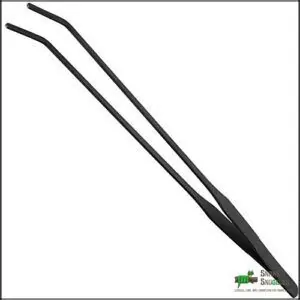
Aquarium tweezers, but make them snake-ready. EvaGO’s curved pair runs about 15 inches, so your hand stays well behind the strike zone. The curve lets you angle a thawed mouse down in front of your snake’s head.
Serrated tips hold slippery prey. The anti-skid handle helps when your palms sweat. At 4.66 ounces, forged stainless steel feels solid, not flimsy.
Caveat: the maker gives no tip size or angle specs, so expect some trial and error. It suits tarantulas too.
| Best For | Aquarium and exotic pet keepers who need a long, sturdy pair of tweezers for handling plants, corals, and live food for pets like bearded dragons, geckos, and tarantulas. |
|---|---|
| Material | Forged stainless steel |
| Length | About 15 inches |
| Tip Design | Curved, serrated |
| Handle Grip | Anti-skid |
| Weight | 4.66 oz |
| Use Case | Aquarium and exotic pet feeding |
| Additional Features |
|
- Curved, serrated tips pick up small objects and live food.
- The anti-skid handle gives you a firm grip.
- Forged stainless steel construction feels solid, and the roughly 15-inch length reaches well into tanks and enclosures.
- No details on tip size or angle precision, so it may not suit fine tasks.
- Little information on corrosion resistance beyond a protective coating.
- Sold as a single unit, so you’ll need to buy more if you want a spare.
5. Fri4Free Aquarium Tweezers
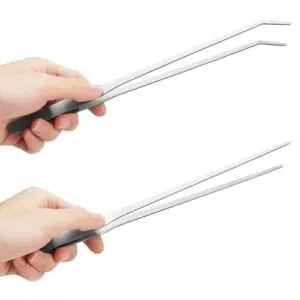
The Fri4Free set gives you two tools for one job: a straight tweezer and a curved one, each 10.6 inches (27 cm) long. That’s enough reach to keep your fingers out of strike range.
Straight grips the clean drop into a bowl or enclosure. Curved gets you around hides, rocks, and cork bark. Switch between them as the setup demands.
The serrated tips grip a thawed mouse without much fuss. Stainless steel resists corrosion, so repeated cleanings won’t wreck them. Using them in a saltwater tank? Rinse and dry them afterward. Skip that step and rust gets a vote.
Now the blunt part. Some users report they bend under pressure, and others call the grip flimsy. Don’t pry, don’t lever, and don’t hand them a heavy rat.
| Best For | Reptile and aquarium keepers who want one reach tool for feeding pets, placing tank plants, and handling light craft or kitchen jobs. |
|---|---|
| Material | Stainless steel |
| Length | 10.6 inches (27 cm) |
| Tip Design | Serrated |
| Handle Grip | N/A |
| Weight | N/A |
| Use Case | Reptile and aquarium feeding |
| Additional Features |
|
- Two 10.6-inch tweezers, one straight and one curved, keep your hands out of strike range
- Serrated tips grip small items like thawed food or plants securely
- Stainless steel resists corrosion and holds up to repeated cleanings
- Some users report the tweezers bend easily under pressure
- Grip quality gets mixed feedback, with some finding them flimsy
- Saltwater use means rinsing and drying them afterward to prevent rust
6. Oliss Reptile Feeding Tongs
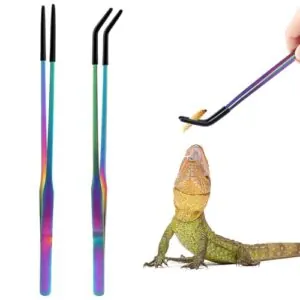
Why trust your bare hand around a feeding strike? Don’t. The Oliss pair gives you 10.63 inches of safe reach and weighs just 3.2 ounces, so your wrist won’t tire mid-session.
You get one straight tong and one angled tong. Use the straight one for dropping thawed mice onto the dish. Use the angled one for tucking food behind a hide or nudging a plant. Rubber tips grip slippery prey, and they work for bearded dragons, geckos, lizards, and shrimp too. They also stop insects from escaping.
Now the blunt part. Rubber tips may not last long with regular use, and some owners report fast wear. Expect to replace them eventually. Keep a spare pair handy, because a snake won’t wait while you shop. Skip very large prey too, because these tongs top out a few sizes up.
Short reach, cheap wear, solid control. Choose accordingly.
| Best For | Reptile and shrimp keepers who want to feed and rearrange their tanks without putting a bare hand near the animals, as long as the prey stays small to medium. |
|---|---|
| Material | N/A |
| Length | 10.63 inches |
| Tip Design | Rubber tips |
| Handle Grip | N/A |
| Weight | 3.2 oz |
| Use Case | Reptile and shrimp feeding |
| Additional Features |
|
- Rubber tips grip slippery food securely and help keep insects from escaping during feeding
- The straight and angled tongs give you precise control for dropping food and tucking it behind hides or around plants
- At 10.63 inches long and 3.2 ounces, the pair gives safe reach without tiring your wrist
- Rubber tips may not last long with regular use, and some customers report fast wear
- Very large prey items beyond a few sizes up are not a good fit
- Frequent users may need to replace the tips or keep a spare pair on hand
7. Stainless Steel Snake Feeding Tongs
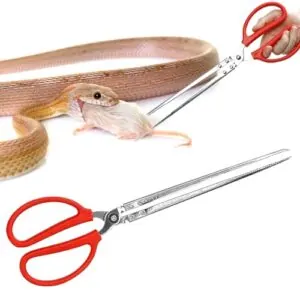
Think stainless steel is overkill for feeding a thawed rat? Fair question. But cheap tools bend, rust, and fail at the worst moment. These tongs don’t.
At 15 inches, they keep your hand well clear of the strike zone. The serrated non-slip tips grip slippery frozen-thawed prey, so you stay in control. Heavy duty stainless steel shrugs off rodent juices and repeated cleaning.
They weigh just 0.16 kg, so your wrist won’t tire. Use them on ball pythons, then switch to lizards, geckos, spiders, or aquarium fish. One tool, many mouths.
Know the limits. Rinse and dry them after every feeding, or you’ll invite spots. Keep them away from kids and pets. And don’t use them to pry or lift heavy loads. They’re feeding tongs, not a crowbar.
Buy once, rinse every time, and your fingers stay attached for years.
| Best For | Reptile and exotic pet owners who want a durable, long-reach tool for safely feeding snakes, lizards, geckos, spiders, or aquarium fish. |
|---|---|
| Material | Heavy duty stainless steel |
| Length | 15 inches |
| Tip Design | Serrated, non-slip |
| Handle Grip | N/A |
| Weight | 0.16 kg |
| Use Case | Snake, reptile, aquarium feeding |
| Additional Features |
|
- Heavy duty stainless steel resists bending, rust, and repeated cleaning.
- Serrated non-slip tips give a secure grip on slippery prey.
- The 15-inch length keeps your hand well away from the strike zone.
- Must be rinsed and dried after every use to avoid spotting.
- Needs to be stored out of reach of children and pets.
- Not suited to heavy lifting or prying tasks.
How to Choose Snake Feeding Tongs: Materials, Length, and Grip
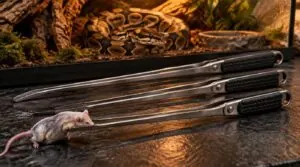
Great tongs come down to three things: material, length, and grip. Get them right and snake feeding tongs keep your fingers out of the strike zone. Here’s what to check, one point at a time.
If you’re new to feeding frozen-thawed prey, this beginner’s guide to snake feeding tongs explains which sizes and tip styles work best for your snake.
Material Durability And Hygiene
Cheap tongs rust. Then they stink. Then you’re picking flakes off a thawed rat.
Choose grade 304 or grade 316 stainless steel for real corrosion resistance. Feeding tool sanitation depends on it:
- Rust hides bacteria.
- Pitted metal won’t disinfect.
- Dead hinges drop prey.
Smooth stainless steel wipes clean and rinses fast. Stainless steel is commonly recommended for its strength, corrosion resistance, and ease of disinfection between feedings. Spend once, sanitize, and forget replacing tongs every season.
Length And Safe Reach
How close do you want your hand to a feeding snake? Exactly. Pick 12 inches as your floor. Juveniles do fine with 10 to 14. Adult pythons and boas need 18 to 24. Past five feet, go 36.
Deep enclosure? Go longer. Your hand should never cross into the strike zone. Shorter tongs don’t make you braver. They make you bitten.
In a deep enclosure, 16-inch reptile feeding tongs give you extra reach so your hand stays well clear of the strike zone.
Longer tongs keep your hand out of the strike zone, because shorter ones don’t make you braver, only bitten
Grip And Tip Design
Ever watch a thawed mouse fly across the room? Not fun.
Tips decide everything. Serrated tips grip without crushing. Rubber coating protects teeth.
Check these:
- Serrated tips for slippery prey
- Soft coating, safer for teeth
- Curved or straight, your call
- Nonslip handle, no drops
- Reinforced joints, zero wobble
Good feeding technique starts here.
Why Use Feeding Tongs for Frozen-Thawed Snake Prey?

Now that you’ve picked your tongs, here’s why they matter. Snakes strike at heat and movement. Your warm hand dangling a thawed mouse? Same signal. Tongs keep your fingers out of the strike zone and turn every safe feeding session into a calm routine.
| Benefit | What it does |
|---|---|
| Safety | Keeps hands outside strike range |
| Response | Mimics live prey movement |
| Hygiene | Limits skin bacteria on prey |
| Consistency | Places prey at the same spot |
Frozen prey adds another reason. It carries no live-rodent bites or parasites, and with proper thawing, tongs let you hold it at body temperature without smearing skin bacteria on it. Wiggle it slowly. Good feeding technique builds trust, and good reptile feeding is boring. Boring is always safe.
How to Safely Thaw, Warm, and Offer Snake Prey With Tongs
Tongs only work if the prey is right. Start with proper thawing. Move the sealed bag to the fridge at 32–40°F. Mice need 6–12 hours. Large rats? Up to 48. Counter thawing breeds bacteria. Skip it.
Then run your safe feeding session like a checklist:
- Wash your hands and sanitize the surface. That’s reptile feeding hygiene, not optional.
- Warm the sealed bag in 98–100°F water. No microwave. Cooked mouse helps nobody.
- Practice prey temperature monitoring. Aim for about 98.6°F. Pit-bearing snakes reject cold or hot meals.
- Grip behind the head, keep distance, and wiggle slowly. That’s hand safety during feeding.
- Pull uneaten prey after 30 minutes. Never refreeze.
Skip one step and your snake will absolutely notice. Boring wins. Every single time.
How to Clean, Disinfect, and Store Snake Feeding Tongs
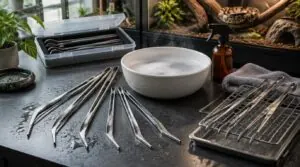
Your session ends when the snake eats. The tongs? They’re still dirty. Fix that now.
Cleaning and maintaining reptile feeding tongs takes five minutes. Scrub off debris with warm water and mild dish soap. Rinse until no suds remain. Then follow your reptile feeding tongs sanitizing protocols: soak in a 1:32 bleach solution for five minutes, or use chlorhexidine per the label. Stainless steel can also take boiling water for 5-10 minutes. Skip ammonia. It pits metal.
Dry them completely. Wet tongs rust. Rusty tongs hurt snakes. An absorbent microfiber drying towel wicks moisture from hinges and tips quickly, leaving no lint behind to trap water.
Reptile feeding tongs storage practices matter just as much:
- Keep them in a dedicated container, away from substrate dust.
- Choose a low-humidity spot.
- Label tongs per enclosure.
- Inspect tips and hinges monthly.
That’s reptile feeding proper care. Clean tools, calm snake.
Frequently Asked Questions (FAQs)
What are the best feeding tongs for snakes?
Buy 12-inch stainless steel tongs with wide, flat tips and a ratchet lock. They handle frozenthawed prey cleanly, keep your fingers out of strike range, and resist rust. Add silicone tips for grip. Skip serrated ones.
Do snake tongs work?
Tongs might be the cheapest life insurance in reptile keeping. They hold prey 12 to 15 inches from the strike, so feeding distance safety is built in. Fully thawed, 98°F prey stays secure, and your hands stay clean.
What is the best frozen food for snakes?
Your freezer is a pantry of tiny lifelines.
For most snakes, frozen mice win. Proper thawing makes thawed rodents safe, balanced prey. Big constrictors? Rats. Reptile feeding starts with feeding safety, so match prey size.
Is it better to feed snakes live or frozen?
Frozen wins. Frozen prey means no bites, no scratches, and far fewer parasites, so feeding safety jumps instantly. Thaw it fully, offer it with tongs, and keep your snake’s face intact.
How to feed a snake frozen food?
Picture a ball python lunging at a half-frozen mouse. Don’t. Do proper thawing overnight in the fridge, warm to 100-105°F, use feeding tongs for frozenthawed prey, keeping your hand 12-15 inches from the strike zone.
How to force feed a snake that won’t eat?
Force feeding is a last resort, not a shortcut. Call your vet first. Most feeding response avoidance is husbandry: fix temperatures, stress, and feeding frequency. Feeding safety means feeding tongs and frozen prey, never rushed.
How to warm up frozen rats for snakes?
Think the microwave’s faster? It’s also explosive.
Seal your frozen prey. Prey thawing duration runs 1-3 hours in cool water. Then try this prey warming technique: 100°F water. Thawed rodents release rodent scent, triggering strikes.
Can I use feeding tongs for live prey?
Tongs protect your fingers, not your snake.
Feeding live prey with tongs works, but gentle prey gripping matters. Pick rubber-coated tips, stay put, and pull the rodent if your snake struggles. Close supervision beats gear.
How often should I replace my feeding tongs?
Replace your tongs the moment they bend, rust, or lose grip. Good feeding tool maintenance and dry feeding tool storage practices stretch tool durability to years. Check the feeding tool tip design every few months.
Can feeding tongs cause injury to the prey?
Yes. Grip too hard and you’ll crush the prey. For feeding safety, hold the rear third lightly, pick a soft tip design, keep tongs clean against contamination risk, and release the moment your snake strikes.
Conclusion
Picture a hungry ball python, a thawed rat, and your bare fingers sharing six inches of air. Someone’s leaving with a bite.
Good snake feeding tongs for frozen prey fix that for pocket change. Pick stainless steel, at least 12 inches long, with grooved tips that hold without crushing. Rinse them, soak them, dry them, and they’ll outlast your snake’s growth spurts.
Boring feeding nights are the goal. Tongs deliver them. Your fingers stay yours.