This site is supported by our readers. We may earn a commission, at no cost to you, if you purchase through links.
A boa constrictor’s strike covers roughly two feet in under half a second—faster than most people can pull their hand back. Experienced keepers learn this early, often the hard way.
The right feeding tongs create critical distance between your fingers and a feeding response that doesn’t distinguish between a rat and your thumb. Length matters, tip design matters, and build quality matters more than most budget picks suggest.
What follows cuts through the noise to show you exactly what to look for and which models hold up when your boa means business.
Table Of Contents
- Key Takeaways
- Best Feeding Tongs for Boa Constrictors
- Choosing The Right Tong Length
- Safest Tip Designs for Boas
- Durability and Cleaning Features
- Safe Feeding Techniques With Tongs
- Frequently Asked Questions (FAQs)
- How often should I replace my feeding tongs?
- Can I use feeding tongs for multiple snakes?
- What if my boa refuses food with tongs?
- Should I wiggle prey or hold it still?
- Are curved or straight tongs better for boas?
- Can tongs double as a handling hook substitute?
- How often should feeding tongs be fully replaced?
- Do tongs work well for live prey feeding?
- Are tongs safe for feeding inside water dishes?
- Conclusion
Key Takeaways
- Tong length isn’t a preference — match it to your boa’s size, with adults over five feet requiring at least 18 inches to stay outside the strike zone.
- Rubber or silicone tips protect your boa’s teeth and jaw on impact, making tip material just as critical as reach when choosing a pair.
- Clean your tongs after every feeding with a reptile-safe disinfectant, and swap out cracked rubber tips every three to six months before they become a hygiene risk.
- How you present prey matters — dangle it at head height, move it slowly, and let your boa strike on its own terms instead of tapping or forcing the feed.
Best Feeding Tongs for Boa Constrictors
Finding the right feeding tongs for a boa constrictor isn’t just about convenience — it’s about keeping both you and your snake safe every single feeding session.
The right pair makes a real difference — check out this guide to safe snake feeding tongs by length to find the best fit for your boa.
The options below cover a range of sizes, tip styles, and builds to match different boa setups and keeper preferences.
Here are seven solid picks worth your attention.
1. Vodolo Stainless Steel Snake Feeding Tongs
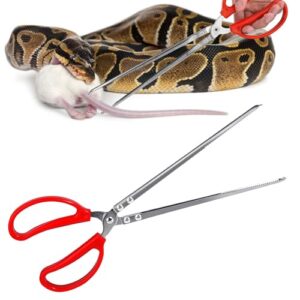
The Vodolo Stainless Steel Snake Feeding Tongs are a solid choice if you’re feeding a medium-to-large boa. At 15 inches, they keep your hand comfortably outside striking range, ensuring safety during feeding sessions.
The serrated jaws lock onto thawed rodents without slipping, securely holding even heavier prey in place. This reliable grip eliminates risks during handling.
Pairing that firm grip with a longer reach is why many keepers choose snake feeding tongs for frozen prey to keep their hands safely clear of a striking ball python.
Constructed from stainless steel, these tongs withstand repeated disinfection without rusting, maintaining hygiene effortlessly.
The silicone-coated handle provides a secure, comfortable grip, replacing the strain of bare metal with confident control.
Lightweight and balanced, they minimize hand fatigue, making extended feeding sessions comfortable and manageable.
| Best For | Snake owners who feed medium-to-large constrictors and want a safe, reliable way to offer prey without risking an accidental bite. |
|---|---|
| Material | Stainless steel + silicone |
| Length | 15 in (38 cm) |
| Jaw Type | Serrated |
| Unit Count | 1 |
| Price | $7.99 |
| Reptile Feeding Use | Yes |
| Additional Features |
|
- The 15-inch length keeps your hand well out of striking range, which is a genuine relief with defensive feeders.
- Serrated jaws hold thawed rodents firmly — no fumbling or dropping mid-feed.
- Stainless steel plus silicone handles means it cleans up easily and holds up in humid terrarium conditions.
- The rigid jaws can be tricky to position precisely if your snake is quick or skittish.
- The handle may feel a bit bulky if you have smaller hands.
- A few buyers have run into shipping delays, so it’s worth ordering ahead if you need it by a specific date.
2. Duedusto Ergonomic Snake Feeding Tongs
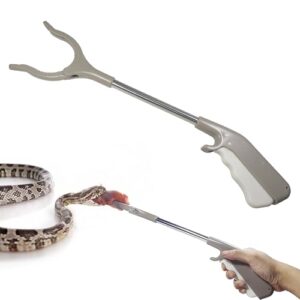
Duedusto Ergonomic Snake Feeding Tongs are worth considering for a refined feeding experience. At 16 inches, they keep your hand safely out of strike range without feeling cumbersome.
The trigger-style handle works with one hand, a practical feature when your other hand is occupied with managing a tank lid.
Textured rubber tips ensure a firm grip on prey, preventing damage to soft tissue.
At $8.99, the price is hard to argue with — though note that plastic components may wear faster under consistent aggressive feeding.
| Best For | Snake keepers who feed fast-striking species like ball pythons or boas and want a reliable, budget-friendly tool that handles a range of prey sizes. |
|---|---|
| Material | Stainless steel + plastic |
| Length | 16 in (41 cm) |
| Jaw Type | Textured rubber tips |
| Unit Count | 1 |
| Price | $8.99 |
| Reptile Feeding Use | Yes |
| Additional Features |
|
- 16-inch length keeps your hand well clear of quick strikers, giving you real peace of mind at feeding time.
- Dual-grip zones work with both tiny pinkies and full-grown mice, so one tool covers most of what you’ll need.
- At $8.99, it’s an easy buy — solid value for a feeding tong that actually does its job.
- Rubber tips can get gouged if your snake latches on, which makes them trickier to clean and sanitize.
- Holding larger prey takes a firm, sustained grip — could get fatiguing if you’re feeding multiple animals in one session.
- Most of the build is plastic, so durability might become a concern if you’re working with aggressive, heavy feeders over time.
3. Stainless Steel Reptile Feeding Tongs
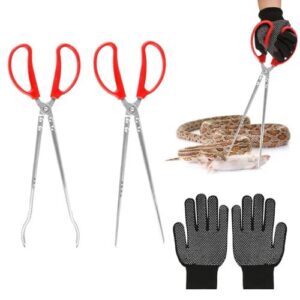
This set is designed for more demanding feeding sessions, offering two tongs — one straight, one curved — crafted from 410 stainless steel with serrated, rivet-reinforced jaws. The curved jaw proves genuinely useful for angled strikes in deeper enclosures, enhancing versatility.
At 15 inches, the reach suits medium boas effectively. Silicone-textured grips ensure a firm hold even mid-lunge, prioritizing control during use.
A pair of nylon gloves is included, adding a practical safety layer that complements the tools without compromise.
| Best For | Reptile keepers who regularly feed medium-to-large snakes or lizards and want a reliable, versatile set that keeps their hands safely out of striking range. |
|---|---|
| Material | 410 stainless steel |
| Length | 15 in (380 mm) |
| Jaw Type | Serrated + rivet-reinforced |
| Unit Count | 2 (straight + curved) |
| Price | Not listed |
| Reptile Feeding Use | Yes |
| Additional Features |
|
- Two jaw styles (straight and curved) give you options for different enclosure depths and feeding angles.
- 410 stainless steel holds up to repeated cleaning without rusting or degrading over time.
- Serrated, rivet-reinforced jaws grip prey securely so it doesn’t slip mid-feed.
- Serrated tips can be too rough for small or delicate feed items — not ideal for tiny insects or pinky mice.
- The fixed 15-inch length may feel awkward in smaller tanks or fall short in very deep setups.
- No rubberized tips, which some keepers prefer to reduce stress or injury to prey.
4. Pankousa Stainless Steel Reptile Feeding Tongs
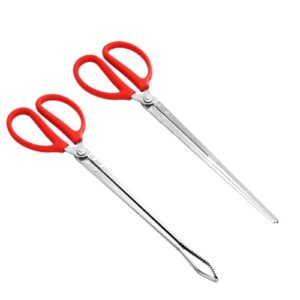
If you’re on a tighter budget, the Pankousa tongs are worth considering. At 15 inches, they keep your hand safely away from the strike zone when handling medium-sized boas. The stainless steel construction ensures rust resistance, making them suitable for wet or humid enclosures.
The serrated tips securely grip thawed prey with minimal hand pressure, enhancing control during feeding.
However, some units exhibit stiffness and imperfect alignment, which can complicate single-handed operation. While adequate for juvenile snakes, buyers should carefully inspect build quality before purchase.
| Best For | Budget-conscious reptile keepers, beginners, or parents looking for a safe, affordable feeding tool for small to medium snakes. |
|---|---|
| Material | Stainless steel + silicone |
| Length | 15 in (38 cm) |
| Jaw Type | Serrated |
| Unit Count | 2 |
| Price | $9.98 |
| Reptile Feeding Use | Yes |
| Additional Features |
|
- Stainless steel build resists rust, so they hold up fine in humid tanks or wet environments.
- The 15-inch length keeps your hand well out of strike range during feeding.
- Serrated tips grip live or thawed prey securely without needing much hand pressure.
- Some units come stiff or slightly misaligned, making one-handed use a bit awkward.
- The build isn’t the most rigid — they can bend under heavier loads or bigger prey.
- Only two tongs in the set, and they may not cut it for larger, heavier feeders.
5. Stainless Steel Feeding Tongs
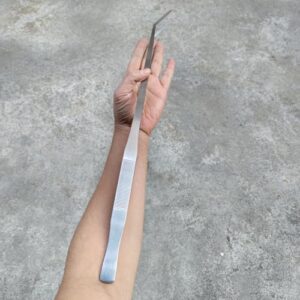
At 18.7 inches, the OAIDVEUY stainless steel tongs provide just enough reach to stay outside a boa’s strike zone without feeling unwieldy. Their lightweight design (198 grams) ensures wrists won’t tire during feeding sessions.
The tongs feature a rounded, polished steel tip, which helps avoid mouth injuries when presenting prey. However, grip strength may fall short with medium or large rats, limiting their versatility for larger specimens.
For smaller boas or frozen-thawed mice, these tongs remain a solid $12.99 pick, balancing safety and affordability effectively.
| Best For | Hobbyists feeding smaller boas or snakes with frozen-thawed mice who want a safe, budget-friendly option. |
|---|---|
| Material | Stainless steel |
| Length | 18.7 in (47.5 cm) |
| Jaw Type | Plain stainless |
| Unit Count | 1 |
| Price | $12.99 |
| Reptile Feeding Use | Yes |
| Additional Features |
|
- At 18.7 inches, it keeps your hand well outside a snake’s strike zone
- Lightweight at 198g, so your wrist won’t fatigue during longer feeding sessions
- Hard to beat at $12.99 for a solid everyday feeding tool
- Grip isn’t strong enough for medium or large rats, so it’s limited with bigger prey
- Can rust if exposed to moisture regularly without proper care
- Not suitable for saltwater environments or humid setups without diligent maintenance
6. Zoo Med Stainless Steel Feeding Tongs
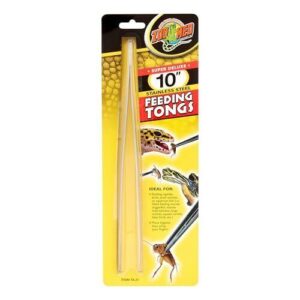
Zoo Med has built a solid reputation in reptile care, and their stainless steel feeding tongs are no exception. The rust-resistant construction withstands humid enclosures without breaking down, and the non-porous tips won’t harbor bacteria between feedings. This ensures a hygienic and durable tool for daily use.
The rounded tip design prioritizes safety, minimizing the risk of injury during a boa’s strike. Measuring 10–15 inches, these tongs are optimally sized for juvenile or medium-sized boas, though they may not suit large adults.
Clean, practical, and backed by a trusted brand, these tongs offer a reliable choice for everyday feeding sessions.
| Best For | Reptile, amphibian, and fish owners who hand-feed small live prey like crickets, worms, or larvae and want to keep their fingers safe. |
|---|---|
| Material | Stainless steel |
| Length | 10 in (25 cm) |
| Jaw Type | Straight narrow |
| Unit Count | 1 |
| Price | Not listed |
| Reptile Feeding Use | Yes |
| Additional Features |
|
- Stainless steel build holds up in humid tanks and is easy to clean between feedings
- At nearly 10 inches long, it keeps your hand a safe distance from quick strikers
- Narrow jaws grip small feeders securely without crushing them
- Jaws may feel too bulky for very small or juvenile animals that need more precise handling
- Not a great fit for large prey items or bigger snakes that need a wider grip
- Some users report receiving open packaging, so a good rinse before first use is a smart move
7. Lasnten Extra Long Rubber Tip Reptile Tongs
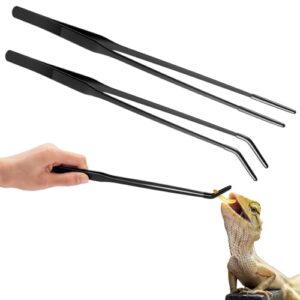
If you’re on a tight budget but still want solid protection, the Lasnten set is worth a look. You get two tongs—one straight, one curved—both around 10 inches with black rubber tips and a stainless steel core.
The rubber cushions each strike and protects your boas’ mouths. That said, 10 inches is short for adult boas, so treat this as a starter option. As your snake grows, upgrade to something longer.
| Best For | Budget-conscious beginners who keep smaller reptiles and want basic hand protection while feeding. |
|---|---|
| Material | Stainless steel |
| Length | 10.6 in (27 cm) |
| Jaw Type | Serrated tips |
| Unit Count | 2 (straight + curved) |
| Price | Not listed |
| Reptile Feeding Use | Yes |
| Additional Features |
|
- Two-tong set (straight and curved) gives you options depending on how your reptile feeds
- Rubber-coated tips cushion each strike and are easy to clean between feedings
- Stainless steel build keeps them sturdy without adding much weight
- At around 10 inches, they’re too short for adult boas or large enclosures
- No locking mechanism means you have to manually hold them the whole time
- Rubber tips can wear down fast if your reptile is an aggressive feeder
Choosing The Right Tong Length
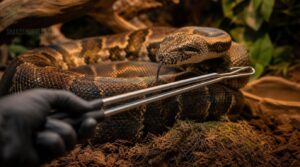
Tongs length isn’t just a preference — it’s the difference between a safe feeding and an unexpected bite.
The right length depends on your boa’s size, temperament, and the setup of its enclosure. Here’s what you need to know before picking up a pair.
Why Adult Boas Need 18–24 Inch Tongs
Adult boas don’t play around at feeding time — their strike radius can exceed two feet in a split second. That’s exactly why 18–24-inch tongs are the standard for handling large constrictors with extended-reach tongs. Members can enjoy Cold Blooded Prime free shipping on these tools.
- Strike Radius Management — keeps your hand well outside the danger zone
- Hand Clearance Buffer — 18–24 inches ensures zero accidental contact
- Deep Habitat Access — best extra reach for large, complex enclosures
- Stress Mitigation — calm, controlled delivery reduces boa anxiety
- Keeper Confidence Boost — longer boa feeding tools mean steadier hands
Safety guidelines for feeding boas consistently point to long tongs as non-negotiable for adults.
When 12–15 Inch Tongs Are Acceptable
Not every boa needs a two-foot reach. For juvenile boa reach situations, and smaller adult boas under six feet, 15-inch length boa feeding tools hit the sweet spot. They offer Tight Enclosure Fit and Low Profile Maneuvering without the awkwardness of long tongs in cramped spaces.
Vertical Habitat Access remains manageable, Small Prey Grip stays secure, and safety guidelines for feeding boas are still met comfortably.
Why 10 Inch Tongs Are Risky
Ten-inch tongs are inherently a liability with a boa constrictor. Reach limitation puts your fingers dangerously close to the strike zone — no safety buffer length, no margin for error. Bite force transfer shoots straight to your hand, and hand fatigue sets in fast.
Mouth protection failure and prey escape potential rise together.
Handling large constrictors with extended-reach tongs isn’t optional — it’s the baseline for safety during reptile feeding.
Matching Tong Length to Boa Size
Matching tong length to your boa’s size isn’t complicated — it just takes honest growth stage scaling. A juvenile under 3 feet can use 12-inch tongs. Once your boa reaches 4 feet, switch to 15-inch tongs. At 6 feet and beyond, 18–24-inch tongs are standard for safe reach.
- Under 3 ft – 10–12 inches
- 3–5 ft – 12–15 inches
- 5–7 ft – 18 inches minimum
- 7 ft+ – 24 inches for full safety buffer length
Feeding Distance for Defensive Boas
Defensive boas require more than appropriate tongue length—they also need proper feeding distance. Watch for Defensive Posture Signals such as a coiled S-shape or rapid head turns toward you; these cues indicate the need to retreat.
| Boa Behavior | Distance Calibration Routine |
|---|---|
| Calm, slow tongue flicks | 12–15 inches |
| Tense, tracking keeper | 18–24 inches |
A Strike Zone Buffer, established through Visual Cue Assessment, ensures predictable feeding. For defensive boas, extra-long or 15-inch-length tongs are non-negotiable—they serve as the baseline for safe Distance Calibration Routine and confident Handling large constrictors with extended-reach tongs.
Safe Reach in Deep Enclosures
Deep enclosures add another layer of complexity. Enclosure geometry matters here — vertical tanks require Vertical Access and Extendable Grips to keep hands well clear.
For vertical tank feeding, extra-long tongs or a 15-inch length create a real safety buffer length.
Staff positioning at a slight angle, combined with safety barriers, makes handling large constrictors with extended-reach tongs far more controlled.
Safest Tip Designs for Boas
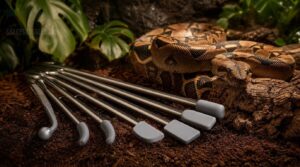
The tip design of your tongs matters more than most people expect. A wrong tip design can hurt your boa’s mouth, ruin a feeding response, or send a frozen rat sliding across the floor mid-strike.
To avoid these issues, focus on tip types worth knowing before you buy. Understanding these options ensures safer, more effective feeding sessions for your boa.
Rubber Tips for Mouth Protection
Rubber tips are quietly one of the most important features on your tongs. When a boa strikes, impact absorption kicks in immediately — the soft rubber cushions the bite rather than letting hard metal jam against delicate teeth. That’s real snake mouth protection, not marketing language.
Rubber tips cushion a boa’s strike so the tongs protect teeth, not just your hands
Here’s why rubber tip durability matters for boa constrictor feeding:
- Bite Cushioning softens the force of a full strike, protecting the jaw from unnecessary stress.
- Pressure Distribution spreads contact evenly across the prey, reducing pinch points in the boa’s mouth.
- Material Flexibility lets the tip conform slightly on contact, which means less tooth snagging.
- Tip Hardness in the Shore A 40–60 range balances grip with gentleness — firm enough to hold prey, soft enough to protect.
- Rubber tip wear is easy to spot; cracking or hardening means it’s time to swap them out.
With rubber-coated tongs for boa feeding, you’re not just gripping a rat — you’re controlling the entire interaction safely.
Silicone Tips for Softer Prey Grip
Silicone tips take prey grip one step further than rubber. Their material softness and customizable hardness let you match tip firmness to prey size—soft for small mice, firmer for weaned rats.
The tactile feedback through a silicone sleeve handle provides precise control, while temperature insulation ensures your hand remains neutral during handling.
Silicone’s microbial resistance guarantees safer, cleaner feedings for your boa constrictor, maintaining hygiene with every use.
Blunt Paddle Tips Versus Pointed Tips
Blunt ends win on safety for your boa constrictor. A paddle-style grab spreads pressure distribution across a wider contact area, cutting tissue trauma risk during fast strikes.
Pointed tips offer better placement precision with smaller prey, but they concentrate force dangerously.
For rubber-coated tongs used in boa feeding, blunt designs also deliver better grip stability and a lower wear rate on repeated use.
Serrated Metal Tips for Heavy Prey
When you’re handling heavy prey for a large boa, metal serrated tips earn their place. Their serration geometry creates multiple contact points that lock onto prey firmly—that’s your prey retention efficiency working as intended. The load distribution across each tip prevents slippage mid-strike.
Stainless construction delivers serious corrosion resistance, ensuring durability in demanding conditions. Worn tips support easy tip replacement, maintaining functionality over time.
Best for large snakes, full stop.
Preventing Tooth, Jaw, and Mouth Injuries
A boa’s mouth is surprisingly fragile. Sharp or rigid tong tips can chip teeth, strain the jaw, or bruise soft tissue — and that damage compounds over time. Think of it like custom mouth guards for your snake: the right tip absorbs impact instead of transferring it.
- Always use rubber-coated tongs for boa feeding to cushion each strike
- Follow a consistent prey thawing protocol — frozen prey causes jaw strain
- Factor in bite force assessment when choosing tip hardness
- Practice jaw hygiene practices by cleaning tongs after every session
- Schedule regular dental inspections with your vet to catch early damage
Grip Strength for Frozen-thawed Rodents
Frozen-thawed rodents are stiffer than fresh prey — and that firmness directly affects how well your tongs hold on. Thawing protocols matter here: inconsistent thaw times alter prey texture, making grip unpredictable.
Rubber-coated tongs outperform serrated tips in these situations, providing a secure grip without slipping. This design excels for boa feeding, ensuring reliability despite texture variations caused by thawing inconsistencies.
Temperature effects and pull speed standardization are critical when handling large constrictors with extended-reach tongs. Both factors influence control and safety during feeding.
Durability and Cleaning Features
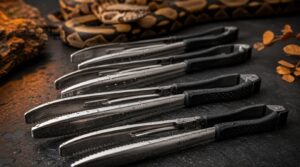
A good pair of tongs isn’t just about length or tip style—how they’re built and how easy they are to clean matters just as much. Durability and hygiene are critical factors when selecting the right tool.
Boas are fed weekly, which means your tongs endure frequent use and must withstand wear without becoming a rust-covered biohazard. Prioritize materials and designs that ensure longevity and effortless maintenance when these essential qualities are at stake.
Stainless Steel Construction for Rust Resistance
Good tongs start with good steel. Medical-grade stainless steel relies on a passivation process driven by chromium content above 10.5% — that thin oxide layer is what keeps rust away, even after repeated bleach cleanings. Molybdenum alloying and an electropolishing finish take it further, resisting pitting from disinfectants.
Pairing that with consistent maintenance practices, your rubber-coated tongs for boa feeding remain reliable for years.
Thick Bars for Adult Boa Strikes
Steel quality matters, but so does what it’s shaped into. Thick metal bar construction ensures rubber-coated tongs remain stable when an adult boa lunges hard. This design prioritizes durability in high-stress feeding scenarios.
The bar thickness provides torque resistance, preventing bending under significant strike force. This structural integrity is critical for maintaining control during aggressive feeding interactions.
A heavy-duty grip surface texture further enhances reliability by preventing prey from spinning, thereby reducing the risk of snake strikes. This feature makes feeding safer and more predictable.
Strong Hinges and Locking Mechanisms
Thick bars only get you so far — the hinge is where tongs either hold up or fail you. Heavy‑Duty Hinges and an Interlocking Lock Design keep everything aligned when handling large constrictors with extended‑reach tongs. Look for:
- Tamper‑Resistant Pins that won’t loosen mid-feed
- Sealed Bearing Housings that block grime buildup
- Magnetic Quick Release for fast, controlled access
- Strong hinge construction rated for repeated high‑torque strikes
- Heavy duty stainless steel for long‑term durability of heavy‑duty feeding tongs
Rubber‑coated tongs for boa feeding need hardware that matches their build quality.
Non-porous Materials for Better Hygiene
Material matters more than most keepers realize. Non-porous surfaces don’t absorb bacteria — they let sanitizers do their job properly. When comparing options, prioritizing such surfaces ensures hygiene protocols function as intended.
Rustproof steel with a High-Gloss Finish and Gapless Joints leaves nowhere for contamination to hide. These features — rustproof steel, smooth finishes, and seamless construction — transform Bacterial Resistance and Sanitizer Compatibility into practical realities.
In material safety comparisons, stainless steel consistently emerges as the superior choice. Its inherent properties make it the reliable backbone of robust cleaning and sanitation protocols for feeding tools.
Disinfecting Tongs After Every Feeding
Clean tongs aren’t optional — they’re part of the job. After every feeding, wash with warm water and dish soap, then apply a reptile-safe disinfectant and respect the contact time: one to five minutes minimum. Rinse completely, then air dry on a raised rack.
Use color coding to separate enclosures and log each cleaning. That’s proper cross-contamination prevention in practice.
Replacing Cracked Rubber or Silicone Tips
Once a tip starts cracking, it’s already a liability. Build a crack inspection routine before every feeding — rubber tips usually last 6–12 months, so replacement lifespan tracking keeps you ahead of failures.
Check secure fit verification and attachment hardware checks each session. Silicone sleeves endure and outlast plain rubber on heavy prey.
For rubber-coated tongs used in boa feeding, keep spare tip storage stocked and ready.
Storing Tongs to Prevent Contamination
Where you store your tongs matters just as much as how you clean them. Use dedicated containers—a labeled storage bag or a sealed case works well. Drop in a desiccant pack to handle moisture control.
Color-coded segregation keeps each snake’s tools separate, cutting cross-contamination risk fast.
Conduct regular inspections of containers, too. Cracks trap bacteria, just like worn tips do.
Safe Feeding Techniques With Tongs
Having the right tongs is only half the equation — how you use them matters just as much. A few simple habits can mean the difference between a smooth feeding and an accidental bite.
Here’s what you need to know before your next session.
Using Tongs Instead of Bare Hands

Your bare hand looks exactly like warm prey to a hungry boa. That’s where hand bite prevention starts — not with reflexes, but with tongs.
They minimize scent transfer minimization by keeping your skin away from the feeding zone entirely.
Heavy-duty implements also reduce handler fatigue during longer sessions and support training consistency feeding after feeding; this makes preventing accidental bites in reptile enclosures genuinely reliable.
Holding Prey Securely by The Scruff

Grip the prey at the scruff — that firm pinch behind the neck — using rubber-coated tongs for boa feeding. Proper grip positioning ensures the prey remains steady, eliminating guesswork in prey stabilization.
Light finger pressure applied through heavy-duty, extra-long tongs with rubber tips enables precise hand alignment without hovering over the strike zone. This small adjustment significantly reduces risks.
By maintaining control and distance, handlers achieve clean hand alignment, directly contributing to preventing accidental bites and stress minimization for both the feeder and the boa.
Presenting Prey Without Stressing The Boa

How you present prey matters just as much as what you’re offering. A quiet feeding area and predictable timing help your boa stay calm and focused. With rubber-coated tongs for boa feeding, controlled prey motion does the rest.
Pairing good technique with safe prey prep—thawing properly and warming it to body temperature—makes a real difference, so it’s worth reviewing solid snake feeding techniques before your next meal session.
And since hygiene and proper thawing matter as much as presentation, a solid guide to preparing snake food helps you avoid the mistakes that cause most health issues.
- Dim the lights before starting
- Present prey at head height
- Wiggle slowly — no sudden jerks
- Watch for stress cues like tail coiling
- Allow two minutes for response before stopping
Releasing Prey After a Secure Strike

Controlled release motion is everything here — a smooth, slow withdrawal lets the snake reposition without thrashing. Do not rush the release after your boa strikes and locks on. Rubber-coated feeding tongs provide the grip control that makes this easy.
| Release Step | Why It Matters |
|---|---|
| Wait for full bite | Prevents prey rebound |
| Withdraw tongs smoothly | Avoids jaw misalignment |
Post-release observation for 30–60 seconds confirms the boa is feeding calmly within the enclosure clearance zone. Finish with a quick mouth inspection routine to detect any minor injuries early.
Avoiding Nose Tapping or Force Feeding

Nose tap prevention starts with patience. Tapping a boa’s snout — or pushing prey toward it — causes stress, breaks teeth, and triggers feeding refusal. Instead, focus on gentle prey placement: dangle the thawed rodent slightly upward and let the boa strike on its own terms.
Rubber-coated tongs for feeding boas make hands-free feeding easy, keeping you clear while enabling gradual exposure training through calm, consistent sessions.
Washing Hands After Handling Prey
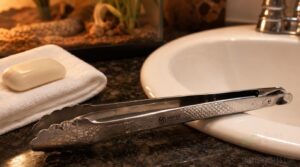
Soap usage matters more than most keepers realize after every feeding session. Prey scent on your hands is a real bite trigger.
- Scrub with soap for at least 20 seconds
- Rinse thoroughly, then focus on hand drying with a clean towel
- Use a sanitizer alternative if soap isn’t handy
Tool cleaning follows the same logic—cross-contamination prevention means wiping tongs down too.
Preventing Food Association With Hands

Clean hands are only half the equation. Boas learn fast, and if prey odor keeps showing up on your skin, they’ll start connecting your hand with food. That’s a bite waiting to happen.
Use scent-free gloves, establish a dedicated feeding station, and commit to a handless presentation ritual with rubber-coated tongs for boa feeding. Prey odor masking and cross-contamination prevention aren’t extras — they’re your baseline.
Frequently Asked Questions (FAQs)
How often should I replace my feeding tongs?
Replace tongs every 6–12 months under heavy use. Your inspection schedule matters — check weekly for rust, cracks, or loose hinges. Rubber tips wear faster, needing swaps every 3–6 months.
Can I use feeding tongs for multiple snakes?
Yes, you can — but scent management matters. Use dedicated enclosure tongs per snake, or wash thoroughly between uses.
If you’re navigating a multi-snake household, feeding multiple snakes together safely covers the practical protocols that keep each animal calm and properly fed.
Color-coded labeling prevents cross-contamination.
Separate storage keeps feeding responses predictable and cross-feeding prevention simple.
What if my boa refuses food with tongs?
Your boa might just be sending a signal. Check temperature tweaks first — warm side below 78°F kills appetite fast.
Consistent feeding times, prey size adjustment, and health diagnostics usually solve it.
Should I wiggle prey or hold it still?
Try both. Some boas respond to a slow wiggle technique, while others prefer static presentation. Match movement pacing to your snake’s mood — calm, deliberate prey motion cues usually win.
Are curved or straight tongs better for boas?
Both work, but curved tongs win for most setups. Their natural angle improves strike alignment and enclosure reach, while straight tongs offer better grip stability in open tanks.
Match the design to your wrist ergonomics and enclosure layout.
Can tongs double as a handling hook substitute?
Tongs can substitute for a hook in a pinch. Longer 18–24 inch models offer lever advantage and enclosure navigation, while rubber-coated tips aid stress mitigation — but they’re not a perfect replacement.
How often should feeding tongs be fully replaced?
For most hobbyists, a 12–18 month replacement schedule works well. Inspect regularly—rust spots, cracked tips, or stiff hinges are clear wear indicators. Replace sooner if something feels off.
Do tongs work well for live prey feeding?
Yes, tongs work well for live prey.
They allow precision prey delivery at a safe distance, improving prey-capture efficiency while supporting handler safety and reducing prey stress throughout the strike.
Are tongs safe for feeding inside water dishes?
Absolutely — like steady hands guiding a ship through rough water, rubber-coated tongs maintain water surface stability, ensuring prey escape prevention and supporting smart hand positioning for operators.
This design guarantees safe water dish feeding through heavy-duty construction, while prioritizing snake strike safety and operator confidence.
Conclusion
Even the old-timers who learned snake keeping from library books and word of mouth figured out one truth the hard way: distance saves fingers. The right feeding tongs for boa constrictors aren’t a luxury—they’re the line between a clean feeding session and a trip to urgent care.
Choose the right length, protect the jaws, keep the steel clean, and your boa eats well. Respect the strike. Every single feeding.