This site is supported by our readers. We may earn a commission, at no cost to you, if you purchase through links.

A reptile’s body temperature isn’t regulated from within—it depends entirely on what you provide. Get the heat wrong, and a bearded dragon stops digesting. A ball python refuses to eat. A blue-tongued skink sits motionless at the cool end, slowly losing condition.
The basking zone isn’t a comfort feature; it’s a life-support system.
Choosing the right heat lamps for reptile terrariums means understanding wattage, infrared output, mounting position, and safety ratings—not just grabbing whatever fits the socket.
The options below cut through the noise and point you toward what actually works.
Table Of Contents
- Key Takeaways
- Types of Heat Lamps for Reptile Terrariums
- Key Features to Look for in Heat Lamps
- Choosing The Right Wattage and Size
- Temperature Control and Regulation
- UVB and UVA Lighting Benefits
- Safety Considerations for Heat Lamp Use
- Top 10 Heat Lamps for Reptile Terrariums
- 1. XFP Reptile Heat Lamp Thermostat
- 2. Fluker Repta Clamp Heat Lamp
- 3. Bourdserk Adjustable Reptile Lamp Stand
- 4. Zoo Med Repti Basking Spot Lamp
- 5. Fluker Ceramic Heat Emitter
- 6. Exo Terra Solar Glo UV Lamp
- 7. Philips BR40 Heat Lamp Bulb
- 8. Neptonion Reptile Dome Lamp
- 9. Briignite Dimmable Reptile Heat Lamp
- 10. ToxiRium Reptile UV Light Fixture
- Installation and Placement Tips
- Maintenance and Longevity of Heat Lamps
- Frequently Asked Questions (FAQs)
- Do terrariums need heat lamps?
- What’s the difference between a basking lamp and a heat lamp?
- Can you put a heat lamp in a reptile tank?
- How far should heat lamps be from basking spots?
- Can you use multiple heat lamps together safely?
- Do heat lamps work at night for nocturnal species?
- Whats the ideal temperature gradient in a terrarium?
- How do you measure temperatures accurately in enclosures?
- Can I use multiple heat lamps together?
- How often should bulbs be replaced?
- Conclusion
Key Takeaways
- Your reptile can’t regulate its own body heat, so the basking zone you create isn’t a luxury — it’s what keeps digestion, behavior, and overall health running.
- Matching lamp type to your setup matters: incandescent and halogen bulbs drive daytime basking, ceramic heat emitters handle overnight warmth without disrupting sleep cycles, and mercury vapor bulbs cover heat, UVA, and UVB all at once.
- 10-gallon tank needs 25–40 watts, while a 40-gallon setup calls for 75–100 watts, and screen tops bleed heat faster than glass, so you’ll need to adjust accordingly.
- A PID thermostat holds temps within 1°F of your target, which is far more reliable than on/off units, and pairing it with a digital probe thermometer at basking level gives you an accurate read of what your reptile actually experiences.
Types of Heat Lamps for Reptile Terrariums
Not all heat lamps work the same way, and the type you choose will shape your reptile’s entire environment. Each option regulates heat, light, and night cycles differently — so matching the right lamp to your setup matters more than most keepers realize.
Getting this right starts with understanding your species — factors like origin and room temperature all play into whether your snake actually needs nighttime heat.
Here are the five main types worth knowing before you buy.
Incandescent Basking Bulbs
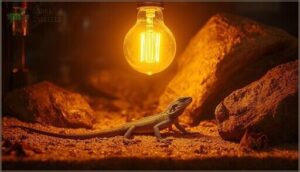
Incandescent basking bulbs are the classic starting point for most reptile keepers. They produce focused Heat Spot Focus through direct Infrared Emission, warming basking surfaces to 95–110°F depending on wattage and distance.
Reptile heat lamps can reach up to 120°F(https://talis-us.com/blogs/news/how-hot-do-reptile-heat-lamps-get) for desert species.
- Available in 25–100 watt options for flexible temperature control
- Color Temperature runs around 2700–3000K, giving a natural daylight look
- Filament Lifespan averages one to four months with daily use
- Energy Efficiency is lower than LEDs, but upfront cost stays minimal
Halogen Basking Bulbs
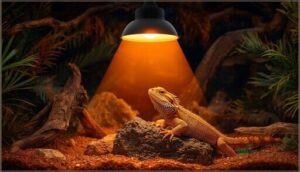
Halogen basking bulbs push beyond what incandescent options offer. Their Infrared Spectrum Efficiency targets Infrared-A and Infrared-B wavelengths, delivering Heat Spot Precision that penetrates deeper into reptile tissue.
Beam Angle Optimization varies by model — Exo Terra’s 40-degree spread suits focused basking zones.
Energy Consumption Rates run lower than incandescents, and Bulb Lifespan Factors reach 2,000 hours. Pair with a dimmer for steady temperature control. The infrared halogen lamp provides up to 2,000 hours of efficient operation.
Ceramic Heat Emitters
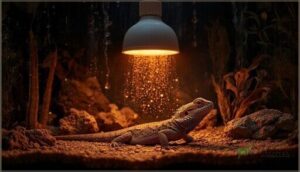
Where halogens leave off, ceramic heat emitters take over — especially after dark.
These units produce no visible light, making Silent Night Heating possible without breaking your reptile’s day-night cycle.
Their Infrared Emission Spectrum targets IR-A and IR-B wavelengths with an Energy Efficient Design that converts nearly all electricity into usable warmth.
Expect Long-Term Durability of 6,000 to 10,000 hours, solid Thermal Uniformity, and reliable temperature control throughout your Reptile Habitat Essentials setup.
Infrared Heat Lamps
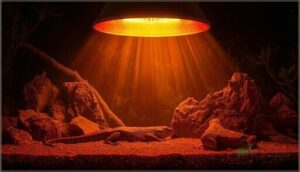
Infrared bulbs bridge the gap between visible basking light and pure ceramic heat emitter function. They emit IR-A and IR-B wavelengths — Infrared Spectrum Penetration that reaches deep tissue for effective temperature regulation.
Vacuum Aluminizing Efficiency boosts output by up to 35 percent, while Bulb Longevity Factors, like automated wire processing push lifespan to 3,000 hours.
Smart heat source selection starts here.
Mercury Vapor and UVB Bulbs
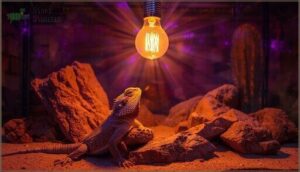
Mercury vapor bulbs are the closest thing to bottled sunlight you’ll find for reptile enclosures. A single bulb manages Heat‑UVB Balance by delivering basking heat, UVA, and UVB lighting simultaneously.
- UVB Decay Rate matters: premium bulbs lose under 30% output before replacement
- UVB Measurement Techniques using a Solarmeter 6.5 confirm real UVI at basking height
- Species UVB Needs vary — desert lizards need far stronger UVB supplementation than forest dwellers
Replace bulbs on Bulb Lifespan Metrics, not when they burn out.
Key Features to Look for in Heat Lamps
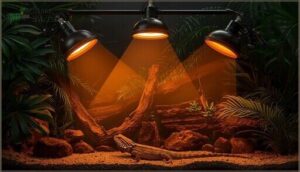
Not every heat lamp on the market is worth your reptile’s safety. Knowing which features actually matter helps you cut through the noise and pick something that works.
Here are the key things to check before you buy.
Adjustable Temperature Controls
temperature swings are one of the fastest ways to stress a reptile. That’s why adjustable temperature controls matter so much.
PID thermostats with Smart Thermostat Integration and Adaptive Pulse Control hold temps within 1°F.
Wireless Temperature Sensors, Custom Temperature Profiles, and Energy Saving Modes give you dual control without guesswork.
| Thermostat Type | Accuracy | Best Use |
|---|---|---|
| PID Dimming | ±1°F | Basking bulbs |
| Pulse Proportional | ±1–2°F | Ceramic emitters |
| On/Off | ±2–4°F | Heat mats |
Dome Reflectors and Mounting Options
Where mount your dome reflector shapes everything about your basking zone.
Deep Dome Efficiency pushes heat deeper into large enclosures, while Shallow Dome Intensity concentrates heat fast in compact setups.
Clamp Angle Adjustability lets you dial in the exact beam angle, and Stand Height Flexibility accommodates varied terrarium sizes.
Alloy Reflector Materials and a reflective interior increase output, while a lamp guard adds a critical safety barrier.
E26 Ceramic Sockets
The socket holding your heat source matters more than most keepers realize. E26 ceramic sockets bring Ceramic Material Strength that resists warping under sustained heat, plus Thermal Shock Tolerance through repeated on/off cycles.
Their High‑Wattage Rating — often 660W/250V — supports any ceramic heat emitter you’ll run.
Bracket Mount Options simplify installation, and 18 AWG Wiring keeps connections stable.
Bulb compatibility covers incandescent, halogen, and CHE formats without adapters.
Built-in Safety Mechanisms
A good heat lamp should protect your reptile — and your home.
Look for a Thermal Fuse that permanently cuts power if internal temps spike past 120–150°C.
A Safety Cage prevents burns from direct contact. Ventilation Slots reduce fire risk by letting heat escape. An Overheat Indicator gives you a visual warning before damage occurs.
Always confirm a UL Certification Mark or equivalent on any fixture you buy.
Choosing The Right Wattage and Size
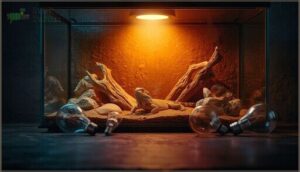
Wattage isn’t one-size-fits-all — the right choice depends on your tank size, your reptile’s needs, and how heat moves through the enclosure. Get it wrong and you’ll end up with cold spots, overheating, or a stressed animal.
Here’s what to think about before picking your lamp.
Matching Lamp Wattage to Terrarium Volume
Wattage scaling guidelines start with one simple rule: match heat output to the size of your terrarium.
10-gallon tank needs just 25–40 watts. Step up to a 40-gallon, and you’re looking at 75–100 watts.
Screen tops bleed heat fast, so adjust accordingly.
Use a thermometer to confirm your temperature gradient — terrarium volume metrics matter more than guesswork.
Adjusting for Reptile Species Needs
Not every reptile wants same heat. Bearded dragons need diurnal basking temps of 108–113°F, while ball pythons rely on nocturnal heat strategies using warm hides at 86–90°F.
Arboreal height placement matters too — chameleons need lamps 12–18 inches above perches.
Juveniles run warmer than adults.
During brumation temperature cycles, scale wattage down gradually.
Heat Gradient and Distribution
Think of your terrarium as a temperature map, not a single setting.
Horizontal Gradient Design means placing the lamp over one end — basking side hits 95–110°F, cool end stays 72–80°F.
Vertical Stratification Zones let arboreal species climb to regulate.
Monitor Surface Air Temperature differences with an infrared and probe thermometer.
Microzone Placement Strategies — rocks, hides, plants — shape the gradient without changing wattage.
Temperature Control and Regulation
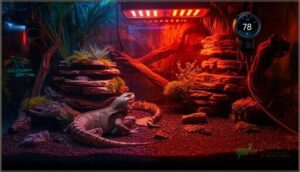
Getting the temperature right isn’t just about picking a good bulb — it’s about keeping conditions steady day and night.
A reliable thermostat, consistent light cycles, and accurate monitoring tools all work together to keep your reptile safe.
Here’s what you need to know about each.
PID Thermostats and Dimmers
PID thermostats use proportional, integral, and derivative algorithms — PID Algorithm Tuning fundamentally — to hold temperatures within 0.5–1°F of your setpoint.
Unlike basic on/off units, their Dimming Voltage Control ramps heat up and down smoothly, reducing bulb stress and flicker.
Check Load Capacity Limits (generally 600–1,000W) and confirm Thermostat Calibration before relying on any smart PID modes for Gradient Monitoring.
Maintaining Day and Night Cycles
Once your PID thermostats have temperature locked in, light timing becomes the next lever. Photoperiod Scheduling keeps your reptile’s Circadian Rhythm Support on track — aim for 10–12 hours of light daily, then true darkness at night.
- Use Smart Timers or smart plugs for consistent on/off cycles
- Shift day length by no more than 30 minutes weekly for Gradual Light Transitions
- Run Night Heat Emitters like ceramic heat emitters for warmth without disrupting darkness
- Pair your thermostat with a dimming or pulsing feature to simulate dawn and dusk
- Adjust light cycles seasonally — roughly 14 hours in summer, 10 in winter
Monitoring With Thermometers and Hygrometers
Even the best thermostat can’t tell you what’s actually happening at ground level.
That’s why combining a digital probe thermometer with a temp gun covers both air and surface readings.
Place one probe directly under the basking bulb, and another at the cool end.
Digital models beat analog for accuracy — most analogs drift 10–20%.
For humidity gradient mapping, position your hygrometer mid-wall, away from water bowls.
UVB and UVA Lighting Benefits
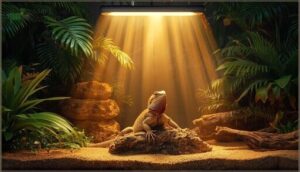
Light does more than just brighten your reptile’s enclosure — it drives core biological processes that keep them healthy. UVB and UVA exposure directly affect vitamin D3 production, natural behavior, and overall wellbeing.
Here’s what you need to know about how the right lighting benefits your reptile from the inside out.
Supporting Vitamin D3 Synthesis
UVB light is the engine behind your reptile’s calcium metabolism — without it, even a calcium‑rich diet falls short. Reptiles synthesize vitamin D3 when exposed to UVB wavelengths between 280 and 320 nanometers, which drives intestinal calcium absorption.
Without UVB light, even a calcium-rich diet cannot fuel a reptile’s vitamin D3 synthesis or bone health
UVB intensity and lamp distance both matter here.
- Place UVB lighting 12–18 inches above the basking spot
- Pair UVB and heat lamp selection carefully to avoid overlapping hot zones
- Use plain dietary calcium most days; skip high-D3 supplements unless a vet advises otherwise
Mimicking Natural Sunlight
Matching natural sunlight means more than just UVB. Spectral balance matters — quality UVA and UVB bulbs cover ultraviolet through infrared, with daylight color temperatures around 6500 Kelvin for accurate solar spectrum matching.
Photoperiod simulation keeps cycles consistent: 12 hours on, 12 off work for most diurnal species. Sunrise dusk ramping, using a controller to dim gradually, helps natural rhythms far better than abrupt switching.
Health Impacts on Reptile Behavior
Lighting shapes behavior more than most keepers realize.
Watch for these Heat Stress Signs and UVB Deficiency Effects before they escalate:
- Low Temperature Lethargy — leopard geckos drop activity by 50% below 22°C.
- UVA Activity Boost — proper basking spot UVA extends monitor basking 20%, improving digestion.
- Thermal Gradient Stress — without escape zones, reptile health deteriorates fast.
Temperature regulation for reptiles and heat lamp safety aren’t optional — they’re survival basics.
Safety Considerations for Heat Lamp Use
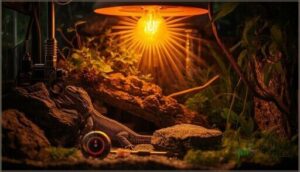
Heat lamps run hot — and that’s exactly why safety can’t be an afterthought. key factors separate a well-designed setup from a fire hazard or an injured animal.
what to watch before you plug anything in.
Overheat Protection and Fire Hazards
A heat lamp running without limits is a slow-moving fire hazard. Surge Protector Use and GFCI outlets catch ground faults before they escalate. Cord Routing Safety matters too — keep cords away from dome housings entirely.
Infrared Temperature Monitoring lets you spot hot zones above 110°F fast. Thermostat Calibration every few months keeps readings honest. And Fire Extinguisher Placement in the room isn’t paranoia — it’s standard heat lamp safety practice.
| Risk Factor | Safe Threshold | Action Required |
|---|---|---|
| Basking surface temp | Under 120°F | Reposition lamp |
| Cord near dome | No contact | Reroute immediately |
| Thermostat probe drift | Verify monthly | Recalibrate against digital thermometer |
| Breaker load (multi-lamp) | Staggered cycling | Use separate thermostats |
| Enclosure air spike | Within set range | Enable smart plug shutoff |
Heat-Resistant Materials and Clamps
Your fixture materials matter as much as the bulb itself. Ceramic Socket Durability keeps connections stable under sustained high wattage — porcelain won’t melt, whereas plastic eventually will.
Aluminum Dome Conductivity disperses heat evenly, while heat‑resistant aluminum metal housing stands up to 150W mercury vapor loads.
Rubber Clamp Grip locks the clamp mount firmly without slipping.
Silicone Insert Sealing and a Graphite Clamp Finish round out a setup built for long‑term safety features that you can actually rely on.
Proper Lamp Placement and Distance
Even the best fixture fails if it’s in the wrong spot. Position your basking spot lamp directly overhead — not off to the side — so heat hits your reptile’s back evenly.
Start at 12 inches for 100W bulbs, then use Distance Increment Testing and Thermal Imaging Checks to fine-tune.
Perch Height Safety and Spot Overlap Ratio keep your heat distribution accurate without burns.
Top 10 Heat Lamps for Reptile Terrariums
Here are ten heat lamps worth considering for your reptile setup in 2026. Each one was selected based on safety features, temperature control, and real-world usability.
Let’s break them down one by one.
1. XFP Reptile Heat Lamp Thermostat

The XFP Reptile Heat Lamp Thermostat takes the guesswork out of temperature management. Its PID dimming technology adjusts power output gradually, keeping temperatures stable between 68°F and 122°F without the constant on-off cycling that stresses bulbs.
The LED display shows ambient temperature, output percentage, and your target setting at a glance.
A built-in light sensor automatically drops temperature by 4°F at night — no manual adjustment needed.
ETL-certified with an E26 ceramic socket, it supports up to 300W and fits most standard terrarium setups.
| Best For | Reptile and amphibian owners who want hands-off temperature control for bearded dragons, geckos, turtles, snakes, and similar pets. |
|---|---|
| Material | Aluminum |
| Wattage | 300W max |
| Socket Type | E26 |
| Color | Black |
| Weight | 1.43 lbs |
| Reptile Compatible | Yes |
| Additional Features |
|
- Stable temperature control from 68°F to 122°F keeps your pet’s habitat consistent without constant babysitting
- LED display makes it easy to check ambient temp and your target setting at a glance
- ETL-certified with a ceramic E26 socket — supports up to 300W and works with most standard setups
- No mention of a probe or sensor included, so setup details aren’t totally clear upfront
- 300W max may not be enough for larger enclosures needing serious heat output
- Limited color option (black only), which might not suit every terrarium aesthetic
2. Fluker Repta Clamp Heat Lamp

Where the XFP manages the brains, the Fluker Repta Clamp Lamp manages the brawn.
Its 8.5-inch heavy-gauge aluminum dome accommodates bulbs up to 150 watts — enough output for most mid-size enclosures.
The ceramic socket works with incandescent, ceramic heat emitters, and compact fluorescent bulbs, so you’re not locked into one bulb type.
A secure clamp attaches to terrarium rims of varying sizes, and the swivel head lets you dial in the exact basking angle your reptile needs.
| Best For | Reptile owners with mid-size to larger enclosures who need a reliable, flexible heat source that works with multiple bulb types. |
|---|---|
| Material | Aluminum |
| Wattage | 150W max |
| Socket Type | Ceramic |
| Color | No color |
| Weight | 1 lb |
| Reptile Compatible | Yes |
| Additional Features |
|
- Handles up to 150 watts, so it’s got plenty of power for bigger tanks
- Ceramic socket plays nice with incandescent, ceramic heat emitters, and CFLs
- The swivel head makes it easy to aim heat exactly where your reptile likes to bask
- Gets hot with extended use, so placement matters
- A few users ran into bulb failures, which hints at some quality control inconsistencies
- The clamp design may not fit every terrarium style or rim thickness
3. Bourdserk Adjustable Reptile Lamp Stand
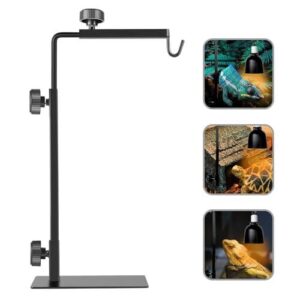
Sometimes the lamp is only half the setup — stand matters just as much. The BOURDSERK Adjustable Reptile Lamp Stand gives you a sturdy all-metal pole that adjusts from 15.7 to 74.3 inches, covering everything from a small gecko tank to an oversized tortoise enclosure.
Its 360-degree swing arm places heat exactly where your reptile basks. Tool-free assembly takes under five minutes. One note: some users report instability at full extension, so add a counterweight if you’re running multiple dome lamps.
| Best For | Reptile and amphibian owners who need a flexible, adjustable lamp setup for tanks of different sizes. |
|---|---|
| Material | Metal |
| Wattage | Not specified |
| Socket Type | Standard |
| Color | Black |
| Weight | 2.16 lbs |
| Reptile Compatible | Yes |
| Additional Features |
|
- All-metal build feels solid and holds up over time
- The 360-degree swing arm makes it easy to dial in exactly where the heat hits
- Tool-free setup means you’re up and running in just a few minutes
- Can get wobbly at full extension, especially with heavier lamps
- Sections may shift or come apart when you move it around
- Build quality isn’t always consistent — some users got a sturdier unit than others
4. Zoo Med Repti Basking Spot Lamp
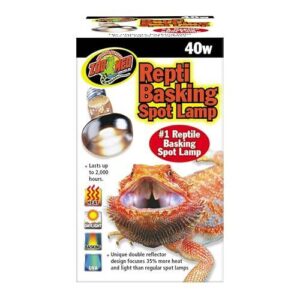
Zoo Med’s Repti Basking Spot Lamp (Model SL-40) earns its place through one standout engineering detail: a patented double reflector that focuses roughly 35 percent more heat and light into a tighter beam than standard spot bulbs. For bearded dragons and iguanas, that means a clearly defined basking zone without overheating the cool side.
It delivers UVA rays to support natural behavior, though you’ll need a separate UVB source.
Available in wattages from 25 to 250, there’s a fit for nearly any enclosure size.
| Best For | Reptile owners keeping bearded dragons, iguanas, or other tropical and desert species who need a focused, well-defined basking spot in their terrarium. |
|---|---|
| Material | Aluminum |
| Wattage | Not specified |
| Socket Type | Standard |
| Color | Silver/Grey |
| Weight | 1.41 oz |
| Reptile Compatible | Yes |
| Additional Features |
|
- The double reflector pushes more heat and light into a tighter beam, so your reptile actually gets a proper basking zone instead of scattered warmth
- Comes in a wide range of wattages (25–250W), making it easy to match the bulb to your enclosure size
- Delivers UVA rays that support your reptile’s natural behavior and psychological well-being
- Doesn’t produce UVB, so you’ll need to buy a separate bulb to cover your reptile’s full lighting needs
- Like any bulb, it’ll need replacing over time, which adds to the ongoing cost
- No built-in guidance on lifespan, so it’s not always clear when it’s time to swap it out
5. Fluker Ceramic Heat Emitter
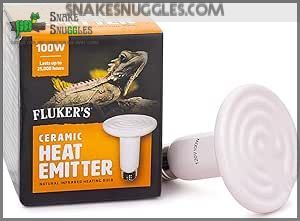
Fluker’s Ceramic Heat Emitter runs quietly in the background — no light, just steady infrared warmth. That makes it ideal when your reptile needs heat through the night without any disruption to its natural cycle.
The 100-watt model spreads heat across a wide circular face, reducing the risk of a single scorching hot spot.
Mount it at one end of the enclosure to build a proper gradient.
Use only a ceramic socket dome — never plastic — and pair it with a thermostat for safe, consistent temperature control.
| Best For | Reptile owners who need reliable overnight heat without disturbing their pet’s natural day-night cycle. |
|---|---|
| Material | Ceramic |
| Wattage | 100W |
| Socket Type | Standard |
| Color | Not specified |
| Weight | 6.4 oz |
| Reptile Compatible | Yes |
| Additional Features |
|
- No light emitted, so your reptile gets steady warmth around the clock without sleep disruption
- Wide circular face spreads heat more evenly, cutting down on dangerous hot spots
- Works with most standard terrarium setups and is straightforward to install
- Doesn’t produce UVB or visible light, so you’ll still need a separate bulb for species that require it
- Gets extremely hot — you’ll need a thermostat and a ceramic socket dome to use it safely
- Requires a separate thermometer or thermostat to monitor temps, adding to the overall cost
6. Exo Terra Solar Glo UV Lamp

The Exo Terra Solar Glo does something most bulbs can’t — it combines UVB, UVA, visible light, and heat in a single 125-watt mercury vapor lamp. That means one fixture covers basking, UV synthesis, and warmth simultaneously.
It penetrates about 12 inches, so your reptile absorbs usable UVB at a safe distance.
Keep it at least 30 centimeters from the basking surface. Don’t use dimmers or cycling thermostats with this bulb — mercury vapor lamps need steady power to last.
| Best For | Reptile owners who want an all-in-one lighting solution for bearded dragons, turtles, or other UVB-dependent pets. |
|---|---|
| Material | Mercury Vapor |
| Wattage | 125W |
| Socket Type | Standard |
| Color | Not specified |
| Weight | 7.8 oz |
| Reptile Compatible | Yes |
| Additional Features |
|
- Combines UVB, UVA, heat, and visible light in one bulb — no need for multiple fixtures
- Supports calcium metabolism and helps prevent metabolic bone disease
- Penetrates up to 12 inches, giving your reptile room to bask at a safe distance
- Some users report bulbs burning out within just a few months
- Pricier than most standard reptile bulbs on the market
- Not compatible with dimmers or cycling thermostats, and may not fit all fixtures
7. Philips BR40 Heat Lamp Bulb
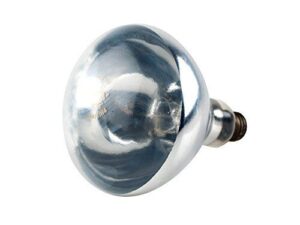
The Philips BR40 isn’t built for reptiles specifically — but it gets the job done.
At 250 watts, this infrared bulb creates basking spots up to 100°F and delivers instant heat with no warm-up time.
Its BR40 reflector shape focuses radiant energy directly where your reptile needs it.
The E26 base fits standard dome fixtures and ceramic sockets without adapters.
Energy costs run around $7.83 annually.
won’t supply UVB, so pair it with a separate UVB source.
| Best For | Anyone who needs a reliable heat lamp for bathrooms, cold rooms, or indoor accent lighting — and reptile owners looking for an affordable basking bulb on a budget. |
|---|---|
| Material | Glass |
| Wattage | 250W |
| Socket Type | Medium screw |
| Color | Warm White |
| Weight | 0.01 oz |
| Reptile Compatible | No |
| Additional Features |
|
- Pumps out serious heat at 250 watts — great for warming up bathrooms or creating a solid basking spot
- Fits standard medium screw base fixtures, so no adapters or special hardware needed
- Low annual energy cost of around $7.83 keeps ongoing expenses minimal
- Doesn’t produce UVB, so reptile owners will need a separate UVB bulb
- Not dimmable, which limits how much control you have over light and heat levels
- Can’t ship to California, and may be too intense for smaller spaces
8. Neptonion Reptile Dome Lamp
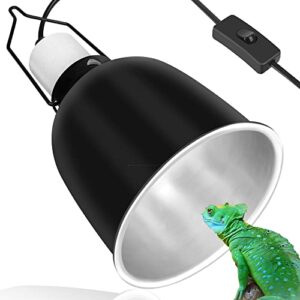
The Neptonion Reptile Dome Lamp keeps things simple — and that’s exactly what makes it useful.
Its 8.5-inch polished aluminum reflector focuses heat and UVB directly into your basking zone, while the E26 ceramic socket accommodates bulbs up to 100 watts without softening under heat.
Ventilation holes on top let hot air escape, extending bulb life.
The inline on/off switch adds daily convenience.
Note: it doesn’t include a bulb, so you’ll choose one based on your species’ specific needs.
| Best For | Reptile owners who want a reliable, no-frills dome lamp that works with a wide range of bulbs and can handle the heat. |
|---|---|
| Material | Ceramic/Glass |
| Wattage | 100W max |
| Socket Type | E26 |
| Color | Black |
| Weight | 15.8 oz |
| Reptile Compatible | Yes |
| Additional Features |
|
- Polished aluminum dome directs heat and light right where your pet needs it
- Ceramic socket handles up to 100 watts and won’t warp over time
- Ventilation holes help bulbs last longer by letting heat escape
- No bulb included, so it’s an extra purchase before you’re up and running
- The on/off switch placement bugs some users depending on their setup
- May not play nice with certain UVB bulbs due to electrode depth limitations
9. Briignite Dimmable Reptile Heat Lamp
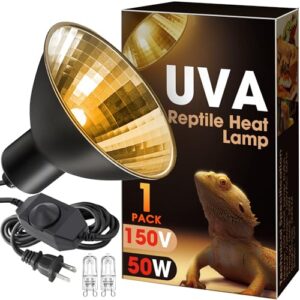
The Briignite Dimmable Reptile Heat Lamp gives you real control over basking temperatures — something fixed-output bulbs simply can’t offer.
Its 50-watt G9 halogen bulb produces UVA-rich, daylight-like heat, while the aluminum dome reflector concentrates warmth into a focused basking spot.
Dimming the output lets you dial in precise temperatures for smaller species like geckos without overheating the enclosure.
Note: it doesn’t include UVB, so you’ll need a separate UVB source for species requiring vitamin D3 synthesis.
| Best For | Reptile owners who want precise temperature control for species like bearded dragons, geckos, and chameleons. |
|---|---|
| Material | Aluminum/Plastic |
| Wattage | 50W max |
| Socket Type | G9 |
| Color | Not specified |
| Weight | 4.2 oz |
| Reptile Compatible | Yes |
| Additional Features |
|
- Dimmable output lets you fine-tune basking temps without swapping bulbs
- Aluminum reflector focuses heat right where your reptile needs it
- Comes with two G9 bulbs, so you’ve got a spare ready to go
- Short cord can be a hassle depending on your tank setup
- A few users reported the lamp breaking sooner than expected
- No UVB output, so you’ll need a separate light for species that need vitamin D3
10. ToxiRium Reptile UV Light Fixture
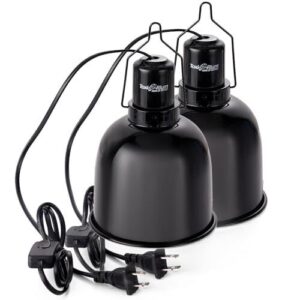
If you need UV coverage alongside focused heat, the ToxiRium Reptile UV Light Fixture supports both. Its 5.5-inch deep dome uses an optical reflector to concentrate UVA and UVB light directly onto the basking spot — no wasted output scattering sideways.
The ceramic E26 socket supports up to 100W and won’t deform under continuous daily use.
Ventilation holes on top manage heat buildup well.
One consideration: wire length is short, so positioning near an outlet matters.
| Best For | Reptile owners who want one fixture that handles both UV lighting and focused heat for a basking spot. |
|---|---|
| Material | Aluminum |
| Wattage | 100W max |
| Socket Type | E26 |
| Color | Black |
| Weight | 2.14 lbs |
| Reptile Compatible | Yes |
| Additional Features |
|
- The 5.5-inch deep dome with optical reflector keeps UVA/UVB light aimed right where your reptile needs it
- Ceramic E26 socket handles up to 100W and holds up to daily use without warping
- Built-in ventilation helps prevent overheating and keeps bulbs lasting longer
- Some buyers have received defective units, so quality control can be hit or miss
- The wire is short, which limits where you can place the fixture
- No labels on the power switch, so you have to guess which position is on or off
Installation and Placement Tips
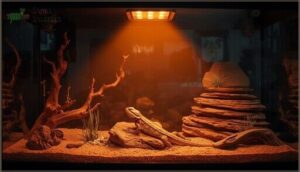
Getting the placement right makes a bigger difference than most people expect. A lamp set at the wrong angle or height can leave your reptile too cold, too hot, or without proper UVB exposure — none of which you want.
Here’s what to keep in mind before you mount anything.
Optimal Lamp Positioning
Position your heat lamp toward one end of the enclosure — this is the foundation of temperature gradient design. Most species need lamp placement distance of 8 to 12 inches above the basking surface.
Basking spot overlap with your UVB zone ensures simultaneous heat and UV exposure. Species-specific height, angle, and focus, and thermostat integration fine‑tune heat gradient mapping into a reliable, safe setup.
Using Stands, Domes, and Clamps
Once your lamp height is dialed in, the hardware holding it matters just as much. A Reptile Lamp Stand with an Adjustable Base lets you fine-tune height from roughly 14 to 60 inches.
Dual Dome fixtures support two bulbs — heat and UVB — over one basking zone.
Use a clamp heat lamp with a secure Clamp Jaw and Heat-Resistant Socket on a Modular Arm for stable, safe placement.
Avoiding Direct Contact With Substrate
Once your mount is secure, keep bulb away from loose bedding.
Follow these Clearance Distance Guidelines:
- Keep 10–12 inches minimum between bulb and substrate.
- Use Non‑Combustible Basking Surfaces like slate or ceramic tile.
- Choose Heat‑Resistant Substrate Choices rated for high temperatures.
- Run Regular Temperature Monitoring checks at 30 minutes and 2 hours.
- Rely on Elevated Lamp Mounts for reliable heat dissipation and ventilation.
Maintenance and Longevity of Heat Lamps
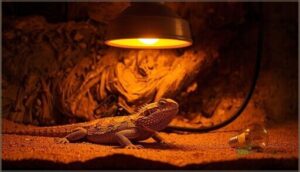
Keeping your heat lamps in good shape directly affects your reptile’s health and your setup’s safety. A few simple habits — like swapping bulbs on schedule and checking cords regularly — go a long way toward avoiding problems before they start.
Here’s what to stay on top of.
Regular Bulb Replacement Schedules
Bulbs don’t announce when they’re failing — they just quietly stop doing their job. Tracking heat lamp lifespan through UV Meter Tracking and Logbook Practices removes the guesswork.
Use Timer Automation to log daily run hours and follow these Species Timelines for heat lamp maintenance and replacement schedules:
| Bulb Type | Daily Use | Replace At |
|---|---|---|
| T8 UVB Tube | 10 hrs | 6–8 months |
| T5 HO UVB Tube | 10 hrs | 10–12 months |
| Ceramic Heat Emitter | 10 hrs | 6,000–10,000 hrs |
Watch for Replacement Indicators, like dimming output or unstable temperatures.
Inspecting Cords and Fixtures
Checking your heat lamp hardware takes less than five minutes — and it can prevent a fire. Run through five checks monthly:
- Look for Cord Insulation Damage — cracks, melted spots, or discoloration means replace immediately.
- Perform Plug Integrity Checks — scorch marks or wobbling blades are red flags.
- Confirm Strain Relief Tightness, so internal wires aren’t bearing mechanical stress.
- Inspect the E26 ceramic socket and metal housing for Fixture Socket Cracks.
- Test Mounting Clamp Security — any wobble risks a dropped fixture.
Cleaning and Safety Checks
Keeping your setup clean isn’t just about appearances — it directly affects heat output and fire safety.
Wipe bulbs weekly for Bulb Dust Removal, and handle Dome Reflector Cleaning with a damp cloth, fully dried afterward.
Screen Vacuuming clears blocked mesh.
Lamp Distance Verification and Thermometer Calibration confirm your safety features stay reliable, supporting smart heat lamp maintenance and replacement schedules long-term.
Frequently Asked Questions (FAQs)
Do terrariums need heat lamps?
Not always — it depends on your reptile’s species-specific heat needs. Some setups use alternative heating methods like ceramic emitters or pads.
What matters is maintaining a stable heat gradient and correct nighttime temperature.
What’s the difference between a basking lamp and a heat lamp?
basking lamp throws focused visible light and intense heat onto one spot.
heat lamp — like a ceramic emitter — raises ambient temperature using infrared only, with no light, ideal for nighttime heating.
Can you put a heat lamp in a reptile tank?
Yes, you can — but placement matters. Most keepers mount the lamp outside, above a mesh lid, to prevent burns. Inside use requires a secure wire guard and proper airflow.
How far should heat lamps be from basking spots?
Too close scorches; too far chills. For most setups, keep an 8–12 inch bulb-to-body gap. Measure the heat spot with a temperature gun, then adjust until you hit your species-specific target.
Can you use multiple heat lamps together safely?
You can, but keep total wattage under 1,440 watts on a 15-amp circuit. Space lamps apart to prevent hotspot overlap, and use a thermostat rated for your combined load.
Do heat lamps work at night for nocturnal species?
Heat lamps can work at night, but only the right type. Ceramic emitters provide infrared night heating without visible light, protecting nocturnal reptiles’ sleep cycles.
thermostat night settings 5–10°F lower for proper nighttime temperature gradient.
Whats the ideal temperature gradient in a terrarium?
Oddly enough, reptiles don’t need you to pick their temperature — they pick it themselves.
Give them a basking spot around 95°F–110°F and a cool end near 75°F–80°F, and they handle the rest.
How do you measure temperatures accurately in enclosures?
Place a digital probe thermometer at basking surface level for accurate multi-zone thermometry.
Use an infrared gun for surface spot-checks, and position your thermostat probe where temperature regulation matters most.
Can I use multiple heat lamps together?
Yes, you can.
Just keep combined wattage within thermostat and fixture limits, use separate secure mounts for each lamp, and verify your temperature gradient with a thermometer before leaving the setup unattended.
How often should bulbs be replaced?
Replace basking bulbs every 3 to 6 months. Heat Output Degradation happens before burnout. Track Bulb Age Monitoring by date. Keep Spare Bulb Stocking ready to avoid dangerous temperature drops.
Conclusion
Studies show reptiles kept at incorrect temperatures are up to 60% more likely to develop chronic illness—a number that puts the stakes in sharp focus. Choosing the right heat lamps for reptile terrariums isn’t about preference; it’s about function.
Wattage, placement, and thermostat control aren’t optional details—they’re the difference between an animal that thrives and one that slowly declines. Get the heat right, and everything else in the enclosure has a chance to work.
- https://reptifiles.com/choosing-the-best-reptile-heat-lamp/
- https://www.reptilesexpert.com/en/news/post/5-grunde-warum-uvb-metalldampflampen-ideal-fur-reptilien-im-terrarium-sind
- https://hardypaw.com/products/zoo-med-repticare-ceramic-infrared-heat-emitter
- https://www.zillarules.com/articles/the-ultimate-guide-to-lighting-and-heating
- https://talis-us.com/blogs/news/how-hot-do-reptile-heat-lamps-get