This site is supported by our readers. We may earn a commission, at no cost to you, if you purchase through links.

A full-grown boa constrictor stretches longer than most humans stand tall, yet hatchlings emerge from their eggs no bigger than a pencil. This dramatic transformation unfolds over five to six years, with females commonly reaching 7 to 10 feet while males plateau around 5 to 8 feet.
Genetics set the ceiling, but subspecies, diet, and environmental conditions determine whether your snake reaches dwarf proportions at 4 feet or approaches the upper limits of its lineage.
Understanding growth patterns isn’t just academic curiosity—it’s the foundation for proper enclosure planning, feeding protocols, and long-term care commitments that span two decades or more.
Table Of Contents
- Key Takeaways
- How Big Do Boas Get?
- Boa Size by Species
- Male Vs. Female Boa Size Differences
- Boa Weight: What to Expect
- Growth Stages of Boa Constrictors
- Factors Influencing Boa Size
- Boa Size in Captivity Vs. Wild
- How Fast Do Boas Grow?
- Size Variations Among Boa Subspecies
- Why Boa Size Matters for Owners
- Frequently Asked Questions (FAQs)
- Do boas get bigger than pythons?
- How big can boas grow?
- How big do pet boas get?
- Are boa snakes aggressive?
- Is a 4x2x2 big enough for a boa?
- How long do pet boas live?
- Do boas grow continuously throughout their lives?
- How does stress impact boa constrictor growth?
- What is the smallest recorded boa constrictor size?
- Can boas grow larger in captivity than in the wild?
- Conclusion
Key Takeaways
- Adult boa constrictors typically reach 6 to 10 feet in captivity, with females consistently outgrowing males by 1 to 2 feet due to reproductive demands that require larger body mass for gestating 20 to 60 live young.
- Growth rates peak during the first three years when juveniles add 10 to 15 inches annually, then slow dramatically after sexual maturity around year 5 or 6, with final adult size determined by genetics, locality, feeding consistency, and environmental conditions like temperature and humidity.
- Subspecies variations create dramatic size differences—dwarf locality boas max out at 4 feet while red-tailed boa constrictors can exceed 12 feet, proving that geographic origin and genetic lineage set hard limits on maximum length regardless of care quality.
- Your boa’s final dimensions directly determine lifelong care requirements including enclosure size (minimum 6×2×2 feet for adults), handling protocols for 60 to 100 pound females, and a 20 to 30 year commitment to veterinary monitoring and habitat maintenance.
How Big Do Boas Get?
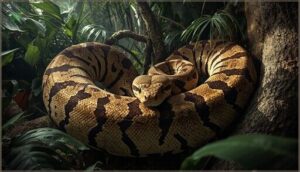
If you’re considering a boa as your next companion, you need to know exactly what you’re getting into—and size is where that journey starts. These powerful constrictors don’t fit neatly into one-size-fits-all categories, with measurements varying dramatically based on species, sex, and genetics.
Understanding boa constrictor size variations helps you prepare the right enclosure and care setup before bringing one home.
Let’s break down the actual numbers you can expect from typical adults, record-breaking giants, and the most common species you’ll encounter.
Typical Adult Boa Length
You’ll find most adult boas measuring six to eight feet in captivity, though size variation across localities creates striking differences. Females usually reach seven to ten feet, commanding more space and respect, while males stay closer to five to eight feet. Dwarf locality specimens break the mold entirely, maxing out around four feet—proving boa constrictor size follows its own rules.
For more details about, some boas from Peru and Colombia are much larger, while those from certain Mexican and island localities remain quite small.
Maximum Recorded Boa Sizes
Record breakers among boa constrictors reach 13 to 14 feet in captivity, with females claiming the upper size limits. Wild populations rarely exceed 12 feet, though outstanding individuals approaching these lengths demonstrate what’s possible under ideal conditions. You’ll witness maximum length records typically held by red-tailed boas receiving consistent feeding and proper enclosure management. For further details about factors driving boa constrictor size, review these.
Large specimens reveal three powerful truths:
- Genetics set your boa’s upper boundary—some bloodlines simply won’t break 10 feet
- Captive care unlocks size potential wild boas can’t reach
- Females dominate the record books, proving sexual dimorphism drives growth patterns
Size Range for Common Boa Species
Beyond record holders, your typical boa constrictor settles into a 6 to 9-foot range depending on species variance and size genetics. Red-tailed boas commonly measure 7 to 10 feet as mature females, while dwarf locality morphology types stay compact at 3 to 6 feet.
Growth patterns reveal how snake size depends on subspecies—Boa constrictor imperator averages smaller than true red-tailed boa species under identical conditions.
Boa Size by Species
Not all boas grow to the same size, and understanding the differences between species helps you prepare for what you’re bringing into your home. Common boa constrictors differ markedly from red-tailed boas in both length and weight, while other boa species present their own unique dimensions.
Here’s what you need to know about the size ranges for the most popular boa species.
Common Boa Constrictor (B. Imperator)
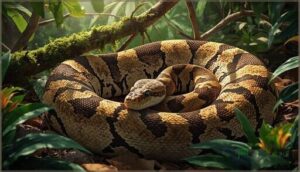
You’ll encounter the Common Boa Constrictor (Boa constrictor imperator) reaching 8 to 10 feet in captivity, though some specimens push toward 12 feet under ideal conditions. Females generally surpass males by 1 to 2 feet, driven by reproductive demands.
This subspecies exhibits varied coloration—light tan to dark brown—with distinctive saddle patterns influenced by geographic locality.
Red-Tailed Boa (B. Constrictor)

The Red-Tailed Boa (Boa constrictor constrictor) draws focus with its sturdy build and striking tail coloration. Adults typically reach lengths of 8 to 10 feet, with exceptional females surpassing 12 feet when habitat destruction hasn’t limited prey access.
- Snake size: Females dominate, averaging 8 to 10 feet while males stay closer to 6 to 8 feet
- Boa constrictor size and weight: Adults weigh 60 to 100 pounds depending on sex and nutrition
- Boa length: Growth slows after year 3, with full size achieved by year 5 or 6
- Constrictor health: Red tailed care requires thermal gradients and humidity monitoring for ideal boa behavior
Other Boa Species Size Comparisons

Boa morphology shifts dramatically across subspecies, revealing size genetics that defy broad generalizations. The short-tailed Boa amarali reaches four to six feet with a slim build, while Dominican red-tailed boas mirror that range with lighter mass.
Mexican Boa constrictor sigma stretches five to eight feet, dwarfing the three-to-five-foot St. Lucia Boa orophias—subspecies comparison underscores snake species diversity.
Male Vs. Female Boa Size Differences
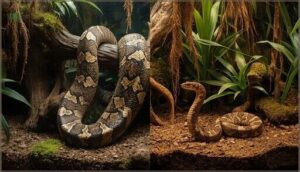
If you’re planning to house a boa, you need to understand that males and females don’t grow to the same size—and the difference isn’t subtle. Female boas consistently outgrow their male counterparts by significant margins, sometimes reaching lengths and weights that are 30-50% greater.
This sexual dimorphism directly impacts your enclosure decisions, feeding schedules, and long-term care commitments.
Sexual Dimorphism in Boas
You’ll notice striking differences when comparing male and female boa constrictors side by side. Sexual dimorphism in these serpents reveals itself through multiple traits, from overall snake size to subtle variations in morphology. Females exhibit larger dimensions, reflecting evolutionary reproductive strategies that favor maternal bulk for embryo development. Males, meanwhile, display elongated tails and slimmer builds, showcasing how size evolution has shaped distinct sex roles in boa constrictor anatomy and growth patterns throughout their lifespan.
| Characteristic | Males | Females |
|---|---|---|
| Maximum Length | Shorter, slimmer build | Several inches to a foot longer |
| Body Girth | Narrow midsection | Broader torso for embryo storage |
| Tail Length | Proportionally longer and thicker | Relatively shorter |
| Typical Weight | Lower overall mass | 60–100 lbs in large species |
| Growth Timing | Earlier sexual maturity | Later maturity, extended growth |
Why Females Grow Larger
When you compare male and female boa constrictors, reproductive benefits drive the size gap. Females need abdominal volume to house litters of 20 to 60 neonates during 5 to 8 month gestations, so natural selection rewards larger bodies. Enhanced energy storage in visceral fat pads fuels embryo development, while growth patterns push females past males in length and mass throughout their lifespan, maximizing snake size and reptile growth potential.
| Factor | Males | Females |
|---|---|---|
| Reproductive Role | Sperm delivery | Live-bearing 20–60+ young |
| Energy Storage | Minimal fat reserves | Large visceral fat pads |
| Abdominal Volume | Compact trunk | Extended body cavity |
| Growth After Maturity | Slows markedly | Continues for years |
| Final Adult Length | 1.8–2.4 meters | 2.1–3.0 meters |
Boa Weight: What to Expect
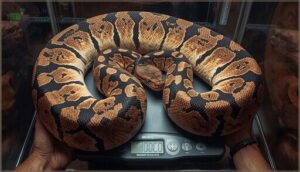
Weight matters just as much as length when you’re planning for a boa’s care and handling needs. Female boas typically reach 60-100 pounds at full size, while males stay considerably lighter throughout their lives.
Understanding the relationship between your boa’s age, sex, and expected weight helps you prepare proper support and enclosures as they grow.
Average Weight by Age and Sex
You’ll notice striking sex differences in boa constrictor weight trends throughout their lifespan. Female boas usually reach 60-100 pounds at maturity, while males remain considerably lighter.
Age factors drive dramatic growth patterns during the first 3-4 years, when juveniles undergo rapid reptile growth before plateauing.
These size correlations between snake size and sex reveal fundamental biological programming that dictates your boa weight expectations.
Weight and Length Correlation
Your boa’s weight doesn’t simply follow its length in a straight line—the length-weight ratio depends on scaling factors that shift as constrictors mature. Understanding this boa constrictor growth pattern reveals critical size predictors:
- Weight scales with length to the power of three in most reptile size comparison models
- Females show higher body mass index values than males at identical boa length measurements
- Growth patterns shift from rapid juvenile gains to gradual adult increases
Growth Stages of Boa Constrictors
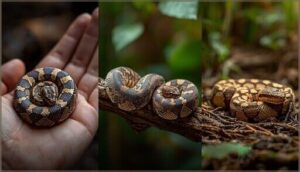
Understanding how your boa grows through different life stages helps you anticipate their changing needs and prepare for their eventual adult size. Boas experience rapid growth during their first few years, then gradually slow as they approach maturity.
The following growth milestones will show you what to expect at each stage of your boa’s development.
Hatchling and Juvenile Growth Rates
Your young serpent’s transformation unfolds at an astonishing pace—hatchlings rocket from 12 to 24 inches at birth to 3 to 5 feet within just 12 months under ideal conditions. Understanding these growth patterns and feeding strategies enables you to master size genetics through precise hatchling care, unlocking your snake’s full potential.
| Growth Stage | Length Gain |
|---|---|
| First 6 months | 6 to 12 inches (15 to 30 cm) |
| First year total | 10 to 15 inches (25 to 38 cm) |
| Second year | 1 to 2 feet (30 to 60 cm) |
| Weight at 12 months | 300 to 1500 grams |
| Weekly feeding (hatchlings) | 1 to 2 small meals |
Temperature consistency between 80 to 90°F accelerates juvenile development dramatically, while prey items matching 20 to 30 percent of your boa’s girth enhance digestion efficiency. These boa constrictor biology fundamentals directly control reptile growth velocity, transforming your understanding of snake size and growth into commanding boa care mastery.
Age and Size Milestones
Tracking your serpent’s development stages reveals the true map to mastery—by year two, most boas measure 4 to 6 feet, while year five marks 8 to 10 feet under ideal conditions.
These age factors and maturity rates directly expose size limits encoded in boa constrictor biology, enabling you to anticipate snake dimensions and command reptile growth through strategic intervention in development stages.
When Boas Reach Full Size
Full size factors converge around 3 to 5 years, when growth patterns slow and maturity signs appear—females often stabilize at 10 to 13 feet, males at 6 to 9 feet. This threshold shifts adult care tips toward maintenance feeding, reflecting size limits encoded in boa constrictors’ biology.
- Monitor weight stabilization as your snake approaches full size
- Adjust feeding frequency from growth-phase schedules to adult maintenance
- Upgrade enclosure dimensions before your boa reaches maximum length
- Track body condition to verify healthy muscle tone without excess fat
Factors Influencing Boa Size

Your boa’s final size isn’t set in stone from the moment it hatches. Several key factors work together to determine whether your snake reaches its maximum genetic potential or falls short. Understanding these influences gives you the power to enhance your boa’s growth and overall health.
Genetics and Locality
Your boa’s genetic blueprint sets the stage for maximum size potential, but locality weaves in surprising twists. Geographic isolation creates distinct population genetics across boa constrictor ranges, with some Central American boa species reaching only six feet while South American cousins stretch past ten.
Local adaptation drives heritability factors tied to prey availability and climate, meaning genetic variation between populations directly influences reptile growth and final snake size.
Diet and Nutrition
Mastering reptile nutrition and feeding unlocks your boa’s full growth potential, with diet directly shaping size outcomes. Nutrient balance and meal planning determine whether your snake reaches maximum dimensions or falls short.
- Feeding schedule precision: Adults need appropriately sized prey every 1-2 weeks to maintain healthy curves without organ stress
- Protein power: 15-25% of daily calories from protein fuels tissue growth and shedding cycles
- Supplement needs: Calcium with vitamin D3 promotes bone development in young boas
- Hydration management: Fresh water changed daily drives proper digestion and metabolism
Environmental Conditions
Beyond diet, environmental conditions command your boa’s growth trajectory. Temperature control between 88 to 92 degrees Fahrenheit, paired with humidity levels at 60 to 70 percent, creates ideal tropical ecosystems for juvenile expansion.
Lighting options mimicking natural photoperiods, substrate choices retaining moisture, and ventilation systems preventing stagnation all sculpt your reptile habitat into a growth engine that mirrors their native ecosystem management.
Boa Size in Captivity Vs. Wild

Your boa’s size won’t be determined by whether it lives in captivity or the wild—both environments produce similar maximum lengths when conditions are right.
What changes is the growth rate and consistency, which you control through feeding schedules, enclosure space, and temperature regulation.
Understanding these differences helps you predict how large your boa will actually get and how quickly it’ll reach full size.
Differences in Growth Rates
Growth patterns in wild boas differ dramatically from their captive counterparts, with environmental impact and nutrition influence controlling the pace. Wild individuals face irregular feeding cycles and seasonal prey shortages, which slow their growth compared to the consistent meals provided in captivity. Age effects compound these size factors—wild boas often take eight to ten years to reach lengths that captive boa constrictors achieve in six years under ideal conditions.
| Environment | Growth Rate | Full Size Timeline | Primary Limiting Factor | Average Adult Length |
|---|---|---|---|---|
| Wild | Slower, irregular | 8-10 years | Variable prey availability | 6-8 feet |
| Captivity | Faster, consistent | 6-8 years | Controlled feeding schedule | 7-9 feet |
| Wild (ideal habitat) | Moderate | 7-9 years | Seasonal fluctuations | 7-8.5 feet |
| Captivity (power feeding) | Rapid, accelerated | 4-6 years | Overfeeding risks | 8-10 feet |
| Wild (resource-poor) | Very slow | 10+ years | Scarce food sources | 5-7 feet |
Impact of Captive Care on Size
Your captive environment determines whether your boa unleashes its full genetic potential or remains undersized. Enclosure design, feeding strategies, and health monitoring directly control final length—generous space requirements and consistent prey schedules push captive boas 15-25% larger than wild counterparts. Boa constrictor care and maintenance, including proper enclosure size and boa feeding regimens, transform pet snake ownership into mastery over snake growth itself.
| Captive Care Factor | Impact on Final Size |
|---|---|
| Enclosure size | Larger habitats = longer adult lengths |
| Feeding strategies | Consistent meals accelerate growth rates |
| Health monitoring | Early intervention prevents growth stunting |
| Space requirements | Vertical options encourage body extension |
| Temperature control | Stable warmth fosters metabolic development |
How Fast Do Boas Grow?
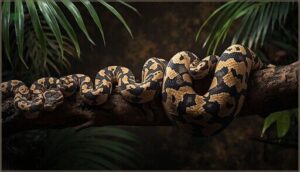
Your boa’s growth rate isn’t set in stone—it shifts dramatically depending on age and how you manage feeding. Juvenile boas experience their most explosive growth during the first three to four years, adding length at a pace that slows considerably once they approach maturity.
Understanding these growth patterns and feeding influences gives you the control to shape your snake’s development timeline.
Growth Rate by Age
Your boa’s transformation from hatchling to powerhouse follows a predictable arc. During the first year, boa constrictors surge ahead at 10-12 inches, commanding their space with explosive growth patterns.
Development stages shift around year two, when size trends slow to 6-10 inches annually. Age factors dominate these maturity rates—females stretch longer into adolescence while males plateau earlier, revealing distinct snake growth trajectories.
Influence of Feeding Frequency
Your feeding schedules dictate nutrient uptake more than you realize. When you adjust meal frequency for your boa constrictor, you trigger growth optimization through calculated diet control:
- Higher feeding frequency accelerates nutrient absorption and facilitates consistent delivery
- Frequent meals improve feed efficiency and stabilize blood glucose in snake species
- Digestion rates increase with well-timed feeding intervals
- Strategic meal frequency maximizes growth potential in constrictors while maintaining proper reptile care protocols
Size Variations Among Boa Subspecies

Not all boa constrictors reach the same dimensions, even within the species. Geographic origin and habitat conditions shape the adult size you can expect from different subspecies.
Understanding these variations helps you predict your boa’s potential growth based on its specific lineage.
Regional and Habitat Influences
Across diverse Climate Zones and Tropical Regions, habitat shapes your boa constrictor’s potential like nothing else. Geographic Barriers isolate populations, while Elevation Effects cool metabolic rates above 1,000 meters, capping maximum size. Prey Distribution drives growth—Amazon basin boas averaging longer due to abundant rodents. Habitat Diversity, from wetland edges to forest margins, determines whether your constrictor reaches its genetic ceiling or stalls midway.
| Habitat Type | Growth Impact |
|---|---|
| Forest edge habitats | Larger average sizes due to prey diversity |
| Wetland-adjacent zones | Higher growth rates with amphibian availability |
| Rocky outcrop areas | Stable growth through ambush feeding success |
| Urban fringe habitats | Variable growth with human-provided resources |
Reptile Conservation efforts now map these patterns to protect Constrictors where conditions enhance survival.
Notable Subspecies With Unique Sizes
Island Boas rarely exceed 2.0 meters, shaped by limited prey and genetic isolation—your compact powerhouse. Highland Subspecies reach 2.8 to 3.0 meters in cooler elevations, while Desert Adaptations keep Constrictors near 2.4 meters maximum. Tropical Giants from Amazon basins command 3.0-meter lengths when conditions align.
Mountain Boas stretch long and slender for ambush hunting, contrasting with the sturdy Redtailed Boa averaging 2.5 meters across diverse Snake Species and Classification groups.
Why Boa Size Matters for Owners

Understanding your boa’s potential size isn’t just academic knowledge—it directly determines whether you can provide adequate care throughout the animal’s 20-30 year lifespan. A hatchling that fits in your palm will transform into a powerful constrictor requiring specialized housing, handling protocols, and long-term commitment.
Before you bring a boa home, you need to grasp three critical ownership considerations that scale with your snake’s growth.
Enclosure and Space Requirements
When your boa reaches full maturity, you’ll need reptile enclosures and housing that match its commanding presence. Proper space allocation and enclosure design determine whether your pet snakes thrive or merely survive, transforming routine snake care and handling into an act of respect for their natural dominance.
- Enclosure size for adult boa constrictors must provide at least 6 feet by 2 feet of floor space, with vertical clearance reaching 2 feet minimum
- Temperature gradients between 24 to 32 Celsius allow natural thermoregulation across thermal zones
- Humidity control maintained at 40 to 60 percent prevents shedding complications
- Ventilation systems with secure access panels balance air exchange while eliminating escape routes
Handling and Safety Considerations
You’ll command respect when safe handling becomes second nature, especially with larger boa constrictors demanding proper snake hooks and cut-resistant gloves. Your pet snakes need both hands supporting their muscular bulk during every interaction, preventing dangerous drops or strikes.
Always keep escape prevention protocols active—secure latches, clear pathways, and a second handler for transport. Master these emergency responses now, because your serpent’s size won’t wait for hesitation.
Long-Term Care Implications
You’re signing on for decades—boas can live 20 to 40 years in captivity, demanding regular veterinary checks, strategic feeding strategies, and constant habitat maintenance. Enclosure design must evolve as your snake grows, while health monitoring becomes your lifelong ritual.
Owning a boa means committing to decades of evolving care, veterinary oversight, and constant habitat adjustments as your snake grows
This isn’t casual pet ownership; reptile keeping as a hobby transforms into unwavering commitment to animal care and welfare, requiring financial resources and disciplined snake care and maintenance protocols.
Frequently Asked Questions (FAQs)
Do boas get bigger than pythons?
Most boas don’t eclipse pythons in sheer length. Reticulated pythons tower over typical boas, often surpassing twenty feet, while common boa constrictors rarely exceed nine feet—except for green anacondas, which rival the largest python species.
How big can boas grow?
You’ll find maximum length records for constrictors approaching 13 feet, though most boa species stay under 10 feet.
Growth patterns depend on genetics, diet, and environmental factors, with weight factors increasing alongside scale variation throughout their lives.
How big do pet boas get?
You’ll generally see your pet boa reach 6 to 8 feet in captivity, though red-tailed boas and certain localities can stretch toward 10 feet with ideal boa constrictor care requirements and consistent feeding.
Are boa snakes aggressive?
Like a coiled spring under tension, your boa constrictor isn’t aggressive by nature—it’s defensive. These nonvenomous constrictors rely on retreat over attack, displaying aggression only when stress factors, handling techniques, or environmental conditions trigger defensive postures.
Is a 4x2x2 big enough for a boa?
A 4x2x2 enclosure provides adequate floor space for boas under 8 feet. However, to optimize habitat complexity and support your snake’s comfort throughout its growth, you’ll want vertical climbing surfaces and strategic hiding spots.
How long do pet boas live?
Under responsible pet care with proper reptile care strategies, captive boa constrictors exhibit a lifespan of 20 to 30 years.
Though rare individuals surpass 35 years when snake health tips enhance the boa aging process.
Do boas grow continuously throughout their lives?
Boa constrictors exhibit continuous growth throughout their lifetime development, though growth patterns shift dramatically with age factors. Most reach their adult size limits by five to six years, after which annual increases become minimal and infrequent.
How does stress impact boa constrictor growth?
Chronic stress triggers hormonal changes that suppress appetite and slow growth patterns in boa constrictors. This diverts energy from development to survival responses, creating nutritional deficits that stunt their potential size.
What is the smallest recorded boa constrictor size?
Certain Tarahumara locality boas break expectations—adults verified around 3 to 4 feet in captive settings represent the smallest recorded boa constrictor dimensions, challenging assumptions about miniature snakes.
This demonstrates how genetics dictate reptile size comparison.
Can boas grow larger in captivity than in the wild?
Captive boas often reach sizes matching their wild counterparts when you provide proper nutrition, stable temperatures, and ample space, though genetics ultimately determine maximum length in both captivity and natural habitats.
Conclusion
Your boa’s size is both predetermined and entirely within your control. Genetics draw the blueprint, but your feeding regimen, enclosure dimensions, and environmental consistency determine whether those blueprints become reality.
Knowing how big boas get transforms abstract numbers into actionable intelligence—the difference between cramped survival and thriving captivity. Every measurement, weight check, and growth marker becomes a checkpoint in your mastery over one of nature’s most adaptable predators.