
This site is supported by our readers. We may earn a commission, at no cost to you, if you purchase through links.
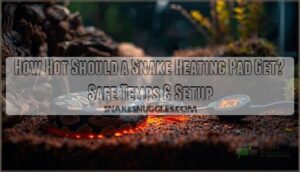
A snake that won’t eat, struggles to shed, or sits lethargic in the corner isn’t being difficult—it’s cold.
Reptile digestion depends entirely on external heat, and a heating pad running even 10°F too low can shut down gut motility within days.
Most keepers obsess over enclosure size and décor while the temperature dial stays an afterthought.
Getting how hot a snake heating pad should get comes down to precision: ball pythons need warm hide surfaces at 88–92°F, corn snakes thrive closer to 80–85°F, and a half‑inch of substrate alone can drop your pad’s output by 4–6°F.
The difference between a thriving snake and a sick one often lives in that narrow margin.
Table Of Contents
- Key Takeaways
- Optimal Temperature Range for Snake Heating Pads
- Factors Affecting Heating Pad Temperatures
- Setting Up and Controlling Heating Pads
- Top 6 Heating Pads for Snake Enclosures
- Safety Tips and Maintenance for Heating Pads
- Frequently Asked Questions (FAQs)
- Do snakes require heating pads?
- How do snake heating pads work?
- How can you safely heat a snake terrarium?
- How do you heat a snake enclosure?
- How long can a snake go without a heating pad?
- What degree is too hot for snakes?
- Can heating pads be used with wooden enclosures?
- How long should a heating pad run daily?
- Do heating pads work well for nocturnal snakes?
- Should heating pads stay on during snake feeding?
- Conclusion
Key Takeaways
- Ball pythons need warm hide surfaces at 88–92°F and corn snakes at 80–85°F, but even half an inch of substrate can drop your pad’s output by 4–6°F — so always measure at the surface, not the pad itself.
- A thermostat isn’t optional: unregulated pads can spike past 120°F, causing burns, fire risk, and rapid health decline in your snake.
- Enclosure material changes how heat moves — glass conducts fast, wood insulates and traps heat, and each requires different thermostat calibration to hold a stable thermal gradient.
- Your snake’s refusal to eat, poor sheds, or lethargy are direct signals that heat is off — fix the temperature before adjusting anything else in the enclosure.
Optimal Temperature Range for Snake Heating Pads
temperature right on your heating pad isn’t guesswork — it comes down to knowing the numbers that actually keep your snake safe.
Understanding safe temperature ranges for snake heating pads helps you avoid the two most common mistakes: too cool to digest, too hot to escape.
Most pads should keep the glass surface between 85°F and 92°F, depending on your species.
Here’s what you need to know about recommended temps, why staying in range matters, and what happens when things go wrong.
Recommended Heating Pad Temperatures
Every snake species runs on its own internal clock — and its own temperature map.
Ball pythons need warm hide surfaces at 88 to 92 °F, while corn snakes do fine around 80 to 85 °F. Nighttime temperatures can dip to 70 °F safely.
Substrate impact matters too — a half‑inch layer drops surface heat by 4 to 6 °F.
Species‑specific targets drive every thermostat calibration decision you make.
heat mats produce only IR‑C is the weakest form of heat.
Importance of Maintaining Safe Heat Levels
Temperature control isn’t just about comfort — it drives snake health at every level. Stable warmth in the 88 to 92°F range boosts digestion efficiency, cutting food passage time nearly in half. It helps immune function, shedding success, and stress reduction by keeping corticosterone levels low.
Stable warmth at 88 to 92°F doesn’t just comfort snakes — it drives digestion, immunity, and calm
Your thermostat is the backbone of heat pad safety. Without it, the safe temperature range collapses quickly. heat mats can cause scorching of surfaces, which raises fire risk.
Risks of Overheating or Underheating
Get the thermal gradient wrong in either direction and you’re looking at serious consequences.
Overheated pads — anything spiking past 100°F — cause thermal burns, dehydration risks, and real fire hazards if your thermostat fails.
Going too cold leads to digestive issues, immune suppression, and chronic weight loss follow.
Heating pad safety isn’t optional. It’s the foundation of your snake’s health.
Factors Affecting Heating Pad Temperatures
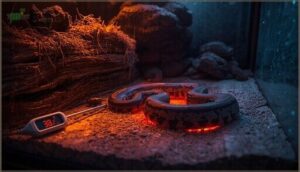
Not every heating pad runs the same, and that’s not a flaw — it’s just how enclosures work.
key variables will determine where your pad’s temperature actually lands. Here’s what shapes that number.
Snake Species and Individual Needs
No two snakes are the same.
A ball python needs its warm hide floor at 88–92°F, while a corn snake thrives closer to 82–88°F.
Age-based temps matter too — hatchlings need slightly warmer nights around 78–80°F for healthy digestion.
Behavioral thermoregulation tells you a lot: if your snake avoids the heating pad entirely, don’t ignore it.
Health-driven adjustments may be needed.
Enclosure Size and Material
Your enclosure material changes everything. Glass loses heat fast, so under-tank heat mats work well here — glass conducts warmth directly into the enclosure. PVC insulates like a thermos, making pad sizing guidelines critical to prevent dangerous heat buildup. Wood retention is reliable but needs proper mat placement.
Always match your thermostat settings to your enclosure design for consistent temperature control.
Substrate Thickness and Placement
Substrate depth quietly undermines your heat mat if you’re not paying attention. Keep substrate under hotspot hidden under 0.5 inches — thicker layers drop surface temperatures 20–30°F, turning your 90°F target into a useless 70°F floor.
Insulation barriers from heavy sand or fiber block thermal conductivity entirely.
Alignment strategies matter too: position your heat source under one-third of the enclosure floor to build a real temperature gradient.
Ambient Room Temperature
Room temperature quietly controls how hard your heat pad works. In a room around 75–78°F, your thermostat needs minimal calibration to hold warm-side targets. Drop below 70°F and the pad runs constantly, wearing faster and risking heat spikes. Seasonal temperature shifts make this worse.
Keep your snake room between 75–78°F year‑round — it improves energy efficiency, stabilizes ambient room temperature, and protects your snake.
Setting Up and Controlling Heating Pads
Getting the temperature right is only half the battle — keeping it consistent is what actually protects your snake.
That means pairing your heating pad with the right tools and knowing exactly where and how to place everything.
Here’s what you need to set up a safe, well-controlled heating system.
Using Thermostats for Accurate Control

A thermostat isn’t optional — it’s the difference between a safe enclosure and a burnt snake. Secure your probe placement directly on the substrate surface above the heat pad, never suspended in air.
Digital modes let you program night/day cycles so temperature regulation follows a natural rhythm. Expect up to 3°F variance, so run regular calibration checks with a secondary thermometer.
- Lock the probe against substrate, not floating mid‑air
- Enable night/day cycles for natural reptile heating patterns
- Verify thermostat reading against an infrared thermometer weekly
- Set alarm integration to catch dangerous temperature spikes overnight
- Recheck calibration monthly — drift happens, and your snake pays the price
Placement Inside or Under The Enclosure

Under-tank heaters belong outside the glass — never inside.
Stick your heat mat to the exterior bottom using adhesive backing, and lift the tank with rubber foot spacers for airflow management.
That gap prevents dangerous heat buildup underneath.
Limit your heat pad size to one-third of the floor.
For wooden enclosures, vertical wall placement is the safer alternative.
Always run a thermostat.
Monitoring With Thermometers and Data Loggers
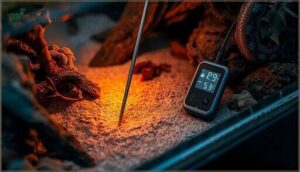
Guesswork kills snakes — precise monitoring doesn’t.
Use digital probe thermometers with ±1°F accuracy for reliable temperature control across your thermal gradient. Position probes directly on warm and cool zone substrates for honest readings.
Integrate a WiFi data logger to track 24‑hour cycles and set alert threshold settings above 95°F.
Calibrate probes quarterly and check battery life every 12 months for consistent heating pad safety and usage.
Creating a Proper Thermal Gradient

Once your probes are reading accurately, put that data to work. A proper thermal gradient runs from an 88–92°F basking spot on the warm end down to a 75–80°F cool zone on the opposite side.
- Position heat sources under one-quarter of the enclosure floor
- Keep basking spot and cool zone at least 10 cm apart
- Use thin substrate for better substrate thermal conductivity and gradient measurement techniques
Top 6 Heating Pads for Snake Enclosures
Choosing the right heating pad makes all the difference between a thriving snake and a stressed one.
Not every pad on the market is built with the same quality, consistency, or safety controls. Here are six options worth your attention.
1. iPower Terrarium Heating Pad with Digital Thermostat
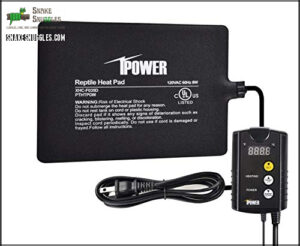
iPower Terrarium Heating Pad with Digital Thermostat takes the guesswork out of temperature management. Its PTC heating element distributes warmth evenly across the pad, and the digital thermostat controls surface temps anywhere from 32°F to 122°F in 1°F increments.
For snakes, you’ll usually dial it into the low-to-mid 80s°F.
It comes in multiple sizes — 4"×7" up to 8"×18" — with wattages from 4W to 24W.
The 3M adhesive backing bonds firmly to glass enclosures.
| Best For | Reptile and small animal owners, hobbyist brewers, and plant growers who need reliable, customizable heat for terrariums or fermentation setups. |
|---|---|
| Size | 11.4 x 6.1 inches |
| Mounting Method | 3M adhesive |
| Thermostat Included | Yes, digital |
| Target Animals | Reptiles, amphibians, small animals |
| Tank Placement | Under tank |
| Brand | iPower |
| Additional Features |
|
- Even heat distribution thanks to the PTC heating element, so no annoying hot spots
- Digital thermostat gives you precise control — easy to dial in the exact temp your setup needs
- 3M adhesive backing sticks firmly to glass, keeping everything in place
- The adhesive can fail over time, meaning the pad may eventually peel away from the tank
- Temperature consistency can drift after the first few uses
- Not great for larger tanks, and customer support has been a sore spot for some buyers
2. Zacro Adjustable Reptile Heating Pad
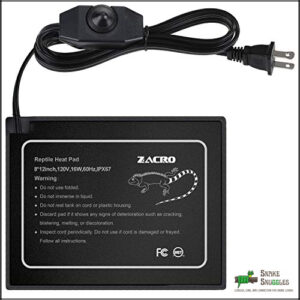
The Zacro Adjustable Reptile Heating Pad gives you manual control through a rotary dial, which is a nice change if you want to fine‑tune output yourself. Its copper wire elements spread heat across a PET surface that tops out around 54°C — no dangerous spikes.
The 12×8 inch size fits 30–40 gallon tanks well.
Just wait 10 minutes after adjusting the knob before checking your thermometer.
And always pair it with an external thermostat — the built‑in dial alone isn’t precise enough for consistent snake care.
| Best For | Reptile and amphibian owners with 30–40 gallon tanks who want hands-on temperature control at a budget-friendly price. |
|---|---|
| Size | 12 x 8 inches |
| Mounting Method | Adhesive tape |
| Thermostat Included | Yes, rotary knob |
| Target Animals | Reptiles, amphibians, plants |
| Tank Placement | Under tank |
| Brand | Zacro |
| Additional Features |
|
- Simple rotary dial lets you manually fine-tune heat output without complicated settings
- The 12×8 inch pad fits 30–40 gallon tanks nicely and spreads heat evenly across a PET surface
- Versatile enough for reptiles, amphibians, plants, or even temperature-sensitive projects like sourdough starters
- The built-in thermostat isn’t precise enough on its own — you’ll want an external one for reliable temperature control
- Adhesive can weaken over time, making it harder to keep the pad securely in place
- Not a great fit for aquariums, since water gaps and insulation issues get in the way of efficient heat transfer
3. VIVOSUN Reptile Under Tank Heating Pad
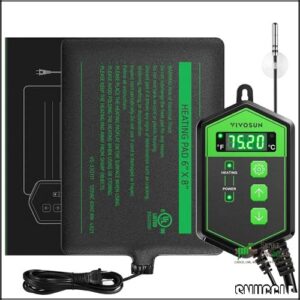
Where the Zacro keeps things manual, the VIVOSUN Reptile Under Tank Heating Pad hands control to a digital thermostat — and that’s a meaningful upgrade. The pad reaches around 104°F unregulated, but paired with VIVOSUN’s digital thermostat, you can lock it anywhere between 40 and 108°F.
Far-infrared heating warms the glass floor evenly rather than creating hot patches.
The 6×8 inch size fits 20–30 gallon tanks well.
Just place the probe at your snake’s warm hide and verify with a temp gun.
| Best For | Reptile owners who want precise, hands-off temperature control for snakes, lizards, turtles, or frogs in 20–30 gallon tanks. |
|---|---|
| Size | 6 x 8 inches |
| Mounting Method | 3M adhesive |
| Thermostat Included | Yes, digital |
| Target Animals | Reptiles, turtles, lizards, snakes |
| Tank Placement | Under or side mount |
| Brand | VIVOSUN |
| Additional Features |
|
- Far-infrared heat spreads evenly across the tank floor — no hot spots to worry about
- Digital thermostat lets you dial in temps anywhere from 40 to 108°F with real precision
- UL-certified and IP67-rated, so it’s built to last and handles moisture well
- The thermostat tends to read a few degrees higher than the actual surface temp
- Adhesive can struggle to stick to glass enclosures and the probe may need extra tape to stay put
- LCD display and membrane buttons feel a bit fragile — press too hard and you might damage them
4. Zoo Med Reptitherm Undertank Heater
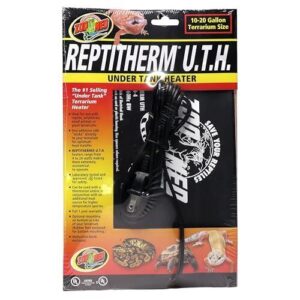
Zoo Med’s Reptitherm Undertank Heater is about as close to a set‑it‑and‑forget‑it solution as you’ll find. The 6×8‑inch pad draws just 8 watts and bonds permanently to the outside of glass tanks via strong adhesive backing — no repositioning once it’s on.
It raises temps roughly 5–10°F above room temperature, making thermostat pairing non‑negotiable. UL and cUL approved, it’s built for continuous 24‑hour use.
Cover the heated glass with even substrate to protect your snake from direct contact.
| Best For | Reptile owners keeping leopard geckos, ball pythons, or bearded dragons who want a simple, low-wattage heat source for glass terrariums. |
|---|---|
| Size | 6 x 8 inches |
| Mounting Method | Adhesive surface |
| Thermostat Included | No |
| Target Animals | Leopard geckos, ball pythons, bearded dragons |
| Tank Placement | Under tank |
| Brand | Zoo Med |
| Additional Features |
|
- Heats up fast — usually within 10–20 minutes and runs continuously without issue
- Low 8-watt draw keeps energy costs down while still doing the job
- UL and cUL approved, so it’s built to a real safety standard
- Gets hot enough to burn your animal if you don’t pair it with a thermostat
- The adhesive is permanent — place it wrong once and you’re stuck with it
- Only raises temps 5–10°F, so it won’t cut it as a sole heat source in a cold room
5. Zilla Black Terrarium Heat Mat 24W
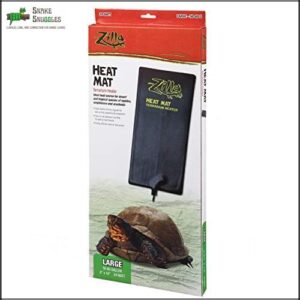
Zilla’s carbon fiber design is what sets this mat apart. Instead of traditional wire coils, carbon fiber strips spread heat evenly across the surface — no hot spots, no broken elements.
The 24W output suits 50–60 gallon tanks well, and the self‑regulating material caps at 113°F. That’s still too hot without a thermostat, so don’t skip one.
Stick it to clean, dry glass only — never plastic. Substrate thickness matters here too; go too deep and you’ll block warmth from reaching your snake.
| Best For | Reptile owners with 50–60 gallon tanks housing desert or tropical species like ball pythons, geckos, or African pygmy hedgehogs. |
|---|---|
| Size | 8.5 x 20 inches |
| Mounting Method | Adhesive mounting |
| Thermostat Included | No |
| Target Animals | Desert and tropical reptiles |
| Tank Placement | Under tank |
| Brand | Zilla |
| Additional Features |
|
- Carbon fiber design spreads heat evenly — no hot spots or broken wire elements to worry about
- Energy-efficient 24W output with a built-in 113°F cap keeps things from getting dangerously hot
- Simple adhesive installation makes setup quick and clean
- A thermostat is required — the mat alone isn’t safe to run without one
- The adhesive can weaken over time, especially on certain surfaces
- Not compatible with 240V power supplies without a transformer, so it won’t work out of the box in the UK
6. Fluker’s Medium Reptile Heat Mat
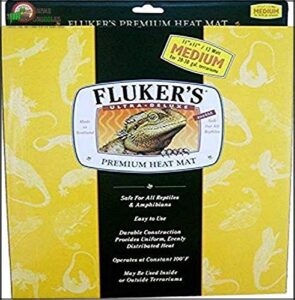
Fluker’s Medium Reptile Heat Mat keeps things simple — and that’s exactly the point.
The 11×11 inch pad runs at a consistent 100°F surface temperature, drawing just 12 watts. That makes it ideal for 20–30 gallon enclosures without taxing your power setup.
Mount it under clean glass, keep substrate thin so warmth transfers properly, and always pair it with a thermostat.
The mat has no adhesive surface, so repositioning is easy if you need to adjust placement.
| Best For | Reptile and amphibian owners who need a simple, reliable heat source for small to mid-sized enclosures like snakes, lizards, or hermit crabs. |
|---|---|
| Size | 11 x 11 inches |
| Mounting Method | No adhesive |
| Thermostat Included | No |
| Target Animals | Reptiles, amphibians |
| Tank Placement | Under or side mount |
| Brand | Unlisted |
| Additional Features |
|
- No adhesive surface means you can reposition it easily without any hassle
- Works under or on the side of the enclosure, giving you flexible setup options
- Pairs well with a thermostat for steady, safe temperature control
- Doesn’t get super hot, so you may need a secondary heat source for species that need higher temps
- The actual heated area can run smaller than the listed size — some users got 10×10 instead of 11×11
- Thin substrate is a must for proper heat transfer, which limits how you can set up the enclosure
Safety Tips and Maintenance for Heating Pads
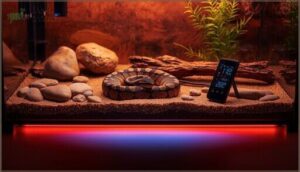
A heating pad that’s running unchecked is one of the fastest ways to harm your snake.
Keeping it safe comes down to four basics: stopping overheating before it starts, staying on top of cleaning, knowing when to swap out old equipment, and making sure everything works with your specific enclosure.
Here’s what you need to know for each one.
Preventing Overheating and Melting
A heat mat without a thermostat isn’t just risky — it’s a fire waiting to happen.
Unregulated pads can exceed 120°F, warping plastic and scorching wood.
Thermostat calibration keeps surface temps locked in the 85–90°F sweet spot.
Use insulation barriers and run material compatibility checks before installation.
| Risk Factor | Safe Practice |
|---|---|
| No thermostat | Use proportional controller |
| Plastic enclosures | Verify material limits first |
| Unmonitored hot spots | Daily heat spot monitoring |
Regular Cleaning and Inspection
neglected pad is a liability. Wipe the surface every 10–14 days in humid snake enclosures using a vinegar-and-distilled-water mix on a microfiber cloth.
Monthly, run a full visual damage check — look for warping, dark spots, and frayed cords.
Do an adhesion inspection and verify substrate heat transfer stays even. Consistent maintenance keeps temperature control reliable and your reptile care routine airtight.
Replacing Faulty or Old Heating Pads
Even a reliable heating pad won’t last forever.
Watch for pad lifespan indicators like dark charred spots, frayed cords, or inconsistent temperature control — those signal it’s time to swap it out.
Most heat mats last 1–3 years before adhesive removal becomes necessary.
Check warranty considerations before buying, and compare cost comparison options.
Dispose of old units responsibly through e-waste programs.
Ensuring Compatibility With Your Snake’s Enclosure
Compatibility comes down to four things: pad size ratio, enclosure design, material heat conductivity, and ventilation impact.
Your heat mat shouldn’t cover more than a quarter of the floor.
Glass conducts heat faster than wood, so thermostat calibration matters more in glass tanks.
Add an insulation layer under the pad on cold floors. That small step keeps your thermal gradient stable and temperature control consistent.
Frequently Asked Questions (FAQs)
Do snakes require heating pads?
Think of a snake as a solar-powered engine — without external warmth, it simply won’t run. Yes, snakes require a heating pad for thermoregulation, habitat simulation, and effective snake care temperature control.
How do snake heating pads work?
A snake heating pad uses a resistive heating element to convert electricity into warmth, emitting infrared C that conducts through the enclosure floor.
A thermostat probe placement ensures precise temperature control via regulated substrate conductivity.
How can you safely heat a snake terrarium?
Pair every heat source with a thermostat. Keep the warm side at 88–92°F and the cool side at 75–80°F. That gradient lets your snake self-regulate naturally and stay healthy.
How do you heat a snake enclosure?
Heat flows like a compass — your snake follows it.
Use a heating pad under the tank, paired with a thermostat, to build a thermal gradient from 90°F warm to 75°F cool.
How long can a snake go without a heating pad?
A healthy snake can manage a short outage if the room stays warm, but don’t push it.
Below its safe range, digestion stalls and feeding must stop until heat is fully restored.
What degree is too hot for snakes?
Anything above 113°F risks burns on contact. Most species hit danger zones around 105°F during prolonged exposure. Thermostat failure is the fastest path there — never skip that safeguard.
Can heating pads be used with wooden enclosures?
Yes, but you need to be careful.
Wood insulates more than glass, which means a heating pad can run hotter than expected.
Always use a thermostat and make sure proper airflow to prevent overheating.
How long should a heating pad run daily?
Run it 24/7 — but your thermostat does the real work, cycling the heat mat on and off to hold target temps. Stable temperature regulation beats any timed schedule.
Do heating pads work well for nocturnal snakes?
Heating pads work great for nocturnal snakes. They deliver belly warmth and lightless heating that won’t disrupt night cycles.
Pair with thermostat accuracy and proper substrate insulation for reliable nighttime digestion support.
Should heating pads stay on during snake feeding?
Keep the heating pad on during snake feeding. Your snake needs that 30–32°C warm spot for digestion timing right after eating. Just make sure your thermostat is doing its job.
Conclusion
Your snake’s behavior is the first signal something’s off—and now you know how to read it. Nail how hot a snake heating pad should get, and you’ve removed the single most common cause of feeding refusals, bad sheds, and sluggish behavior overnight.
Check your warm hide temperature today. If it’s not hitting the right range for your species, adjust the thermostat before the next feeding window.
That one measurement protects everything else you’ve built.
- https://www.zenhabitats.com/blogs/reptile-care-sheets-resources/ball-python-complete-lighting-and-heating-guide
- https://cornsnake.net/pages/heating
- https://reptifiles.com/corn-snake-care-guide/corn-snake-temperatures-humidity/
- https://www.furrycritter.com/pages/articles/snakes/heat_pad_burns.htm
- https://www.snakehaus.com/frontpage/education/heat-tape-safety/