This site is supported by our readers. We may earn a commission, at no cost to you, if you purchase through links.
Most snake keepers obsess over temperature gradients and humidity levels, yet overlook the one variable that quietly governs everything else: light duration.
A snake running on a chaotic photoperiod—lights on at random hours, off whenever you remember—experiences measurable hormonal disruption. Corticosterone levels climb 30–40%, feeding refusals follow, and the animal you’re trying to keep thriving starts working against you.
Knowing how long to run UV light for snakes isn’t a minor detail you’ll fine-tune later. It’s the foundation your entire husbandry schedule builds on, and getting it right is more systematic than most guides suggest.
Table Of Contents
- Key Takeaways
- Run UV Light for Snakes 10–12 Hours Daily
- UV Light Duration Varies by Snake Species
- Set Up Your UVB Schedule With a Timer
- Step 1 — Choose The Right UVB Bulb Output (2–5% for Most Snakes)
- Step 2 — Position The Fixture 9–18 Inches Above The Basking Spot
- Step 3 — Program a Timer for a Consistent On/off Window Each Day
- Step 4 — Add a 30–60 Minute Dawn and Dusk Transition to Reduce Stress
- Step 5 — Sync UVB Timing With Your Heat Source for Overlapping Basking Hours
- Safety Considerations for Snake UV Lighting
- Replace and Monitor UVB Bulbs on a Schedule
- Frequently Asked Questions (FAQs)
- Is UVB lighting good for snakes?
- Do Reptiles need UV light?
- What happens if a pet reptile doesn’t get UV light?
- Should reptiles be exposed to UVB?
- Are snakes attracted to UV light?
- How long do UV lights last for reptiles?
- Can UV light affect a snakes shedding cycle?
- Does room lighting interfere with a snakes photoperiod?
- Should UV run time change after a snake feeds?
- Can hatchlings and juveniles handle the same UV duration as adults?
- Conclusion
Key Takeaways
- UVB light for 10–12 hours daily on a consistent timer keeps your snake’s stress hormones, appetite, and sleep cycle working together instead of against each other.
- Different species need different UV exposure — ball pythons do fine with low‑intensity, 10–12‑hour cycles, while nocturnal snakes only need 6–8 shaded hours to stay healthy.
- UVB bulbs go silent before they go dark, so replace compact bulbs every 6–8 months and linear tubes every 10–12 months regardless of how bright they still look.
- Heat and UVB must run at the same time — cold skin under UV light won’t trigger vitamin D3 synthesis, which means your snake gets the light but misses the biological benefit.
Run UV Light for Snakes 10–12 Hours Daily
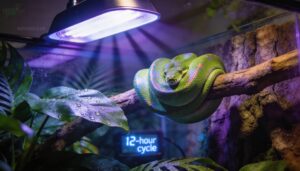
Running UVB light for 10–12 hours a day isn’t arbitrary — it mirrors the natural light cycle your snake’s biology is built around. Getting the timing right affects everything from appetite to stress hormones to long-term bone health.
A consistent schedule matters more than most keepers realize — this guide on setting up UVB lighting for snake enclosures walks through the practical steps to get it dialed in.
Here’s what you need to know about making that daily window work.
Why a 12-hour Light and 12-hour Dark Cycle Works Best
A 12‑hour light/12‑hour dark photoperiod isn’t arbitrary — it mirrors the natural dawn‑dusk rhythm most snake species evolved alongside. This structure drives Circadian Hormone Sync, keeping Metabolic Rhythm Stabilization and Immune Function Timing locked to a predictable cycle.
Your UVB schedule should reinforce that pattern daily:
- Light on at the same time every morning
- Consistent 12-hour active window
- Full dark period every night
How Consistent Photoperiods Regulate Appetite and Stress Hormones
Consistent photoperiods do more than mark day and night — they regulate melatonin signaling, leptin rhythm, and the corticosterone cycle that governs your snake’s hunger and stress response. Irregular schedules spike stress markers by 30–40% and trigger feeding refusals in nearly two-thirds of affected colubrids.
Irregular light schedules spike snake stress markers by 40% and trigger feeding refusals in most colubrids
| Biological Process | Consistent Photoperiod Effect | Irregular Photoperiod Effect |
|---|---|---|
| Melatonin rhythm | Stable dark-phase peaks | Disrupted timing signals |
| Hypothalamic gene expression | Balanced AgRP clock activity | Elevated neuropeptide Y drive |
| Corticosterone cycle | Predictable dark-phase surge | Blunted, arrhythmic stress response |
| Leptin rhythm | Normal satiety signaling | Impaired appetite regulation |
| Circadian rhythms | Coordinated feeding behavior | 30–40% elevated stress markers |
Using a Timer to Prevent Photoperiod Drift Throughout The Week
All that biological precision collapses fast if your lighting schedule shifts even slightly day-to-day. Automated timers lock your photoperiod in place — same minute, every day.
Use digital models with battery backup so power outages don’t erase your UVB lighting schedule.
Do weekly drift checks, especially after Daylight Saving Adjustments. Timer Calibration and Dawn/Dusk Staging keep timer programming accurate and stress markers low.
Aligning UVB Run Time With Your Snake’s Daytime Heat Cycle
Your UVB lighting schedule only works if your heat is running at the same time. That’s Circadian Heat Alignment in practice — Heat UV Sync means your Basking Window Overlap happens when temperatures actually support basking.
Getting this right takes some fine-tuning, but UVB lighting systems for boa constrictors walks you through syncing heat and light cycles so your basking window actually works.
A thermal gradient leaves your snake cool during UVB hours, cutting real UVB dosage.
Match Thermal Gradient Timing to your photoperiod, and Temperature UV Integration manages the rest.
Remember that UVB enables vitamin D₃ synthesis is essential for calcium homeostasis.
UV Light Duration Varies by Snake Species
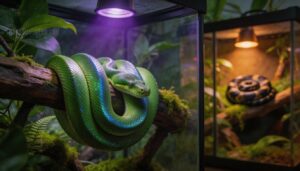
Not every snake needs the same amount of UV light — and getting that wrong can do more harm than good.
Your snake’s activity pattern, natural habitat, and Ferguson Zone placement all shape how long the light should actually run.
Here’s how different species break down.
Ball Pythons and Corn Snakes — Low-level UVB in Ferguson Zone 2
Both ball pythons and corn snakes sit comfortably in Ferguson Zone 2, meaning their natural UVI target lands between 0.7 and 1.0 — well below what a sun-loving lizard needs.
Shade method placement using a T8 tube positioned 25–30 cm away manages Ferguson zone calibration cleanly.
UVB intensity measurement confirms low-level UVB dosage without pushing your snake beyond its comfort zone.
Diurnal and Crepuscular Species That Need Longer UVB Exposure
Diurnal racers and active crepuscular species demand a fundamentally different UVB schedule than calmer snakes.
Their Crepuscular Activity Window and Extended Dawn Phase mean longer diurnal lighting exposure — usually 10–12 hours — with Higher UVB Dosage aligned through Thermal UVB Sync:
- Maintain a 10–12 hour photoperiod daily
- Target Ferguson Zone 3 UVB intensity (UVI 1.0–3.0)
- Sync UVB schedule with basking heat for Vitamin D3 Synthesis
- Run UVB during peak crepuscular species activity windows
- Adjust UVB intensity seasonally, not just duration
Nocturnal Snakes and Why Shaded or Shorter UVB Windows Suit Them
Nocturnal species operate on a completely different clock. They rely on ambient light cues — not direct basking — to regulate their circadian rhythm, so excessive UVB exposure works against them.
A shorter photoperiod of 6–8 hours, paired with shaded UVB setup, honors their shade preference and night vision adaptation. Since nocturnal snakes lean heavily on dietary vitamin D for calcium metabolism, low light hunting behavior stays intact without aggressive UVB schedules.
Seasonal Adjustments — Reducing Run Time During Winter-like Periods
Seasonal adjustments mirror what happens in nature — days shorten, and your snake’s biology expects that shift. A gradual light reduction of 1–2 hours across several weeks eases your snake into a winter photoperiod without disrupting appetite or basking habits.
Sync your seasonal heat tuning so UVB and warmth still overlap. Behavioral monitoring confirms the new UVB schedule is working before you finalize it.
Set Up Your UVB Schedule With a Timer
Getting your UVB schedule right comes down to five straightforward steps, and a timer makes the whole thing nearly foolproof. Each step builds on the last, so your snake gets consistent light, heat, and dark cycles without you having to manually adjust anything.
Here’s exactly how to set it up.
Step 1 — Choose The Right UVB Bulb Output (2–5% for Most Snakes)
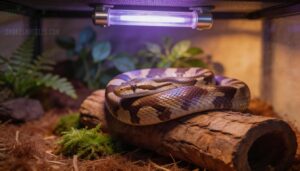
Start by matching bulb’s output to your snake’s actual UVB requirements — not just any bulb off the shelf. For most pet snakes, a 2–5% UVB bulb output hits the right UVB dosage without overwhelming them.
Ferguson Zone Mapping helps here: Zone 2 species, like ball pythons, need low‑intensity UVB, while reflector impact and intensity calibration determine real‑world UVI at the basking spot.
Step 2 — Position The Fixture 9–18 Inches Above The Basking Spot
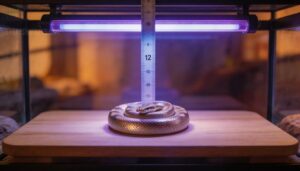
Getting UVB bulb placement and distance guidelines right is non‑negotiable — fixture height directly controls UVB dosage at the basking spot.
Measure from the bulb surface, not the enclosure floor, and keep center alignment directly over where your snake rests.
- Distance Measurement: Stay within 9–18 inches for usable UVB intensity
- Barrier Impact: Mesh tops reduce penetration — compensate with verified basking temperatures
- Mounting Stability: Secure fixtures so height doesn’t drift daily
- Temperature Verification: Confirm the basking spot stays warm enough for your snake to linger
Step 3 — Program a Timer for a Consistent On/off Window Each Day
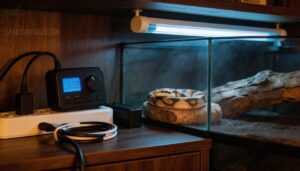
Once your fixture height is locked in, the next variable to control is timing. Program a digital lighting timer to run your UVB light on the same on/off window daily — a consistent photoperiod keeps stress hormones stable and feeding response predictable.
Use a Smart Scheduler with DST Adjustments built in, add battery Power Backup, and run a quick Verification Checklist after any outage.
Step 4 — Add a 30–60 Minute Dawn and Dusk Transition to Reduce Stress
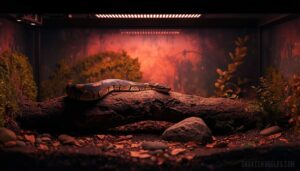
Once your timer is programmed, don’t let the light switch from zero to full strength in an instant. A gradual light ramp of 30–60 minutes mimics natural dawn and dusk simulations, which directly enhances circadian cueing and can cut stress markers by up to 25%.
Block any light leaks from nearby room lamps — stray light blurs the day-night signal your snake depends on.
Step 5 — Sync UVB Timing With Your Heat Source for Overlapping Basking Hours
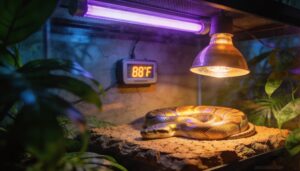
Your UVB schedule only works when heat and UVB run together. Vitamin D3 synthesis requires warm skin under UV — cold skin under UVB accomplishes very little.
- Turn both the basking bulb and UVB on simultaneously via your light timer.
- Confirm basking zone hits 85–90°F using a temperature gun.
- Keep UVB off when heat drops at night.
- Adjust heat before extending UVB hours.
- Treat Heat-UVB overlap as one coordinated photoperiod package — Basking Zone Synchrony means Temperature-UVB Pairing, not two separate schedules.
Safety Considerations for Snake UV Lighting
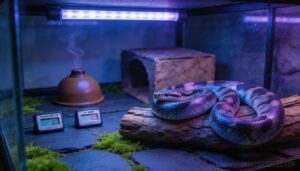
Getting the UVB schedule right is only half the job — the other half is making sure the setup itself doesn’t cause harm. A few overlooked details can turn a well-intentioned lighting rig into a stress source or, worse, a burn risk.
Here’s what to keep in mind before you call the setup complete.
Keeping UVB Off at Night to Protect Your Snake’s Dark Cycle
Night is non-negotiable. Your snake’s dark cycle isn’t just downtime — it’s when circadian rhythms reset and nocturnal rest behavior kicks in.
Any UVB shutoff protocol worth following cuts all UV and visible light the moment "night" begins. Nighttime light pollution disrupts the light-dark cycle just as much as skipping UVB does during the day.
Swap to heat-only night sources like ceramic emitters to maintain dark cycle integrity without sacrificing warmth.
Creating a Light Gradient So Your Snake Can Self-regulate Exposure
Your snake isn’t passive — it moves toward or away from light based on need. Smart UVB placement pairs with your thermal gradient so basking zones offer peak UVB dosage while shade hides and climbing branches provide retreat options.
This UV gradient approach lets your snake self-regulate exposure instinctively. Regular UVB mapping confirms the gradient holds, keeping your lighting schedule delivering real UVB exposure benefits.
Preventing Burns by Securing Fixtures Away From Direct Contact
Burns happen fast when a snake presses against an unshielded bulb.
Guard Mesh Installation blocks direct contact while still letting UVB pass through. Stable Mount Brackets keep fixtures from tilting under climbing pressure. Heat Shield Barriers redirect radiant heat downward. Cable Strain Relief stops cord movement from shifting your light angle.
Maintain Safe Fixture Distance — 9–18 inches — so your snake basks without touching the source.
Replace and Monitor UVB Bulbs on a Schedule
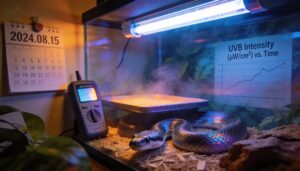
UVB bulbs don’t announce when they stop working — they just quietly fail while still looking fine.
Keeping your snake healthy long-term means staying ahead of that invisible decline with a few consistent habits. Here’s what to track and when to act.
Why UVB Output Fades Before The Visible Light Does
Your bulb can look perfectly bright while delivering almost no usable UVB. Phosphor degradation inside the tube causes UVB photochemical decay long before visible light dims.
Window filtering aging adds further attenuation, and distance and angle attenuation shrinks the effective basking zone quickly.
Atmospheric UVB loss principles apply similarly here — UVB intensity drops far more quickly than lumen output suggests.
UVB lamp efficacy and UVB measurement checks reveal what your eyes can’t.
Replacing Bulbs Every 6–12 Months to Maintain Effective Vitamin D3 Synthesis
Replace compact UVB bulbs every 6–8 months and linear tubes every 10–12 months — that’s your practical UVB bulb replacement frequency.
The intensity decline curve starts well before you notice dimming, quietly cutting vitamin D3 synthesis and nudging your snake toward metabolic bone disease.
Log your Installation Date on the bulb itself, set a calendar reminder, and don’t rely on appearance alone.
Watching for Behavioral Signs That UVB Duration or Intensity Needs Adjusting
Your snake’s behavior is the most honest feedback loop you have for your UVB lighting schedule.
Watch for these five red flags signaling UVB dosage needs adjustment:
- Basking Reluctance — Repeated test-and-leave visits signal intensity is too high
- Appetite Decline — Sudden feeding behavior drop often points to inadequate UVB
- Eye Irritation — Squinting or discharge indicates overexposure
- Skin Burns — Visible irritation means the fixture is too close
- Disrupted shedding patterns — Irregular cycles reflect rising stress markers
Cleaning Fixtures and Checking Placement Every Few Weeks for Consistent Output
Even a clean bulb loses effectiveness when dust, shed skin, and condensation coat the cover glass. Every few weeks, wipe down the cover glass, cleaning and inspect reflector alignment — even a slight angle shift changes your UVB gradient creation.
Verify fixture height verification against your original mark, check screen mesh maintenance for buildup, and log anything that looks off.
Consistent UVB output depends on the whole system staying clean and correctly positioned.
Frequently Asked Questions (FAQs)
Is UVB lighting good for snakes?
Yes — UVB lighting genuinely benefits snake health. The UVB spectrum drives vitamin D3 synthesis, which facilitates calcium metabolism, bone health, and immune support.
Without it, metabolic bone disease becomes a real risk.
Do Reptiles need UV light?
Most reptiles do. UVB lighting drives vitamin D3 synthesis, which powers calcium metabolism and bone health.
Without it, metabolic bone disease becomes a real risk — and that can turn fatal fast.
What happens if a pet reptile doesn’t get UV light?
Without UV light, your snake faces a cascade of silent failures —
Vitamin D3 Deficiency disrupts calcium metabolism, triggering Metabolic Bone Disease, Growth Stunting, Immune Suppression, and Behavioral Stress that compound into serious, life‑threatening Health consequences of UVB deficiency in reptiles.
Should reptiles be exposed to UVB?
Most snakes benefit from UVB exposure. It drives vitamin D3 synthesis, aids calcium metabolism and bone health, and strengthens immune function.
Without it, metabolic bone disease becomes a genuine long-term risk.
Are snakes attracted to UV light?
Snakes aren’t drawn to UV light itself, but UV sensitivity shapes how they detect prey, read markings, and choose basking spots — making UVB exposure a meaningful factor in their daily behavior.
How long do UV lights last for reptiles?
Most UVB bulbs last 6–12 months before UVB output decay makes them ineffective — even when they still glow. Hour-based replacement beats waiting for visible failure every time.
Can UV light affect a snakes shedding cycle?
Yes — UVB lighting influences vitamin D3 synthesis, calcium metabolism, and skin health, all of which shape shedding frequency.
Stable photoperiod and circadian rhythms keep hormonal regulation steady, supporting cleaner, more consistent shedding patterns.
Does room lighting interfere with a snakes photoperiod?
Yes — ambient room lighting can quietly disrupt your snake’s photoperiod. Light leaks, window light shifts, and inconsistent household light timing all erode the dark phase.
Blackout shielding helps maintain a consistent light-dark cycle.
Should UV run time change after a snake feeds?
No, feeding doesn’t change your UVB schedule. Your snake’s circadian rhythms and photoperiod drive UV timing — not meals.
Keep the light cycle consistent to avoid feeding-linked stress and unnecessary hormonal disruption.
Can hatchlings and juveniles handle the same UV duration as adults?
Hatchlings can follow the same 10–12-hour photoperiod as adults, but matching UV dose duration matters more than matching the timer.
Gradient placement and thermal overlap timing determine whether juveniles actually benefit.
Conclusion
Like a master conductor leading an orchestra, a well-crafted photoperiod harmonizes your snake’s environment, ensuring a thriving performance. By following these guidelines on how long to run UV light for snakes, you’ve taken the first step toward a balanced husbandry schedule.
Consistency is key; stick to your routine, and your snake will reward you with vibrant health.
A well-lit habitat is a sanctuary, not a guessing game – now, go give your snake the light it deserves daily.
- https://www.reptiles.swelluk.com/help-guides/uvb-lighting-part-1-snakes-nocturnal-species/
- https://pmc.ncbi.nlm.nih.gov/articles/PMC3139743/
- https://journals.physiology.org/doi/full/10.1152/ajpregu.00424.2002
- https://news.feinberg.northwestern.edu/2019/03/21/connection-between-circadian-rhythm-and-hunger-discovered/
- https://familysnake.com/guides/shedding-light-on-creating-a-healthy-habitat-for-your-snake/