
This site is supported by our readers. We may earn a commission, at no cost to you, if you purchase through links.

Most snake owners learn handling tolerance the hard way—a defensive strike, a coiled refusal to move, or a snake that won’t eat for two weeks after one too many sessions. These aren’t random acts of reptile stubbornness. They’re precise behavioral responses to stress, shaped by species temperament, age, health, and the specific way you picked them up.
A corn snake and a green tree python can share the same enclosure room and require completely different handling protocols. Knowing how much handling snakes tolerate—and reading the signals when you’ve crossed the line—is what separates a thriving animal from a chronically stressed one.
Table Of Contents
- Key Takeaways
- How Much Handling Can Snakes Tolerate?
- What Factors Influence Handling Tolerance?
- How Often Should You Handle Pet Snakes?
- What Are Signs of Handling Stress in Snakes?
- What Happens if You Handle Snakes Too Much?
- When Should You Avoid Handling Your Snake?
- How Do You Safely Handle Snakes?
- Are Some Snakes Better for Frequent Handling?
- What Are The Risks to Human Health?
- How Can You Improve Your Snake’s Handling Tolerance?
- Frequently Asked Questions (FAQs)
- Conclusion
Key Takeaways
- Species and age hard-wire your snake’s handling ceiling—ball pythons can take 2–3 sessions weekly, but green tree pythons will flip defensive almost immediately.
- Rapid breathing, S-curved posture, and post-session hiding aren’t attitude problems—they’re your snake telling you that you’ve already gone too far.
- Never handle within 48 hours of feeding, during a shed cycle, or in the first 7–14 days after bringing a new snake home—these windows turn routine contact into genuine harm.
- Building tolerance is a slow game: start under five minutes, add duration before frequency, and always end the session before tension appears.
How Much Handling Can Snakes Tolerate?
Not every snake is wired the same way—tolerance varies wildly by species, age, and personality. Some thrive with regular interaction; others see your hand as a threat every single time. Here’s what shapes that threshold.
Even stress from handling can sometimes show up physically—if your snake starts regurgitating undigested meals, that’s a clear sign it needs more space and less contact for a while.
Typical Handling Tolerance by Species
Not all snakes share the same tolerance thresholds—and that gap matters.
Ball pythons handle two to three sessions weekly, around 10–15 minutes each, without much pushback. Corn snakes are even more forgiving, accepting every-other-day contact.
But species temperament differences are real: racers, whip snakes, and green tree pythons hit their handling frequency limits fast, flipping into defensive behavior almost immediately.
For more details on popular pet snake species, you can explore their unique characteristics and care needs.
Individual Snake Variability
Species temperament differences only tell part of the story. Individual tolerance is where it gets personal. Two ball pythons from the same clutch can react completely differently—one relaxes within a minute, the other stays coiled and tense the whole session.
Snake personalities are real. Watch your animal’s stress signals closely. Defensive behavior, not species charts, tells you where the handling limits actually are.
Notably, research has revealed that can influence their stress and relaxation responses.
What Factors Influence Handling Tolerance?

Not every snake draws the line in the same place—and that’s not random. Handling tolerance comes down to a few hard factors that shape how much contact your snake can actually handle.
Here’s what you need to understand before you pick up that snake.
Species Differences
Your snake’s breed is the first thing that defines the game. Ball pythons and corn snakes carry Breed Characteristics and Genetic Factors that make them genuinely forgiving—most tolerate 2–3 handling sessions weekly without protest.
But Species Variance is real. Carpet pythons and green tree pythons demand tighter Handling Techniques, shorter sessions, lower frequency. Snake Temperament isn’t random—it’s wired into the species itself.
Age and Life Stage
Age shapes everything. A baby snake fresh from the egg is wired for survival—not socializing. Keep neonate care sessions under five minutes, and wait until it’s eating reliably before making handling frequency routine.
Juvenile handling follows similar logic: once or twice weekly, nothing more.
Senior health demands extra caution too—aging spines can’t absorb rough holds. Life Stage Transitions rewrite the rules every time.
Health and Environment
Environment is the silent variable most keepers underestimate. A snake living in poor conditions hits its stress thresholds fast — and handling risks multiply. Watch these four Environmental Factors closely:
- Temperature gradient: 85–90°F warm side, 75–80°F cool side
- Humidity levels matched to species
- Two hides minimum for Security
- Minimal predator-pressure from pets or foot traffic
Nail these, and snake health improves — handling tolerance follows.
How Often Should You Handle Pet Snakes?

Handling frequency isn’t one-size-fits-all — it depends heavily on the species you’re keeping and how well you read their cues. Most snakes do best with a structured routine rather than random, whenever-you-feel-like-it sessions.
Here’s what the science and experience actually recommend.
Recommended Frequency by Species
Not all snakes follow the same rules. Snake temperament and species handling limits define your frequency guidelines. Respect those boundaries, and your snake stays cooperative.
Ball pythons handle 2–3 sessions weekly without issue once feeding reliably. Corn snakes—active and naturally docile—manage every other day. Kingsnakes tolerate moderate frequency but will nip if pushed. Green tree pythons? Keep handling to a minimum.
Establishing a Consistent Schedule
Consistency is your secret weapon. Pick Fixed Windows—early evening, between 6–9 p.m., works well—and stick to them. Keep Session Length to 10–15 minutes.
Build Rest Days into your Schedule Coordination so feeding days stay handling-free.
Use Handling Logs to track frequency and catch stress thresholds before they become problems. A locked-in handling routine transforms your snake’s handling tolerance.
What Are Signs of Handling Stress in Snakes?
Snakes don’t complain out loud — but they do communicate. Your job is learning to read the signals before stress turns into a real problem.
Here are the key signs to watch for.
Defensive Posturing and Hiding

Your snake’s body language doesn’t lie. When handling tolerance breaks down, defensive posturing kicks in fast—an S-shaped neck, flattened head, and raised front body are classic threat displays.
Escape tactics follow: rapid, jerky movements, head-pulling, immediate retreat to hides. These stress signals aren’t random.
Prolonged hiding behaviors after sessions—days of silence—mean you’ve crossed the line. Read the signs. Respect them.
Rapid Breathing and Regurgitation

Breathing patterns don’t lie. A relaxed snake barely moves when it breathes—you can’t even count the breaths. Pick it up and suddenly its sides are pumping? That’s a hard stress signal. Put it down immediately.
Regurgitation causes are just as telling: handle within 48 hours post-feeding and you’re risking a full ejection. Repeated regurgitation damages the esophagus and wrecks snake health long-term. Know your handling limits.
What Happens if You Handle Snakes Too Much?

Overhandling isn’t just annoying for your snake—it causes real damage. Too much contact pushes their stress response into overdrive, and the fallout shows up in two distinct ways. Here’s what actually happens.
Physical Health Risks
Overhandling doesn’t just stress your snake—it breaks it down physically. Musculoskeletal damage builds quietly: unsupported body weight strains the spine, and rough grabs risk rib fractures.
Immune suppression follows chronic stress, opening the door to respiratory issues like pneumonia. Digestive problems—including regurgitation and esophageal inflammation—spike when handling frequency ignores post-feeding windows.
Skin injuries from abrasive surfaces or dry hands compromise shedding. This is reptile care at its most consequential for animal welfare.
Behavioral Changes and Stress
The physical toll bleeds into behavior fast. Chronic stress hormones reshape snake temperament—what was once a calm ball python starts striking at your shadow.
Watch for behavioral shifts like glass surfing, constant hiding, and feeding refusal. These stress signals don’t lie. Poor handling techniques and weak environmental factors compound everything.
Fix the pattern early, or handling tolerance collapses completely.
When Should You Avoid Handling Your Snake?

Knowing when not to handle your snake matters just as much as knowing how. There are specific windows where picking up your snake isn’t just unwelcome — it’s genuinely harmful. Here’s when to keep your hands to yourself.
After Feeding
After feeding, your snake’s body is a machine locked into one job—digestion. Interrupt it, and you’re gambling with regurgitation risks that can spiral fast. Here’s what solid handling guidelines demand you respect:
- Wait 24–48 hours minimum before any handling after feeding
- Extend to 3–7 days for larger meals or slower species
- Skip handling entirely after a regurgitation event for 14 days
- Watch for digestion stress signs: lethargy, refusal, unusual posturing
- Schedule handling sessions before feeding day—not after
Post feeding care isn’t optional. Handling after feeding triggers a stress response that mechanically disrupts digestion, compressing stomach contents and spiking regurgitation risks. That single mishandled session can torch an entire meal’s worth of calories and nutrients. Adjust your handling frequency around the snake’s digestive timeline—not your schedule.
During Shedding (“in The Blue”)
Shedding flips everything. When your snake goes into the blue phase, those cloudy eyes aren’t cosmetic—vision changes reduce sight to vague shapes, turning your hand into a threat. Handling risks spike hard here. Back off.
| Blue Phase Sign | What It Means |
|---|---|
| Cloudy eyes | Vision severely impaired |
| Increased hiding | Stress response active |
| Defensive striking | Feels threatened |
| Dull, faded skin | Old layer loosening |
| Reduced appetite | Energy redirected to shedding |
Boost humidity control instead. Let shedding stress resolve naturally.
When Newly Acquired or Ill
New snake, sick snake—same rule: hands off. Give a newly acquired snake 7–14 days of zero contact for acclimation periods. Quarantine protocols matter too; separate rooms, clean setups, 30–90 days minimum.
- Skip handling until your new snake eats consistently
- Illness management means handling only for vet care—nothing casual
- Snake stress tanks handling tolerance fast when health is already compromised
How Do You Safely Handle Snakes?
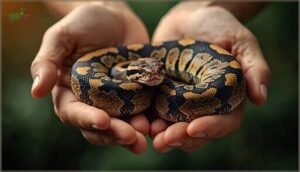
Safe handling isn’t complicated, but it does demand intention. Get the basics right and your snake stays calm, healthy, and far less likely to remind you it has teeth.
Here’s what actually matters when you pick one up.
Proper Support Techniques
Support is everything in snake handling. Nail the Mid Lift Technique—slide one hand under the mid body, the other cradling the rest. That’s Body Alignment in action.
Keep it horizontal. Always.
| Support Method | Application | Benefit |
|---|---|---|
| Snake Hooking | Pre-lift signal | Reduces startle response |
| Multiple Contact Points | Every 3–4 ft | Prevents spinal strain |
| Gentle Restraint | Medical holds only | Minimizes defensive biting |
Duration and Frequency Guidelines
Most snakes hit their stress thresholds fast. Cap routine sessions at 10–15 minutes—that’s your handling limit baseline.
For frequency caps, 2–3 times per week is the sweet spot for building handling tolerance without crossing into overhandling territory. Skip sessions 48 hours post-feeding.
Session timing matters as much as duration. Let the snake’s behavior—not your schedule—set the pace.
Minimizing Startle Responses
Startle responses are your biggest threat to long-term handling tolerance. Master these calm approach fundamentals:
- Approach from the side—never above—to avoid triggering defensive responses
- Move hands slowly, pause before contact to let snake behavior settle
- Start gentle touch at the midbody, never the head
- Use stress reduction techniques: quiet rooms, no sudden vibrations
- Read body language before lifting—frozen tongue means stop
Handling techniques that respect snake behavior build trust fast.
Are Some Snakes Better for Frequent Handling?
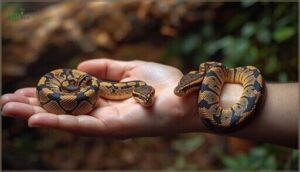
Not all snakes are built for the social life. Species vary wildly in how much handling they’ll actually tolerate before stress kicks in.
Here’s how the most common pet snakes stack up.
Ball Pythons and Corn Snakes
Two species dominate the beginner market for good reason. Ball pythons and corn snakes both offer solid handling tolerance—but they behave very differently in your hands.
| Trait | Ball Python | Corn Snake |
|---|---|---|
| Session Length | 10–15 minutes | 15–30 minutes |
| Movement Style | Still, curls up | Active, exploratory |
| Stress Signal | Balls tight | Rapid crawling away |
| Handling Frequency | 2–3x weekly | 3–4x weekly |
Your Snake Habitat Design and handling techniques shape everything.
Species With Low Tolerance
Not every snake species suitable for handling actually wants to be held. Some have hard-wired Handling Limits you simply can’t train away.
- Green tree pythons strike from the perch — Arboreal Species that see removal as a threat
- Coachwhips musk, bite, and thrash — classic Defensive Behavior under restraint
- Emerald tree boas flash Stress Signals fast, especially northern localities
- Rock pythons develop Defensive Responses as they mature
- Low Tolerance species reward observation, not contact
What Are The Risks to Human Health?

Snakes aren’t just a risk to themselves — they pose real health considerations for you, too. Handling one means you’re coming into contact with bacteria and parasites that don’t care how experienced you’re.
Here’s what you need to know before you reach into that enclosure.
Salmonella and Parasites
Your snake might look clean — it isn’t. Roughly 45% carry Salmonella enterica, the strain behind most human salmonellosis cases. That’s not speculation; it’s documented across thousands of reptile samples. Zoonotic diseases and parasitic infections don’t announce themselves.
Nearly half of all pet snakes silently carry Salmonella—clean appearance means nothing
| Risk | Source | Human Impact |
|---|---|---|
| Salmonellosis | Fecal contact | Fever, cramps, diarrhea |
| Pentastomiasis | Mucus/feces handling | Internal cyst lesions |
| Bacterial infections | Enclosure surfaces | Systemic illness |
Parasite control and reptile hygiene aren’t optional — they’re the price of keeping a predator.
Importance of Handwashing
So you’ve got Salmonella on your radar — good. Now act on it.
Wash your hands with soap and running water for at least 20 seconds after every session. That’s non-negotiable snake handling guidelines. Hand hygiene isn’t a suggestion; it’s germ prevention in real time.
No sink nearby? Use 60%-alcohol sanitizer. Simple sanitizing methods, zero excuses.
How Can You Improve Your Snake’s Handling Tolerance?

Building a snake that actually tolerates handling isn’t luck—it’s a process. The good news is that with the right approach, most snakes can improve markedly over time. Here’s what works.
Gradual Acclimation
Start slow—leave new arrivals alone for five to seven days before any contact. Then open the enclosure, place your hand inside, and let the snake decide. Early sessions stay under five minutes.
Build gradually: more duration first, then more frequency, never both at once.
Consistent handling routines, calm environmental factors, and predictable acclimation techniques rewire even a defensive snake’s temperament over weeks.
Recognizing Stress Signals
Acclimation only works if you can read the feedback. Stress signal identification isn’t guesswork—it’s pattern recognition. Watch for body language cues: rigid posture, frantic escape attempts, hissing, or rapid breathing. Any one sign warrants attention. Multiple signs together mean stop immediately.
Recognizing snake stress signals early protects handling tolerance long-term. Snake anxiety compounds fast when you ignore the warnings your animal is already sending.
Building Positive Associations
Reading stress signals gives you the data. What you do next builds the relationship. Trust building isn’t magic—it’s repetition and consistency. Pair calm environments with gentle touch every session. Keep predictable routines: same days, same quiet space, same slow movements.
- Use target training to separate hands from food
- End sessions before tension appears
- Return your snake to a familiar hide every time
Frequently Asked Questions (FAQs)
Can snakes recognize their owners over time?
Funny enough, the snake that seems “happy” to see you isn’t feeling affection—it’s recognizing your scent. Owner recognition is real, but it’s sensory-driven habituation, not bonding.
Do snakes enjoy being handled at all?
Snakes don’t enjoy handling the way mammals do. Snake emotion is minimal—their brains aren’t wired for pet bonding. Most show tolerance, not pleasure.
Calm stillness means they’ve accepted it, not embraced it.
How does temperature affect a snakes mood?
Temperature effects are everything. Too cold, and your snake goes sluggish—not calm, just shut down. Too hot, muscles fire faster, defensive strikes come quicker.
Thermal comfort is the difference between a manageable snake and a moody one.
Can handling snakes worsen existing health conditions?
Yes, it can. If you have respiratory risks, allergic reactions, immune disorders, cardio issues, or skin complications, direct contact may trigger flare-ups.
Wash hands, wear gloves, and handle in well-ventilated spaces.
What role does enclosure size play in temperament?
Enclosure size shapes animal temperament more than most keepers expect. Tight quarters limit stretching, reduce environmental enrichment, and spike defensive responses—making snake comfort nearly impossible.
Better enclosure space means calmer snakes and improved handling tolerance.
Conclusion
Think of handling tolerance like a bank account—every session makes a withdrawal. Over-handle, and you’re overdrawn: a stressed snake that won’t eat, strikes on sight, or hides for days. How much handling snakes tolerate depends on species, age, and the signals you’re actually reading.
Make consistent deposits through patience, proper timing, and gradual acclimation. Respect those limits, and you won’t just own a snake—you’ll share space with one that genuinely tolerates your presence.