This site is supported by our readers. We may earn a commission, at no cost to you, if you purchase through links.
A single ball python can sell for more than the price of a used car—not because it’s rare in the wild, but because the right combination of recessive alleles landed in the same animal. That’s the strange economy driving the morph hobby, where two copies of a piebald gene or a precisely stacked multi-gene combo can push a snake past the $1,500 mark overnight.
Most keepers can spot an albino by its red eyes and washed-out yellows, but identifying rare ball python morphs gets complicated quickly once epistatic interactions start masking traits or supergene architecture locks alleles together in unexpected ways.
Knowing what you’re actually looking at—and why—changes everything about how you breed, buy, and build a collection.
Table Of Contents
- Key Takeaways
- What Are Rare Ball Python Morphs?
- Genetic Principles Behind Morph Identification
- Key Visual Traits of Rare Morphs
- Techniques for Identifying Rare Morphs
- Factors Impacting Rarity and Value
- Frequently Asked Questions (FAQs)
- How do I verify a morphs pedigree before buying?
- Can rare morphs be safely bred with common morphs?
- What tools are needed for at-home genetic testing?
- Do rare morphs have different care requirements than normals?
- How can I tell if a seller is misrepresenting morphs?
- How do I document rare morph breeding records?
- Which rare morphs are best for beginner collectors?
- Can rare morphs interbreed with wild-type pythons?
- How does aging affect rare morph coloration?
- Where can I buy verified rare ball pythons?
- Conclusion
Key Takeaways
- A ball python’s price is driven by its genetic makeup — stacking recessive alleles like piebald or albino into one animal can push its value past $1,500, while common morphs sit under $100.
- Visual identification alone won’t cut it, since lighting, age, and hidden carrier genes can all fool your eye — DNA testing collapses years of test-breeding guesswork into a single lab report.
- Health risks are baked into certain morphs by design, not bad luck — the spider morph’s wobble syndrome is a direct consequence of its genetic mutation, and no amount of good husbandry fixes it.
- Rare morphs hold value longer because producing them through recessive inheritance can take six to nine years across multiple generations, keeping supply tight no matter how strong demand gets.
What Are Rare Ball Python Morphs?
Not every ball python you come across at a reptile expo is created equal — some carry genetic combinations so rare that breeders spend years chasing them. Understanding what separates a rare morph from a common one starts with knowing how genes actually drive these differences.
Browsing a curated list of ball python morphs for sale can quickly show you just how dramatically price reflects genetic rarity in practice.
Here’s a closer look at what defines rare ball python morphs and why they matter.
Definition of Ball Python Morphs
When you study ball python genetics, a morph isn’t just a pretty color — it’s a heritable change in phenotype driven by a specific allele combination. That distinction matters.
Environmental factors can shift appearance temporarily, but true morphs follow predictable dominant, co-dominant, or recessive gene inheritance patterns, meaning the trait is locked into the genotype.
Breeders use a morph classification system with standardized naming conventions to organize hundreds of recognized variants, keeping identification consistent across the hobby.
Genetic Basis of Rare Morphs
Every morph you see starts with a mutation — a single change in the genetic code that rewrites how pigment or pattern develops. Genetic inheritance patterns in ball pythons follow three main modes:
- Recessive inheritance — genes like albino and piebald require two copies before phenotype expression occurs.
- Dominant gene inheritance — pinstripe expresses with just one allele present.
- Co-dominant inheritance — doubles into "super" forms, like super fire’s leucistic white body.
Beyond these basics, Supergene Architecture and Chromosomal Inversions lock multiple alleles together, preserving complex traits across generations. Epistatic Interactions between gene complexes — like the blue-eyed leucistic group — alter Allele Penetrance unpredictably. Sex-Linked Morphs add another layer, shifting morph rarity between male and female offspring. Understanding genetic mutations in reptiles helps breeders predict morph outcomes.
Difference Between Common and Rare Morphs
Market availability tells most of the story. Pastels and Spiders are everywhere — common morphs often prices under $100, while rare ball python morphs and pricing can push well past $1,500 due to genetic inheritance patterns in ball pythons requiring multiple precise alleles.
Price disparity reflects breeding success rates, collector preference, and real health risks — like spider wobble syndrome — that quietly reshape market value fluctuations over time.
Studying edge populations for unique variants can aid in locating rare morphs.
Genetic Principles Behind Morph Identification
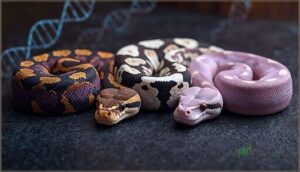
Before you can confidently identify a rare morph, you need to understand what’s actually driving the differences you see. Genetics is the foundation — and once you understand how dominant, co-dominant, and recessive genes work, a lot of the mystery disappears.
Digging into carpet python color variations and morph genetics makes it much easier to predict which traits will show up in your next clutch.
Here’s what you need to know.
Dominant, Co-Dominant, and Recessive Genes
Think of allele interaction patterns as the rulebook behind every morph you see. A dominant allele masks its recessive partner — one copy is all it takes to express the trait. Codominant inheritance works differently: both alleles contribute, producing a distinct intermediate form, and homozygous vs heterozygous pairings yield three separate phenotype classes.
- Dominant inheritance: ~50% visuals when bred to normals
- Codominant (het × het): 25% supers, 50% singles, 25% normals
- Recessive inheritance: 25% visuals from het × het crosses
- Gene masking effects hide recessive alleles in carriers for generations
- Pedigree tracking strategies reveal inheritance ratio predictions across clutches
Genetic Mutations Creating Rare Morphs
Rare morphs don’t appear by accident — they trace back to specific mutation hotspots where pigment pathways, neural crest development, or scale pattern genes break down in predictable ways.
Loss-of-function changes drive classics like Albino, while allele synergy between epistatic modifiers produces complex designer combos like Dreamsicle.
Gene penetrance determines how strongly a trait is expressed, which is exactly why ball python morph genetics rewards careful lineage tracking over guesswork.
Key Visual Traits of Rare Morphs
Once you understand the genetics, the next step is training your eye to recognize what those genes actually look like on a living snake.
Rare morphs each carry specific visual signatures — from color gradients and pattern breaks to scale texture and eye color — that set them apart from anything you’d find in the wild.
Here’s what to look for.
Unique Color Variations and Patterns
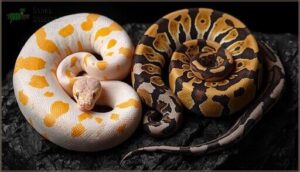
Color tells you more than you’d expect.
Albino morphs strip out dark pigment entirely, leaving bold yellow-orange blotches on white with red eyes — high contrast, unmistakable. Axanthic morphs pull the opposite direction, trading yellows for silver-gray tones.
Piebald scatters unpigmented white across anywhere from 10 to 90 percent of the body, while monsoon breaks side blotches into dense, maze-like swirls.
Pinstripe elegance reduces lateral markings to almost nothing.
Some lines even show a metallic sparkle or iridescent sheen — vanishing contrast at its most striking.
Head Stamps, Scale Texture, and Eye Color
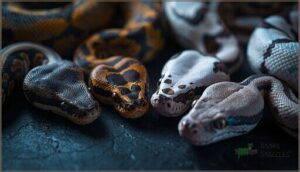
Head markings are one of the fastest visual cues you’ll find on a ball python. Clown morphs pack the crown with busy teardrop spots and lip markings — classic stamp pattern variation that’s hard to miss. Spotnose and yellow belly show subtler head marking exceptions, with pale crowns that only register once you know what to look for.
Eye hue indicators follow a reliable logic: albino morphs lose melanin entirely, shifting eyes toward red or pink, while blue-eyed leucistic combos land on that distinctive bright blue.
Scale gloss consistency and texture aging effects matter too — scaleless morphs expose wrinkled skin where glossy scales would normally sit, making scale pattern genetics visible at a glance.
Still, visual cue analysis only gets you so far without pedigree records.
Techniques for Identifying Rare Morphs
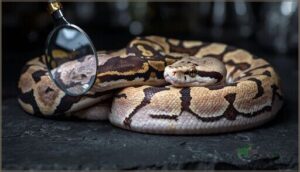
rare ball python morph goes beyond a quick visual check — some genes hide completely until the right conditions expose them. Knowing which method to use can mean the difference between a confident ID and an expensive mistake.
Here are the three main techniques breeders and collectors rely on.
Phenotypic Identification and Its Limits
Phenotype alone won’t close the case. Lighting Variability shifts perceived color dramatically — the same snake can look like two different morphs under a warm bulb versus daylight. Age Fading dulls patterns over time, complicating visual cue analysis. Observer Bias means two experienced eyes can disagree on the same animal. Hidden Allele Masking is perhaps the biggest trap: carriers appear completely normal. For reliable morph identification checklist and workflow outcomes, Photo Standardization and genetic testing versus visual assessment aren’t optional.
- Lighting conditions alter pigment intensity and pattern contrast
- Aging progressively fades or darkens original phenotypic traits for hobbyist identification
- Hidden carriers show no distinguishing features visually
- Subjective interpretation skews visual identification of snake patterns
Test Breeding for Hidden Genes
When visuals fail you, controlled breeding trials become your most reliable tool. Het pairing ratios follow Mendelian logic — a het × het cross gives you 25% visual offspring, 50% heterozygous carriers, and 25% clean animals.
Proving out carriers means pairing your suspected het against a visual and watching clutch outcome odds across multiple clutches. Multi-gene projects demand record keeping strategies that track every pairing, because hidden alleles move silently through generations without leaving visual markers.
Molecular and DNA-Based Identification
Genetic testing doesn’t just speed things up — it rewrites the rules. Instead of waiting years through controlled pairings, you ship shed skin to a commercial lab and get back a concrete answer about alleles you couldn’t see.
- SNP panels detect single or multiple recessive alleles before your snake ever reaches breeding age.
- Mitochondrial haplotypes and DNA barcoding separate true causal mutations from neutral background variation.
- Whole genome sequencing confirms genotype analysis on complex multi-gene combos where phenotype alone misleads.
- Epigenetic biomarkers and DNA sequencing expand test catalogs as university research validates new genetic mutation markers.
That’s how you compress a decade of genetic inheritance guesswork into one lab report.
One lab report can replace a decade of genetic guesswork
Factors Impacting Rarity and Value
A morph’s price tag isn’t random — it’s shaped by a mix of genetics, market forces, and biology working together.
Some morphs command thousands of dollars while nearly identical-looking snakes sell for under a hundred, and the reasons why are worth understanding.
Here’s what actually drives rarity and value in the ball python world.
Market Demand and Morph Popularity
Few forces shape the morph market more than social media buzz. When a well-known breeder drops a clutch reveal on Instagram or TikTok, buyer segments respond quickly — collector demand spikes, and price trends follow.
But novelty fades. Trend cycles mean today’s must-have combo becomes tomorrow’s bargain bin once supply scarcity disappears.
Multi-gene projects tend to hold value longer because they’re genuinely harder to replicate. Watch price depreciation patterns closely — morph popularity and morph market timing can make or break your investment.
Breeding Complexity and Gene Availability
Novelty drives demand, but breeding complexity determines whether supply ever catches up. Producing rare morphs through recessive gene inheritance often takes six to nine years across multiple generations.
Nucleus breeding schemes concentrate elite lines, while marker-assisted selection helps identify hidden carriers early.
Key constraints include:
- Donor allele introgression introduces new traits, but requires careful linkage drag management
- Genomic diversity strategies prevent inbreeding depression across long-term projects
- Gene isolation demands homozygous founder stock, limiting availability for years
- Allelic series interactions complicate dominant vs recessive trait predictions substantially
Health Considerations Linked to Rare Morphs (e.g., Wobble Syndrome)
breeding complexity sets the ceiling on supply, but health is what sets the floor on ethics.
The spider morph is the clearest example — wobble syndrome isn’t a rare complication, it’s a built-in consequence of the genetic mutation itself.
inner ear defects cause real feeding challenges and welfare concerns, no husbandry support can fully fix.
| Morph | Health Risk |
|---|---|
| Spider | Neurological disorder, spider wobble |
| Scaleless | Scale loss health risk, abrasion sensitivity |
| Blue-Eyed Leucistic | Low breeding success |
| Super Pastel | Possible kinked spine |
| Piebald | No major known defects |
Know what you’re breeding into.
Frequently Asked Questions (FAQs)
How do I verify a morphs pedigree before buying?
Before money changes hands, demand official lineage paperwork, DNA test results, and full ownership history.
Verify parent IDs, check breeder reputation through buyer references, and confirm morph lineage records match the animal in front of you.
Can rare morphs be safely bred with common morphs?
Yes — pairing a rare morph with a common one is generally safe when both animals are healthy and you’ve screened for problem genes like the spider complex’s wobble-linked traits first.
What tools are needed for at-home genetic testing?
At-home genetic testing kits usually include a saliva collection kit, stabilizing solution, biohazard bag, and prepaid return mailer.
Results arrive through a secure results portal, and pairing findings with a morph calculator confirms your ball python’s genetic makeup.
Do rare morphs have different care requirements than normals?
Most rare morphs follow standard ball python care.
A few exceptions exist — scaleless morphs need humidity adjustments and scale protection, while spider morphs require neurological monitoring, consistent feeding frequency, and regular veterinary screening.
How can I tell if a seller is misrepresenting morphs?
Start with photos. If images look edited, cropped, or avoid key angles, that’s your first red flag.
Ask direct questions about genetics—vague answers or pressure to just trust the listing signal misrepresentation.
How do I document rare morph breeding records?
Tie every clutch to a Parentage Log, assign a Clutch ID Tracking number, build a Phenotype Photo Archive, and keep Genotype Confirmation Notes updated — your Sales Lineage History completes the record.
Which rare morphs are best for beginner collectors?
Pastel and albino morphs make ideal budget-friendly starter choices — simple gene combos, stable health traits, and easy-to-identify patterns.
Both offer clear genetic inheritance of snake morphs without overwhelming price or complexity.
Can rare morphs interbreed with wild-type pythons?
Yes — rare morphs and wild-type ball pythons are the same species, so hybrid viability isn’t a concern.
Gene flow moves freely between them, and carrier detection often requires test breeding rather than visual inspection alone.
How does aging affect rare morph coloration?
Aging gradually dims rare morph colors through pigment fading, slower metabolic pigment stability, and hormonal color modulation.
Scale texture changes and subtle eye color shifts follow, making vibrant patterns softer over time.
Where can I buy verified rare ball pythons?
Think of verified rare morph buying like sourcing fine art — provenance matters.
MorphMarket connects you with trusted breeders offering genetic documentation, live-arrival policies, and seller reputation scores before you ever pay.
Conclusion
Consider this: over 5,000 distinct ball python morphs exist today, each a genetic puzzle. Mastering their visual and genetic languages transforms how you engage with these reptiles—turning guesswork into breeding strategy and market insight.
When you understand identifying rare ball python morphs, you don’t just see a snake; you decode heredity’s blueprint. This knowledge reveals hidden value, avoids costly mistakes, and honors the biology behind every scale.
The next time you handle a python, look closer—its DNA tells a story only you’re equipped to read.
- https://terrariumquest.com/ball-python/rare-morphs/
- https://pangovet.com/pet-lifestyle/snakes/rarest-ball-python-morphs/
- https://matthewkaeppeli.com/ball-python-morphs-guide/
- https://www.morphmarket.com/us/c/reptiles/pythons/ball-pythons/557475
- https://www.everythingreptiles.com/blue-eyed-leucistic-ball-python/