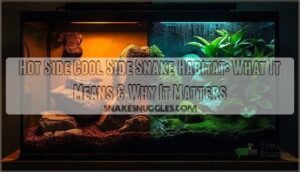
This site is supported by our readers. We may earn a commission, at no cost to you, if you purchase through links.
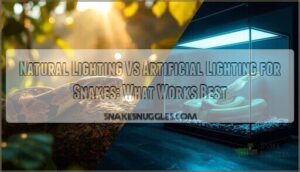
A snake’s body reads light the way ours reads time. The first burst of morning sun triggers movement and feeding, while fading daylight cues rest and digestion. In captivity, that rhythm can easily collapse if your lighting setup sends mixed signals.
Natural lighting shifts with the sun’s arc—color, intensity, and warmth changing hour by hour—while artificial systems hold steady at the flick of a switch. Understanding how those differences shape circadian timing, vitamin D3 production, and thermoregulation is the foundation of healthy husbandry and the key to creating enclosures that behave like real ecosystems.
Table Of Contents
Key Takeaways
- Natural sunlight provides full-spectrum, shifting light cues that regulate a snake’s circadian rhythm, thermoregulation, and vitamin D3 production more effectively than static artificial light.
- Artificial lighting lets keepers control heat, UVB intensity, and day–night cycles indoors, but requires precise placement, timing, and monitoring to prevent stress or overheating.
- Balanced reptile lighting combines UVB, visible light, and infrared heat in gradients that let snakes self-regulate exposure, digestion, and rest just as they would in the wild.
- Lighting setups must match species behavior and life stage—diurnal snakes need brighter UVB and strong thermal gradients, while nocturnal species prefer dimmer, lower-intensity setups.
Snake Lighting Basics: Natural Vs Artificial
Lighting shapes everything about a snake’s daily rhythm—from when it warms up to how it hunts. In captivity, you have two main ways to recreate those natural light cycles: sunlight and artificial fixtures. Here’s what to know before choosing the setup that fits your snake’s needs best.
For a deeper look at how lighting influences feeding patterns and behavior, check out this guide to California kingsnake light and temperature care.
Key Differences Between Natural and Artificial Lighting
Natural sunlight shifts in intensity, color, and angle throughout the day, guiding snakes’ circadian rhythms through reliable visual cues. These natural patterns highlight how, affecting activity levels, thermoregulation, and overall physiological balance. Artificial reptile lighting offers steady output and photoperiod control but lacks these natural fluctuations.
The table below compares key features that influence thermoregulation, UVB absorption, and thermal gradients critical to snake health.
| Feature | Natural Sunlight | Artificial Lighting |
|---|---|---|
| Light Spectrum | Full, varied range | Fixed, species-tuned UVB light |
| Thermal Gradients | Naturally variable | Created with basking lamps |
| Photoperiod Control | Seasonal, self-adjusting | Timer-based, consistent duration |
| Visual Cues | Sun movement and shadows | Static illumination |
| Circadian Rhythms | Naturally synchronized | Must be manually regulated |
Light Spectrum and Intensity in Snake Habitats
As you move from how light behaves over the day to what it actually contains, you’re really managing the light spectrum snakes experience and how intense each band is. UVB light facilitates vitamin D3 production, visible spectrum lamps let your snake see clearly, and infrared heat creates the thermal gradients they use to warm and cool themselves.
For a deeper understanding of, keep in mind how different wavelengths affect reptile behavior, vitamin D3 synthesis, and thermoregulation.
| Element | Role in Habitat |
|---|---|
| UVB Lighting | Facilitates vitamin D3 use |
| Visible Spectrum | Helps navigation and feeding |
| Infrared Heat | Builds a safe thermal gradient |
Impact on Snake Circadian Rhythms
Light does more than brighten — it sets your snake’s internal clock. A consistent day/night cycle keeps circadian rhythms aligned, triggering predictable rest and activity. Disrupt that with irregular light cycles or artificial light at night, and melatonin regulation falters, feeding responses shift, and stress hormones climb.
For more on keeping your snake calm through proper lighting routines, see this guide on preventing snake feeding aggression, which explains how light consistency supports natural behavior and reduces tension.
Light doesn’t just illuminate—it governs your snake’s rhythm, driving rest, feeding, and stress through daily cycles
| Lighting Factor | Circadian Effect | Health Impact |
|---|---|---|
| Consistent photoperiod | Stable sleep patterns | Normal feeding and activity |
| Irregular light cycles | Fragmented rest phases | Reduced appetite, stress |
| Night light exposure | Suppressed melatonin regulation | Weakened immune response |
| Seasonal photoperiods | Hormonal timing alignment | Healthy breeding cycles |
| Constant artificial light | Circadian disruption | Metabolic inefficiency |
Benefits of Natural Lighting for Snakes
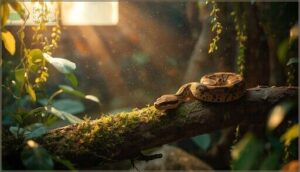
Natural light does more than brighten a snake’s enclosure — it sustains their health, instincts, and daily rhythm. When used correctly, sunlight can offer several benefits artificial bulbs can’t fully match.
Here’s how natural lighting can positively shape your snake’s environment.
Sunlight and UVB Exposure
You can think of direct sun as the “benchmark” for UVB exposure, but you still have to control how your snake gets it through careful UVB lighting and sunlight replication in captivity. Standard window glass causes heavy sunlight filtering, so you get brightness without meaningful UVB dosage, which means you must meet UVB lighting requirements with proper fixtures instead. When you do, you support reptile vision tuned to ultraviolet, more natural lighting cycles, and healthier day‑night UVB duration patterns that match how a wild snake would move between open patches and shade.
To ensure proper UVB exposure for your snake, follow these guidelines:
- Use unfiltered outdoor sun only in secure, ventilated setups with shade.
- Never rely on window light alone for UVB light or health.
- Pair UVB lighting with clear basking and hiding options so the snake can self‑regulate exposure.
- Aim for UVB dosage that creates a gentle gradient, not a single harsh hot spot, to mimic patchy natural light.
Effects on Vitamin D3 Synthesis and Calcium Absorption
Sunlight-driven Vitamin D3 Production is the backbone of your snake’s Calcium Metabolism, because UVB intensity on the skin kick-starts vitamin D3 synthesis, which then powers efficient calcium absorption in the gut and protects Bone Health.
For families comparing care needs, the guide to gentle, child-friendly snake morphs explains which species thrive with proper UVB lighting and calcium support.
When you match reptile lighting requirements with appropriate UVB lighting for reptiles and solid Reptile Nutrition, you give the skeleton what it needs to mineralize correctly and stay structurally sound.
Behavioral Enrichment and Natural Activity Patterns
Predictable light cycles act like a daily script for snake behavior, because steady photoperiods and a clear day-night cycle anchor circadian rhythms, activity patterns, and how your snake uses environmental enrichment. Under naturalistic lighting and thermal gradients, you tend to see:
- More timely basking and cryptic basking.
- Cleaner shifts between day and night activity.
- Increased exploratory animal behavior along routes and perches.
- More consistent feeding and hide use that match wild patterns.
Advantages and Challenges of Artificial Lighting
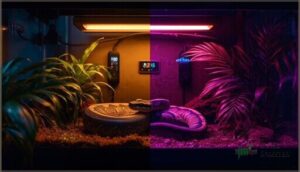
Artificial lighting gives you full control over your snake’s light, heat, and day–night cycle. It makes it easier to recreate natural conditions indoors, but only when used correctly.
Here’s a look at the main types of lighting you can use and what to watch for with each.
Types of Artificial Lighting for Snake Enclosures
You’ve got a whole toolbox of reptile lighting options, and each one plays a different role in your snake’s world. UVB Lighting for Reptiles (linear tubes, compact bulbs, or mercury vapor) covers UVB lighting needs, while heat lamps and Infrared Heating create focused basking zones. Ceramic Emitters give you dark, steady warmth, and LED lighting or other LED Options handle bright, energy‑efficient reptile lighting without blasting heat.
| Type | What it Provides | When you’d Use it |
|---|---|---|
| UVB Lighting | UVB for vitamin D3 and bone health | Diurnal species needing moderate UVB |
| Heat Lamps | Intense surface heat, basking spot | Daytime basking for many common snakes |
| Ceramic Emitters | Light‑free infrared warmth | Night heat without disturbing sleep |
| LED Options | Bright visible light, low heat | Display tanks and plant‑friendly setups |
| Infrared Heating | Gentle radiant warmth with dim light | Supplemental warmth for sensitive species |
Controlling Temperature and Photoperiod
Strong Temperature Control is what makes artificial lighting so useful, because you can build a precise thermal gradient instead of guessing about warm and cool spots. By pairing heat lamps or ceramic emitters with thermostats, you keep basking zones around 85–95°F while the cool side stays near 75–80°F, so your snake can thermoregulate by choice rather than desperation.
Timers handle photoperiod cycles for you, creating steady 12‑on/12‑off light cycles or season‑style lighting schedules, and that predictable pattern of photoperiods, UVB lighting, and heat management keeps your snake’s internal clock, digestion, and daily activity in sync.
Risks of Improper Artificial Lighting (overheating, Stress)
Improper artificial lighting quietly stacks Stress Factors against your snake, because overheating and glare build up long before you notice obvious distress. Overpowered heat lamps placed too close create thermal burns and steep overheating risks instead of a safe thermal gradient, while harsh light intensity and poorly positioned UVB lighting can cause UVB damage, increase stress levels, and slowly erode overall reptile health.
- Watch for dark, blistered skin under lamps, which often signals thermal burns from concentrated heat.
- If your snake never leaves the darkest corner, assume the light intensity or UVB lighting setup is overwhelming.
- Sudden food refusal, constant hiding, or clumsy movement under lights usually means your heating and lighting plan needs urgent adjustment to protect reptile health.
Species-Specific Lighting Needs
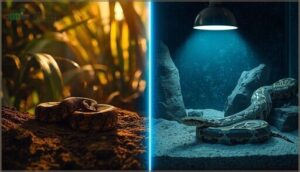
Every snake species has its own rhythm and light preference shaped by where it comes from. A setup that suits a ball python won’t work for a kingsnake or a garter.
Here’s how different lighting approaches match the needs of common species.
Diurnal Vs Nocturnal Snake Lighting Requirements
You can think of diurnal snakes as “solar powered” and nocturnal snakes as “shadow oriented,” so your Light Cycle Management and UVB Intensity Levels need to reflect that.
Diurnal snakes do best with bright daytime UVB lighting, a defined thermal gradient, and strong Circadian Rhythm Regulation, while nocturnal snakes prefer softer visible light, gentler UVB gradients, and heat sources that prioritize Thermal Gradient Control, Snake Visual Perception, and low-stress reptile lighting requirements.
Popular Snake Species and Recommended Lighting Setups
Diurnal snakes set the pattern, but what you do with specific snake species and their Snake Habitat matters just as much, especially when you’re trying to balance UVB Levels, Basking Spots, and stable Lighting Cycles with a safe thermal gradient and low-stress reptile lighting.
For example, a Ball Python usually does well with low-output T5 UVB lighting over roughly half the enclosure, while a corn snake or boa constrictor may use similar UVB lighting but at slightly higher basking UVB Levels and brighter overhead light to support more active daytime behaviors within their Snake Habitat.
To keep things clear, you can think in three buckets:
- Low-light, shy snakes like Ball Pythons that need gentle UVB lighting, dimmer Basking Spots, and strong hiding options.
- Active colubrids such as corn snakes and kingsnakes that benefit from brighter reptile lighting, moderate UVB Levels, and clear day–night Lighting Cycles across the full thermal gradient.
- Larger partial-sun pythons and boas that use structured Basking Spots under mid-range UVB lighting, with enough enclosure height and branchwork to choose between stronger and weaker exposure without overwhelming their eyes or disrupting their natural rest patterns.
Adjusting Lighting for Different Life Stages
You match species to setups, but you also tweak reptile lighting as snakes grow, because Hatchling Care, Juvenile Development, Adult Maintenance, Breeding Cycles, and Senior Health all stress reptile health and lighting differently.
You use gentler UVB lighting for reptiles, tight thermal gradient control, and steady circadian rhythms, then ease intensity and hours back again for aging snakes.
Best Practices for Snake Lighting Setups
Getting your snake’s lighting right takes more than just picking a bulb. Each setup needs the right balance of heat, UVB, and timing to keep your snake healthy and stress-free.
Let’s look at the key steps to set up and maintain effective lighting in your enclosure.
Choosing The Right Fixtures and Bulbs
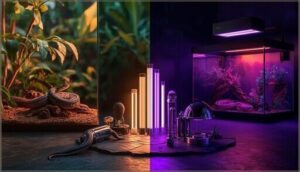
Smart reptile lighting starts with fixture choices that match your snake’s UVB intensity and heat sources, not just what fits the tank. T5 HO UVB lighting for reptiles works well in taller setups, while T8 tubes or LED Lighting for Reptile Enclosures suit lower enclosures and softer gradients, so you’re choosing reptile fixtures that support reptile health and lighting goals.
For instance, you might pair a T5 UVB strip with separate basking heat sources, then plan Bulb Replacement on a schedule, because UVB output drops long before bulbs visually burn out, and mixing Fixture Options this way keeps Lighting Cycles predictable without blasting the snake with constant glare.
UVB lighting for reptiles should be treated like medication, so you match percentage and distance to species needs, rather than chasing the strongest tube on the shelf.
Placement, Duration, and Maintenance Tips
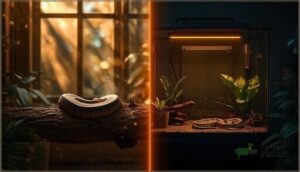
Once you’ve chosen fixtures, placement and timing do the real work. Mount heat lamps over Basking Zones at one end so your snake gets clear Thermal Gradients for thermoregulation, then keep UVB Intensity within the manufacturer’s distance range and run reptile lighting on a 12-hour lighting schedule.
Fold Maintenance Routines into your week: wipe reflectors, check guards, and note UVB bulb dates so your Lighting Schedules stay safe and predictable.
Monitoring Snake Health and Behavior for Optimal Lighting
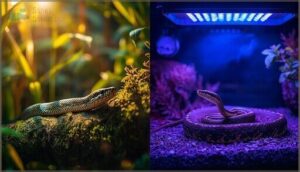
Observation is your best tool for Snake Health Indicators, because subtle shifts in appetite, shedding, and breathing often flag Lighting Stress Signs before you see obvious illness.
Watch Behavioral Observations against your Environmental Monitoring. If reptile lighting changes precede hiding, soaking, pacing, or lethargy, you’re likely disrupting thermoregulation, circadian rhythms, or other Health Risk Factors, and your reptile care plan needs adjusting.
Frequently Asked Questions (FAQs)
What is the best light for a snake?
The best light for a snake is a balanced reptile lighting setup that matches your snake species, combining gentle UVB Benefits with heat lamps for Thermal Gradients, neutral LED lighting for visibility, and stable Lighting Cycles that protect Snake Vision.
Is UVA or UVB better for snakes?
Picture a corn snake that eats well but slowly develops weak muscles and soft bones. When you add low-level UVB reptile lighting, Vitamin Synthesis improves, calcium use normalizes, and symptoms ease, showing UVB Benefits outweigh UVA Roles for long-term health.
Meanwhile, UVA mainly aids Snake Vision, behavior, and natural Lighting Cycles across the ultraviolet spectrum through careful UVB measurement and application.
What type of light is best for snake plants?
For snake plants, you want bright, indirect Natural Illumination or full-spectrum LED Options that mimic a balanced Light Spectrum.
Place the plant a few feet from a window or 12–24 inches below a grow light to support steady Plant Growth without scorch.
How does seasonal daylight change affect captive snakes?
Seasonal cues shift photoperiods that reset circadian rhythms and hormone regulation, guiding thermoregulation, feeding, and breeding cycles.
Without natural daylight changes, captive snakes lose these photoperiod effects, disrupting thermal cycling and normal day–night behavioral balance.
Are dawn and dusk light transitions beneficial for snakes?
Like a slow sunrise easing the world awake, gradual dawn and dusk light transitions stabilize circadian rhythms, guide snake behavior, reduce stress, and align thermoregulation with natural photoperiod effects for a balanced lighting schedule daily.
Conclusion
Picture your snake waking to a soft timed glow that mimics sunrise, settling under a warm gradient as the day moves across the enclosure. That kind of planned cycle matters more than debating natural lighting vs artificial lighting for snakes, because consistency, spectrum, and heat gradients are what actually reach the animal.
Choose tools that let you control those pieces, watch how your snake responds, and treat adjustments as routine maintenance, not emergencies at home.
- https://iere.org/should-i-put-my-snake-in-the-sun/
- https://www.cttlight.com/post/reptile-uvb-lighting-guide
- https://www.stumpscustomwood.com/keeping-up/optimal-lighting-tips-for-large-reptile-enclosures
- https://www.zenhabitats.com/blogs/reptile-care-sheets-resources/should-i-give-my-nocturnal-crepuscular-reptile-uvb-lighting-zen-habitats
- https://www.facebook.com/ZillaRules/