This site is supported by our readers. We may earn a commission, at no cost to you, if you purchase through links.

A newborn ball python striking at your hand doesn’t mean you’ve got a dangerous snake—it means you’ve got a scared one. Hatchlings arrive in your care having never experienced a human, a glass enclosure, or the particular strangeness of tongs carrying dead mice. Everything registers as a potential threat.
Newborn ball python aggression is almost always defensive, rooted in a nervous system wired for survival, not hostility. The behaviors that look like aggression—tight coils, rapid strikes, tail vibrating against the substrate—are the same behaviors that keep wild hatchlings alive.
Understanding what’s actually driving those reactions puts you in control of fixing them.
Table Of Contents
- Key Takeaways
- Why Newborn Ball Pythons Get Aggressive
- Enclosure Stress That Causes Strikes
- Feeding Mistakes That Increase Aggression
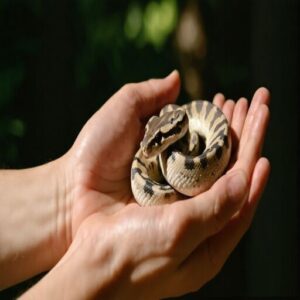
- Handling Newborns Without Triggering Bites
- Pre-Strike Signs You Should Notice
- When Aggression Signals a Health Problem
- Frequently Asked Questions (FAQs)
- Why did my baby ball python bite me?
- What are signs of overfeeding a ball python?
- Do male hatchlings show more aggression than females?
- Can clutchmates raised together develop behavioral differences?
- Does substrate type affect newborn stress levels?
- At what age do hatchlings typically calm down?
- Can scent from other snakes trigger defensive strikes?
- Conclusion
Key Takeaways
- Nearly all striking behavior in newborn ball pythons is defensive, not aggressive — it’s a scared hatchling responding to unfamiliar stimuli, not a dangerous one showing its true nature.
- Enclosure setup is a direct dial on your snake’s stress level: missing hides, unstable temperatures, and poor placement stack quietly until striking becomes the hatchling’s only outlet.
- Feeding mistakes — wrong prey size, your scent on hands, or handling too soon after a meal — are among the fastest ways to turn a calm hatchling into a consistent biter.
- When better handling and husbandry don’t reduce aggression, look for a health issue like mites, respiratory infection, or mouth rot, because a snake in pain will strike no matter how careful you are.
Why Newborn Ball Pythons Get Aggressive

Most newborn ball pythons aren’t aggressive — they’re scared.
That defensive striking you’re seeing is just a scared baby doing its best — understanding why ball pythons strike without biting can really change how you respond to it.
Understanding what actually triggers that defensive behavior makes a real difference in how you handle and care for them from day one.
Here’s what’s driving it.
Defensive Behavior Vs True Aggression
Most newborn ball python behavior that looks like aggression is actually defense — fear vs intent is the real distinction. When a hatchling coils into a tight S-shape, vibrates its tail, or strikes, it’s trying to escape, not attack.
Remove the threat, and it withdraws.
True aggression persists regardless of retreat options. Watch for behavioral consistency across situations to tell them apart.
Why Hatchlings Are Naturally More Reactive
Hatchlings aren’t nippy ball pythons by choice — they’re wired that way from day one. A cortisol surge at hatching keeps their neural sensitivity dialed up high, meaning even low‑intensity touch triggers a flight reflex before any learned response can kick in.
Research on delicate skinks shows that embryos can hatch early when they detect predator‑induced early hatching cues.
Four reasons they’re naturally reactive:
- Sensory priming keeps unfamiliar stimuli classified as threats
- Metabolic burst capacity enables rapid escape movement
- Head shy responses develop from overhead threat detection
- High baseline reactivity fades only with consistent, calm exposure
Common Triggers in Newly Settled Babies
That high baseline reactivity doesn’t exist in a vacuum — your setup either calms it or compounds it. Frequent enclosure opening, improper handling, human scent transfer on hands, and environmental factors like inadequate water dish size or enclosure size all register as threats.
Even handling tool choice matters. These triggers stack quietly, and each one nudges a settled baby closer to signs of aggression.
How Stress Builds Into Striking Behavior
Stress in reptiles doesn’t flip a single switch — it compounds. Each disturbance raises neurological arousal slightly, and when triggers stack, you cross the arousal threshold fast. That’s when a hormonal cascade kicks in, locking the snake into defensive behavior. A hatchling experiencing sensory overload can enter a stress feedback loop where handling stress alone keeps signs of aggression elevated for hours.
Reptile stress doesn’t flip a switch — it compounds until a hatchling locks into defense
Here’s how that escalation usually unfolds:
- A disturbance raises baseline alertness and vigilance
- Repeated contact prevents the nervous system from resetting
- Identifying pre-strike body language becomes harder as tension builds quickly
- The snake interprets routine stimuli as active threats
- Biting becomes the fastest available " stop this now " response
Enclosure Stress That Causes Strikes
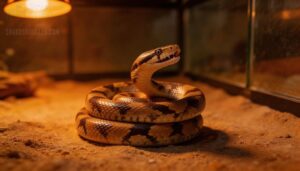
newborn ball python strikes aren’t about attitude — they’re about the enclosure making the snake feel unsafe. poorly set up habitat sends constant stress signals that push a hatchling toward defensive behavior.
what to check first.
Missing Hides and Lack of Security
A bare enclosure is one of the fastest ways to turn a calm hatchling into a defensive one. Without at least two Dual Zone Hides — one on the warm side, one on the cool side — your snake has nowhere to retreat. Secure Hide Placement with Tight Entry Entrances lets it disappear fully, dropping stress fast.
| Hide Setup Element | Problem Without It | Stress Reduction Benefit |
|---|---|---|
| Dual Zone Hides | Constant exposure, defensive striking | Thermal choice without open roaming |
| Tight Entry Entrances | Prolonged visibility, startle responses | Full concealment, lower alert state |
| Visual Barrier Integration | Overhead threat perception, tension | Breaks sight lines, reduces reactivity |
Visual Barrier Integration and an Escape-Proof Enclosure with proper hiding places round out a cage setup that actually works. Environmental stressors drop substantially when your hatchling can vanish on demand.
Incorrect Warm and Cool Side Temperatures
Temperature is just as critical as hides. Without proper Gradient Stability, a hatchling can’t regulate its body temperature — and a snake that can’t thermoregulate stays defensive.
- Warm side: 88–92°F; cool side: 78–80°F
- Thermostat Placement and Temperature Probe Accuracy prevent Side Temperature Swings
- Heat Source Oversizing causes unpredictable cycling, increasing aggression
- Floor-level temperature gradients matter more than air readings
Low or Unstable Humidity Levels
Humidity levels that swing too low — or never stabilize — quietly stack stress on a hatchling.
Dry air during digestion is especially risky — it’s one of several factors that can trigger a stress bite in ball pythons before you even realize something’s wrong.
Evaporation Effects pull moisture from skin, and Mucus Drying irritates respiratory surfaces, triggering mouth-gaping you might mistake for aggression.
Shed Skin Sticking follows, blocking vision and raising defensiveness. Dehydration Risk compounds it all.
Aim for 55–60%, increasing to 70% during shed, and watch hatchlings seek Microclimate Spots near humid hides.
Bright Lights, Noise, and Heavy Traffic
Your hatchling’s environment is louder and brighter than you think. Light leaking through tank gaps, glare sensitivity from overhead LEDs, traffic noise through walls, and bright light flicker from TVs all register as threats to a newborn.
These environmental factors affecting snake behavior stack fast:
- Sudden noise triggers immediate defensive strikes
- Vibrations from speakers cause persistent noise-induced stress
- Car headlights reset calm repeatedly
- Nearby foot traffic amplifies reptile stress
Large Open Tanks Without Clutter
An empty tank feels like open water to a hatchling — nowhere to hide, nowhere to feel safe.
Large open tanks without clutter create Exposed Substrate Zones, Extended Thermoregulation Paths, and Sparse Hide Entrances that force Increased Roaming Stress. Limited Visual Barriers mean your snake stays on edge.
Proper enclosure size paired with hiding places and stress reduction strategies for reptiles keeps enclosure disturbances minimal.
Drafts, Vibration, and Poor Enclosure Placement
Where you put the enclosure matters more than most keepers realize. Airflow drafts, vibration disturbances, and door proximity effects constantly disrupt a hatchling’s sense of safety — pushing it toward defensive behavior.
- Drafts lower humidity control and destabilize your temperature gradient.
- Window temperature swings create unpredictable hot and cold pockets.
- Vibrations cause hatchlings to vibrate their tails and strike defensively.
- Door proximity effects deliver repeated pressure pulses and enclosure disturbances.
- Base isolation solutions — like foam pads — reduce transmitted floor vibration.
Feeding Mistakes That Increase Aggression
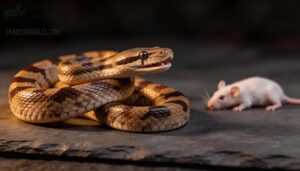
How you feed your newborn ball python matters just as much as where it lives.
Small mistakes around feeding time, like prey size, timing, or how you present food, can flip a calm hatchling into a defensive striker fast.
These are the feeding habits worth getting right.
Hunger and Feeding Response Behavior
A hungry hatchling doesn’t just want food — it’s wired to find it. Feeding motivation builds steadily between meals, sharpening cue discrimination and contact salience, meaning your hand near the enclosure becomes a potential target.
Underfeeding keeps that drive elevated, while overfeeding creates its own problems. Stick to a consistent feeding schedule, and use tongs every time to avoid feeding aggression from misdirected prey instinct.
Wrong Prey Size for Newborn Ball Pythons
Prey size matters more than most people realize. The Midbody Thickness Rule keeps it simple: match prey width to the snake’s thickest point, not larger.
Respect Prey Mass Limits by moving up through Step-Up Sizing gradually — small to medium rat pup, one level at a time.
Nail the Prey Temperature Cue by warming frozen-thawed prey to around 100–105°F.
Wrong Prey Type Selection quietly fuels feeding aggression.
Live Prey Stress Vs Frozen Thawed Prey
Live prey introduces unpredictable Prey Movement Dynamics — struggling, biting back, and triggering rapid, reflexive strikes that can blur the line between feeding and aggression management. Frozen-thawed prekilled mice remove that chaos entirely.
- Feeding Window Predictability improves because still prey limits arousal spikes
- Injury Prevention Strategies eliminate live-prey counterattacks on fragile hatchling tissue
- Odor Cue Variation after thawing can slow acceptance, so warm prey to 100–105°F
- Bacterial Growth Risk rises if thawed prey sits too long before feeding
Preventing Hand to Food Association
Once you’ve switched to frozen-thawed prey, protect that progress through Scent Transfer Control.
Your hands carry food odors, so wash thoroughly before any enclosure contact.
Use Dedicated Feeding Tools — tongs keep prey at the right distance and reinforce Hand-Free Prey Delivery, separating your hands from food entirely.
Minimal Hand Movement during delivery prevents behavioral conditioning that links your fingers with feeding triggers.
Feeding Schedule for Hatchlings
A consistent feeding schedule is one of the most effective feeding strategies to reduce aggression in hatchlings. First Meal Timing matters — wait until after the first shed before offering food.
Follow these Feed Frequency Guidelines:
- Offer meals every 5–7 days
- Match prey to body width (Growth-Based Portioning)
- Feed only when Temperature Stability is confirmed
- Monitor Post-Feeding Observation for regurgitation
- Avoid overfeeding to prevent stress-linked defensiveness
Why Baby Ball Pythons Bite During Feeding
Feeding bites usually come down to one of three things: Heat Signature Confusion, Scent Transfer from recently handled prey, or Prey Movement Mimicry, when your hand moves too close.
Handler Proximity during active feeding practically invites a strike.
Feeding Tube Stress can also push a hatchling into defensive mode before food even arrives.
Keep hands back, use tongs, and let the snake do the work.
Handling Newborns Without Triggering Bites
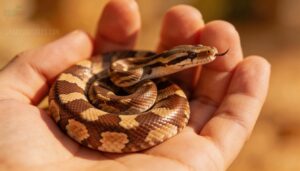
Handling a newborn ball python isn’t complicated, but the approach matters more than most new keepers expect. A few small habits — done consistently — make the difference between a snake that tolerates you and one that actually settles down over time.
Here’s what to focus on from the start.
When to Start Handling a New Hatchling
Don’t rush the first touch. Your hatchling needs an Initial Settling Time of one to two weeks before you consider handling at all.
Use the Feeding Consistency Cue as your real green light — wait until it’s eaten reliably two or more times.
Skip the Shedding Sensitivity Period entirely.
Behavioral Readiness, not a calendar date, drives your Stress-Free Introduction to gentle handling.
How Long to Wait After Feeding
full tummy isn’t a green light. After your hatchling eats, give it a Digestive Pause of 20 to 30 minutes minimum. Skipping this Stress-Free Interval raises Regurgitation Risk and can push an otherwise calm snake straight into defensive mode.
Use this time as an Observation Window — watch for Calm Post-Meal behavior before you reach in. Not right after eating, ever.
Safe Ways to Lift and Support The Body
How you pick up your hatchling matters as much as when. Slide one hand under the midsection using the Cup Grip Technique — fingers forming a shallow cradle, never pinching.
Support the rear third with your other hand for stress‑free handling. Keep lift height low, use Midsection Support to prevent dangerous dangling, and warm your hands first for Heat Retention Handling that keeps your snake calm.
Why Overhead Grabbing Causes Defensive Strikes
Reaching down from above puts you directly in a hatchling’s Visual Targeting zone — their head and neck read it as a predator move, not your hand. That approach creates Sudden Pressure along the Head Neck Threat area, triggers Escape Path Blockage, and disrupts Airflow around the face.
Combined, those signals push any aggressive ball python straight into defensive postures and a strike position, fast.
Short Handling Sessions That Build Trust
Once you’ve scooped from below, keep sessions to five or ten minutes. Consistent Timing matters — handling at the same time each day creates predictable routines that support Behavioral Conditioning and Trust Building over weeks.
Gentle Touch with firm Support Points underneath the body removes the falling sensation that spikes defensive behavior. Quiet Environment and Rest Day Scheduling between sessions reduce cumulative stress substantially:
- short contact daily beats one long stressful session
- let the snake move along your hands, don’t reposition it forcefully
- handle before feeding, never after
- signs of aggression and stop at the first coil tightening
When to Stop Handling Immediately
Stop the moment you see a tight S-coil, hissing, or frantic tail movement — those are clear signs of aggression, not stubbornness. Owner anxiety often leads to tightened Grip Pressure, which worsens the situation.
Watch your Handling Duration closely, keep Escape Route options open, and recognize stress indicators early. Improper handling past these warnings turns a tense snake into a biting one.
Pre-Strike Signs You Should Notice
Ball pythons don’t strike without warning — they almost always tell you first. Learning to read those signals is what separates a calm handling session from a bite.
Here are the key pre-strike signs to watch for.
Tight S-shaped Coil Posture
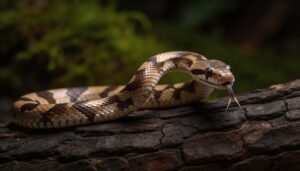
When a newborn ball python pulls its front third into a tight S‑shape, that’s spring‑like energy loading for a strike. The anchored rear base holds steady while coil tension dynamics concentrate force near the head.
Watch for these body posture cues:
- Front third curves tightly inward
- Head points forward, ready for reach optimization
- Rear body stays flat and grounded
- Posture energy transfer focuses toward the head
- Snake holds position without advancing
Signs of aggression mean back off now.
Head Lifting and Body Tension

Once the S-coil sets, watch the head. Neck Angle Signaling kicks in when the head lifts higher than the spine — that’s Defensive Focus Targeting in action.
Rigid Front Bracing stiffens the upper body, cutting off fluid movement. Combined with Breathing Stillness and Muscle Coiling Readiness, these stress indicators mean the snake isn’t exploring anymore.
It’s locked on you.
Tail Movement and Tense Muscles

As the head lifts, shift your attention lower — the tail tells just as much. A Tail Stiffening Response driven by Co-contraction Mechanics causes Base Rigidity Signal, where the tail stops waving and holds firm.
That Straightening Tension Cue, combined with a rising Muscle Tonus Indicator, is classic PreStrike Body Language. These stress indicators mean handling techniques need to pause immediately.
Flattening, Hissing, and Escape Attempts
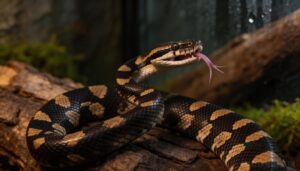
Three behaviors often appear together right before a bite: Surface Pressure Flattening, Defensive hissing, and Boundary Pushing Behavior.
- Flatten themselves: widening the body to feel more grounded and harder to lift.
- Hissing Warning Patterns: Acoustic Threat Signals forced through a nearly closed mouth.
- Escape Route Optimization: sustained Boundary Pushing Behavior toward enclosure seams and hiding places.
- Environmental factors affecting snake behavior drive all three — review your handling techniques immediately.
How to Respond Before a Bite Happens

Once you spot tense muscles or a raised head angle, the window to prevent a bite is still open — but only if you act without hesitation.
| Signal | Your Response | Why It Works |
|---|---|---|
| S-coil forming | Pre‑Bite Pause — hold still | Stopping movement removes the target |
| Head tracking your hand | Hand‑Free Observation — withdraw slowly | Breaks the prey-identification sequence |
| Body rigid near opening | Hook‑Tap Conditioning — tap before entry | Shifts the snake’s focus away from your hand |
| Forward head angle | Distraction Object Use — redirect with a hook | Interrupts strike-path targeting |
| Advancing toward fingers | Calm Exit Strategy — close enclosure calmly | Ends the trigger cycle without escalation |
Identifying PreStrike Body Language early is what separates a clean interaction from a defensive bite. Preventing Ball Python Bites comes down to reading stress indicators in captive reptiles and using handling techniques to reduce aggression before they become necessary. Identifying aggression triggers in ball pythons lets you stay one move ahead.
Calming The Snake After a Strike
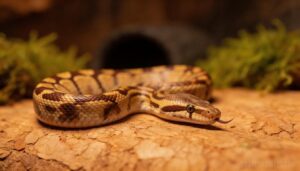
After a strike, your priority is a clean, calm reset — not a repeat attempt.
- Quiet Enclosure Return — Place the snake back without chasing or pinning it.
- Minimal Interaction Time — Keep hands out for at least 30 minutes.
- Low Light Setting — Dim the area to reduce lingering reactivity.
- Calm Pause Duration — Wait until you see a relaxed, lowered posture before any gentle handling.
Post-strike reset works. Rushing doesn’t.
When Aggression Signals a Health Problem
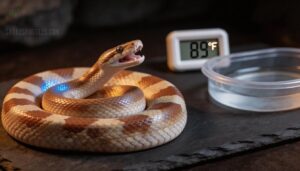
Sometimes a ball python’s aggression isn’t about stress or handling at all — it’s the body sending a distress signal. Health issues can look a lot like attitude problems, especially in hatchlings who can’t show discomfort any other way.
Here’s what to watch for when the behavior just doesn’t add up.
Shedding Discomfort and Reduced Visibility
Shedding turns a normally curious hatchling into a defensive one fast. Eye Clouding Impact is real — cloudy eyes from the blue phase cut visibility sharply, triggering Visibility Loss Startle responses to shadows and movement.
Retained Skin Pain and Shedding Friction Issues add physical discomfort.
Keep humidity levels at 60–70% and temperature range 75–85°F stable.
Avoid handling during Shedding Timing Strikes windows until the eyes clear completely.
Respiratory Infection Symptoms That Mimic Aggression
A sick hatchling can look like an aggressive ball python, but the two aren’t the same.
Respiratory infections produce labored breathing, wheezing sounds, nasal discharge, and coughing or gagging that raise stress hormones and lower handling tolerance fast.
Fever and lethargy shift the snake’s baseline, so normal touch triggers defensive strikes. These clinical signs of illness and respiratory disease need a vet, not more taming attempts.
Mites, Parasites, and Pain-related Defensiveness
Parasites are a quieter culprit than a respiratory infection, but just as disruptive. Mite infestations trigger Mite Itching and Inflammatory Skin Response that keep your hatchling in constant discomfort — and a snake that hurts is a snake that strikes.
Key signs of parasitic infestations driving Defensive Irritation:
- Visible mites (tiny black or red specks) near eyes, vents, or water dish
- Excessive soaking as the snake tries to drown mites off its scales
- Restless, repetitive rubbing against enclosure walls
- Unexplained striking during routine handling — classic Pain Sensitization in action
- Raised or rough scales indicating Burrowing Parasite Pain beneath the surface
These behavioral triggers reflect reptile stress rooted in real physical pain, not temperament. Health Issues Leading to Aggressive Behavior like mite infestations won’t resolve with better handling technique alone — treat the parasite, and the defensiveness often follows.
Injuries and Mouth Rot Warning Signs
Mouth injuries and mouth rot (infectious stomatitis) follow a similar pattern — pain makes your hatchling defensive, fast. Red Mouth Swelling, Visible Oral Sores, and Excessive Drooling are clinical signs of illness that often appear before you notice anything else is wrong.
| Warning Sign | What It Means |
|---|---|
| Red Mouth Swelling | Early mucosal infection or injury |
| Thick Oral Discharge | Progressing bacterial infection |
| Visible Oral Sores | Tissue damage requiring treatment |
| Loss of Appetite | Pain interfering with feeding |
These Health-related causes of snake aggression won’t resolve on their own. A snake in oral pain will bite — not from temperament, but self-protection.
When Aggression is Not Improving
When health-related causes of snake aggression go unaddressed, behavioral stagnation sets in fast.
Watch for these unresolved stress triggers:
- Strikes on contact despite consistent care — Handling timing mismatch
- No loose coil return after disturbances — Inadequate calm periods
- Worsening reactivity across successive days
- Stuck shed or visible mites — Overlooked health indicators
- Feeding encounters still causing defensive biting — feeding practices and aggression management failing
That pattern won’t self-correct.
When to See an Exotics Veterinarian
If aggression sticks around despite fixing your husbandry, it’s time to call an exotics vet. Watch for weight loss, persistent lethargy, eye swelling, or mouth odor — these are health-related causes of snake aggression that won’t resolve on their own.
Behavioral regression after progress is a red flag too. Reptile veterinary care gives you answers when the basics stop working.
Frequently Asked Questions (FAQs)
Why did my baby ball python bite me?
Most likely, your baby ball python felt threatened. Baby balls bite defensively — not out of malice. Scent transfer, improper handling, or temperature shock can all flip that switch fast.
What are signs of overfeeding a ball python?
Watch for a rounded body shape, abdominal bulging, digestive lag, regurgitation episodes, and reduced activity.
Poor body condition and irregular elimination often signal feeding frequency or prey size is too high.
Do male hatchlings show more aggression than females?
Yes, male hatchlings do tend to bite more often. On average, males strike about 35 percent more frequently than females, driven largely by boundary testing behavior and faster reactive response times.
Can clutchmates raised together develop behavioral differences?
Even from the same clutch, hatchlings can develop noticeably different temperaments.
Early Social Bonding, Resource Access Variability, and Handling Schedule Divergence all shape individual behavior — no two snakes turn out identical.
Does substrate type affect newborn stress levels?
Substrate type does affect newborn stress levels.
Texture comfort, microbial load, odor retention, heat insulation, and particle ingestion all shape how settled a hatchling feels — making substrate one of the most overlooked environmental factors in stress management.
At what age do hatchlings typically calm down?
Most hatchlings settle noticeably within four to six weeks.
The first shedding cycle often marks a turning point, with post-shed calmness returning once temperature acclimation, humidity stabilization, and feeding routine consistency are all in place.
Can scent from other snakes trigger defensive strikes?
Absolutely. Conspecific odor detection is real — scent markings left by other snakes trigger defensive striking behavior quickly.
Cross scent prevention through clean tools and scent masking via unscented soap keeps handling calm and safe.
Conclusion
Understanding newborn ball python aggression requires patience, observation, and adjustment. By recognizing defensive behaviors, identifying environmental stressors, and refining your handling techniques, you can transform a fearful hatchling into a calm, confident companion.
As you master these strategies, you’ll simply reduce newborn ball python aggression, but also build a strong foundation for a lifelong, trusting relationship. With time and practice, your interactions will become smoother, and your snake’s well-being will thrive.