This site is supported by our readers. We may earn a commission, at no cost to you, if you purchase through links.
A snake that strikes without warning feels like a betrayal—but from the snake’s perspective, it followed a perfectly logical sequence of signals you missed. Most pet snake aggression isn’t random.
It traces back to identifiable triggers: a feeding response mistaking your hand for prey, the raw irritability of a snake mid-shed with compromised vision, or chronic stress from an enclosure that’s too loud, too bright, or too exposed.
Recognizing those triggers early changes everything. Understanding what drives aggressive behavior gives you the tools to prevent pet snake aggression before it becomes a pattern.
Table Of Contents
- Key Takeaways
- What Causes Pet Snake Aggression?
- Recognizing Aggressive Snake Behavior
- Preventing Aggression During Feeding
- Minimizing Stress During Shedding
- Optimizing Snake Enclosure Conditions
- Identifying Health Issues Linked to Aggression
- Safe and Stress-Free Snake Handling
- Establishing Predictable Routines
- Reducing Environmental Triggers of Aggression
- Calming an Aggressive Snake Safely
- Frequently Asked Questions (FAQs)
- How to deal with an aggressive pet snake?
- How to stop a pet snake from biting you?
- How to make a pet snake friendly?
- Can multiple snakes share one enclosure peacefully?
- Do certain snake colors indicate mood changes?
- How does seasonal change affect snake temperament?
- Can music or TV stress a pet snake?
- Do snakes recognize their owners over time?
- Conclusion
Key Takeaways
- Most snake strikes trace back to identifiable triggers — hunger, shedding discomfort, poor enclosure conditions, or undiagnosed pain — meaning aggression is preventable once you know what to look for.
- Your snake’s body language tells the full story before a strike happens: a rigid S-curve, rapid shallow tongue flicks, tail vibration, or hissing are all early warnings you can act on.
- Enclosure quality directly controls baseline stress — correct temperature gradients (75–92°F), humidity at 50–70%, opaque hides on both ends, and vibration reduction all reduce defensive behavior more reliably than handling technique alone.
- Consistent routines for feeding, handling, and environmental conditions aren’t just good practice — they’re the primary mechanism through which snakes learn that human contact is safe and predictable.
What Causes Pet Snake Aggression?
Most snake aggression isn’t random — there’s a reason behind every strike, bluff, or defensive posture. Understanding those reasons puts you in a much better position to prevent them.
Knowing exactly what triggers a strike — like sudden movement or feeling cornered — helps you stay safe, and this deep dive into snake bite causes, behaviors, and real-world facts breaks it all down clearly.
Here are the most common causes to know.
Hunger and Feeding Response
Hunger drives more snake aggression than most keepers realize. When food drive peaks, hungry snakes patrol their enclosure, hold a loose S-curve near the door, and launch fast, repeated feeding strikes at any warm movement — including your hand.
Feeding cues like lid-lifting or tapping glass condition a strike response over time. Consistent feeding frequency keeps hunger signs predictable and defensive behavior low.
Shedding and Discomfort
Shedding discomfort ranks just below hunger as a trigger for defensive behavior. During the shedding process, temporary vision loss from fluid buildup between eye caps leaves your snake virtually blind, making any touch feel like a threat. Skin irritation intensifies this reactivity — the loosening outer layer is sensitive.
Discomfort signs like hiding, dull coloring, and food refusal usually appear one to two weeks before the shed completes. Humidity control around 50–70% reduces shedding aggression noticeably.
It’s especially important to minimize environmental transition stress during this vulnerable period to help your snake feel secure.
Environmental Stressors
Environmental stressors hit harder than most keepers expect. Poor enclosure design — think bare glass tanks with no visual barriers — keeps your snake locked in constant vigilance. Inadequate temperature gradients, humidity control failures, and lighting effects that disrupt natural cycles all compound into sustained defensive behavior. Noise reduction matters too; groundborne vibrations from nearby appliances register as real threats.
- A snake that can’t hide doesn’t feel safe
- Wrong enclosure conditions can undo weeks of trust-building
- Environmental enrichment isn’t optional — it’s the foundation of calm behavior
Health and Pain Issues
Beyond the enclosure, your snake’s own body can drive aggression. Undiagnosed chronic injuries, internal parasites, oral infections, and respiratory issues all create pain that makes handling feel threatening.
A normally calm snake that suddenly strikes when touched along its mid-body may be reacting to intestinal discomfort or spinal damage — not attitude.
Consistent health and wellness monitoring, including regular vet checks, catches these health problems before they reshape behavior.
Species and Individual Temperament
Species and individual temperament shape snake aggression just as much as environment does. Reptile behavior varies widely — even within the same clutch.
- Corn snakes: calm, tolerant, ideal for beginners
- Ball pythons: defensive, rarely aggressive, curl rather than strike
- Kingsnakes: nippy juveniles, manageable with consistent handling
- Captive breeding programs reduce defensive behavior across generations
- Individual snake personalities remain stable — a shy snake stays shy
Temperament testing early guides smarter pet snake ownership decisions. Recent studies have highlighted the value of comparing defensive behaviors in neotropical snakes to better understand how temperament and ecology interact.
Recognizing Aggressive Snake Behavior
Snakes don’t throw tantrums randomly — their body language tells a clear story if you know what to look for. Before a strike ever happens, your snake has usually been signaling discomfort for a while.
These are the four key warning signs to recognize early.
S-Curved Neck and Tense Posture
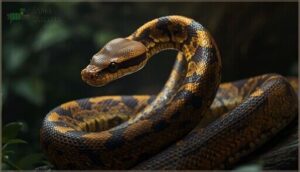
A tight S-curve isn’t just a quirky pose — it’s your snake’s loaded spring. In defensive posture, the front third of the body stiffens like a coiled trap, head elevated and tracking your movement. Curious vs threat distinction matters here: curious S-curves stay loose, while aggressive snake defensive behavior looks rigid and pulled back — ready.
| Signal | Curious S-Curve | Defensive S-Curve |
|---|---|---|
| Body tension | Loose, relaxed bends | Stiff, compressed coils |
| Tongue flicking | Regular, exploratory | Slowed or paused |
| Head movement | Sways, follows scents | Fixed, elevated, still |
| Strike posture nuances | No forward lunges | Aligned for precision strike |
| Feeding mode S | Rare unless near feeding time | Common; snaps at movement |
Tail Flicking or Rattling
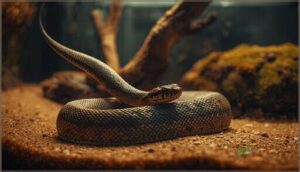
Tail vibrations are one of the clearest defensive signals your snake can send. Even non-rattlesnake species produce rattle sounds by buzzing their tail against enclosure walls or substrate — classic snake communication that says “back off.”
If tail vibrations accompany meal refusals, it’s worth reviewing baby snake feeding frequency and warning signs to rule out stress as the root cause.
Watch for this agitation cue alongside a tense body and rapid breathing. That combination signals genuine defensive behavior, not curiosity. Slow down, step back, and give your snake space.
Hissing and Striking
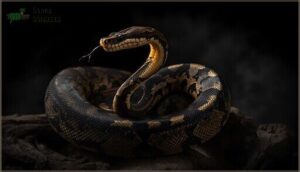
A hiss is your snake’s first verbal warning — and you should take it seriously. That sharp, forced sound marks a clear shift from curious to defensive behavior. Paired with a striking posture, it signals the snake is loaded and ready.
Watch for these aggression triggers before a bite happens:
- Hissing sounds with a fixed stare mean threat assessment is active
- Defensive posture with an S-curved neck indicates strike mechanics are primed
- Bite inhibition drops fast if you keep pushing forward
Irregular Tongue Flicking
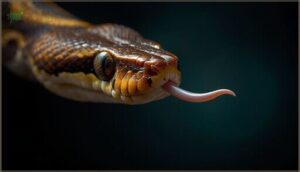
Tongue flick patterns are one of the earliest stress signals most keepers miss. A relaxed snake shows slow, full flicks — but rapid, shallow, or stuttering flicks mean your snake is threat-assessing in real time.
| Flick Pattern | What It Signals | Aggression Prevention Response |
|---|---|---|
| Slow, full extension | Calm, familiar environment | Continue normal snake care |
| Fast, shallow flicks | Environmental triggers detected | Pause handling immediately |
| Absent flicking | Severe stress or illness | Consult a vet promptly |
Preventing Aggression During Feeding
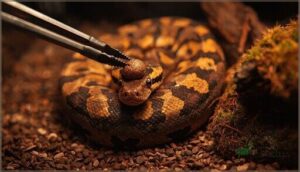
Feeding time is when snakes are most primed to strike — hunger sharpens their instincts, and anything moving nearby becomes a potential target.
A few targeted adjustments to how and when you feed can cut that risk markedly. Here’s what actually works.
Feeding Schedule Optimization
A poorly timed meal can reset days of calm behavior in minutes. Feeding frequency directly shapes hunger cues — juveniles need twice-weekly meals, while most adults do fine every one to two weeks. Mismatched schedules keep snakes in a food-seeking mindset that escalates defensive behavior fast.
- Match prey size to the snake’s widest body point
- Feed juveniles twice weekly; adults every 7–14 days
- Schedule meals consistently, ideally at dusk
Safe Feeding Techniques
Once the schedule is dialed in, prey presentation becomes your next line of defense against food aggression. Warm frozen prey to the mid-80s°F — heat-sensing species won’t reliably target cold food.
Use feeding tongs to keep your hands 8–12 inches from the strike zone. Consistent feeding tools train hunger cues away from your hands, reducing defensive behavior markedly.
Handling Precautions Around Feeding
Tongs handle prey placement — but your timing and pre-feeding handling habits matter just as much. Avoid handling your snake on feeding day entirely; even calm contact raises arousal and sharpens feeding response timing.
After meals, wait 48–72 hours minimum. Picking up a digesting snake risks defensive posture and regurgitation.
Snake hook training adds another layer: a light hook touch before any hands-in session signals “interaction,” not food.
Minimizing Stress During Shedding
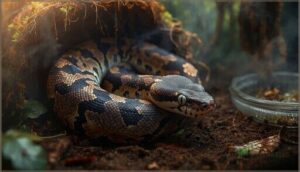
Shedding is one of the most stressful periods in your snake’s life, and it’s when aggression spikes without warning. Your snake’s behavior, vision, and tolerance for handling all shift during this window.
Knowing what to expect — and how to respond — makes the difference between a smooth shed and a defensive strike.
Behavioral Changes While Shedding
Shedding discomfort reshapes your snake’s entire behavioral profile, sometimes overnight. Recognizing pre-shed behavior early helps you adjust handling techniques before aggression triggers escalate. Watch for these shedding cues:
- Reduced activity and prolonged hiding (one to two weeks)
- Skipped meals due to physiological stress
- Increased skin sensitivity and surface-rubbing behavior
These shifts in snake behavior and psychology are temporary — not personality changes.
Vision Loss and Irritability
Those behavioral shifts don’t stop at hiding and skipped meals — cloudy eye care becomes the next real concern. When eye scale shedding begins, your snake’s vision drops sharply, pushing it toward sensory compensation through scent and vibration. Retained eye caps compound this, adding physical irritation that fuels snake aggression directly.
| Vision Phase | Snake Behavior and Psychology |
|---|---|
| Early cloudiness | Increased tongue-flicking, mild tensing |
| Full blue phase | Defensive posturing, strike readiness |
| Retained eye caps | Chronic vision loss, persistent irritability |
| Post-shed clearing | Gradual return to baseline temperament |
Reptile care and management — and animal welfare and conservation — both hinge on recognizing these phases before health problems escalate.
Safe Handling During Shedding
Patience is your most effective handling tool during shed. Shedding Preparation starts before you ever open the enclosure — read the room first.
- Skip non-essential contact; Gentle Handling means not handling at all when Defensive Posture appears.
- Use Handling Tools like a snake hook to reduce startle responses and Skin Irritation.
- Maintain Humidity Control at 50–70% to ease Shedding Discomfort and support safer Handling Techniques that minimize Snake Aggression and stabilize Snake Behavior.
Optimizing Snake Enclosure Conditions

Your snake’s enclosure isn’t just a home — it’s the single biggest factor controlling its stress levels day to day. Get the setup wrong, and even the calmest snake can turn defensive fast.
Here are the key conditions to get right.
Proper Enclosure Size
Cramped quarters are one of the most overlooked drivers of snake aggression. Enclosure size should match your snake’s length at minimum — width ideally at least half that snake length.
A boa between 2 and 5 feet needs roughly 4×2×2 feet of space. Proper vertical height, enclosure depth, and tank size directly support calmer behavior and safer snake care and handling overall.
Temperature and Humidity Control
Beyond enclosure size, thermal gradients and humidity management directly shape how calm or defensive your snake stays day to day. Ball pythons need a warm side near 88 to 92°F and a cool side around 75 to 80°F. Temperature fluctuations stress reptile health and wellness fast.
Keep humidity between 50 and 70 percent using reliable heat sources, thermostats, and hygrometers — stable enclosure conditions mean fewer defensive strikes.
Adequate Hides and Visual Barriers
A hide isn’t decoration — it’s your pet snake’s first line of defense against stress. Effective hide placement strategies call for at least two snug, opaque hides: one on the warm side, one on the cool. These snake security measures let your snake regulate temperature without feeling exposed.
Adding visual barrier effects through background panels or dense decor further reduces defensive posture by limiting constant visual stimulation.
Reducing Noise and Activity
Sound travels through floors and furniture, and your snake feels it before you hear it. Chronic vibration keeps snakes locked in defensive posture, priming aggressive behavior even before you open the enclosure.
To mitigate these effects:
- Place rubber pads or foam under the enclosure for vibration control
- Practice noise reduction by keeping bass-heavy audio out of the room
- Apply activity limits by scheduling handling during predictably quiet periods
Calm environments and quiet handling reshape snake behavior and psychology over time.
Identifying Health Issues Linked to Aggression
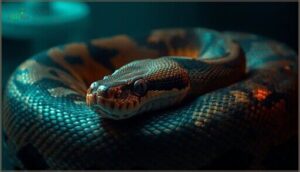
Sometimes a snake’s aggression has nothing to do with its environment or your handling — it’s in pain. Health problems like mouth infections and respiratory illness can make even a calm snake defensive overnight. Knowing what to look for makes all the difference.
Signs of Pain or Illness
Pain indicators in your pet snake often show up before the biting does. Watch for snake lethargy that stretches beyond a day or two — staying coiled, unresponsive, refusing food.
Eye problems like sunken or dull eyes signal dehydration or illness. Skin issues, including wrinkled folds or incomplete sheds, add to the discomfort cycle.
These illness signs directly fuel defensive snake behavior and psychology.
Oral Disorders and Respiratory Problems
Two specific health problems drive sudden defensive behavior: oral disorders and respiratory issues. Mouth rot — a bacterial gum infection — causes enough pain that even calm snakes will strike when their head is approached. Oral injuries and gum infections follow the same pattern.
Respiratory issues like wheezing or open-mouth breathing signal snake health deterioration. Both conditions demand immediate attention for reptile health and wellness.
When to Seek Veterinary Care
Knowing when to call a vet matters more than most owners realize. Abnormal snake behavior paired with weight loss, open-mouth breathing, or unresponsiveness are emergency signs demanding immediate reptile health and wellness support.
If your snake suddenly strikes without provocation, stops eating for two to three months, or shows repeated regurgitation, those are health alerts that need medical intervention — not husbandry tweaks.
Safe and Stress-Free Snake Handling
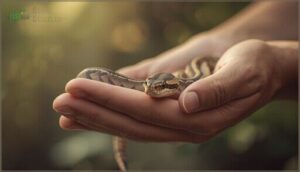
How you handle your snake matters just as much as how you house it. Small mistakes — grabbing too fast, handling too often, or skipping the warm-up process — can undo weeks of trust-building.
These three practices will help you keep sessions calm and your snake cooperative.
Avoiding Over-Handling
Less is genuinely more regarding handling. Most snakes thrive with 10 to 20 minutes a few times per week — not daily marathon sessions. Pushing past that threshold triggers stress reduction to work against you, turning gentle interaction into a source of anxiety.
Respect those handling limits, and your pet snake’s calm environments do the behavioral heavy lifting for you.
Calm Handling Techniques
How you pick up a snake matters as much as how often you do it. A calm approach, gentle touch, and secure handling form the foundation of stress-free interaction.
- Move slowly from the side — never above
- Support at least one-third of the body
- Use snake hooks for defensive individuals
- Keep sessions in quiet, low-traffic spaces
- Let the snake crawl hand-to-hand freely
Gradual Training and Desensitization
Start small. Begin handling sessions at just 3 to 5 minutes, then gradually extend time as your snake stays calm.
Tap training — a gentle hook touch near the midbody — signals handling time versus feeding, reducing food-driven strikes.
Body desensitization starts at the tail and moves forward over weeks.
Track behavioral progress session by session; if aggression worsens, pause and consult a vet.
Establishing Predictable Routines

Snakes thrive on predictability — when feeding, handling, and environmental conditions follow a consistent pattern, defensive behavior drops noticeably.
Think of routine as a form of communication: your snake learns what’s coming next, and that removes a lot of the uncertainty that drives stress.
Routine is communication: when snakes know what comes next, stress loses its grip
Here are three key areas where consistency makes the biggest difference.
Consistent Feeding Times
Feeding schedules do more than satisfy hunger — they shape your snake’s entire behavioral baseline. Consistent meal timing regulates hunger cycles, which directly reduces food aggression and defensive striking.
Juvenile snakes fed every 5–7 days and adults every 1–2 weeks develop predictable digestive health patterns, making handling far safer on off-days. Without that rhythm, even routine pet snake care becomes a guessing game.
Regular Handling Protocols
Predictable handling matters just as much as feeding schedules in snake care. Aim for 2 to 4 sessions per week, each lasting 5 to 15 minutes. A calm approach and gentle restraint reduce defensive responses markedly.
Snake taming through consistent handling techniques builds long-term trust. Abrupt or irregular sessions disrupt stress reduction progress, increasing strike frequency and teaching your snake that human contact is unpredictable.
Stable Environmental Cues
Your snake reads its environment like a map — and any sudden rearrangement is disorienting. Stable light cycle management (10–12 hours on, 12–14 off) keeps circadian rhythms intact. Consistent temperature gradients, predictable noise levels, and visual consistency in enclosure layout all reduce environmental stressors markedly.
Regular enclosure maintenance at set times reinforces calm associations, supporting long-term snake care and animal welfare by minimizing reptile aggression and defense responses.
Reducing Environmental Triggers of Aggression

Even a well-fed, healthy snake can turn defensive if its environment is consistently stressful.
Noise, instability, and sensory overload are triggers you can actually control.
Here’s what to adjust in your snake’s space to bring that stress level down.
Managing Noise and Vibrations
Snakes don’t hear sound the way you do — they feel it. Low-frequency vibrations travel through their jaw and body, triggering defensive behavior before you’ve even opened the enclosure.
For vibration reduction and noise minimization, enclosure placement matters: keep tanks away from subwoofers and shared walls. Rubber mats under stands absorb floor vibration, while steady sound masking — like soft background noise — prevents the unpredictable spikes that fuel reptile aggression.
Enrichment and Sensory Stimulation
A bored snake is a reactive snake. Enrichment and sensory stimulation directly foster animal welfare by channeling natural reptile behavior into exploration rather than defense.
Tactile exploration through cork bark and branches, olfactory enrichment via rotating safe scent items, visual stimulation with varied enclosure objects, and foraging activities like hidden prey all build sensory diversity that fosters behavioral training and conditioning — reducing snake handling incidents driven by animal aggression.
Limiting Sudden Environmental Changes
Enrichment keeps a snake curious rather than defensive — but even the best-enriched setup can trigger reptile aggression and defense responses if changes hit too fast. Gradual transitions matter: swap one décor item at a time, preserve familiar scents by reusing old substrate, and pre-cycle new enclosures for climate control stability before moving your snake in.
- Sudden full cleanouts reset every scent cue your snake relies on
- Temperature spikes over a few degrees in one day spike stress immediately
- Skipping light management disrupts the rest-activity cycle snakes depend on
- Noise reduction near the enclosure prevents vibration-driven defensive postures
- Stacking stressors — travel, illness, new enclosure — pushes calm snakes toward frequent strikes
Calming an Aggressive Snake Safely

When a snake shifts into defensive mode, your first move matters more than most people realize. Knowing how to de-escalate the situation — and what to do consistently over time — can make a real difference in how your snake reacts to you.
Here are the key strategies to have in your corner.
Immediate De-escalation Strategies
When a snake is in full defensive mode, your first move is distance—step back one or two paces to exit its strike range, which covers roughly one-third to one-half of its body length. Environmental calming through dimmed lights and reduced noise cuts visible stimuli fast. These de-escalation techniques work because they remove the perceived threat entirely.
| Action | Effect |
|---|---|
| Step back slowly | Exits strike range immediately |
| Dim room lighting | Reduces stimulus overload |
| Use a snake hook | Redirects without hand exposure |
| Cover enclosure | Encourages retreat over defense |
Long-Term Behavior Modification
De-escalation buys you time, but lasting change requires consistent behavioral reinforcement over weeks. Habituation techniques drawn from applied animal behavior and behavioral psychology work by pairing handling with calm, predictable outcomes. Stress reduction and environmental enrichment reduce baseline reactivity so desensitization methods can actually stick.
- Short, 10–15 minute sessions rewire the snake’s fear response gradually
- Hook-tapping before each lift signals safety through repetition
- Stable temperatures and hides lower chronic stress between sessions
- Consistent handling schedules build reliable, measurable behavioral patterns
- Calm returns to the enclosure reinforce relaxed snake behavior long-term
Monitoring for Improvement
Behavior tracking turns guesswork into data. Keep a simple log rating each handling session on a 1–5 calmness scale, noting feeding responses, shed cycles, and any aggressive behavior.
Over several weeks, look for calm indicators like slower tongue flicking, fewer strikes, and shorter recovery times. These improvement metrics confirm whether your stress reduction efforts are actually shifting the animal’s baseline.
Frequently Asked Questions (FAQs)
How to deal with an aggressive pet snake?
Think of aggression signs as a conversation — your snake’s telling you something’s wrong. Read its body language, adjust environmental factors, and use calm, confident handling tips to de-escalate stress fast.
How to stop a pet snake from biting you?
To stop a pet snake from biting, it’s essential to read its aggression signs early, use calm handling techniques, reduce stress, and maintain consistent routines.
Most snake bite incidents trace back to husbandry gaps, not animal aggression.
How to make a pet snake friendly?
Patience is the foundation of snake socialization. With gentle handling, calm environments, and consistent trust building routines, even an aggressive snake can become noticeably more tolerant through steady, low-stress interaction over time.
Can multiple snakes share one enclosure peacefully?
Most snake species aren’t built for cohabitation. Ball pythons, corn snakes, and kingsnakes are solitary by nature — sharing an enclosure often triggers competition, chronic stress, and real cohabitation risks, even when no visible aggression appears.
Do certain snake colors indicate mood changes?
Color isn’t a mood ring. Most color shifts in pet snakes reflect thermoregulation, shedding, or chromatophore function — not aggression. Read body language instead.
How does seasonal change affect snake temperament?
Seasonal change directly shifts snake temperament. Fall aggression peaks as brumation effects kick in, photoperiod changes reduce activity, and temperature fluctuations trigger irritability.
These are seasonal behavior patterns that vary considerably across snake species.
Can music or TV stress a pet snake?
Yes. Music and TV act as invisible stressors — vibrations and shifting light register as threats. Sound sensitivity and media placement both shape snake behavior, making noise pollution a real animal welfare concern.
Do snakes recognize their owners over time?
Over time, your snake builds scent association and habituation through chemical cues, learning your routine means safety — not danger. That’s owner recognition in action: practical, scent-driven familiarity, not emotional bonding.
Conclusion
Reading your snake’s posture, respecting its feeding window, and maintaining a stable enclosure aren’t separate habits—they’re a single, continuous practice. Each one reinforces the others.
When you learn to prevent pet snake aggression by addressing its root causes rather than reacting to its symptoms, the situation shifts. Strikes become rare, trust becomes measurable, and handling becomes predictable.
Your snake didn’t change—your understanding of it did, and that distinction makes all the difference.