
This site is supported by our readers. We may earn a commission, at no cost to you, if you purchase through links.
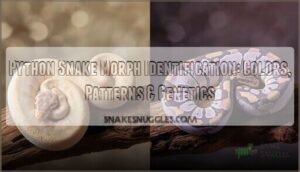
A pale yellow ball python with scattered white patches walks past a nearly identical snake—except the second one glows with lavender undertones and sports charcoal flecking along its spine. They’re siblings from the same clutch, yet they look like different species entirely.
Python snake morph identification hinges on recognizing these genetic variations, where a single mutation can shift pigmentation from earthy browns to candy-corn yellows or ghost-like silvers. With over 3,000 documented morphs now circulating in captive breeding, distinguishing between a banana pastel and a coral glow requires more than a casual glance.
You’ll need to spot the subtle markers—blushing on the head, keyhole patterns versus alien heads, even the faint metallic sheen that separates a mojave from a lesser platinum.
Table Of Contents
- Key Takeaways
- What Are Ball Python Morphs?
- How Morphs Develop: Genetics Explained
- Key Features for Morph Identification
- Popular Ball Python Morphs and Traits
- Step-by-Step Morph Identification Guide
- Frequently Asked Questions (FAQs)
- How do you determine a morphs genetic makeup?
- Can morphs change appearance as they age?
- What breeding errors create unintended morph combinations?
- How do you test for hidden recessive genes?
- What health issues link to specific morphs?
- How do I verify a morphs genetic lineage?
- How does temperature influence morph color development?
- What breeding mistakes produce unintended morph outcomes?
- Conclusion
Key Takeaways
- Ball python morphs are selectively bred genetic variations arising from naturally occurring mutations that alter pigmentation and patterning, with over 3,000 documented morphs now circulating through captive breeding programs worldwide.
- Morph identification relies on recognizing three key visual categories—color variations driven by melanin and carotenoid interactions, distinct pattern types like alien heads or keyholes, and subtle physical traits including blushing patterns, eye color, and scale texture.
- Genetic inheritance follows three predictable patterns: dominant traits appear with one allele copy, recessive morphs require two copies to express visibly, and co-dominant genetics create intermediate forms in heterozygotes with intensified “super” forms in homozygotes.
- Accurate identification combines systematic visual inspection under proper lighting, comparison with verified reference images, and consultation with experienced breeders when encountering unfamiliar combinations or planning breeding projects.
What Are Ball Python Morphs?
Ball python morphs are selectively bred variations that display unique colors and patterns, created through genetic mutations that naturally occur in wild populations.
Breeders continue developing new morphs each year, though ethical considerations in ball python genetics remain important as some mutations can affect health and quality of life.
Breeders have developed over 3,000 distinct morphs by isolating and combining these genetic traits, producing everything from vibrant yellows to striking white patches.
Popular examples include the Snow morph and other types of boa snakes that showcase how these genetic combinations create uniquely patterned specimens.
Understanding what morphs are, where they come from, and why they’ve captured the attention of reptile enthusiasts starts with three foundational concepts.
Learning about corn snake morphs and their care requirements will give you the knowledge to select a healthy snake and understand what makes each color variation so special.
Definition of a Morph
A morph is a distinct phenotypic expression within a species that you can recognize by its unique color or pattern.
Pairing anerythrism with other recessive traits produces striking combinations like Ghost and Snow, which have become some of the most sought-after morphs in the hobby.
In ball pythons, morphs represent stable genetic variants produced through trait inheritance and selective breeding. Each morph showcases specific species variation—from altered pigmentation to pattern mutations—that differs from the wild type. This genetic basis allows breeders to reliably reproduce these striking forms, creating the thousands of color morphs you see today.
In computer animation and biology, morphing refers to shape transformation techniques used to create smooth visual transitions between forms.
Origins of Ball Python Morphs
The first captive breeding milestone came in 1992 when breeder Bob Clark hatched an albino morph from wild-caught stock, marking the genetic roots of modern morph classification. Throughout the 1990s, breeding techniques improved as piebald and axanthic specimens arrived from Europe, proving that genetic mutations in reptiles could be reliably inherited.
By the early 2000s, ball python morphs and genetics had evolved into a global phenomenon:
- Wild-caught specimens provided foundational genetic diversity for early breeding programs
- Controlled crosses verified recessive and dominant inheritance patterns across multiple generations
- European imports introduced piebald genetics that expanded pattern possibilities
- Standardized terminology emerged to classify morphs by visual traits and lineage
- Online marketplaces accelerated global distribution of established morph lines
Understanding the basics of is essential for identifying how these morphs can be produced and inherited. This snake evolution transformed ball pythons from uniform wild types into thousands of designer varieties you see today.
Why Morphs Are Popular
You can see why morphs transformed ball python keeping: color diversity rivals tropical fish tanks, from butter yellows to deep purples.
Pattern uniqueness makes each snake recognizable—no two piebalds show identical spotting.
Rarity value drives market demand as collectors chase limited genetics, while breeding challenges turn hobbyists into geneticists.
Tracking down specific carpet python morph availability becomes crucial when top-tier designer combinations sell out within hours of hatching.
Snake color and pattern variation teaches inheritance basics, making genetic variation visible across generations.
How Morphs Develop: Genetics Explained
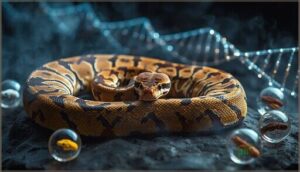
Understanding ball python genetics is like learning the recipe behind each snake’s appearance—every color and pattern comes down to specific genes passed from parent to offspring. These genes follow predictable inheritance patterns that determine whether a trait shows up in every baby, only some, or just when two copies are present.
Let’s break down how these genetic mutations work, how they’re inherited, and what separates a wild-caught snake from a carefully bred designer morph.
Genetic Mutations in Ball Pythons
You’ll find that genetic mutations in ball pythons arise when pigment pathways shift, altering melanin and xanthin production in chromatophores—the specialized cells responsible for color.
These mutations affect one or both gene copies your snake inherits, creating visible changes in browns, yellows, and blacks. Some variants reduce patterns entirely, while others intensify intensity, giving you the stunning diversity seen across thousands of ball python morphs today.
Inheritance Patterns (Dominant, Co-dominant, Recessive)
Understanding how genetics shape ball python morphs requires you to grasp three inheritance patterns. Dominant traits appear with just one allele copy, while recessive morphs need two copies to express visible changes—carriers remain visually normal.
Codominant genetics create a middle ground:
- Heterozygotes show distinct intermediate phenotypes
- Homozygotes produce “super” forms with intensified traits
- Both alleles contribute equally to coloration
This dominance hierarchy determines which morphs you’ll see in offspring.
Designer Morphs Vs. Natural Morphs
You’ll encounter two distinct origins when exploring ball python morphs. Designer morphs arise from breeders targeting rare mutations through selective pairings, driving Morph Market Trends and Morph Pricing based on novelty.
Natural morphs reflect spontaneous genetic drift in wild populations, raising questions about Conservation Impact and Breeding Ethics. Both follow identical inheritance patterns for Snake Morphs and Pattern Morphs, but designer lines concentrate multiple Ball Python Morphs and Genetics for dramatic visual effects.
Key Features for Morph Identification
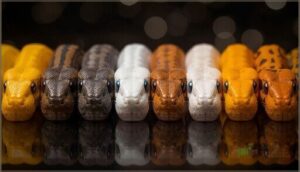
Identifying a ball python morph isn’t guesswork—it’s about reading the visual clues that each genetic combination leaves behind.
You’ll need to examine three main categories of traits: the colors and pigmentation patterns across the body, the specific shapes and arrangements of markings, and subtle physical features that set certain morphs apart. Let’s break down each identification feature so you can confidently recognize what you’re looking at.
Color Variations and Pigmentation
Ball python morphs showcase stunning color variations driven by melanin effects and pigment interaction within scale layers. You’ll notice how scale reflection and iridescence shift under different lighting, revealing hidden warmth or cooler tones that help distinguish one morph from another.
Three pigment factors shape what you see:
- Melanin concentration determines base darkness from pale cream to rich chocolate brown
- Carotenoid presence adds yellow-orange warmth derived from dietary sources
- Structural scale properties create metallic sheens and color shifts through light interaction
Pattern Types (Alien Heads, Keyholes, Stripes)
Pattern recognition starts with three classic motifs: alien heads, keyholes, and stripes. Alien heads feature bold helmet-shaped clusters along the dorsal surface, while keyholes display elongated ovals that taper inward like carved silhouettes.
Color contrast between pattern elements and base color determines visual density, directly influencing morph classification and genetics-based identification.
Unique Physical Traits (Blushing, Eye Color, Scale Texture)
Beyond pattern and color, you’ll notice subtler physical markers that sharpen morph identification. Blush patterns appear as warm pigment distribution on flanks or heads, created by localized melanin clustering rather than vascular changes.
Eye coloration varies with genetics—some morphs show lighter irises against darker rims, aiding quick differentiation. Scale variations remain mostly uniform, though texture analysis reveals slight sheen differences under proper humidity and lighting conditions.
Popular Ball Python Morphs and Traits
Once you understand the genetic foundations and visual markers, you’ll want to know which morphs you’re most likely to encounter.
Some morphs have become staples in the reptile trade due to their striking appearance and predictable genetics, while others remain rare treasures that command premium prices.
Let’s examine the most recognizable ball python morphs, their defining traits, and what makes certain combinations especially valuable.
Common Morphs (Piebald, Albino, Banana, Spider, Pastel)
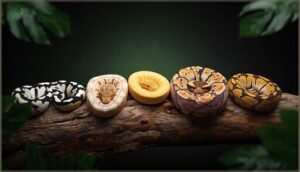
Understanding the building blocks of ball python genetics starts with five foundational morphs you’ll see everywhere in snake breeding circles. Each brings distinct color genetics and pattern variations that define morph classification in the hobby.
- Piebald – White patches dominate the body with irregular dark splotches, priced around $300–$700
- Albino – Bright yellows and oranges replace melanin, with pink eyes, usually $200–$400
- Banana – Lemon-yellow base with purple-brown saddles intensifying with age, running $500–$750
- Spider – Lighter ground color creates web-like pattern density, often under $150
- Pastel – Deepened, brightened tones with washed contrast, co-dominant genetics priced under $100 to over $1,000
Notable Rare and High-Value Morphs
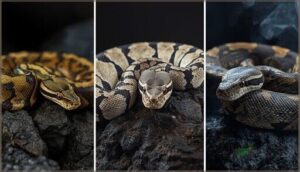
Once you’ve got the common morphs down, rare color patterns and exotic morphs enter high-value breeding territory where genetic rarity drives morph market trends.
Axanthic removes yellow entirely, leaving silver-gray scales with black contrast—codominant genetics pushing prices well above mid-tier snake morphs.
Verde Cocoa produces olive-to-emerald hues that darken with age, while Carbon Sand creates charcoal bases speckled with sandy tones through dominant inheritance, both commanding premium valuations in selective ball python breeding.
Morph Combinations and Super Forms
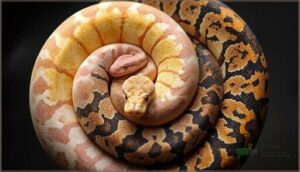
Pairing morphs together—like Piebald crossed with Albino or Banana with Pastel—creates stunning hybrid breeding outcomes where color patterns layer and intensify through trait inheritance.
Super forms emerge when you double up on the same allele:
- Super Pastel deepens yellow saturation beyond single-gene morphs
- Super Spider magnifies webbed patterning with increased contrast
- Super Banana brightens pink-lavender tones dramatically
- Piebald-Albino blends white patches with pigment absence
- Calico-Spider hybrids produce complex netted designs
Morph genetics drive endless morph creation possibilities, fueling genetic diversity and collector demand.
Step-by-Step Morph Identification Guide
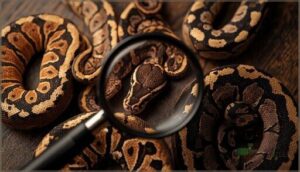
Identifying a ball python morph isn’t guesswork—it’s about knowing what to look for and where to find reliable comparisons.
You’ll start by examining specific visual traits like base color, pattern shape, and subtle details such as blushing or eye pigmentation. Here’s how you can confidently narrow down your snake’s morph through systematic observation and smart use of resources.
Visual Inspection Techniques
When you inspect snake morphs, start with strong overhead lighting to reveal true color intensity and pattern boundaries. Move through each section of the body systematically—head to tail—noting pigment distribution and markings like alien heads or keyholes.
Use magnification tools for fine details such as scale texture or subtle blushing. This surface analysis and defect mapping approach, paired with proper lighting techniques and inspection protocols, ensures accurate identification before comparing your findings with references.
Comparing With Reference Photos
Once you’ve mapped the key features, line up your snake photos with verified morph references for image alignment and pattern matching. Adjust for pose differences, then run a methodical check:
- Compare head shape and pattern placement against reference images
- Verify dorsal hue values for accurate color calibration
- Measure key landmarks like alien heads or keyhole shapes
- Examine belly color and lateral edge details for scale verification
- Note any lighting-induced hue shifts before finalizing your ID
When to Seek Expert or Breeder Advice
When should you call in backup for morph identification? Reach out for expert consultation or genetic counseling if you encounter unfamiliar labels, suspect morph health risks, or plan to breed designer combinations.
Reputable breeders prioritize breeder transparency with documented lineage and morph authentication records. Before acquiring high-value morphs, consult a specialist to verify reptile breeding and genetics claims and confirm ball python genetics accuracy.
Frequently Asked Questions (FAQs)
How do you determine a morphs genetic makeup?
Like reading a family tree backward, you determine a morph’s genetic makeup through breeding records, visual gene expression, allele identification from known pairings, and modern genetic testing that confirms hidden traits with lab precision.
Can morphs change appearance as they age?
Yes, many ball python morphs change appearance as they age through color shifts and pattern evolution.
Pastel morphs often brown out, while banana morphs develop freckles—aging patterns driven by genetics, not genetic drift.
What breeding errors create unintended morph combinations?
Poor record keeping, mislabeling genetics, and outcrossing distant lineages create unintended morph combinations.
Inheritance mistakes from incomplete pedigrees also yield surprise phenotypes carrying hidden recessive alleles or incompatible gene interactions.
How do you test for hidden recessive genes?
Testing for hidden recessive genes in ball python genetics requires careful carrier detection through strategic breeding trials.
You’ll pair suspected carriers with known recessives, then analyze offspring ratios to confirm mutation inheritance patterns through multiple generations.
What health issues link to specific morphs?
Spider and Enigma morphs show neurological issues like wobble syndrome, while some albino ball pythons experience light sensitivity.
High-contrast morphs can face breeding complications including reduced fertility and smaller clutch sizes.
How do I verify a morphs genetic lineage?
You verify a morph’s genetic lineage through breeder validation—reviewing pairing records, clutch documentation, and parent IDs.
For certainty, DNA analysis from shed skin confirms specific genes, enabling true morph authentication beyond visual inspection alone.
How does temperature influence morph color development?
Thermal cues during embryonic stages shape pigment cell formation, driving color plasticity in reptile genetics.
Warmer developmental temperatures often yield lighter morphs, while cooler conditions trigger darker pigmentation through temperature-sensitive windows that fine-tune environmental influence on snake morphs.
What breeding mistakes produce unintended morph outcomes?
Breeding blunders often start when you pair two carriers—inbreeding risks exacerbate recessive mutations, while epistasis effects and gene interaction create surprise morphs through genetic drift, revealing hidden breeding errors you didn’t anticipate.
Conclusion
You’ve now got the scales tipped in your favor in python snake morph identification. Whether you’re decoding a clutch of hatchlings or verifying a breeder’s label, those subtle blushing patterns and keyhole shapes now carry meaning instead of confusion.
Genetic combinations will always surprise you—a piebald-banana cross might look nothing like its parents—but your trained eye can now trace pigmentation shifts back to their inherited blueprints. That confidence transforms every snake you examine.
- https://www.researchgate.net/publication/339918500_Searching_for_snakes_ball_python_hunting_in_southern_Togo_West_Africa
- https://www.9news.com.au/world/snake-with-smiley-faces/d121de50-5fa5-4d98-8839-c5d59e35dcb9
- http://basicgenetics.ansci.cornell.edu/lethal_alleles.php?section=mratios
- https://www.youtube.com/watch?v=hlkabXX3KVs
- https://www.pitt.edu/~dash/snake.html