This site is supported by our readers. We may earn a commission, at no cost to you, if you purchase through links.

Most breeders lose their first clutch not from bad luck, but from skipping the foundational steps that separate a productive colony from an expensive hobby. Python snake breeding techniques demand precision at every stage—wrong weights, mismatched temperaments, or a single unquarantined animal can unravel months of preparation.
The difference between a 95% hatch rate and a failed season often comes down to decisions made before the male ever meets the female. Getting those decisions right means understanding health screening, environmental controls, genetic pairing, and the subtle behavioral cues pythons telegraph when they’re ready to breed.
Table Of Contents
- Key Takeaways
- Select Healthy Breeding Pythons
- Confirm Sex and Quarantine
- Prepare The Breeding Environment
- Pair Pythons for Mating
- Incubate Eggs and Raise Hatchlings
- Frequently Asked Questions (FAQs)
- What breeding loans and partnerships work best?
- How do you ship breeding snakes safely?
- When should you retire older breeding animals?
- What record keeping systems track breeding data?
- How do you price offspring competitively?
- How do ball python morphs affect offspring coloration?
- Can ball pythons breed successfully in community enclosures?
- What legal permits are required for selling hatchlings?
- How does stress impact a females egg production?
- When should you retire a ball python from breeding?
- Conclusion
Key Takeaways
- Before pairing ever happens, your female needs to be at least 3 years old and hit 1,500 g — skip that threshold and you’re gambling with her health and your entire season.
- A 60–90 day quarantine with daily health checks isn’t optional busywork; one unscreened animal can collapse a colony you’ve spent months building.
- Breeding behavior stalls without a precision-engineered thermal gradient — your warm end needs to hold 88–92 °F while the cool end stays at 75–80 °F, with zone deviations kept under 1 °C.
- Incubator accuracy at 88–90 °F with daily temperature logging is what separates a 95% hatch rate from a failed clutch, because small drifts compound fast across a 52–60 day cycle.
Select Healthy Breeding Pythons
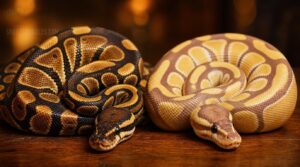
Getting your breeding stock right is the foundation everything else is built on. Before you think about pairing, cooling cycles, or incubators, you need animals that are genuinely ready — the right age, the right weight, and in solid health. Here’s what to look for when making your selections.
If you’re still figuring out which species suit your goals, this snake species breeding guide breaks down the key differences before you commit to a pairing.
Age and Weight Requirements
Most breeders underestimate how much age and weight shape a successful season. Females must be at least 3 years old and reach female weight 1500 g before their first breeding. Males need male weight 700 g and 16–18 months of growth to reach sexual maturity.
- Target a Body Condition Score of 3.0–3.5 on a 1–5 scale
- A gravid female should weigh 1.7–1.8 kg for peak fertility
- The Age Fertility Window peaks between ages 3–7 in females
- Males perform most reliably from age 4–6
- Weight Monitoring monthly catches dangerous fluctuations above 10%
Temperament and Handling Response
Weight gets you through the door, but temperament decides whether breeding goes smoothly. A snake that strikes defensively during routine checks will cause constant disruption during pairing.
Prioritize animals that tolerate handling with minimal startle response, — calm, slow-moving individuals that don’t coil tightly or thrash under contact are your safest candidates for a productive breeding colony.
Morph Pairing Goals
Once your animals are handled well, the next layer is purpose: what traits are you actually trying to produce?
Morph pairing goals start with defining clear color intensity targets and pattern outcomes before any introduction happens. Pairing without a plan wastes an entire breeding season.
Map allele interaction forecasts using known dominant and recessive relationships, and always cross-reference morph compatibility to avoid combinations that compromise hatchling viability.
Pedigree and Genetic Diversity
Morph goals shape what you breed toward — but pedigree determines what you’re actually working with beneath the surface.
Pedigree and genetic diversity aren’t optional extras; they’re the foundation your entire breeding program rests on. Track founder contributions carefully, because overusing one dominant line creates a genetic bottleneck fast, compressing your effective population and locking in inherited health risks across generations. Repeated use of a single stud can trigger popular sire syndrome, further reducing breed variability.
Veterinary Breeding Clearance
Before any python enters your breeding program, get a veterinary breeding clearance. A licensed reptile vet examines each animal, documents findings on a health clearance form, and confirms no obvious physical, behavioral, or genetic disorders are present.
This pre-mating check also verifies your snake’s microchip number, linking clearance directly to that individual — no guesswork, no mix-ups.
Confirm Sex and Quarantine
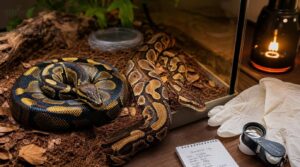
Before you pair any pythons, you need to know exactly what you’re working with. Guessing at sex or skipping health checks is how mistakes become expensive problems. Here’s what to cover first.
Safe Cloacal Probing
Cloacal probing is the most reliable hands-on method for sex determination in pythons, but it demands precision. In females, the probe reaches only 3–4 scale rows; in males, it travels 7–9.
This precision mirrors the broader instinctive body mechanics pythons rely on, where even subtle anatomical differences drive remarkably consistent, measurable outcomes.
Always use a properly sized, sterile probe with water-soluble lubricant, insert gently, and stop at resistance. If you’re not trained, don’t guess — get a veterinarian involved.
New Snake Quarantine
Once a new snake clears sex determination, it doesn’t go straight into your breeding colony — not even close.
Quarantine duration runs 60–90 days minimum, in a physically separate room with dedicated tools, gloves, and a strict one-way workflow. Daily checks track weight, appetite, respiration, and shedding. Document everything.
Only after stable health and veterinarian clearance does reintroduction begin.
Parasite and Mite Checks
Mites and internal parasites are silent saboteurs — you won’t always see the damage until it’s too late.
Inspect every snake thoroughly using three focused checks:
- Skin surface scan — examine around the head, eyes, and scale edges under bright, angled lighting for tiny moving specks.
- Vent area examination — look for abnormal residue, mucus, or discoloration around the cloaca indicating internal parasites.
- Fecal analysis — collect fresh stool promptly and screen for watery consistency, undigested prey, or visible parasite material.
Patchy, incomplete sheds often signal mite irritation before visible specks appear. Use separate tools and gloves between animals to prevent cross-contamination throughout the entire quarantine procedure.
Respiratory Health Screening
Respiratory health is easy to overlook — until a sick snake infects your entire colony.
| Screening Step | Method Used | What It Detects |
|---|---|---|
| Respiratory questionnaire | Symptom and history review | Wheezing, prior infections |
| Oxygen saturation check | Pulse oximetry | Low blood oxygen levels |
| Lung function test | Spirometry assessment | Airflow restriction or weakness |
Health surveillance and exposure risk evaluation catch problems before breeding begins.
Prepare The Breeding Environment
Getting the environment right is what separates a successful breeding season from a frustrating one. Before you introduce any snakes, there are a few key setup decisions you’ll need to make. Here’s what to focus on first.
Breeding Enclosure Setup

Your vivarium setup is the foundation everything else depends on. Use an enclosure at least 6 feet long by 3 feet wide, with an 18-inch minimum height. Three elements determine whether that space actually works:
- Escape-proof latches on a tight-fitting, warp-resistant lid
- Coconut fiber or sphagnum moss as moisture-retaining substrate
- Secure hides at both ends to reduce pair-bonding stress
Temperature Gradient Design

Once your enclosure dimensions are locked in, the next variable to master is heat — specifically, how it moves across the length of the space.
Temperature gradient design isn’t just about hitting one target number. You’re engineering a spectrum: a warm end, a cool end, and a smooth thermal bridge between them. Pythons self-regulate by moving through that range, so if the gradient collapses or creates dead zones, they can’t thermoregulate properly — and breeding behavior stalls.
A python’s thermal environment isn’t a single number — it’s a precision-engineered spectrum that drives breeding behavior
Set your warm basking zone to 88–92 °F (31–33 °C) using ceramic heaters or deep-penetrating heat lamps positioned at one end. The cool end should hold steady at 75–80 °F (24–27 °C). That 12–17 °F spread is your working range.
Zone Control means each heating element runs on an independent controller — ideally with PID (Proportional-Integral-Derivative) logic — so temperature swings stay under 1 °C across any 24-hour window. Overshoot is the enemy here; even a 2 °F deviation can suppress ovulation signals.
| Enclosure Zone | Target Temp (°F) | Heating Source |
|---|---|---|
| Warm End | 88–92 °F | Ceramic heater / heat lamp |
| Mid Zone | 82–85 °F | Ambient + radiant bleed |
| Cool End | 75–80 °F | Passive / no direct heat |
Sensor Placement matters as much as the hardware. Mount probes at substrate level — not mid-air — and space them at regular intervals along the enclosure. Air temperature and surface temperature diverge by 3–5 °F in poorly monitored setups, which skews your readings and your snake’s behavior.
Your Insulation Strategy closes the loop. Use reflective foil barriers and thermal breaks between zones to stop lateral heat bleed. Seal enclosure joints with gaskets to block drafts — airflow flattens gradients faster than any equipment fault. Run a 72-hour Gradient Calibration test before introducing any animals, confirming drift stays below 0.5 °C throughout.
Think of it like tuning an instrument before a performance. The snakes respond to precision.
Humidity Control Methods

Temperature sets the stage, but humidity seals the deal.
Target 60–70% relative humidity in your breeding enclosure. Use a digital hygrometer mounted at substrate level — air readings run 3–5% higher and will mislead you. An ultrasonic humidifier raises RH quickly, but position it carefully to avoid pooling directly on surfaces. Misting frequency of once or twice daily, combined with humidity automation through a thermostat-integrated controller, keeps fluctuations under 8% across 24 hours.
Seasonal Cooling Cycle
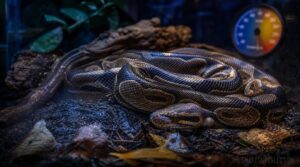
Once your humidity levels are dialed in, it’s time to mimic nature’s own off switch — seasonal brumation.
Starting in late October, run a cooling-off period by dropping nighttime temps to 72–75 °F (22–24 °C) while keeping daytime basking spots at 82–85 °F. Sustain this temperature cycling for 6–8 weeks.
- Cut male feeding to near zero
- Keep females on regular meals
- Hold deviations under 2 °F
Light Cycle Adjustments
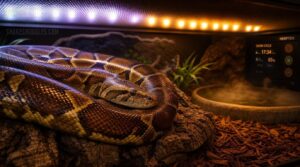
Temperature cycling sets the stage, but light is the silent conductor of your python’s reproductive clock.
During seasonal brumation, reduce the photoperiod to 10 hours of light and 14 hours of darkness. Use automated light controllers to handle this consistently — no manual guessing.
| Phase | Photoperiod |
|---|---|
| Cooling (Oct–Dec) | 10 hrs light / 14 hrs dark |
| Breeding Season | 14–16 hrs light |
| Post-Breeding | 10–12 hrs light |
| Dawn/Dusk Simulation | 20–30 min ramp |
| Spectral Color Temperature | 5000–6500K white |
Keep light intensity levels at 30–60% daytime, dimming at dusk. Dawn dusk simulation over 20–30 minutes prevents stress spikes that can stall ovulation.
Pair Pythons for Mating

Pairing pythons isn’t just putting two snakes together and hoping for the best. Timing, preparation, and close observation are what separate a successful breeding season from a frustrating one. Here’s what you need to know to get it right.
Understanding how snakes naturally seek out and move between environments can help you create the right pre-breeding conditions — see how providing enough hiding spots for your python supports the behavioral cues that trigger breeding readiness.
Getting the enclosure environment right matters just as much during breeding season, so make sure your setup follows proper snake enclosure lighting requirements to avoid disrupting your pair’s natural rhythms.
Signs of Breeding Readiness
Knowing exactly when your pythons are ready to breed isn’t guesswork — it’s pattern recognition.
A female at peak readiness shows a noticeably fuller midsection as follicles develop, a glossy skin condition, and a subtle distension near the cloaca. Her tongue-flick rate rises sharply during close contact, signaling active pheromone detection.
Meanwhile, a breeding-ready male displays increased tail-base tension and persistent following behavior.
Male Stimulation Techniques
Briefly housing several males together for 10–20 minutes before pairing sharpens competitive drive and raises mating motivation in your male ball python.
This short co‑housing period triggers natural rivalry cues, priming him to pursue the female more assertively.
Once removed and introduced separately, that heightened behavioral state carries over — making the shift into active mating behavior noticeably more deliberate and focused.
Nighttime Pair Introductions
Once the cooling period has primed both animals, timing your introduction matters as much as the pairing itself.
Introduce the male to the female’s enclosure at night, when low light conditions naturally reduce overstimulation and pheromone readiness signals are strongest. Quiet handling sessions beforehand help both snakes stay calm, making the entire encounter more deliberate and productive.
Monitoring Mating Locks
A successful mating lock is your clearest confirmation that fertilization is underway. Lock duration commonly runs 30 minutes to several hours — longer is better.
Watch for aligned vents, rhythmic tail pulsing, and both snakes holding still.
Keep lighting subdued and avoid enclosure vibrations, as disruptions can trigger premature release, reduce conception rates, and stress both animals.
Resting Breeding Males
After each mating lock, your male needs real downtime — not just a few hours, but at least one week of rest before his next pairing.
- Rest preserves sperm motility and concentration
- Reduces oxidative stress in seminal plasma
- Stabilizes appetite and weight after breeding
- Aligns recovery with circadian rest patterns
- Minimizes handler disturbance during recovery windows
Skipping this step quietly tanks your fertilization rates.
Incubate Eggs and Raise Hatchlings
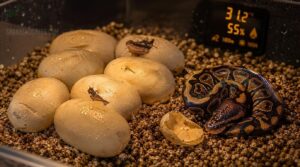
Once the eggs are laid, the real work begins — and getting it right separates a good clutch from a lost one. Every decision from this point forward, from your lay box setup to your hatchling’s first meal, directly shapes how many healthy babies you walk away with.
Here’s exactly what you need to do, step by step.
For a deeper dive into timing, weight thresholds, and pairing decisions, this ball python breeding guide for beginners walks through each step with practical, experience-backed advice.
Understanding the irregular puncture patterns shown in these rattlesnake bite pictures and facts can help you recognize a strike long before swelling sets in.
Lay Box Preparation
The lay box is where everything starts. Use sphagnum moss or coconut fiber as your moisture substrate — both hold humidity at 60–70% without soaking eggs.
Keep the box 30–40 cm square, 15–20 cm tall, with substrate 8–12 cm deep.
Place a hygrometer inside, check it daily, and replace substrate every 1–2 weeks to prevent mold.
Egg Collection and Candling
Once the female has laid, move quickly. Collect eggs within 24–48 hours to minimize contamination risk. Use sanitized containers lined with damp sphagnum moss, and label each egg with the lay date.
For egg candling, darken the room and press a bright light against the shell. Fertile eggs show red-orange blood vessels by day 14; clear or yellow-green eggs aren’t viable.
Incubator Temperature Settings
Once you’ve candled and confirmed viable eggs, the incubator becomes your most important tool. Set your incubation temperature to 88–90 °F (31–32 °C) and hold it within one degree Celsius. Even small deviations compound over 52–60 days.
| Setting | Target |
|---|---|
| Daytime temp | 88–90 °F (31–32 °C) |
| Humidity | 90–100 % |
Use a digital thermometer with at least two calibrated probes placed near egg level — not just at the wall. Daily temperature logging keeps drift visible early. Set an alarm threshold at ±0.5 °C so equipment faults don’t go unnoticed overnight. Temperature control at this stage directly determines hatch rates.
Hatchling Housing Setup
Once your eggs hatch, the incubator’s job is done — yours is just beginning. Each hatchling needs its own 12–18 inch enclosure with at least 2 square feet of floor space. Use paper towels or reptile carpet as substrate, kept 1–2 inches deep. Clear, vented plastic tubs work well, offering airflow and easy observation.
- Warm side: 86–90 °F for digestion
- Cool side: 78–82 °F for rest
- Humidity: 40–60 % with accurate hygrometer placement
- Hides: one on each end to reduce stress
First Shed and Feeding
Your hatchlings have settled into their new enclosures — now the real milestones begin. First shed timing usually falls within 7–14 days of hatching. Watch for dull eyes and increased hiding as reliable cues.
Maintain 60–70% humidity and temperatures of 28–30 °C to support a clean, complete shed. Once the shed is finished, feeding readiness is confirmed.
Frequently Asked Questions (FAQs)
What breeding loans and partnerships work best?
It takes money to make money." Profit sharing models and flexible loan amortization let you fund a strong breeding pair selection program without overextending — keeping genetic diversity and breeding ethics central to every partnership decision.
How do you ship breeding snakes safely?
Use rigid, escape-proof containers with ventilation, keep temperatures between 70–86 °F, and include health certificates. Minimize handling, avoid extreme weather windows, and label boxes clearly with species names and live animal markings.
When should you retire older breeding animals?
Even the strongest tree must eventually be retired to the forest floor. Retire female pythons by seven to nine years old, or sooner if clutch sizes drop for two straight seasons.
What record keeping systems track breeding data?
Digital Database Records tie together animal ID, birth date, sire, dam, and status in one searchable system, making lineage tracing and fertility assessment fast and audit-ready across every clutch.
How do you price offspring competitively?
Price offspring by combining lineage premium, morph rarity, and health certificates. Factor in size, sex, and market demand trends. Adjust within 5–15% weekly based on current buyer activity and documented growth projections.
How do ball python morphs affect offspring coloration?
Ball python morphs directly shape offspring color through genetic dominance — recessive genes like albino require both parents, while co-dominant traits like pastel appear in 50% of hatchlings from a single carrier.
Can ball pythons breed successfully in community enclosures?
Community enclosures aren’t ideal for breeding. Always introduce the male to the female’s enclosure — never the reverse. Stress reduction and individual space control make solo pairings far more successful than shared setups.
What legal permits are required for selling hatchlings?
In Germany, selling hatchlings commercially requires a trade permit from your local authority. You’ll also need CITES documentation and species protection proof confirming legal acquisition before any transaction.
How does stress impact a females egg production?
Chronic stress triggers cortisol egg suppression, disrupting ovulation timing and reducing clutch size. For your female python, stress during breeding directly compromises follicle health, egg quality, and overall reproductive output — so maintaining a calm, ideal environment isn’t optional.
When should you retire a ball python from breeding?
Retire a female when she shows declining clutch size across three consecutive seasons or struggles to maintain 5× her body weight post-lay. Prioritize her health over one more clutch.
Conclusion
Even the ancient Romans knew that mastery begins long before the moment of action—and python snake breeding techniques are no different. Every decision you’ve made, from pairing genetics to dialing in incubator temps, compounds into either a thriving clutch or a costly lesson.
You’ve built the foundation now. Trust the process, watch your animals closely, and let the data guide your adjustments.
The hatch rate you want isn’t luck—it’s the result you’ve already engineered.