
This site is supported by our readers. We may earn a commission, at no cost to you, if you purchase through links.
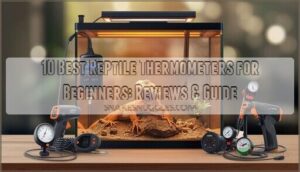
Your bearded dragon won’t tell you when its basking spot drops to unsafe levels, and a ball python can’t complain about overnight temperature swings that slow its digestion. Reptiles rely entirely on external heat to regulate their metabolism, immune function, and basic survival—which means guessing at enclosure temperatures isn’t just risky, it’s a recipe for chronic stress or worse.
Beginners often underestimate how dramatically a few degrees can affect shedding cycles, appetite, and disease resistance. Choosing the right thermometer eliminates that guesswork, but the market floods newcomers with dozens of digital displays, analog gauges, and combo units that vary wildly in accuracy and durability.
Understanding which features actually matter—and which ones just inflate the price tag—helps you build a monitoring system that keeps your reptile thriving without draining your wallet.
Table Of Contents
- Key Takeaways
- Best Reptile Thermometers for Beginners
- 1. Fluker’s Digital Thermometer Hygrometer
- 2. Zoo Med Dual Thermometer Humidity Gauge
- 3. Repti Zoo Digital Thermometer Hygrometer
- 4. ThermoPro Digital Hygrometer Thermometer
- 5. Inkbird Digital Thermometer Hygrometer Monitor
- 6. Reptile Tank Thermometer And Hygrometer
- 7. Mini Digital Hygrometer Thermometer
- 8. Paizoo Reptile Thermometer Hygrometer
- 9. Oasirep Reptile Thermometer Hygrometer
- 10. Digital Reptile Thermometer Hygrometer
- Why Accurate Temperature Matters for Reptiles
- Key Features to Look for in Thermometers
- Thermometer and Hygrometer Combo Benefits
- Proper Thermometer Placement in Enclosures
- Maintaining and Calibrating Your Thermometer
- Budget Considerations and Brand Reputation
- Tips for New Reptile Owners Using Thermometers
- Frequently Asked Questions (FAQs)
- Conclusion
Key Takeaways
- Reptiles can’t regulate their own body temperature, so even a 2-3 degree error in your thermometer readings can disrupt digestion, shedding, and immune function—making accuracy more critical than features or price.
- Digital thermometers generally outperform analog gauges for precision (±1-2°F vs ±2°F or worse), but you’ll need to verify calibration monthly against a reference device since even quality units drift over time.
- Place multiple thermometers at different heights and zones—one near the basking spot, one at the cool end, and one at your reptile’s eye level—because a single reading won’t capture the thermal gradient your animal actually experiences.
- Combo temperature-humidity units simplify monitoring for most beginners, but species with strict environmental requirements (desert vs tropical) may need separate devices positioned strategically to avoid misleading composite readings.
Best Reptile Thermometers for Beginners
You’ll need a reliable thermometer to maintain the temperature and humidity ranges your reptile requires for basic physiological functions.
The following products represent tested options that work well for beginners who are establishing their first monitoring system. Each model offers different features and price points to match your specific enclosure needs and budget constraints.
1. Fluker’s Digital Thermometer Hygrometer
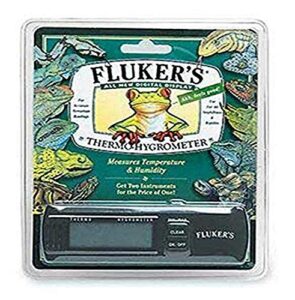
You’ll want to explore Fluker’s Digital Thermometer Hygrometer if you’re starting out—it measures both temperature and humidity on one compact digital display. This reptile thermometer operates on battery power and mounts easily in your terrarium at mid-level for accurate readings.
The unit’s water-resistant design manages humid environments well, though some users report the hygrometer drifts over time. You should verify sensor calibration periodically against a secondary device to maintain reptile health, especially since proper humidity control directly affects shedding and hydration in your animals.
| Best For | Reptile and amphibian owners who need an affordable, all-in-one digital monitor to track both temperature and humidity levels in their terrariums or enclosures. |
|---|---|
| Display Type | Digital LCD |
| Measures | Temperature & Humidity |
| Power Source | Battery |
| Mounting Method | Adhesive |
| Material | Plastic |
| Temperature Accuracy | Standard |
| Additional Features |
|
- Combines temperature and humidity sensing in one compact device with an easy-to-read digital display
- Battery-powered and water-resistant design works well in humid reptile environments
- Flexible mounting options allow for proper mid-tank placement to get accurate ambient readings
- Hygrometer accuracy can drift over time and may need regular verification against a backup device
- Adhesive mounting may fail in some setups, causing the unit to fall or creating a risk for pets
- Some users report inconsistent humidity readings that require periodic calibration checks
2. Zoo Med Dual Thermometer Humidity Gauge
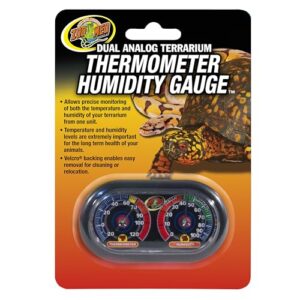
Zoo Med’s Dual Analog Gauge offers an affordable analog alternative to digital displays, mounting via Velcro backing so you can reposition it as your enclosure layout evolves. The unit tracks both temperature in Fahrenheit and relative humidity on side-by-side dials, though gauge accuracy usually falls within ±2°F and ±10% RH—broader tolerances than digital models.
You’ll find this thermometer and hygrometer best suited for species with less stringent environmental requirements, since sensor calibration isn’t user-adjustable and some owners report drift over extended use.
| Best For | Budget-conscious reptile owners with species that tolerate wider temperature and humidity ranges and who need a simple, relocatable monitoring solution. |
|---|---|
| Display Type | Analog |
| Measures | Temperature & Humidity |
| Power Source | Battery |
| Mounting Method | Velcro |
| Material | Plastic |
| Temperature Accuracy | Varies |
| Additional Features |
|
- Velcro backing makes it easy to move the gauge around your enclosure to find the best monitoring spot or adjust as your setup changes.
- Affordable analog option that doesn’t require batteries or any power source to keep running.
- Monitors both temperature and humidity in one compact unit, saving space on your enclosure wall.
- Accuracy is less precise than digital models, with tolerances of ±2°F and ±10% RH that may not suit finicky species.
- You can’t calibrate the gauges yourself, and some users report the readings drift or become less accurate over time.
- Not ideal for animals that need tight environmental control since the broader measurement range can miss critical temperature or humidity shifts.
3. Repti Zoo Digital Thermometer Hygrometer
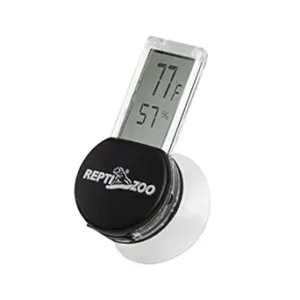
If you want tighter digital accuracy without spending a fortune, Repti Zoo’s Digital Thermometer Hygrometer delivers simultaneous readings on a clear LCD screen. The unit claims ±1°F temperature precision and ±5% humidity tolerance—acceptable margins for most beginner setups, though thermometer calibration isn’t adjustable beyond factory settings.
You’ll mount it via suction cup, which some keepers find tricky on textured glass, and the casing isn’t fully waterproof. Battery life spans several months under typical use, making this reptile digital thermometer a solid entry point for monitoring environmental control and supporting reptile health.
| Best For | Budget-conscious reptile keepers who need basic temperature and humidity monitoring in a single digital unit without advanced features. |
|---|---|
| Display Type | Digital LCD |
| Measures | Temperature & Humidity |
| Power Source | Battery |
| Mounting Method | Suction cup |
| Material | Glass/Plastic |
| Temperature Accuracy | ±1°F/°C |
| Additional Features |
|
- Simultaneous temperature and humidity readings on a single LCD display make it easy to check both metrics at a glance
- Affordable price point with decent accuracy (±1°F temperature, ±5% humidity) for entry-level setups
- Battery-powered design lasts several months, so you won’t be constantly swapping cells
- Suction cup mounting can be frustrating on textured glass and may not hold reliably over time
- Not fully waterproof, so it can malfunction if exposed to misting or high moisture levels
- No calibration adjustment available, meaning you’re stuck with factory settings if readings drift
4. ThermoPro Digital Hygrometer Thermometer
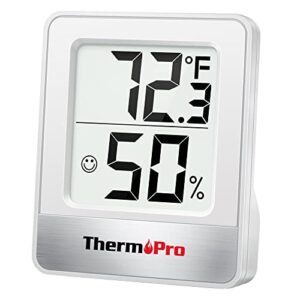
ThermoPro’s Digital Hygrometer Thermometer pairs temperature sensors with humidity control in a compact white casing that weighs just 35 grams. You’ll see ±1°F digital accuracy and ±2–3% relative humidity readings refresh every ten seconds—responsive enough for reptile monitoring without draining the alkaline battery.
The face icon indicates dry, comfort, or wet air conditions at a glance, though the lack of backlighting makes nighttime checks difficult. Magnetic backing and tabletop options simplify placement, and the large digits remain legible across most enclosures, making this a practical choice for beginners prioritizing reptile care and maintenance.
| Best For | Reptile owners and plant parents who want affordable, real-time humidity and temperature tracking without needing nighttime visibility or advanced features. |
|---|---|
| Display Type | Digital LCD |
| Measures | Temperature & Humidity |
| Power Source | Battery |
| Mounting Method | Stand/Magnetic/Hanging |
| Material | Plastic |
| Temperature Accuracy | ±1°F/°C |
| Additional Features |
|
- Accurate readings (±1°F and ±2–3% RH) that refresh every 10 seconds, giving you quick feedback on enclosure conditions
- Face icon comfort indicator makes it easy to see at a glance whether your space is too dry, too wet, or just right
- Lightweight design with magnetic backing and multiple mounting options lets you place it anywhere without hassle
- No backlight means you’ll need a flashlight or external light to check readings in the dark
- Basic splash resistance only—keep it away from direct water or high-moisture areas to avoid sensor damage
- Some users report minor temperature drift over time, which is common at this price point but may require occasional recalibration
5. Inkbird Digital Thermometer Hygrometer Monitor
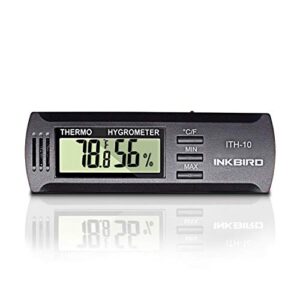
Inkbird’s ITH10 digital thermometer hygrometer gives you a clear LCD display that refreshes temperature and humidity simultaneously, letting you spot trends through minimum and maximum history logs.
You’ll appreciate the ±1.8°F sensor accuracy and ±3% humidity tolerance—tight enough for most beginner setups—though you should cross-check readings with a second device during initial calibration.
Battery life stretches several months on a single CR2032 cell, and magnetic or adhesive mounting options keep the compact black housing secure against glass or mesh.
Basic calibration tips recommend periodic verification to maintain reliable reptile thermometer performance.
| Best For | Beginner reptile keepers who need affordable, straightforward temperature and humidity monitoring in a single enclosure without advanced connectivity features. |
|---|---|
| Display Type | Digital LCD |
| Measures | Temperature & Humidity |
| Power Source | Battery (CR2032) |
| Mounting Method | Placement |
| Material | Plastic |
| Temperature Accuracy | ±1.8°F |
| Additional Features |
|
- Clear LCD with simultaneous temp and humidity display plus min/max history makes trend-spotting easy
- Compact design with magnetic or adhesive mounting fits small enclosures and hard-to-reach spots
- Budget-friendly price point with decent accuracy (±1.8°F, ±3% RH) for most starter setups
- Non-adjustable calibration means you’ll need to verify accuracy with a second device or salt test
- Some users report inconsistent readings or display issues across different units
- No connectivity or advanced alarms—just basic on-device readouts
6. Reptile Tank Thermometer And Hygrometer
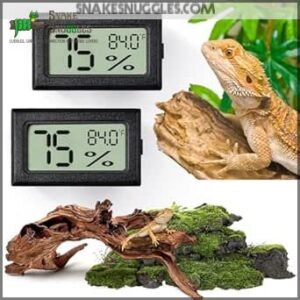
Vodolo’s two-pack reptile digital thermometer delivers 0.9°F thermometer accuracy through a high-precision chip, letting you track temperature and humidity control across multiple zones without buying separate units.
You’ll find the LED display readable in dim enclosures, and the ℉/℃ toggle matches your preference. Double-sided adhesive simplifies tank monitoring, though some users report the mount loses grip over time.
Battery power keeps these environmental sensors cordless, supporting reptile health through continuous readings—just verify calibration against a reference device before relying on data for critical adjustments.
| Best For | Reptile owners who need affordable dual monitoring across multiple tanks or zones and want easy-to-read displays without dealing with wires. |
|---|---|
| Display Type | Digital LED |
| Measures | Temperature & Humidity |
| Power Source | Battery |
| Mounting Method | Double-sided adhesive |
| Material | Plastic |
| Temperature Accuracy | ±0.9°F |
| Additional Features |
|
- High-precision chip delivers 0.9°F accuracy for reliable temperature and humidity tracking
- LED display stays readable in low-light conditions, and quick ℉/℃ switching adapts to your preference
- Two-pack design lets you monitor separate tanks or different zones in one enclosure without buying duplicates
- Adhesive backing can lose grip over time, causing units to fall inside the tank
- Some users report inaccurate readings, so you’ll want to verify against a reference device first
- Battery replacement required periodically, though the design aims for energy efficiency
7. Mini Digital Hygrometer Thermometer
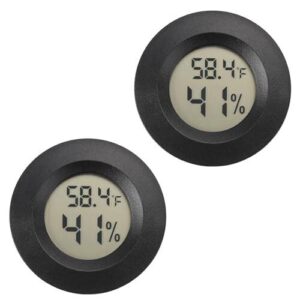
This mini hygrometer thermometer fits tight spaces while delivering ±1°F sensor accuracy and ±3% humidity readings—essential when you’re dialing in basking zones or monitoring shed cycles. The digital display updates every 10 seconds, and you can toggle between Fahrenheit and Celsius, though the button mechanism frustrates some users.
Its compact design means you’ll place it at your reptile’s level without blocking sightlines, but beware: high humidity above 75% shortens lifespan, and the included adhesive fails in moist enclosures.
Calibration tips matter here—compare readings against a reference device before trusting this budget unit for critical humidity control decisions.
| Best For | Reptile keepers who need quick temperature and humidity checks in tight enclosures and don’t mind occasional recalibration. |
|---|---|
| Display Type | Digital LCD |
| Measures | Temperature & Humidity |
| Power Source | Battery (LR44) |
| Mounting Method | Placement/Adhesive |
| Material | Plastic |
| Temperature Accuracy | ±1°F |
| Additional Features |
|
- Updates every 10 seconds with ±1°F accuracy, so you catch basking-zone shifts fast
- Compact size fits at animal level without blocking sightlines or taking up prime real estate
- Dual display for temperature and humidity means one device handles both critical metrics
- High humidity above 75% can short out the unit and kill it within months
- The adhesive backing fails in moist environments, forcing you to find alternative mounting
- Switching between Fahrenheit and Celsius involves a finicky button that frustrates users
8. Paizoo Reptile Thermometer Hygrometer
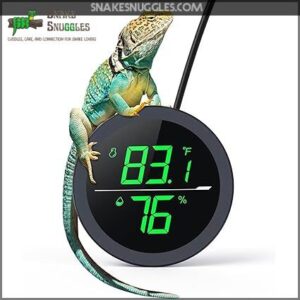
The PAIZOO Reptile LED Thermometer shifts digital displays into backlit territory, allowing you to read temperature and humidity at night without disturbing nocturnal species. Its USB power eliminates battery swaps, though you’ll need an outlet near the enclosure.
Sensor accuracy holds within typical consumer margins, but expect some drift over months; thermometer calibration against a reference device protects reptile health when basking gradients matter.
The 140 cm cable reaches most setups, yet high humidity degrades adhesive mounts—users report the 3M tape failing in tropical environments, requiring alternative mounting solutions for reliable environmental monitoring.
| Best For | Reptile owners who want an affordable, always-on display to monitor both temperature and humidity without dealing with battery changes. |
|---|---|
| Display Type | Digital LED |
| Measures | Temperature & Humidity |
| Power Source | USB |
| Mounting Method | 3M tape |
| Material | Acrylic |
| Temperature Accuracy | High precision |
| Additional Features |
|
- Backlit LED display makes it easy to check conditions at night without disturbing nocturnal reptiles
- USB power means you’ll never scramble for replacement batteries
- Long 140 cm cable reaches most enclosure setups without needing extension cords
- Sensor accuracy can drift over time, so you’ll want to check it against a reference thermometer occasionally
- The included adhesive tape struggles in high-humidity environments and may fail in tropical setups
- Some users report the display stopping or showing incorrect readings after several months of use
9. Oasirep Reptile Thermometer Hygrometer
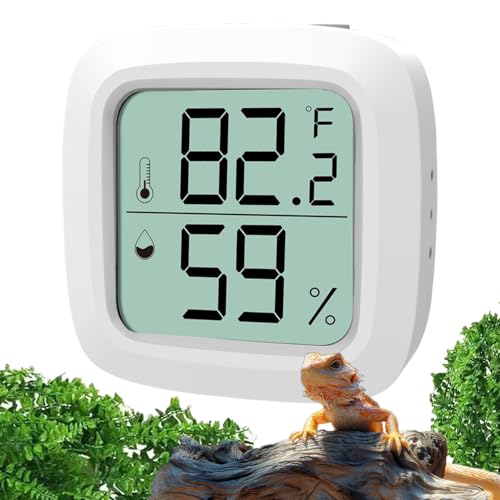
The Oasirep Reptile Thermometer Hygrometer delivers straightforward digital displays with ±1.8°F sensor accuracy—sufficient for most beginner setups, though you’ll want device calibration against a reference thermometer after the first month.
Battery life extends to twelve months on a single CR2032 cell, reducing maintenance frequency compared to units demanding AAA replacements.
Mounting options rely on double-sided adhesive, which holds reliably in temperate enclosures but may fail under direct misting. Its compact 2-inch profile fits smaller tanks without obstructing sightlines, making this thermometer hygrometer a practical choice when space constraints matter.
| Best For | Reptile owners seeking an affordable, low-maintenance digital thermometer and hygrometer for small to medium terrariums where precise climate tracking matters but waterproofing isn’t essential. |
|---|---|
| Display Type | Digital LCD |
| Measures | Temperature & Humidity |
| Power Source | Battery (CR2032) |
| Mounting Method | Double-sided adhesive |
| Material | ABS |
| Temperature Accuracy | ±1.8°F |
| Additional Features |
|
- Twelve-month battery life on a CR2032 cell cuts down replacement hassles compared to AAA-powered alternatives.
- Compact 2-inch design fits tight spaces without blocking views or taking up prime real estate in smaller enclosures.
- ±1.8°F accuracy handles most beginner and intermediate setups where slight variance won’t harm your pet’s health.
- Adhesive mounting can lose grip under direct misting or high humidity, requiring repositioning or alternative attachment methods.
- Not waterproof, so you’ll need to keep it away from spray zones and water dishes to avoid damage.
- Some users report readings run slightly lower than reference thermometers, meaning you should cross-check calibration early on.
10. Digital Reptile Thermometer Hygrometer
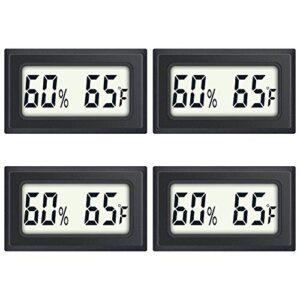
When you’re managing a rack system or multiple enclosures, this 4-pack thermometer hygrometer offers practical redundancy at a budget-friendly price point. Each digital thermometer displays temperature from -58°F to 158°F and humidity from 10% to 99%RH, with ±2°F sensor accuracy adequate for routine reptile care.
The embedded opening and adhesive tape mounting adapt to varied enclosure designs, though you’ll need to position units away from misting zones to prevent condensation inside the LCD housing.
Battery life reaches eight months per LR44 cell, simplifying temperature monitoring across multiple habitats.
| Best For | Reptile keepers running multiple enclosures or rack systems who need affordable, basic temperature and humidity monitoring across several habitats. |
|---|---|
| Display Type | Digital LCD |
| Measures | Temperature & Humidity |
| Power Source | Battery (LR44) |
| Mounting Method | Embedded/Tape |
| Material | Plastic |
| Temperature Accuracy | ±2°F |
| Additional Features |
|
- Four-pack format gives you backup units and coverage for multiple terrariums at a fraction of the per-unit cost
- Eight-month battery life on a single LR44 cell means less maintenance and fewer battery swaps across your collection
- Flexible mounting with both embedded openings and adhesive tape works with different enclosure types and rack setups
- ±2°F accuracy is acceptable for basic care but not tight enough for species with narrow temperature requirements
- LCD housing can fog up if placed near misting systems or in high-humidity zones without proper positioning
- Humidity display appearing on the left side instead of the right confuses some users who expect temperature first
Why Accurate Temperature Matters for Reptiles
Your reptile’s body doesn’t produce its own heat—it depends entirely on the environment you create. When temperatures drift even a few degrees outside the ideal range, your pet’s metabolism, digestion, and immune function start to break down.
Reptiles depend entirely on their environment for heat—even slight temperature drift disrupts metabolism, digestion, and immune function
Understanding why precision matters will help you prevent the most common health problems new reptile owners face.
Preventing Health Issues in Snakes
Your snake’s health depends on precision. When basking temperatures drift outside species-specific ranges, neurological and metabolic disorders can develop. Chronic humidity issues cause dysecdysis—incomplete shedding that leads to skin infections.
Reliable reptile thermometers and environmental control tools help you maintain stable conditions, reducing respiratory infections and stress-related illnesses while supporting early health monitoring and species research for your snake habitat.
Accurate scientific study summaries using methodological rigor are essential for understanding the importance of precise temperature control in reptile care.
Impact on Shedding and Hydration
Temperature and humidity control directly shapes shedding cycles and reptile hydration. When your hygrometer readings fall short, dehydration stresses your animal’s skin health, triggering incomplete molts and retained shed. Here’s how proper monitoring facilitates molt management:
- Track humidity spikes during shedding windows to promote complete skin release
- Monitor temperature gradients that influence metabolic water production
- Document shedding dates alongside environmental readings for pattern recognition
- Adjust misting schedules based on hygrometer feedback to prevent desiccation
Your reptile thermometer becomes your first line of defense against hydration-related complications.
Creating a Naturalistic Enclosure Environment
Your thermometer data should guide every habitat simulation decision you make. When you understand thermal gradients through precise microclimate design, you’ll create enclosure layouts that support natural thermoregulatory behavior.
Species research reveals which terrarium setup and equipment choices—substrate depth, branch placement, hide box positioning—best replicate native conditions.
Accurate temperature and humidity monitoring transforms a basic reptile enclosure into a functional ecosystem where your animal thrives.
Key Features to Look for in Thermometers
Not all reptile thermometers are created equal, and knowing what separates a reliable unit from a problematic one can save you from costly mistakes.
The right features guarantee you’re getting accurate readings that actually reflect your pet’s living conditions—not just numbers on a screen.
Here’s what you need to evaluate before making your purchase.
Digital Vs. Analog Displays
When you’re choosing between digital and analog displays, consider that digital thermometers show precise numeric readings on LCD screens—often to one decimal place—while analog models use a dial with a rotating needle.
Here’s what matters for your reptile’s care:
- Digital displays offer enhanced display accuracy and easy digital calibration options
- Analog reliability shines in humid environments thanks to simpler mechanical construction
- Readability comparison favors backlit digital units in low-light enclosures
Digital thermometer and hygrometer combos provide exact measurements that reduce interpretation errors, whereas analog gauges let you spot temperature trends at a glance across your enclosure’s gradient.
Durability and Water Resistance
Your enclosure’s high humidity puts constant stress on every sensor and housing seal. Look for reptile thermometers with IP65-rated waterproof materials—ABS or polycarbonate housings paired with rubberized gaskets resist daily misting cycles and condensation buildup. Stainless steel probes offer enhanced corrosion resistance compared to coated alternatives, while shock absorption features protect internal circuits during routine handling.
| Feature | Why It Matters |
|---|---|
| Sealed battery compartments | Prevents moisture ingress during cleaning |
| Conformal-coated boards | Blocks humidity-related corrosion |
| UV-stable plastics | Extends life under bright basking lamps |
| Drop-tested housings | Survives accidental enclosure bumps |
Best reptile thermometers balance moisture testing standards with practical seal durability—check thermometer and hygrometer reviews for real-world performance in your species’ humidity range.
Power Source and Battery Life
Most digital thermometers run on CR2032 coin cells or AAA batteries, giving you six to twelve months between replacements under typical conditions. Rechargeable models with USB charging cut long-term costs and boost energy efficiency, though disposable battery types offer wider availability.
You’ll find low battery indicators on quality units—essential for catching drift before readings become unreliable. Auto-off features and adjustable display brightness extend battery life in power-conscious digital devices.
Mounting and Placement Options
Where you put your reptile thermometer determines whether you catch dangerous gradients before they harm your animal. Secure sensors at eye level with adhesive pads or twist ties, and keep them away from heat lamps and spray zones to avoid skewed readings.
- Position one sensor near the basking area and another at the cool end to monitor temperature gradients accurately
- Mount at animal height to reflect the microclimate your reptile actually experiences
- Use removable adhesive mounting types for easy repositioning during enclosure layout adjustments
- Pair your reptile thermometer with a separate hygrometer in high-humidity zones for better humidity control
Display Readability and Backlighting
You won’t catch a dangerous temperature spike if you can’t read your digital thermometer in the dark. Look for backlit displays with adjustable brightness—blue or white backlighting cuts through glare without disturbing nocturnal species, while large numerals reduce interpretation errors during quick checks.
| Feature | Benefit |
|---|---|
| High-contrast digital display | Improves visual accuracy in varied lighting |
| Adjustable backlight modes | Tailors screen protection to ambient conditions |
| Large numerals | Enhances display clarity for fast readings |
| Water-resistant housing | Maintains readability factors in humid setups |
Auto-brightness sensors adapt as enclosure light shifts, and sealed buttons prevent corrosion that degrades display clarity over time. Battery-powered units with dimmable backlights balance readability with longer operation between replacements.
Thermometer and Hygrometer Combo Benefits
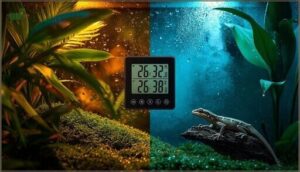
Monitoring both temperature and humidity gives you the full picture of your reptile’s environment, since these two factors work together to support proper thermoregulation and hydration. Combo units simplify this process by displaying both readings in one place, though certain situations call for separate devices instead.
Understanding when each approach works best helps you make the right choice for your specific setup.
Importance of Monitoring Humidity
Your reptile’s health depends on more than just temperature—humidity shapes every breath it takes. Tropical species require 60–80 percent relative humidity to shed properly and prevent respiratory infections, while desert-adapted animals thrive below 40–50 percent.
Without accurate hygrometers tracking moisture levels in your reptile enclosure, you’re guessing at environmental conditions that directly affect hydration, skin health, and overall reptile health through proper humidity control.
Advantages of Combo Devices
Combining temperature and humidity readings in a single unit delivers measurable combo benefits that simplify your daily monitoring routine. You’ll save money compared to purchasing separate devices, and device integration means synchronized data consolidation for both metrics—no more cross-referencing multiple screens.
- Reduce enclosure clutter by eliminating redundant probes and mounting hardware
- Track environmental patterns more efficiently with unified data logging systems
- Guarantee consistent accuracy across both readings from calibrated sensors
- Access convenient features like backlit displays designed for low-light viewing
Models like the REPTI ZOO Reptile Thermometer Hygrometer and Flukers ThermoHygrometer exemplify this simplified monitoring approach, giving you reliable measurements without complicated setup.
When to Use Separate Devices
Despite these advantages, you’ll need separate devices when your enclosure demands precise thermal accuracy across strong temperature gradients. Independent sensor placement lets you verify basking zones and cool retreats simultaneously, while dedicated humidity monitoring prevents misleading composite readings in multi-substrate setups.
Device calibration becomes simpler when you can cross-check independent thermometers and hygrometers, quickly identifying sensor drift before it compromises your reptile’s health.
Proper Thermometer Placement in Enclosures
Where you mount your thermometer makes all the difference between useful data and misleading numbers. Reptiles experience their enclosure as a three-dimensional space with distinct temperature zones, so your gauge needs to reflect what your animal actually feels.
Let’s walk through the placement strategies that give you readings you can actually trust.
Monitoring Temperature Gradients
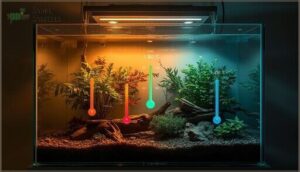
Your reptile’s tank isn’t a single temperature zone—it’s a landscape of thermal microclimates. Proper gradient mapping means placing multiple digital thermometers at different heights and horizontal locations to capture the full thermal gradient from basking to cool zones.
- Position three to five reptile thermometers throughout the enclosure to track temperature fluctuations
- Record readings during different thermal cycles (morning, afternoon, evening) for environmental stability
- Place a thermometer gauge at each end to monitor the complete gradient
- Avoid direct contact with heat sources to prevent falsely elevated readings
Positioning for Accurate Readings
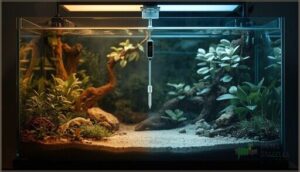
Once you’ve mapped your gradient, focus on sensor placement to guarantee reading accuracy. Position your digital thermometer probe at the center of each thermal zone—not against glass walls where conduction skews results.
Keep probes elevated above substrate level, since buried sensors reflect ground temperature rather than ambient air your reptile actually experiences.
For environmental monitoring of temperature gradients, mount your reptile digital thermometer where probe calibration won’t be compromised by direct contact with surfaces or bedding materials.
Avoiding Placement Near Heat Sources
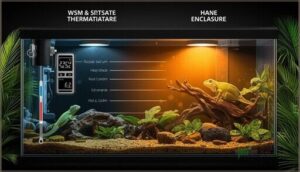
Just as you’ve secured proper probe positioning, you must keep sensors away from direct heat source risks. Maintain at least 15 cm clearance from basking lamps or heat mats to prevent falsely elevated readings that misrepresent your temperature gradients.
Effective monitoring strategies require:
- Placing sensors in ambient zones opposite heating elements
- Using multiple thermometers across your reptile enclosure maintenance setup
- Validating readings with infrared spot-checks
This sensor placement protects temperature regulation accuracy.
Maintaining and Calibrating Your Thermometer
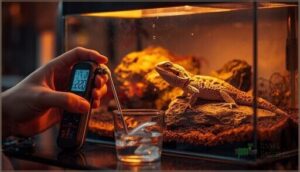
A thermometer won’t stay accurate forever, and even a few degrees off can stress your reptile or disrupt its basking routine. Regular calibration and basic maintenance keep your readings reliable and extend the device’s lifespan.
Here’s how to test accuracy, keep your thermometer clean, and fix the most common problems you’ll run into.
How to Calibrate for Accuracy
Your reptile thermometer won’t stay accurate forever. Compare it against a certified reference device at your enclosure’s hot end, cool end, and midpoint—record any differences.
For humidity sensors, use a saturated salt solution like potassium sulfate to check readings at known levels.
Document your calibration results monthly and apply correction factors to daily readings. Recalibrate after battery changes or any drops.
Cleaning and Routine Maintenance
Wipe down your thermometer housing every two weeks with mild soap and warm water—this removes waste residue and substrate dust that interfere with sensor function. For sanitization methods that prevent cross-contamination, apply diluted isopropyl alcohol to the exterior, avoiding direct contact with digital components.
During terrarium maintenance, inspect mounting hardware and probe cables for cracks or corrosion. Regular hygiene practices protect both equipment longevity and reptile health and wellness.
Troubleshooting Common Issues
When your reptile thermometer displays erratic readings, start by checking battery levels—low power causes drift in temperature and hygrometer measurements. Reading fluctuations often stem from poor device placement or substrate covering humidity probes. Water exposure creates temporary false readings on digital displays, while faulty displays with unresponsive sensors indicate replacement time.
Compare multiple thermometer reviews to identify reliable error sources before troubleshooting sensor calibration issues.
Budget Considerations and Brand Reputation
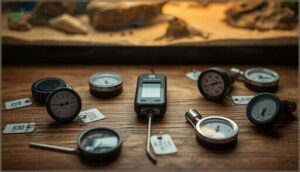
You don’t need to spend a fortune to get reliable temperature readings, but understanding where your money goes makes a real difference. Different brands offer distinct advantages at various price points, and knowing what separates a $10 unit from a $30 one helps you avoid both overpaying and cutting corners that matter.
Let’s break down what you should expect at different budget levels and which manufacturers consistently deliver value for reptile keepers.
Price Ranges for Beginners
Your budget for a reptile thermometer doesn’t need to break the bank. Most beginner-friendly digital thermometers fall into clear price tiers that reflect their features and reliability:
- Under $10: Basic analog gauges with limited accuracy
- $10–$20: Entry-level digital models with standard displays
- $20–$30: Reliable combo units with improved sensors
- $30–$50: Premium digital thermometers with enhanced features
- $50–$60: Professional-grade monitoring systems with probes
Temperature accuracy improves as you move up these cost factors, though affordable models in the $15–$25 range usually meet most beginner needs.
What to Expect From Different Brands
Not all brands deliver the same experience. Brand A thermometers consistently offer dual readouts with 2% to 5% humidity accuracy—solid for most setups. Brand B units feature backlit digital displays and auto-sleep modes, while Brand C keeps things compact but battery life varies wildly. Brand D prioritizes water resistance with IP-rated housings, and Brand E balances affordability with basic reliability, perfect for your first reptile digital thermometer setup.
Understanding Warranties and Support
When your reptile thermometer malfunctions at 2 a.m., solid warranty claims and support channels make all the difference. Most manufacturers offer 1- to 2-year coverage against defects, but you’ll want proof of purchase and product registration details ready. Strong customer service matters for pet care and management—here’s what separates the reliable brands from the rest:
- Email and phone support responding within 24–72 hours
- Return policies allowing 30–90 day exchanges for defective units
- RMA numbers required before shipping faulty thermometers back
- Replacement guarantees when your model’s discontinued
- Beginner-friendly troubleshooting guides reducing accidental damage claims
Tips for New Reptile Owners Using Thermometers
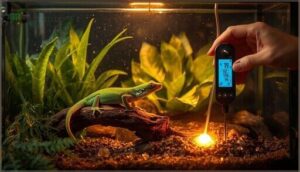
Owning a thermometer is one thing—knowing how to use it correctly is another. Many new reptile owners make basic mistakes that compromise their pet’s health, from inconsistent monitoring to misinterpreting temperature fluctuations.
Here’s what you need to establish from day one to keep your reptile thriving.
Establishing a Monitoring Routine
Consistently checking your reptile thermometer at the same times each day—morning and evening—helps you spot patterns that matter. Place devices in both the basking zone and the cooler side to capture the full gradient your animal experiences.
Use a hygrometer alongside your thermometer to track humidity control, and jot down readings in a simple log so you can adjust heating or misting as needed.
Recording and Interpreting Readings
Once you’ve logged those morning and evening digital thermometer readings, compare them against your species’ thermal requirements—hot-end targets for basking, cool zones for retreat.
Watch for trends over seven to fourteen days; sustained shifts beyond two degrees signal you need heater adjustments.
Accuracy checks every few weeks with a reference thermometer keep your data analysis meaningful, ensuring gradient monitoring reflects real conditions rather than sensor drift.
When to Upgrade Your Equipment
After several months of consistent readings, you’ll recognize when your thermometer no longer reflects reality—erratic numbers, slow response to heat changes, or disagreement with a reference device all point to sensor calibration drift. Replace units after three to five years of regular use, or sooner if you’re adding species with stricter thermal demands. Consider upgrades when:
- Readings become unreliable across multiple checks
- Your enclosure size increases notably
- New features offer better humidity measurement ranges
Frequently Asked Questions (FAQs)
How often should I replace my thermometer batteries?
Your reptile digital thermometer won’t text you when it’s dying—shocking, right? Most batteries last six to twelve months, but frequent backlight use and high humidity accelerate drain. Replace yearly to avoid mid-molt catastrophes.
Can I use household thermometers for reptile enclosures?
You shouldn’t rely on household thermometers—they lack the precision reptiles need. Most can’t handle humidity or measure gradients accurately, risking your pet’s health through temperature variance and improper calibration needs.
What temperature range is safe for most reptiles?
Most species thrive when daytime temperatures stay between 75–85°F, with basking spots reaching 90–110°F. Nighttime cooling to 65–75°F maintains natural rhythms.
Always verify your specific reptile’s thermal needs through species research.
Do I need different thermometers for different species?
Think of your enclosure like a custom-tailored suit—one size doesn’t fit all. Desert species need thermometer calibration for dry-heat basking spots, while tropical reptiles require hygrometer-equipped environmental monitoring to track humidity control across different reptile habitats and species temperature requirements.
How do I know if my thermometer is broken?
You’ll notice faulty signs like inconsistent readings, failure to respond to temperature changes, or values that differ by more than 1–2°C from a trusted reference thermometer during calibration checks.
Conclusion
A broken thermometer costs fifteen dollars. A veterinary visit for metabolic bone disease or respiratory infection costs hundreds—and subjects your animal to preventable suffering.
Choosing the right reptile thermometers for beginners isn’t about flawlessness; it’s about building consistent monitoring habits with reliable tools. Start with accurate devices, place them strategically across your temperature gradient, and check readings daily.
Your reptile can’t advocate for itself, so let precision instruments handle that responsibility while you focus on observation and care.
- https://www.nature.com/articles/srep08861
- https://www.reptilesupplyco.com/wholesale-reptile-thermometers-hygrometers/2272-digital-thermometerhygrometer-rsc.html
- https://www.walmart.com/ip/Faitaliicy-Reptile-Thermometer-Digital-Thermometer-Hygrometer-Reptile-Terrarium-Easy-Read-Terrarium-Thermometer-Humidity-Gauge-Aquarium-Tank
- https://reptizoo.store/products/repti-zoo-reptile-terrarium-thermometer-hygrometer-digital-display
- https://industrialphysics.com/knowledgebase/articles/what-does-a-thermo-hygrometer-measure