This site is supported by our readers. We may earn a commission, at no cost to you, if you purchase through links.
The rosy boa’s survival hinges on its ability to exploit one of North America’s harshest landscapes—a world where summer rocks can scorch scales and winter nights plunge below freezing. These small constrictors don’t just endure the southwestern deserts; they’ve engineered a lifestyle around temperature extremes that would overwhelm most reptiles.
From sea-level washes in coastal California to rocky slopes at 4,500 feet in Arizona, the rosy boa’s natural habitat spans multiple desert ecosystems, each demanding specific adaptations. Understanding where these snakes thrive—and why certain microclimates become critical refuges—reveals how geography, geology, and climate converge to shape their daily rhythms and long-term survival.
Table Of Contents
- Key Takeaways
- Rosy Boa Habitat Overview
- Climate and Environmental Adaptations
- Regional Habitat Variations
- Top 5 Products for Rosy Boa Habitat Replication
- Frequently Asked Questions (FAQs)
- Where are rosy boas native to?
- Are rosy boas native to Arizona?
- What is the natural habitat of a boa constrictor?
- What is the desert rosy boa habitat?
- What is the rosy boa native habitat?
- What predators threaten rosy boas in wild?
- How do rosy boas find water sources?
- Do rosy boas migrate seasonally between habitats?
- What vegetation grows in rosy boa territories?
- How does urbanization affect rosy boa populations?
- Conclusion
Key Takeaways
- Rosy boas thrive across southwestern North America’s harshest deserts by exploiting rocky terrain, thermal gradients, and microhabitats ranging from sea level to 4,500 feet elevation.
- These snakes survive extreme temperature swings (below freezing to 95°F+) through strategic shelter use in rock crevices, abandoned burrows, and thermal refuges that maintain stable conditions year-round.
- Geographic location directly shapes each population’s appearance—Mojave snakes display tan camouflage for sandy terrain while canyon dwellers show darker patterns that mirror shadowed rocks.
- Successful captive care requires replicating five critical wild conditions: precise temperature zones (75-90°F active range), moderate humidity (40-60%), heat-conductive substrate, multiple hiding spots, and accurate thermal monitoring equipment.
Rosy Boa Habitat Overview
Understanding where rosy boas live in the wild helps you create a better home for them in captivity. These snakes occupy a surprisingly diverse range across the southwestern United States and northwestern Mexico, from scorching desert floors to rocky canyon slopes.
Their preference for rocky terrain and extreme temperature zones makes understanding rosy boa habitat requirements essential before setting up your first enclosure.
Let’s look at the specific regions they call home, the arid landscapes they’ve mastered, and the environmental features that define their natural world.
Geographic Distribution in North America
Across southwestern North America, you’ll find rosy boas inhabiting arid regions from southern California, Nevada, and Arizona to New Mexico and western Texas. Their geographic distribution extends into northwestern Mexico, including Sonora and Baja California’s desert ecosystems.
These regional variations span multiple geographic hotspots within the Mojave and Sonoran deserts, where habitat fragmentation increasingly affects population connectivity across their North American range.
Typical Desert and Arid Regions
Within this geographic range, rosy boas occupy true desert dwelling zones where arid rainfall drops below 250 mm annually.
You’ll encounter them in regions with sparse vegetation, extreme diurnal swings, and powerful desert winds that shape their habitat adaptation and survival. Flash floods occasionally reshape low-lying washes, while climate influence on wildlife drives these arid regions’ ecology—from sandy flats to rocky slopes throughout their territory.
For more insight into the ecological context, review these desert ecosystem characteristics.
Key Environmental Features
Rosy boa habitat and distribution rely on distinct desert landscapes where rock formations, soil composition, and microclimates create ideal conditions. You’ll find them in areas with:
- Elevation gradients from sea level to 4,500 feet
- Sandy to gravelly substrates that aid camouflage
- Rock piles and crevices offering thermal refuge
- Sparse vegetation with scattered shrubs and cacti
These features drive habitat adaptation and survival across desert reptile habitat zones.
Climate and Environmental Adaptations

Rosy boas have mastered the art of desert survival through specialized physical and behavioral adaptations. Their ability to thrive in extreme heat, minimal moisture, and rocky terrain makes them one of the most resilient snakes in southwestern North America.
Rosy boas thrive in extreme desert conditions through specialized adaptations that make them one of the Southwest’s most resilient snakes
Let’s look at how these adaptations help them navigate their challenging environment.
By studying rare ball python morphs, you can see how specific genetic traits produce unique patterns that aid in camouflage and survival.
Temperature Tolerance and Seasonal Changes
Your rosy boa thrives when daytime temperatures stay between 75 and 90 degrees Fahrenheit—the sweet spot these desert natives seek out through thermal regulation. Understanding seasonal shifts helps you replicate their natural cycle: spring and fall bring peak activity, while winter dormancy kicks in below 60°F. They handle temperature fluctuations by moving between sun and shade, showing striking climate resilience through desert acclimation strategies.
| Season | Temperature Range | Activity Level | Thermoregulation Strategy |
|---|---|---|---|
| Spring | 70–85°F | High foraging | Basking during warm periods |
| Summer | 75–90°F+ | Dawn/dusk peak | Retreat to cool burrows |
| Fall | 65–80°F | Extended feeding | Moderate basking cycles |
| Winter | Below 60°F | Dormancy | Metabolic slowdown |
Prolonged exposure above 95°F causes heat stress and feeding suppression. Temperature ranges directly influence habitat requirements—burrows provide a vital thermal buffer, maintaining stable conditions even when surface rocks spike. This climate impact on behavior means your captive setup needs similar options for retreat and controlled heating zones.
Humidity and Moisture Levels
Unlike steamy tropical habitats, your rosy boa needs moderate humidity control between 40 and 60 percent to mirror arid desert microclimates. Water provision through a shallow dish facilitates hydration strategies without soaking substrate.
Moisture retention varies across microhabitats—cooler crevices hold dampness longer than sun-baked surfaces.
This environmental balance prevents respiratory issues while ensuring proper shedding, making humidity and water management essential for desert-adapted health.
Shelter Use: Rocks, Burrows, and Crevices
Across rocky deserts, your rosy boa habitat and distribution depends on three shelter preferences: rock formations that trap solar warmth for thermal regulation, abandoned rodent burrows offering cooler microhabitats, and narrow crevices providing humidity pockets.
These reptile enclosure setup elements prevent dehydration while deterring predators. Burrow architecture creates stable temperatures year-round, and crevices management facilitates natural shedding cycles essential for desert survival.
Regional Habitat Variations
Rosy boas don’t just live in one type of desert—they’ve adapted to several distinct ecosystems across the Southwest. Each region has shaped these snakes differently, from the rocky Mojave to lush coastal canyons.
You’ll notice these differences most clearly in their striking color variations and preferred hiding spots.
Mojave, Sonoran, and Colorado Deserts

The geographic range of rosy boas spans three distinct arid ecosystems in North America.
Mojave Desert populations inhabit rocky outcrops and creosote-dominated bajadas across California, Nevada, Arizona, and Utah.
Sonoran Desert rosy boas thrive among saguaro-studded landscapes in southern Arizona and Mexico.
The Colorado Desert subspecies occupy sandy washes and sparse scrublands in southeastern California, where extreme heat shapes desert flora and wildlife conservation priorities.
Both the Mojave and Colorado regions are known for their unique desert physiographic features that influence local habitats.
Coastal Foothills and Canyon Environments

Transitional zones between marine-influenced coastlines and inland arid regions offer rosy boas a different set of survival tools. You’ll find them tucked into rocky outcrops and talus slopes formed by fractured sandstone and shale.
Microclimate effects from fog intrusion boost soil moisture in shaded ravines, while canyon ecosystems provide thermal gradients that help these snakes thermoregulate.
Foothill geology creates crevices perfect for shelter and hunting small mammals in chaparral-dominated terrain.
Locale-Specific Color and Pattern Differences
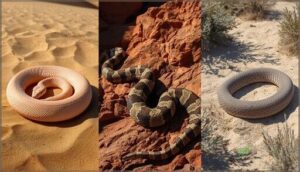
Geographic pigmentation in rosy boas reads like a masterclass in desert camouflage. You’ll spot tan to light pink color morphs blending into Mojave sand, while canyon-dwelling subspecies sport darker brown saddles that mirror shadowed rock. Coastal populations show paler tones with fine speckling—pattern variations shaped by microhabitats.
Regional adaptations guarantee each snake matches its terrain, demonstrating how geographic distribution of snakes drives evolutionary fine-tuning.
Top 5 Products for Rosy Boa Habitat Replication
Replicating the rosy boa’s arid desert environment at home requires specific tools and materials that mirror their natural conditions. You’ll need products that help you maintain proper temperature gradients, substrate composition, and overall enclosure hygiene.
Here are five essential items that make habitat replication straightforward and effective.
1. Etekcity Infrared Thermometer Gun

When you’re managing a desert-adapted species like the rosy boa, you can’t afford guesswork with temperature monitoring. The Etekcity Infrared Thermometer Gun delivers precise surface readings from -50°C to 450°C without disturbing your snake’s environment.
Its 12:1 distance-to-spot ratio lets you measure basking zones or cool hides from 36 cm away. You’ll appreciate the adjustable emissivity (0.1-1.0) for accurate readings on rocks, sand, or glass.
The 0.5-second response time and backlit display make daily thermal gradient checks efficient and reliable.
| Best For | Reptile keepers who need precise, non-contact temperature monitoring for creating accurate thermal gradients in enclosures. |
|---|---|
| Primary Use | Temperature monitoring |
| Dimensions | 6.14 x 3.15 x 1.57 inches |
| Weight | Not specified |
| Material | Plastic/Electronic |
| Target Animals | Various (pet care) |
| Color | Not specified |
| Additional Features |
|
- Fast 0.5-second readings let you quickly check multiple spots without stressing your animals
- 12:1 distance ratio means you can measure temps from outside the enclosure without opening it
- Adjustable emissivity handles different materials like slate, ceramic, or wood substrates accurately
- Won’t store readings, so you’ll need to write down measurements for tracking trends
- Shiny surfaces like water bowls can throw off accuracy without emissivity adjustments
- Not for checking your pet’s body temperature directly—surface temps only
2. Zoo Med Natural Desert Sand
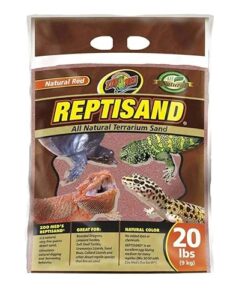
Substrate choice impacts thermoregulation just as much as ambient temperature does. Zoo Med Natural Desert Sand provides the heat-conductive base your rosy boa needs for belly thermoregulation. This pure quartz substrate (available in 10 lb or 20 lb bags) contains no dyes or chemical treatments that could irritate skin or digestive tracts.
The fine grain encourages natural burrowing behaviors while maintaining a realistic desert aesthetic. You’ll find spot-cleaning straightforward—just sift out waste without full substrate replacement during routine maintenance cycles.
| Best For | Desert reptile owners looking for a natural, heat-conductive substrate that encourages burrowing and creates an authentic arid habitat. |
|---|---|
| Primary Use | Terrarium substrate |
| Dimensions | 9.98 x 1 x 1 inches |
| Weight | 20 lb |
| Material | Natural sand |
| Target Animals | Desert reptiles |
| Color | Natural red/orange |
| Additional Features |
|
- All-natural quartz with no dyes or chemicals that could harm your reptile
- Excellent heat conductor that helps with belly thermoregulation
- Easy to spot-clean by sifting out waste without full replacements
- Can be quite dusty right out of the bag (rinsing before use helps)
- Fine grain may coat some reptiles in sand during active periods
- Clumps when wet and not suitable for all animals despite marketing claims
F10 Ready to Use All Purpose Disinfectant
Keeping your setup pathogen-free requires disinfectant efficacy beyond standard household cleaners. F10 Ready to Use All Purpose Disinfectant addresses biosecurity measures through broad-spectrum antimicrobial action while maintaining animal safety for rosy boa captive care.
The pre-diluted formula streamlines disinfection protocols—just spray cleaned surfaces and air-dry:
- Trigger-spray bottles (500ml or 1L) eliminate mixing guesswork
- Non-toxic formulation suits frequent use in reptile enclosures
- Residual surface sanitizing continues after drying
- Safe for habitat setup maintenance between humidity adjustments
3. Repti Zoo Collapsible Reptile Terrarium
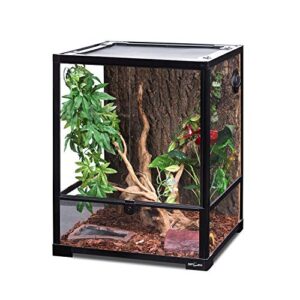
Space-saving storage becomes essential when you’re managing seasonal habitat setups or moving juveniles. The Repti Zoo Collapsible Reptile Terrarium offers a patented foldable design that sets up in three minutes through four simple steps.
This 20-gallon desert enclosure features tempered glass panels with a water-tight base, front ventilation strips, and removable top mesh for UVB penetration. The elevated leg design accommodates heat mats beneath while double-hinged front doors provide wide access during feeding and maintenance routines.
| Best For | Reptile owners who need flexible storage options and want a quick-setup terrarium for small to medium snakes, geckos, or young bearded dragons. |
|---|---|
| Primary Use | Cage disinfection |
| Dimensions | 9.17 x 4.8 x 4.61 inches |
| Weight | 2.64 pounds |
| Material | Liquid spray |
| Target Animals | All pets |
| Color | Clear/odorless |
| Additional Features |
|
- Sets up in just three minutes with a patented collapsible design that’s perfect for seasonal habitats or moving between setups
- Tempered glass construction with full 360° viewing and excellent ventilation through front vents and removable mesh top
- Elevated legs accommodate under-tank heaters while double doors make feeding and cleaning super convenient
- Some customers received units with missing parts like mesh screens or cable management pieces
- Assembly can be tricky since the doors are angled and need careful alignment during setup
- The 20-gallon size won’t work for larger adult reptiles that need more space
4. Repti Zoo Glass Terrarium Tank

When you’re ready to invest in a permanent setup, the Repti Zoo Glass Terrarium Tank (model RK0119) delivers both durability and function. Its 36 x 18 x 17.75-inch footprint gives adult rosy boas adequate floor space, while dual front-opening doors minimize escape risks during feeding.
The raised bottom frame creates clearance for undertank heating pads—critical for maintaining proper belly heat in desert-adapted species. Waterproof seals support humidity gradients when needed, and the removable mesh top ensures full UVB and infrared light penetration for thermoregulation.
| Best For | Keepers investing in a long-term enclosure for adult rosy boas who need reliable heating clearance and flexible ventilation controls. |
|---|---|
| Primary Use | Reptile housing |
| Dimensions | 30 x 12 x 12 inches |
| Weight | 27.1 pounds |
| Material | Glass and PVC |
| Target Animals | Reptiles and amphibians |
| Color | Black |
| Additional Features |
|
- Raised bottom frame fits substrate heaters perfectly for consistent belly heat
- Dual front doors reduce escape risk during feeding and maintenance
- 2-in-1 mesh and glass side panels let you adjust airflow based on humidity needs
- Tempered glass can’t be modified if you need custom holes or cuts later
- Some users report shipping damage and wonky locking mechanisms
- Assembly instructions are pretty bare-bones and might leave you guessing
Frequently Asked Questions (FAQs)
Where are rosy boas native to?
Rosy boas are native to the southwestern United States and northwestern Mexico, spanning southern California, southern Arizona, and adjacent regions of Baja California and Sonora in arid, rocky environments.
Are rosy boas native to Arizona?
Yes, rosy boas are native to Arizona. You’ll find them in the Mojave and western Sonoran Desert regions, particularly among rocky terrain and desert scrub in the southwestern portions of the state.
What is the natural habitat of a boa constrictor?
Boa constrictors call tropical rainforests, savannas, and semi-arid scrublands home across Central and South America.
They thrive near water sources, hunting from tree branches or rocky outcrops where prey passes by.
What is the desert rosy boa habitat?
Desert rosy boas thrive in rocky deserts with abundant outcrops and crevices from sea level to 2,000 meters, spanning the Mojave, Sonoran, and Colorado deserts across southwestern North America.
What is the rosy boa native habitat?
Like a pioneer homesteading the frontier, these snakes claim the rocky deserts and scrublands of southern California, Arizona, and northwestern Mexico—favoring crevices and burrows from sea level to 4,500 feet elevation.
What predators threaten rosy boas in wild?
Hawks, owls, and roadrunners hunt from above, while coyotes, kit foxes, and kingsnakes attack on the ground.
Juveniles face the highest risk because their smaller size makes them easier targets for predators.
How do rosy boas find water sources?
In arid regions with annual rainfall under 10 inches, rosy boas lick dew from rocks and plants rather than seeking standing water.
They exploit humid burrows and gain moisture from prey’s bodily fluids.
Do rosy boas migrate seasonally between habitats?
No, rosy boas don’t migrate seasonally. They stay within their home range year-round, shifting between underground shelters and surface rocks based on temperature and prey availability rather than undertaking long-distance movements.
What vegetation grows in rosy boa territories?
Picture sun-baked stones and hardy desert roses clinging to life—that’s where you’ll find rosy boas.
Creosote bush, sagebrush, California buckwheat, and scattered cacti dominate their rocky territories, providing essential cover and hunting grounds.
How does urbanization affect rosy boa populations?
Urban sprawl fragments desert landscapes, cutting off dispersal routes and isolating populations.
Road mortality, habitat loss, and prey decline from pesticides squeeze rosy boas into smaller pockets with fewer genetic connections.
Conclusion
The rosy boa’s survival reads like a desert blueprint—each crevice, each thermal gradient, each moisture pocket acts as both refuge and resource.
Your understanding of rosy boa natural habitat transforms these snakes from passive survivors into active architects of their environment.
When you replicate those rocky sanctuaries, seasonal rhythms, and temperature refuges in captivity, you’re not just building an enclosure. You’re honoring millions of years of adaptation sculpted by North America’s most unforgiving landscapes.
- https://www.reptilebasics.com/t5-light-fixtures-kits/
- https://www.reptilesrus.ca/arcadia-earthpro-revitalised3-100g-calcium-with-d3-see-note-about-best-before-date/
- https://www.myanimaldispensary.com/products/f10-sc-veterinary-ready-to-use-disinfectant
- https://new.wildphotosphotography.com/2021/09/25/a-rosy-boa/