
This site is supported by our readers. We may earn a commission, at no cost to you, if you purchase through links.

Your snake just developed a respiratory infection, and you can’t figure out why. The temperature’s right, humidity’s stable, substrate’s clean—but there’s one detail most keepers overlook until it’s too late.
Stagnant air doesn’t just make enclosures smell musty; it creates pockets of concentrated ammonia, traps moisture against glass surfaces, and forces your snake to breathe the same recycled air for hours. Poor snake enclosure air circulation turns an otherwise perfect habitat into a breeding ground for pathogens.
The fix isn’t complicated, but it requires understanding how air moves through enclosed spaces and what your specific species needs to thrive.
Table Of Contents
- Key Takeaways
- Why Air Circulation Matters in Snake Enclosures
- Designing Effective Enclosure Ventilation
- Balancing Airflow and Humidity Needs
- Monitoring and Maintaining Air Quality
- Troubleshooting Common Ventilation Problems
- Frequently Asked Questions (FAQs)
- Does a snake enclosure need ventilation?
- How to increase ventilation in reptile enclosure?
- Where should the vent be in a reptile enclosure?
- What are the common reptile enclosure mistakes?
- Can fans be used for snake enclosure ventilation?
- How often should ventilation components be replaced?
- Do larger enclosures need more ventilation holes?
- What materials work best for custom vent screens?
- Should ventilation differ for breeding vs display enclosures?
- Conclusion
Key Takeaways
- Stagnant air creates concentrated ammonia pockets and moisture traps that directly cause respiratory infections in snakes, making proper ventilation non-negotiable for snake health.
- Position intake vents low on the cool end and exhaust vents high on the warm side to create natural cross-ventilation, with total vent area measuring 1.5 to 2.5 percent of enclosure volume.
- Poor airflow shows up as condensation buildup, temperature imbalances exceeding 4°C between zones, and respiratory distress signs like open-mouth breathing or mucus discharge.
- Species-specific ventilation requirements vary significantly—desert species need higher airflow to maintain low humidity, while forest dwellers require gentler air exchange with moisture-rich zones.
Why Air Circulation Matters in Snake Enclosures
Air circulation isn’t just a nice extra—it’s critical for keeping your snake alive and healthy. Poor airflow creates conditions where respiratory infections thrive, humidity swings wildly, and your snake suffers in silence.
Understanding how different snake species need different airflow setups helps you choose the right enclosure before problems even start.
Proper air circulation isn’t optional—it’s the difference between a healthy snake and one silently suffering from respiratory infections and unstable humidity
Understanding why proper ventilation matters will help you set up an enclosure that protects against these dangerous problems.
Preventing Respiratory Issues
Inadequate airflow creates dangerous conditions in your snake enclosure. Stale air allows carbon dioxide and ammonia to build up, irritating respiratory passages and triggering infections. Proper ventilation dilutes these harmful gases and removes dusty particulates before they damage delicate airways.
Watch for these critical warning signs:
- Open-mouth breathing or audible wheezing sounds
- Mucus discharge around the nostrils or mouth
- Sudden changes in breathing patterns or respiratory effort
Effective snake enclosure ventilation systems prevent these respiratory issues entirely.
Maintaining Stable Humidity Levels
Proper air circulation keeps humidity levels steady instead of swinging wildly. Without effective airflow management, you’ll see condensation pooling on glass after misting, then humidity crashing hours later as moisture escapes through open vents.
A well-designed ventilation system balances moisture retention and air exchange—install intake vents low on the cool side and smaller exhaust vents near your heat source to maintain stable climate regulation. Choosing substrates and vent setups that support optimal vivarium humidity control is essential for your snake’s health.
Supporting Snake Health and Comfort
Beyond keeping humidity steady, good airflow directly affects snake behavior and overall wellness. Stagnant air quality stresses snakes and triggers defensive responses, while proper ventilation creates a comfortable habitat where your animal feels secure enough to explore and digest food normally.
- Snake enclosure ventilation removes ammonia from waste that irritates respiratory tissue
- Airflow prevents hot spots and cold pockets that disrupt thermoregulation
- Health monitoring becomes easier when ventilation systems maintain consistent conditions
Ensuring proper ventilation is just one aspect of comprehensive snake health and welfare.
Designing Effective Enclosure Ventilation
Getting the air moving in your snake’s enclosure isn’t complicated, but it does require some planning. The right ventilation setup depends on three core decisions: where you place your vents, how you create airflow between them, and what materials you use.
For a detailed breakdown of vent placement strategies and materials that work best, check out this guide to proper airflow in snake habitats.
Let’s break down each element so you can build a system that keeps your snake healthy.
Vent Placement Strategies
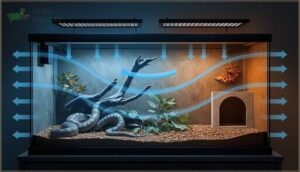
Think of your enclosure layout as a highway: vents need entry and exit ramps. Place intake vents low near the cool end and exhaust vents high on the warm side to drive natural circulation patterns. This diagonal vent location creates reliable airflow patterns without drafts.
| Vent Position | Function |
|---|---|
| Bottom intake (cool end) | Draws fresh air in |
| Top exhaust (warm end) | Removes stale air out |
| Corner diagonal placement | Creates steady circulation systems |
Keep 1 cm clearance between vents and substrate to prevent blockages.
Cross-Ventilation Techniques
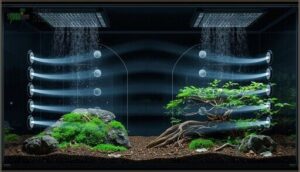
When opposing wall openings align, wind and natural convection create a doorway-like flow that sweeps through your enclosure. This cross ventilation drives stale air out while fresh air enters, establishing reliable airflow patterns.
- Position vents to optimize pressure differences during prevailing winds
- Use multiple small openings for more uniform air distribution than one large gap
- Align intake and exhaust vents to create short, low-resistance air paths
Choosing Vent Size and Materials
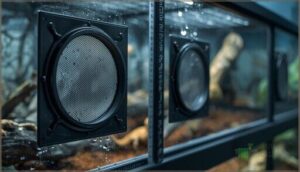
You’ll need vent openings that total 1.5 to 2.5 percent of your enclosure volume for adequate airflow. For a 40-liter setup, that means 60 to 100 square centimeters of combined vent area.
Position vents on opposite sides to create cross-ventilation, and check out this complete boa constrictor care guide for enclosure setup tips.
Choose PVC or ABS plastic vents—they resist moisture better than metal in humid snake enclosure ventilation systems. Nylon mesh screen options prevent escapes while maintaining proper ventilation rates without corrosion.
Balancing Airflow and Humidity Needs
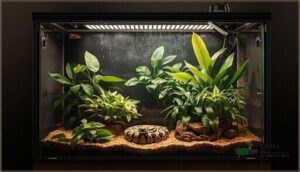
Getting airflow right is only half the battle—you also need to keep humidity where your snake needs it. Too much ventilation dries out the enclosure, while too little traps moisture and causes respiratory problems.
The key is tailoring your setup to match your species’ requirements while preventing stagnant air.
Adapting Ventilation for Different Snake Species
Desert species like ball pythons demand higher airflow through your ventilation system to prevent heat buildup and maintain low humidity control. Forest dwellers such as green tree pythons tolerate gentler air exchange with moisture-rich zones.
Match your reptile enclosure ventilation design to species airflow needs—arboreal snakes benefit from cross ventilation that eliminates stagnant pockets, while large constrictors require multiple vents for respiratory comfort.
Managing Humidity With Air Circulation
Your ventilation system and humidity control work as opposing forces—boost airflow and relative humidity drops, reduce air circulation and moisture levels climb.
Install humidity sensors at three points to track how circulation patterns shift air quality across warm and cool zones.
Adjust vent size or add partial covers to fine-tune airflow control without disrupting your snake’s target humidity range.
Using Misting and Ventilation Together
Mist ventilation relies on timing—short bursts raise humidity while steady airflow prevents condensation buildup on walls and hides.
Coordinate your humidity control and air exchange cycles to balance moisture:
- Open automated vents during misting to distribute evaporative cooling without creating localized humidity spikes
- Position intake vents away from misting outlets to prevent direct water contact with your snake enclosure ventilation system
- Monitor temperature control with sensors placed at multiple heights to confirm airflow distributes cooled air evenly
Monitoring and Maintaining Air Quality
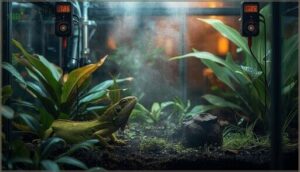
You can’t fix what you don’t measure. Tracking temperature and humidity levels gives you the data you need to keep your snake’s air quality in the safe zone.
Here’s how to monitor conditions, spot warning signs, and maintain your ventilation system for long-term success.
Using Hygrometers and Thermometers
You can’t fix what you can’t measure—that’s why hygrometers and thermometers are essential. Digital displays with backlighting let you read values instantly in dim enclosures. Place devices at snake height, away from heat vents or water sources, for accurate humidity tracking and temperature monitoring.
Sensor calibration improves reliability. Allow 15 minutes for stabilization after device placement adjustments—temperature regulation and airflow depend on trustworthy data. These ventilation tips guarantee your humidity and temperature control systems work properly together.
| Feature | Benefit | Best Practice |
|---|---|---|
| Digital sensors | Fast, precise readings | Calibrate every 6 months |
| Multiple devices | Capture microclimates | Position at cool and warm ends |
| Data logging | Track trends over time | Review weekly for pattern shifts |
| Alarm alerts | Instant threshold warnings | Set limits for your species |
Detecting Poor Airflow and Stagnant Air
Spotting stagnant air signs early protects your snake from respiratory distress. Walk into your enclosure zone—if air feels heavy within 10 minutes, you’ve got poor air exchange rates.
Check for these airflow indicators:
- Odor buildup near vents signals restricted circulation
- Temperature imbalance exceeding 4°C between zones shows blocked pathways
- Condensation on one side while the opposite stays dry reveals vent blockages
Thermal imaging exposes cold pockets behind décor where air can’t reach.
Cleaning and Maintaining Vents
Once you’ve spotted poor airflow patterns, clean vent covers every 6–12 months to restore proper crossventilation. Remove mesh screens and wash with warm soapy water—dust blocks 30% of intake capacity. Vacuum duct interior channels using a soft brush attachment.
Mark your maintenance schedule; households with heavy substrate shedding need cleaning every 3–6 months to prevent vent problems that compromise enclosure ventilation.
Troubleshooting Common Ventilation Problems
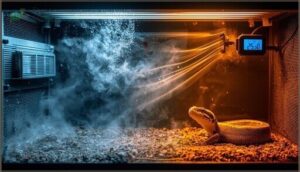
Even well-designed ventilation systems can develop problems that compromise your snake’s health. You’ll recognize these issues through visible signs like condensation buildup, temperature fluctuations, or respiratory distress in your animal.
Let’s address the three most common ventilation challenges and how to fix them quickly.
Addressing Condensation and Mold
When moisture appears on enclosure glass, you’re seeing a ventilation design problem. Condensation control starts with cross-ventilation—install mesh panels on opposite ends to keep air moving across water dishes and damp substrate.
Maintain humidity levels between 40 and 60 percent using a hygrometer.
For mold prevention, wipe condensation within 15 minutes and clean affected surfaces with 70 percent alcohol to protect air quality.
Fixing Uneven Temperature Distribution
Cold spots in one corner while another area overheats signal poor airflow zoning. You need balanced heat source optimization—place your heat lamp or mat to allow natural convection currents. Inspect ductwork (vent holes) for blockages. Temperature gradients depend on cross-ventilation:
- Position heat sources near enclosure center for even distribution
- Add thermal insulation to cold-prone walls or corners
- Angle vents to promote air mixing across all zones
- Monitor with multiple thermometers at different depths
- Adjust airflow openings seasonally for temperature control
Safety Tips for Ventilation Adjustments
Electrical hazards pose real danger when adjusting snake enclosure ventilation tips, so install a clearly labeled emergency shutdown switch within reach. Turn off fans before opening the enclosure to prevent sudden airflow disruptions.
Use protective gloves during vent safety inspections and fan maintenance. Keep cords away from enclosure edges.
Slowly ramp fan speeds to maintain stable humidity levels and air quality without shocking your snake.
Frequently Asked Questions (FAQs)
Does a snake enclosure need ventilation?
Yes, your snake enclosure needs proper ventilation to prevent dangerous respiratory infections.
Airflow reduces stale air buildup, controls humidity, and ensures breathing systems function normally—critical ventilation benefits that directly support snake health.
How to increase ventilation in reptile enclosure?
Add more vents at opposite enclosure ends to boost airflow dynamics. Install mesh-covered openings low on cool sides and high on warm sides.
These ventilation hacks create natural cross-ventilation without expensive ventilation systems.
Where should the vent be in a reptile enclosure?
For vent placement, put one low on the cool side and another high on the warm side—this creates natural airflow patterns that keep your reptile enclosure fresh.
What are the common reptile enclosure mistakes?
Common reptile enclosure mistakes include inadequate space, heating errors, humidity mistakes, enrichment lack, and maintenance neglect.
Poor ventilation tips, improper enclosure ventilation, and neglecting proper ventilation directly compromise snake health and respiratory function.
Can fans be used for snake enclosure ventilation?
Small axial fans boost airflow in snake enclosures when paired with vents. Place them to pull air across—not at—your snake. Fan placement controls drafts while supporting humidity management and proper air circulation.
How often should ventilation components be replaced?
Filter replacement every six months maintains airflow. Airflow monitoring with hygrometers guides system upgrades when ventilation rates drop.
Vent cleaning quarterly prevents blockages in snake enclosure systems. Component maintenance annually checks mesh screens and seals.
Do larger enclosures need more ventilation holes?
You’d think a bigger snake enclosure needs fewer ventilation holes, but the opposite holds true. Larger spaces require proportionally more vent area—roughly 2 to 3 percent of surface area—to maintain consistent air exchange and humidity control.
What materials work best for custom vent screens?
Stainless steel mesh offers exceptional durability and pest resistance, while aluminum screens balance airflow with corrosion protection.
Fiberglass remains budget-friendly for screen vents, though polyester screens resist tearing better during cleaning and maintenance.
Should ventilation differ for breeding vs display enclosures?
One size doesn’t fit all: breeding vent tips prioritize higher ventilation rates and strategic vent placement to manage pairing humidity, while display airflow favors gentler patterns that reduce stress without compromising air quality in your snake enclosure.
Conclusion
You might think adding vents complicates humidity control, but the opposite is true. Proper snake enclosure air circulation prevents moisture from pooling in corners where mold thrives, while strategic vent placement lets you target humidity zones precisely.
Your snake doesn’t need sealed air—it needs fresh air moving predictably through its space. Measure twice, drill once, and monitor daily for the first week. The difference shows in breathing patterns, not guesswork.
- https://reptifiles.com/corn-snake-care-guide/corn-snake-temperatures-humidity/
- https://reptilinks.com/blogs/news/humidity-how-to-increasing-or-decreasing-moisture-in-your-enclosures
- https://www.evolutionreptiles.co.uk/blog/how-to-lower-humidity-in-vivarium/
- https://keshtezar.com/blog/posts/ventilation-in-terrariums-when-and-how-to-allow-air-exchange/
- https://www.reptilecentre.com/blogs/reptile-blog/5-ways-to-increase-humidity-for-reptiles