This site is supported by our readers. We may earn a commission, at no cost to you, if you purchase through links.

Picture ice fishing at 67°N, deep in Arctic Norway, and spotting a coiled shape sunning itself on a rock. That’s no hallucination. It’s a European adder, the only snake on Earth documented living above the Arctic Circle, and its existence breaks every rule you thought applied to cold-blooded animals.
Most reptiles can’t handle sustained freezing temperatures, yet this species has cracked the code with specialized cellular antifreeze and communal dens holding up to 100 individuals. Snake habitat in the arctic isn’t some evolutionary fluke, it’s a masterclass in survival engineering.
You’re about to learn exactly how this snake pulls it off, from thermoregulation tricks to the physiology keeping its blood from crystallizing.
Table Of Contents
- Key Takeaways
- Do Snakes Live in The Arctic?
- Where Do Arctic Snakes Live?
- How European Adders Survive Arctic Cold
- Arctic Adder Life Cycle and Ecology
- How Climate Change Affects Arctic Snakes
- Frequently Asked Questions (FAQs)
- Do any snakes live in the Arctic?
- What state has the worst snake problem?
- How cold is too cold for snakes?
- What snake has 100% fatality?
- Why do snakes not live in the Arctic tundra?
- What is snake main habitat?
- How far north can snakes live?
- Do snakes hibernate in the Arctic tundra?
- What types of prey do Arctic snakes hunt?
- How do Arctic snakes regulate their body temperature?
- Conclusion
Key Takeaways
- The European adder is the only snake ever found living above the Arctic Circle, surviving past 67°N in Scandinavia through a mix of antifreeze-like body chemistry, fat insulation, and communal underground dens holding up to 100 snakes.
- These vipers survive brutal winters by slowing their metabolism by 70-90% and tolerating up to 40% of their body water freezing solid, thanks to cryoprotectant molecules like taurine and glycerol.
- Success depends on finding the right microhabitats—sun-warmed south-facing slopes, sandy burrow sites, and dens dug below the frost line—since Arctic Alaska has no snakes at all due to permafrost and short summers blocking these options.
- Climate change is rapidly expanding adder territory, with suitable habitat growing fivefold in a decade, even as thawing permafrost destroys the very hibernation dens the snakes rely on to survive.
Do Snakes Live in The Arctic?
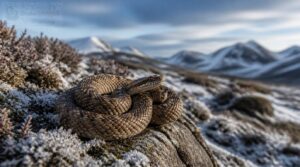
Picture the Arctic and snakes probably don’t come to mind—yet one species has quietly rewritten that assumption. You’re about to see exactly which snake pulls this off, and where its icy boundaries actually sit. Here’s what you need to know, starting with the record-holder itself.
The common European adder has adapted remarkable survival strategies for enduring Arctic winters, thriving well above the Arctic Circle in Scandinavia.
European Adder, The Northernmost Snake
Persistence explains it best. The European adder (Vipera berus) stands alone as the only snake documented above the Arctic Circle, pushing cold tolerance to its absolute limit. While every other species retreats south, this viper thrives past 67°N through Arctic survival mechanisms honed over millennia, proving that ectothermic life isn’t automatically excluded from the far north, just narrowly, remarkably represented.
The European adder alone proves cold-blooded life can survive past the Arctic Circle, narrowly but remarkably
To endure the harsh winters, adders hibernate communally underground in groups of up to 100 individuals, sharing shelter until warmer months return.
Countries Above The Arctic Circle
Eight nations claim land above the Circle, but only Scandinavia and Russia host that hardy viper.
- Norway, Sweden, Finland – adder strongholds
- Russia – Yamal, Taimyr, Yakutia expansion zones
- Denmark, Canada, USA – Arctic Ocean borders, snake-free
- Iceland – no native reptiles at all
Indigenous governance and Arctic Council cooperation shape habitat preservation as climate change reshapes fauna ranges northward.
Why Arctic Alaska Has None
So why does America’s Arctic stay snake-free while Scandinavia hosts thriving adders? Permafrost barriers block denning below the frost line, and winter darkness shrinks foraging windows.
Short summers can’t support reproductive cycles, while prey scarcity and a harsh coastal climate seal the deal. No thermal refuges, no cold tolerance workaround, just biology hitting a wall.
Common Arctic Snake Myths
Alaska’s absence breeds confusion, and that gap in understanding fuels every Arctic snake myth out there.
Reality check: adders aren’t mythical creatures, they’re documented venomous snakes thriving above the Arctic Circle. They don’t migrate south for winter, either. Instead, they rely on hibernation and thermal basking behavior.
Cold tolerance facts beat folklore every time, especially as climate change reshapes where these reptiles can survive.
Where Do Arctic Snakes Live?
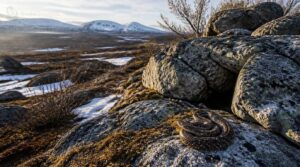
Finding an adder above the Arctic Circle isn’t about luck—it’s about knowing exactly which microhabitats offer the warmth and shelter these snakes need to survive.
You won’t spot them scattered randomly across the tundra; they stick to specific terrain that solves their heating and hibernation problems at once.
Here’s where you’ll actually find them, from basking grounds to the dens they return to year after year.
Tundra Edges and Forest Clearings
Why edges? Because that’s where warmth meets cover. Adders exploit the tundra-forest interface, basking in sunlit clearings, then retreating into mossy edge vegetation. Forest clearing foraging pays off too: thinner ground cover exposes rodents and invertebrates.
This edge-dwelling strategy extends into mating season, where understanding snake courtship rituals reveals how females use these same clearings to assess and select mates.
Edge temperature gradients run 1-3°C warmer than deep forest, and seasonal edge patterns, snowmelt to summer bloom, drive smart microhabitat selection amid growing habitat fragmentation.
South-Facing Slopes and Rocky Ground
Few features matter more than aspect. South-facing slopes run 6-12°C warmer than shaded ground, turning exposed outcrops into prime thermal basking spots.
Loose talus traps solar heat, while rock crevices hold warm air pockets after sunset. This rocky microclimate boosts soil temps past 15-20°C at 5cm depth, extending activity windows and concentrating prey right where adders hunt.
Sandy, Sheltered Hibernation Sites
Sand pockets tucked beneath grass tussocks give adders what rock crevices can’t: subsurface thermal stability near 5-10°C year round.
- Sandy hibernation nests with loose, fast-burrow layers
- Wind-protected sand sites near sparse vegetation
- Sun-warmed microheats on clear days
- Insulated sand cavities sealed with organic debris
That rapid burrowing capability means a viper can vanish from danger, or a cold snap, in seconds.
Dens Below The Frost Line
Why stop at sand when the real estate below matters more? True hibernacula push past the frost line depth, tapping subterranean stability where permafrost zones can’t intrude.
Talus slopes offer natural den insulation, while vertical seams enable air exchange without exposure. Hibernaculum reuse is common. These thermal refuges, once proven, get revisited year after year, denning site protection built through instinct, not chance.
Seasonal Habitat Changes
An adder’s map redraws itself every few months. Spring brings snowmelt basking sites; autumn triggers hibernation site shifts toward deeper refuges.
Four seasonal drivers shape movement:
- Daylength activity windows extending foraging time
- Prey availability cycles peaking late summer
- Microclimate variation across south-facing slopes
- Permafrost thaw impact opening fresh burrows
These thermal refuges aren’t static, they’re negotiated fresh each year.
How European Adders Survive Arctic Cold
Survival this far north isn’t luck—it’s a five-part biological toolkit refined over generations. You’re looking at a snake that’s part solar panel, part antifreeze factory, part insulated thermos. Here’s how each piece of that toolkit actually works.
Basking and Body Flattening
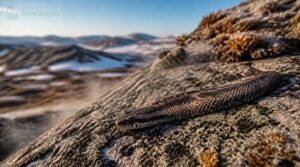
Picture a living solar panel: that’s an adder flattening itself against sun-warmed rock. Body flattening for heat gain boosts surface contact, pulling warmth straight through the dorsal skin. Males bask conspicuously post-hibernation, readying for reproduction.
Stillness matters too. Reduced movement cuts convective cooling, while south-facing slopes and microclimate variation let these vipers fine-tune temperature, squeezing precious degrees from thin Arctic sunlight.
Brumation and Metabolic Slowdown
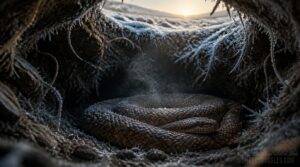
Basking only gets an adder so far. Once autumn cuts daylight and ground temps drop, brumation kicks in, dropping metabolic rate 70-90%. Heart rate slows dramatically, blood shifts to essential organs, and digestion halts entirely.
You’re watching energy conservation perfected: intermittent arousals allow brief movement, but true dormancy cycles preserve fat reserves through the punishing Arctic winter.
Cold-Protective Body Chemistry
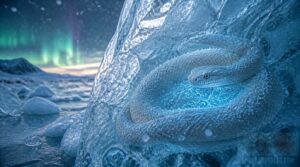
Slowed metabolism buys time, but cryoprotectant molecules do the real freeze-proofing. Taurine and glycerol lower the freezing point inside cells, while antifreeze proteins bind ice crystals through thermal hysteresis, blocking growth before it ruptures membranes.
This cellular freeze tolerance lets 40% of body water freeze safely. Meanwhile, blood glucose regulation keeps fuel steady, powering organs through subzero temperature adaptation without a single shiver.
Insulating Skin and Fat
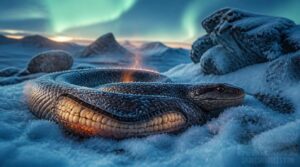
Chemistry alone won’t stop frostbite. That’s where subcutaneous fat earns its keep, forming a hypodermis thermal barrier beneath the skin.
Five ways fat insulates:
- Low thermal conductivity blocks heat loss
- Fewer blood vessels limit transfer
- Seasonal fat layer adaptation boosts winter reserves
- Skin fat interaction traps warmth
- Structural padding cushions frozen terrain
Compact, Heat-Retaining Bodies
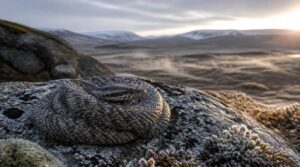
Fat and skin do their part, but shape matters just as much. A stout, thick-bodied build gives adders body shape efficiency: less surface area per pound of snake, less heat lost to Arctic air.
| Trait | Cold-Survival Benefit |
|---|---|
| Compact trunk | Reduces heat loss |
| Dense muscle | Stores warmth |
Combined with blood flow control, this reptile cold tolerance keeps baskers warm longer.
Arctic Adder Life Cycle and Ecology
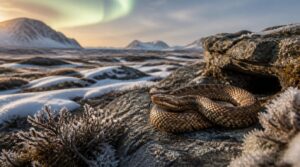
Survival is only half the story—an adder still has to eat, mate, and raise its young on a clock that most reptiles would find brutally short. You’re about to see how timing becomes everything up here, from the first sunbeam after brumation to the final ambush before winter closes back in.
Here’s what that hard-won Arctic lifestyle actually looks like, season by season.
Spring Emergence and Summer Activity
Ever wonder what wakes a viper from months underground? Soil temperature does the talking: once daytime highs pass 5 to 10°C, adders emerge and start patrolling within one to three weeks.
- Basking on sun warmed rocks rebuilds body heat
- Foraging ranges widen as voles and lizards resurface
- Reproductive readiness sharpens with summer prey abundance
Live Birth in Cold Climates
Picture a female adder carrying young through brumation itself: that’s ovoviviparity at work, embryos developing internally until birth near her den in late summer.
Neonates emerge mobile, venom-ready, foraging within hours.
| Factor | Lean Year | Abundant Year |
|---|---|---|
| Litter size | 3-8 | 12-20 |
| Maternal fat | Low | High |
| Neonate size | Smaller | Larger |
Mating and Delayed Fertilization
When two adders finally meet after brumation, courtship isn’t gentle: males wrestle in dominance dances before mating even starts.
Sperm storage lets females hold viable sperm for months, timing fertilization to snowmelt and prey peaks. This delayed fertilization strategy means:
- Better litter synchronization
- Improved neonate survival
- Flexible female mate choice
It’s a savvy viviparous reproduction hack, letting your local adder outsmart the Arctic’s brutal timing constraints.
Prey and Ambush Hunting
How does an ambush predator eat well in a place with scarce prey? Precision. Your adder tongue-flicks for scent, tracks silhouettes visually, then strikes in under 0.2 seconds near vole and shrew burrows. Camouflage keeps detection windows to mere seconds. One successful strike on small mammals can fuel weeks of survival, letting adders exploit crepuscular prey activity without wasting precious cold-season energy.
Predators and Tundra Balance
Being ambush hunters doesn’t put adders at the top of the food chain, and that’s the point: foxes and raptors keep viper numbers in check, while your snake’s rodent kills prevent tundra overgrazing.
- Predator-prey cycles stabilize populations
- Foxes and raptors hunt adders
- Rodent control preserves vegetation
- Maintains trophic level stability
- Shapes seasonal foraging shifts
How Climate Change Affects Arctic Snakes
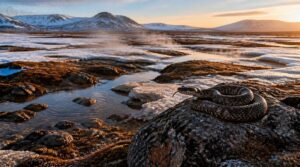
Climate change isn’t just background noise for Arctic adders—it’s actively redrawing their world, one warming season at a time. You’re about to see how shifting temperatures ripple through everything from where these snakes can live to when they hunt and hibernate. Here’s what’s changing, and why it matters.
Northward Adder Range Expansion
Suitable adder habitat has grown fivefold in a decade, from 15,000 to over 76,000 km². You’re watching genuine range expansion, not anecdote: Yamal, Yakutia, and Taimyr populations now push into former permafrost.
Scandinavian sightings jumped 30% yearly since 2020. Models predict another 300 km northward shift this decade, tracking rodent prey availability and warming microclimates across the tundra edge.
Longer Seasonal Activity
Range isn’t the only thing shifting northward, timing is too. Warmer springs trigger earlier emergence patterns, stretching active seasons well beyond historical norms.
You’ll find adders basking longer each day, foraging into late summer, delaying brumation as autumnal cold snaps arrive later. This active season extension means more hunting, mating, and thermoregulation opportunities packed into every Arctic year.
Changing Prey Availability
More active days mean more mouths to feed, but tundra menus stay unpredictable.
- Prey scarcity periods force reliance on limited small mammals
- Insect prey reliance spikes during brief warm peaks
- Vertebrate prey surges in voles and lemmings after thaws
- Bird egg predation targets tundra nesting sites
- Fish amphibian intake rises when streams unfreeze
This dietary flexibility helps maintain the fragile predator-prey balance and aids long-term health of the natural world.
Loss of Hibernation Sites
A full belly means little if the den beneath you collapses. Permafrost thaw eats away frost pockets, while soil compaction and surface litter loss strip insulation adders need.
Erosion clogs entrances, sediment blocks routes, and snowpack decline destabilizes humidity.
Add road fragmentation near traditional sites, and hibernation itself, not just survival, becomes the bottleneck.
Monitoring and Conservation Needs
Collapsed dens demand answers, not guesses. That’s why researchers pair environmental DNA surveillance with mark-recapture and radio transmitters, feeding data into shared repositories under strict standards.
Citizen science participation and Indigenous knowledge sharpen threat assessment protocols.
- Watching a denning site erode, knowing generations of adders called it home
- Losing count data that took a decade to build
- Communities empowered to protect what’s theirs
Habitat protection zones now hinge on this collaborative, policy-engaged vigilance.
Frequently Asked Questions (FAQs)
Do any snakes live in the Arctic?
Against all odds, one cold-blooded outlaw cracks the Arctic’s icy fortress: Vipera berus. This lone survivor hibernates nine months yearly, defying frozen tundra where reptile life seems impossible, proving Arctic reptile distribution has real, scaly exceptions.
What state has the worst snake problem?
Florida claims the dubious title, thanks to invasive Burmese pythons and dense native populations. Texas venomous snakes and Georgia copperhead density rank high too, but nothing near the Arctic Circle faces this problem, cold tolerance simply isn’t there.
How cold is too cold for snakes?
Below 10°F, activity stops entirely. Adders push freeze tolerance further than most reptiles, letting 40% of body water crystallize while cryoprotectants like taurine guard essential organs, a true thermal death point most snakes never survive.
What snake has 100% fatality?
Like the mythical hydra, no single snake guarantees death with every strike. Even the inland taipan, with fearsome neurotoxins, isn’t a 100% killer: prompt antivenom and medical care turn nearly every bite survivable.
Why do snakes not live in the Arctic tundra?
Cold-blooded physiology can’t handle year-round subzero temperatures. Thermal limitations, scarce prey, and frozen ground blocking hibernation dens create a triple bind, ruling out sustained tundra survival for nearly every reptile species on Earth.
What is snake main habitat?
Most snakes chase heat: deserts, tropical forests, warm grasslands. The European adder defies that script, working sunny south slopes, rocky crevices, and frost-free dens across tundra edge zones near the Arctic Circle itself.
How far north can snakes live?
Talk about pushing the envelope, or in this case, the permafrost: the European adder claims bragging rights near 69°N in Scandinavia, while most North American cold tolerance limits stall snakes around 60°N latitude.
Do snakes hibernate in the Arctic tundra?
Technically, it’s brumation, not true hibernation. Adders drop metabolic rate drastically, tucking below the frost line where hibernacula selection matters most, sometimes staying dormant nine months until winter emergence timing aligns with rising temperatures.
What types of prey do Arctic snakes hunt?
Your typical adder menu leans on voles and shrews, with lizards, amphibians, and ground-nesting bird eggs rounding things out. Juveniles ambush insects and beetles first, honing hemotoxin-driven strikes before graduating to true predator-prey mastery over vertebrate prey.
How do Arctic snakes regulate their body temperature?
Warming their blood the old-fashioned way, adders master behavioral thermoregulation: basking on sun-warmed rock, flattening bodies for maximum solar gain, retreating to subsurface warmth when needed. This ectothermic strategy, paired with metabolic flexibility, sustains survival across brutal temperature swings.
Conclusion
Cold is a locked door, and this adder simply learned the combination. No other reptile on the planet has cracked arctic survival quite like this.
Snake habitat in the arctic proves that biology bends before it breaks, given enough time and the right cryoprotectants. You’ve seen the mechanisms, the dens, the delayed births, the slow-burning metabolism.
What remains uncertain isn’t survival skill, it’s whether warming trends outpace the very adaptations that made this snake a polar pioneer.