This site is supported by our readers. We may earn a commission, at no cost to you, if you purchase through links.
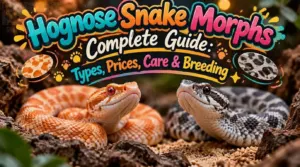
A hatchling Stormcloud hognose looks like a puff of blue-grey smoke. Give it a year, and it darkens into something closer to charcoal.
That shift is the thrill of hognose snake morphs. Every pattern comes from a tiny genetic change, and every change follows rules you can learn. Albinos glow orange and red. Axanthics fade to ash. Snows mix both into pale pink.
But a flashy snake still needs 3 to 5 inches of burrowing substrate, the right humidity, and a prey item sized to its thickest point. Here’s your complete guide to hognose snake morphs, from colors and prices to care, breeding, and the laws that apply to you.
Table Of Contents
- Key Takeaways
- Hognose Snake Morph Basics: Species, Traits, and Genetics
- Popular Hognose Snake Morphs: Albino, Axanthic, Anaconda, and Combinations
- Hognose Snake Morph Prices: Rarity, Age, Sex, and Bloodlines
- Caring for Hognose Snake Morphs
- Breeding Hognose Snake Morphs Responsibly and Legally
- Frequently Asked Questions (FAQs)
- What is the rarest morph of hognose?
- How many morphs of hognoses are there?
- What are some cool morphs for hognose snakes?
- What is the most expensive hognose morph?
- What is the rarest morph of a hognose snake?
- What is the best setup for a hognose snake?
- What is a toxic hognose morph?
- What is a ghost hognose?
- How do you identify a healthy hognose snake morph?
- What are the most common morph-related health issues?
- Conclusion
Key Takeaways
- Morphs come from genetic changes in pigment or pattern that follow recessive, dominant, or co-dominant rules, so learning genetics early helps you plan breeding and explains why rarer combinations cost more.
- Price depends mainly on rarity, sex, age, and bloodline, ranging from about $60 to $80 for common hatchlings to $6,000 or more for leucistic animals, so ask for lineage records and compare listings before you buy.
- Every morph needs the same basics: 3 to 5 inches of burrowing substrate, species-appropriate humidity, a thermostat-controlled heat gradient, prey sized to the snake’s thickest point, and weekly weigh-ins to catch problems early.
- Breeding means confirming genotypes, rotating unrelated bloodlines, controlling incubation temperature, and keeping detailed records, while ownership and permit rules vary by state and city, so check your local laws first.
Hognose Snake Morph Basics: Species, Traits, and Genetics
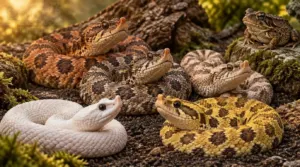
Hognose snake morphs begin with three species: Eastern, Western, and Southern. Each one has an upturned, pig-like snout built for digging up buried toads. You’ll also notice rough, keeled scales and round pupils. Eastern hognose snakes are dietary toad specialists, using enlarged rear teeth to "pop" inflated toads.
Size shifts by species and sex. Western females hit 28 to 36 inches, while Southern males stay near 13 to 15 inches. Pick your species first, because it shapes everything else.
Since a hognose’s final length depends so much on sex and species, checking this hognose snake size guide can help you plan an enclosure that fits.
Now for the fun part. Morphs come from genetic mutations that change pigment, mainly melanin (black and brown) and xanthin (yellow), or the pattern itself. These traits follow Mendelian rules, so they can be recessive, dominant, or co-dominant.
Learn genetics early. It guides your breeding plans and explains morph pricing, since rarer gene combinations cost more.
Popular Hognose Snake Morphs: Albino, Axanthic, Anaconda, and Combinations
Now that you know how genes shape color and pattern, let’s meet the stars. This hognose snake morphs guide starts with three single-gene favorites.
Albino hognose snakes lack melanin, so they glow in red, orange, and yellow, with red or pink eyes. No black, no brown. Just bright color.
Axanthic flips the script. It strips out red and yellow, leaving cool white, grey, and black tones. Many darken to grey as they age.
Anaconda changes pattern, not color. Saddles connect, and the sides get cleaner. Breed two together and you get a Superconda, almost patternless with a solid black belly.
Then the fun starts with combination morphs. Albino plus axanthic makes a Snow, pale and pinkish. Axanthic plus sable gives you a Stormcloud, which hatches blue-grey and darkens with age.
Hognose Snake Morph Prices: Rarity, Age, Sex, and Bloodlines
Pretty colors come with price tags, so let’s talk money. Morph pricing in the hognose world follows a few simple rules.
Rarer patterns and bolder colors can push prices from under a hundred dollars into the thousands, and this hognose snake morph price guide shows what each popular morph typically costs.
Rarity leads the pack. Common morphs start around $60 to $80 as hatchlings, while lavender runs $600 or more. Leucistic animals can hit $6,000 to $8,000.
Three things move the number most:
- Sex: Females usually cost $50 to $200 more than males.
- Age: Hatchlings cost least, and proven breeding-age adults cost more.
- Bloodlines: Respected breeder lines can fetch two to three times the standard price.
Visual morphs also beat het carriers by a wide margin. Prices shift by region too, so compare listings before you buy. Ask for lineage records, and don’t rush. Patience saves you money and headaches.
Caring for Hognose Snake Morphs
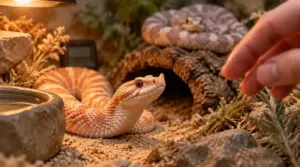
Good news: caring for hognose snake morphs is easier than you’d think. Whether you’ve got a bright albino or a moody lavender, every morph needs the same simple care basics. Here’s what you’ll want to get right, from housing and feeding to health checks and handling.
Housing, Temperature, and Humidity
Western hognoses do best at 30-50% humidity, while Eastern and Southern types want 50-60%. Get your humidity levels wrong and you’ll fight shedding trouble fast.
Pick the right enclosure size: 20-40 gallons for adults. Add 3-5 inches of substrate, like topsoil and play sand, for burrowing. Build a temperature gradient with an under-tank heater on a thermostat, skipping hot rocks.
Feeding and Healthy Body Condition
You’ll keep your hognose healthy by matching prey size to its body. Check these five points:
- Prey width equals the thickest body part.
- Hatchlings eat every 3-4 days.
- Adults eat every 7-14 days.
- Keep a steady feeding schedule.
- Watch for obesity risks like fat rolls.
Spot a dramatic bulge? Downsize the next meal and stretch your feeding frequency a bit.
Health Monitoring, Hygiene, and Safe Handling
You’ll catch trouble early if you weigh your hognose weekly on a gram scale. Weight loss is often the first red flag. Add notes on feeding, sheds, and mood, because detailed records help your vet.
Keep humidity at 30-50% and feed in a separate tub. Wash your hands, support the whole body, and handle gently. Wheezing or open-mouth breathing? Call a reptile vet fast.
Breeding Hognose Snake Morphs Responsibly and Legally
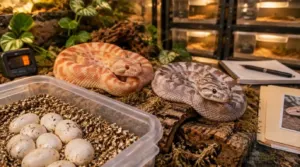
Ready to take your hognose hobby to the next level? Breeding morphs is a big step, so you’ll want to get the basics right before any eggs show up. Here’s what you’ll cover below: pair selection, incubation, record keeping, and the permit rules that keep you legal.
Pair Selection and Genetic Compatibility
Think of pairing hognoses like building a recipe. Skip one ingredient and the whole thing flops.
Start with genetic compatibility. Then check these four things:
- Confirm each snake’s genotype, not just its looks.
- Match recessive genes carefully, since both parents must carry them.
- Track trait inheritance for Arctic and Anaconda dosage.
- Rotate unrelated bloodlines to protect genetic diversity.
Breeding Preparation and Egg Incubation
Picture Maya fasting her female for two weeks, then cooling her slowly. Eight weeks later, eggs appear.
Precise temperature control wins here. Set your reptile incubator to 80-84°F, mix vermiculite 1:1 by weight, and mark each egg’s top. Egg incubation methods and clutch size vary.
| Moment | Feeling |
|---|---|
| Eggs laid | Joy |
| Rotated egg | Heartbreak |
| Hatchlings | Pride |
| Steady incubation | Relief |
Genetic Records and Bloodline Diversity
Think of your breeding records as a passport for every snake you produce. Without one, a hatchling’s story stops at your door.
Your breeding records are a snake’s passport, and without them, a hatchling’s story ends at your door
Log each pairing, clutch, and hatchling photos by date. Note which recessive genes each parent carries, and whether you proved them. Solid bloodline documentation keeps buyers honest and your bloodlines trustworthy.
Rotate unrelated animals in often. Lineage diversity protects genetic variation.
Ownership Laws and Permit Requirements
Think hognose snakes are legal everywhere? Think again. Ownership legality shifts from state to state, so check before you buy.
Illinois, Missouri, and New Jersey all require state permits, and Colorado bans wild collection as of May 1, 2026. Moving a snake into Colorado means a vet certificate and proof of captive breeding. Federal import and export rules are lenient, but local ordinances, like New York City’s, can still shut you down.
Frequently Asked Questions (FAQs)
What is the rarest morph of hognose?
Ready for a treasure hunt? Leucistic hognoses take the crown for rarity.
Their genetics make breeding difficulty real, and market demand keeps price volatility very high. You’ll pay around $6,000 when you finally find one.
How many morphs of hognoses are there?
Picture scrolling a breeder’s page and counting forty tiles before you stop. Over 50 hognose snake morphs exist, and breeders keep mixing combination morphs from base morphs, so your count keeps climbing.
What are some cool morphs for hognose snakes?
Hognose snake morphs get wild fast. Start with Yeti, a snow white albino axanthic mix with light grey pattern.
Want drama? Snowburst glows translucent, almost coral pink. Mercury, axanthic plus lavender, looks icy and cool.
What is the most expensive hognose morph?
The most expensive hognose morph is the leucistic. Expect a price range of $5,000 to $8,000, with females on top. You’re paying for breeding value and steady market demand.
Rarity shifts can nudge prices too.
What is the rarest morph of a hognose snake?
Picture a snowdrift with eyes. That’s a leucistic hognose, stark white with dark eyes, and its rarity is legendary.
Limited genetics and few breeding records push morph pricing sky high, even for a single hatchling.
What is the best setup for a hognose snake?
Here’s a number to remember: 40 gallons suits adult females, while males get by with
Fill it with 4 inches of topsoil and sand, keep humidity near 40%, and feed one right-sized mouse weekly.
What is a toxic hognose morph?
Picture a hognose snake flaring its neck like a tiny cobra, all drama and no menace. That’s your toxic hognose morph, a seller’s catchy label, not a recognized genetics trait. Ask for lineage records before you buy.
What is a ghost hognose?
A ghost hognose is a double recessive morph, pairing axanthic with Evans hypo. You get pastel gray and pink tones, muted patterns, and dark eyes. Unlike albino, anaconda, or codominant morphs, it’s seriously rare, too.
How do you identify a healthy hognose snake morph?
A healthy hognose looks like a drama queen with perfect posture. Check for clear eyes, smooth scales, and a firm body. It should flick its tongue, eat well, and shed in one piece.
What are the most common morph-related health issues?
Like finding a pebble in your shoe, morph health problems nag at you. Run regular health checks for kinked spines, deformities, and poor appetite. Watch shedding issues too, since delicate skin can stick.
Conclusion
Picture a first-time keeper who buys a $900 snow hognose for its looks, then loses sleep over a refused meal. Her fix was boring: warmer hide, deeper substrate, smaller mouse.
That’s the real lesson of this hognose snake morphs complete guide. Genes decide the color, but your habits decide the snake. Keep records. Obey local laws. Your hognose won’t care about its price tag. It’ll just want a good burrow, a good meal, and you.