This site is supported by our readers. We may earn a commission, at no cost to you, if you purchase through links.
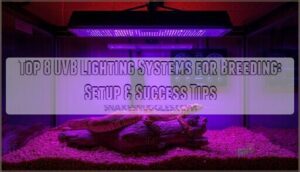
Most breeders who lose clutches trace the failure back to lighting—not temperature, not humidity, not genetics. A single photoperiod misstep or weak UVB output during pre-breeding can halt follicle development before pairing even starts.
The difference between a gravid female and a missed season often comes down to spectrum quality and exposure timing, not just bulb wattage. UVB lighting systems for breeding aren’t optional accessories; they’re the hormonal trigger that syncs everything from ovulation to hatchling bone density. Getting the setup right means understanding how photoperiod duration, irradiance levels, and fixture placement work together to mimic the seasonal cues your snakes evolved to respond to.
Table Of Contents
Key Takeaways
- Most breeding failures trace back to lighting mistakes, specifically photoperiod timing and UVB spectrum quality, not temperature or genetics, because proper UVB triggers the hormonal cascades that drive follicle development and ovulation.
- UVB systems for breeding require three critical factors working together: 12-14 hour photoperiods during active breeding, UVI readings of 2-3 at basking height (measured 6-12 inches from fixture), and bulb replacement every 6-12 months before output degrades.
- The right UVB setup directly impacts reproductive success by powering vitamin D3 synthesis for calcium metabolism in gravid females, synchronizing seasonal breeding cues through consistent photoperiods, and supporting hatchling bone density from day one.
- T5 HO fixtures deliver the most reliable performance for breeding programs with 12-18 month bulb lifespans and even coverage, while LED systems offer 20,000+ hour operation with adjustable intensity but require careful monitoring to verify actual UVB output over time.
Key Features of UVB Lighting Systems for Breeding
UVB lighting isn’t optional when you’re serious about breeding—it’s the difference between random pairings and consistent reproductive success. The right system does more than just enlighten your enclosures; it triggers hormonal cascades, synchronizes breeding behaviors, and fosters healthy egg development from ovulation to hatching.
If you’re working with compact setups, selecting the right UVB lighting systems for small enclosures ensures your breeders get adequate exposure without the guesswork of oversized equipment.
UVB lighting separates random pairings from consistent reproductive success by triggering the hormonal cascades that drive breeding behavior and healthy egg development
Understanding what separates adequate lighting from breeding-grade UVB systems means looking at three critical factors that directly impact your pairing outcomes.
Importance of UVB in Snake Reproduction
UVB lighting isn’t just nice to have—it’s non-negotiable for serious snake breeding. Your snakes need proper UVB exposure to facilitate reproductive success and maintain healthy calcium reserves during the demanding breeding season.
- Vitamin D3 synthesis powers calcium absorption, critical for egg development and shell formation in gravid females
- Adequate UVB helps prevent metabolic bone disease during gestation
- Proper UVB dosage influences hormonal balance, regulating seasonal cycling and mating readiness
- Natural basking behavior under UVB maintains steady body condition for successful pairing
- Consistent exposure aids hatchling bone development and growth after the fertile period
Effective breeding setups should provide throughout the entire reproductive cycle.
Optimal Photoperiods and Light Cycles
Getting the photoperiod right is where most breeders trip up. You need 12-14 hours of light daily during your active breeding season—this triggers reproductive cues and maintains circadian rhythms that sync with mating readiness. Ramp up gradually over 2-4 weeks; abrupt shifts wreck hormonal balance and stress your pairs out.
| Breeding Phase | Photoperiod Duration |
|---|---|
| Pre-breeding setup | 10–12 hours light |
| Active pairing season | 14–16 hours light |
| Gestation monitoring | 12–14 hours light |
| Post-lay recovery | 10–12 hours light |
Consistent dawn and dusk timing matters more than you’d think—use programmable timers to eliminate human error and keep UVB lighting cycles locked in. If mating stalls, extend your photoperiod by 1-2 hours and watch behavior closely. For a deeper look at the effects of optimal light duration on breeding, consult the latest research on photoperiod and plant growth.
Integrating UVB With Temperature Control
Your UVB lighting doubles as a heat source—T5 HO lamps push basking zones to 95°F or higher, which means heat management isn’t optional. Position fixtures 6-12 inches above basking platforms to nail a UVI of 2-3 while maintaining your thermal gradient from 88-90°F warm side to 78-80°F cool.
Use programmable thermostats with probes near basking surfaces—temperature fluctuations wreck breeding readiness fast.
Choosing The Right UVB Lighting for Breeding Setups
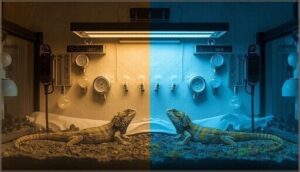
You can’t just grab any UVB fixture off the shelf and expect breeding success—species requirements and fixture performance vary wildly, and mismatches kill your pairing efforts before they start.
The right setup balances UVB output, coverage area, and safe exposure timing to trigger those reproductive behaviors you’re working so hard to achieve. Here’s what you need to know to match your lighting system to your breeding program.
Matching UVB Levels to Snake Species
Not every snake sees the sun the same way—and that’s the foundation of smart UVB species research. Royal pythons and boa constrictors benefit from moderate exposure that enhances vision and calcium metabolism, while corn snakes show improved growth under UVB during juvenile stages.
Use UVB meter calibration to verify your snake habitat simulation hits species-specific targets, matching basking behavior analysis to natural microhabitats. One-size-fits-all reptile lighting design fails every time.
Fixture Types: T5, LED, and Combo Kits
Your fixture choice boils down to three workhorses: T5 Fixtures deliver wide, even UVB outputs with high-reflectivity housings and house T5 UVB bulbs rated for 12–18 months.
LED Lighting runs cooler with 50,000+ hour lifespans and adjustable fixture mounting. Combo Kits merge UVB reptile lighting with full-spectrum visible light in one unit—ideal reptile lighting solutions when you’re scaling UVB lighting for reptiles across multiple enclosures without rewiring.
Distance, Placement, and Coverage
When you’re dialing in UVB distribution, start with fixture mounting 12–18 inches above substrate—then verify coverage patterns with a meter at the basking spot and shaded zones.
If your meter readings drop significantly within six months, consult a comprehensive UVB lighting guide for ball pythons to troubleshoot bulb degradation and replacement schedules.
Lighting angles matter: position bulbs perpendicular to enhance UVB radiation across terrarium lighting setups. Distance calibration isn’t optional—shift your reptile lighting solutions just two inches and you’ll blow your entire UV Index gradient.
Safety Considerations and Overexposure Risks
UVB Toxicity isn’t some theoretical risk—it’s a documented breeding failure waiting to happen. Excessive UVB radiation causes eye protection issues, conjunctival reddening, and skin irritation around ventral scales.
Direct exposure triggers thermal burns and tissue lesions. Photoperiod stress from sudden intensity shifts tanks immunity fast.
Shield your UVB kit properly, monitor UV lighting duration religiously, and balance UVAlight with UVBlight exposure—overexposure wrecks metabolic function.
Top 8 UVB Lighting Systems for Breeding
Choosing the right UVB fixture can make or break your breeding season—it’s that critical.
The market is flooded with options, but only a handful deliver the consistent UV output and reliability serious breeders demand.
Here are eight systems that actually perform when it counts, tested across different breeding setups and species requirements.
1. QZQ UVB Reptile Light Fixture
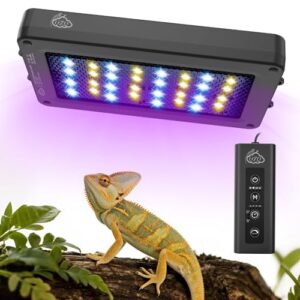
When you’re chasing consistent breeding results, the QZQ UVB Reptile Light Fixture gives you four selectable modes—daylight, warm light, UV, and moonlight—so you can dial in exactly what your breeding pairs need throughout their cycle.
The 24-watt LED configuration delivers both UVA and UVB output with a built-in dimmer, letting you fine-tune intensity without repositioning the unit. Its 24/7 timer function automates photoperiods to mimic natural rhythms, and the memory backup ensures your settings survive power hiccups.
Aluminum housing keeps LEDs cool, extending lifespan while maintaining stable output.
| Best For | Reptile breeders who need precise control over lighting schedules and intensity to support consistent breeding cycles across different species. |
|---|---|
| UVB Output | UVB (4 LEDs) |
| Power | 24W |
| Material | Plastic |
| Weight | 1.28 lbs |
| Color | Black |
| Target Species | Bearded dragons, geckos |
| Additional Features |
|
- Four lighting modes with dimming control let you customize conditions for different breeding phases without swapping fixtures
- 24/7 timer with memory function automates day/night cycles and recovers settings after power outages
- Energy-efficient 24W LED design with 1900 lumens covers UVA, UVB, and visible spectrum in one compact unit
- Some users report uncertainty about UVB output strength for species with high calcium requirements
- Timer only supports one schedule at a time, limiting flexibility for complex breeding setups
- Wire length may require extension cords for larger breeding racks or tall enclosures
2. Reptile UVB Light Fixture Combo Kit
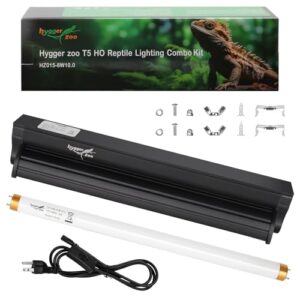
Breeding pairs need precision—and the Reptile UVB Light Fixture Combo Kit delivers both UVB and heat in one compact unit.
Dual independent switches let you control UVB and auxiliary lighting separately, so you’re not locked into an all-or-nothing setup.
The integrated reflector maximizes UVB output while the combo design pairs a UVB tube with a daylight lamp for complete photoperiod coverage.
It fits standard terrarium domes and works with T5 or compact fluorescent bulbs depending on your model, making bulb swaps straightforward when you hit that 6–12 month replacement window.
| Best For | Breeders and keepers managing multiple desert reptiles who need flexible control over UVB exposure and supplemental lighting in a single fixture. |
|---|---|
| UVB Output | Higher UVB value |
| Power | 8W |
| Material | Aluminum |
| Weight | 1.06 lbs |
| Color | Black |
| Target Species | Bearded dragons, turtles |
| Additional Features |
|
- Dual independent switches let you run UVB and daylight separately, giving you precise control over your reptile’s photoperiod
- Curved aluminum reflector boosts UVB intensity and heat dissipation, extending bulb life and improving calcium absorption
- Versatile mounting works on mesh tops or inside tanks, fitting most standard terrariums without extra hardware
- Durability concerns reported by some users, with potential quality control issues affecting long-term reliability
- May struggle in larger enclosures (120 gallons) where UVB coverage becomes inconsistent
- Fixture may shift or require additional support to stay securely positioned during daily use
3. Zoo Med Turtle Lighting Kit
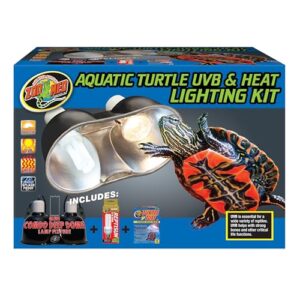
You get dual ceramic sockets rated to 100 watts each—that’s what makes the Zoo Med Turtle Lighting Kit a workhorse for aquatic setups that still apply to snake breeding racks.
The polished aluminum dome boosts output by 30%, and the deep design keeps bulbs recessed so you don’t risk accidental contact during enclosure maintenance. It ships with a 50-watt splashproof halogen for basking heat and a ReptiSun 5.0 Mini for UVB, covering both metabolic support and thermal gradients in one fixture.
| Best For | Aquatic turtle keepers who need a complete dual-bulb lighting solution that delivers both UVB and basking heat in one compact fixture. |
|---|---|
| UVB Output | 5.0 UVB |
| Power | 13W + 50W |
| Material | Aluminum |
| Weight | 1.6 lbs |
| Color | Not specified |
| Target Species | Aquatic turtles |
| Additional Features |
|
- Ships with both a 50W halogen basking bulb and ReptiSun 5.0 UVB Mini, so you’re ready to go out of the box
- Dual 100W ceramic sockets give you flexibility to upgrade bulbs or adjust heat output as your setup changes
- Polished aluminum dome increases light and UV output by up to 30% while keeping bulbs safely recessed
- Bulbs will need replacement every 6-12 months depending on use (halogen rated for 2500 hours, UVB degrades over time)
- 100W per socket cap might limit options for larger enclosures that need higher wattage heat sources
- Designed primarily for aquatic turtles, so you’ll want to verify UVB strength meets requirements for other reptile species
4. Zoo Med Desert UVB Lighting Kit
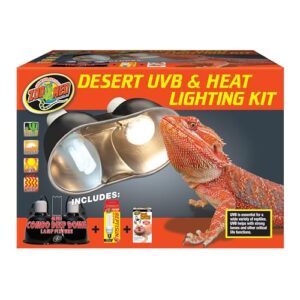
If you’re running desert species—beardies, uros, or high-UV colubrids—the Zoo Med Desert UVB Lighting Kit is your go-to. It pairs a 75-watt basking lamp with a ReptiSun 10.0 UVB compact in one deep dome fixture, giving you dual ceramic sockets rated to 160 watts combined.
The higher 10.0 UVB output matches desert-dwelling reptiles’ needs without forcing you into separate fixtures. Dual on/off switches let you control photoperiod and heat independently—critical when cycling breeders through seasonal triggers.
| Best For | Desert reptile keepers who need high UVB output and separate heat control in a single fixture—especially for bearded dragons, uromastyx, and other species that bask under intense sunlight. |
|---|---|
| UVB Output | 10.0 UVB |
| Power | 13W + 75W |
| Material | Metal |
| Weight | 1 lb |
| Color | Black |
| Target Species | Desert reptiles |
| Additional Features |
|
- Combines 10.0 UVB and basking heat in one deep dome, saving space and wiring hassle
- Dual switches let you control lighting and heat independently for precise day/night cycling
- High-wattage ceramic sockets (160W combined) give you room to adjust output as needed
- Bulbs tend to burn out faster than expected according to user reports
- Heat lamp socket can short out or fail, requiring replacements or workarounds
- Compact UVB bulbs don’t spread light as evenly as tube bulbs, creating hot spots
5. Reptile UVB Light Fixture Kit
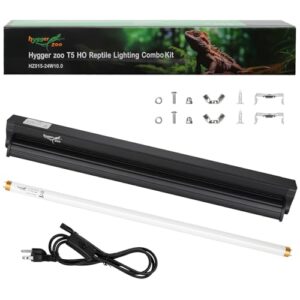
For breeders who need a solid all-arounder without breaking the bank, the Reptile UVB Light Fixture Kit delivers. You’re getting a 24-watt T5 setup with a polished aluminum reflector that pushes UVB down where it counts—right into the basking zone.
The fixture spans 23.4 inches, fitting standard 20-40 gallon setups cleanly. Installation’s simple: mount it on mesh or inside the enclosure. It won’t wow you with fancy extras, but it manages daily photoperiod cycles and facilitates calcium absorption reliably across most colubrid and python breeding projects.
| Best For | Breeders running mid-sized enclosures (20-40 gallons) who need reliable UVB output for standard colubrid and python setups without spending a fortune. |
|---|---|
| UVB Output | Higher UVB value |
| Power | 24W |
| Material | Aluminum |
| Weight | 1.45 lbs |
| Color | Black |
| Target Species | Bearded dragons, turtles |
| Additional Features |
|
- Polished aluminum reflector concentrates UVB directly into basking zones for better calcium synthesis
- Simple installation with mesh-mount or in-tank options that work right out of the box
- Budget-friendly 24W T5 design that covers daily photoperiod needs without excessive energy costs
- Won’t handle larger enclosures beyond 40-50 gallons effectively
- Some users report durability issues and stability problems with long-term use
- Basic feature set means you’re managing schedules manually—no timers or automation included
6. Zoo Med Turtle UVB Lighting Kit
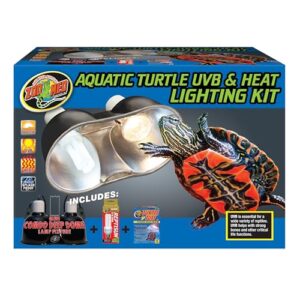
Zoo Med’s Turtle UVB Lighting Kit addresses a different niche—aquatic turtle breeders—but it’s sneakily useful for anyone running humid breeding setups. The mini combo deep dome accommodates two sockets: one Turtle Tuff splashproof halogen for heat, one ReptiSun 5.0 UVB mini compact.
The polished aluminum dome boosts output by roughly a third, and you control each lamp independently. At 2.35 pounds and 12.45 inches wide, it’s compact enough for smaller enclosures yet delivers consistent UVB across basking zones—critical for calcium metabolism during follicle development.
| Best For | Aquatic turtle owners and breeders who need a compact dual-fixture system that delivers both splashproof heat and UVB lighting in humid environments. |
|---|---|
| UVB Output | Included UVB bulb |
| Power | 50W |
| Material | Metal |
| Weight | 2.35 lbs |
| Color | Black/White |
| Target Species | Aquatic turtles |
| Additional Features |
|
- Dual independent switches let you control heat and UVB separately for precise environmental management
- Splashproof halogen design holds up well in high-humidity setups like turtle tanks
- Polished aluminum reflector boosts light output by about 30%, giving you better coverage without upgrading wattage
- Durability complaints suggest the fixture may not last as long as expected given the price point
- Bulbs tend to burn out faster than advertised, adding to long-term maintenance costs
- Requires two separate outlets to run both lamps simultaneously, which can be inconvenient in tight spaces
7. T5 Ho Uvb Reptile Light Fixture
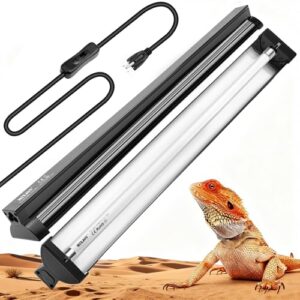
High-output T5 HO ballasts deliver serious UVB without melting your enclosure—24W to 54W configurations run from 12 to 46 inches, so you’ll match nearly any rack or vivarium.
The polished aluminum reflector concentrates UVB across two-thirds of your basking zone, which matters when you’re cycling females through follicle development. Mount it beneath your top screen, keep tubes 6 to 10 inches from the basking surface, and swap bulbs every six to twelve months—UVB decay sneaks up on calcium metabolism fast.
| Best For | Keepers of desert reptiles like bearded dragons, leopard geckos, or tortoises who need reliable 10% UVB output to prevent metabolic bone disease and support breeding cycles. |
|---|---|
| UVB Output | 10% UVB |
| Power | 24W |
| Material | Aluminum |
| Weight | 5.9 oz |
| Color | Not specified |
| Target Species | Bearded dragons, tortoises |
| Additional Features |
|
- High-output T5 ballast delivers consistent 10% UVB with a polished reflector that focuses light where your reptiles actually bask
- Aluminum housing dissipates heat quickly and comes with flame-retardant materials for safer long-term operation
- Multiple size options (12–46 inches) fit most enclosures, and installation is straightforward with versatile mounting hardware
- Glass or acrylic barriers block UVB completely, so you’ll need mesh or open-air access between the fixture and your animals
- Bulbs lose UVB potency over 6–12 months even when they still look bright, requiring regular replacement to maintain effectiveness
- The 10% desert spectrum won’t suit tropical or shade-dwelling species that need lower UVB percentages
8. Reptile UVB LED Light Fixture
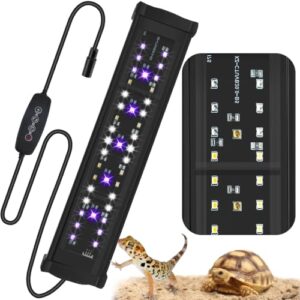
LED UVB fixtures push 20,000-plus hours before output drops—you’ll replace three fluorescent bulbs before one LED module fails. The REPTIDLDB 11-inch 15W model offers adjustable 10.0 to 20.0 UVB output with dimming and timer controls, so you dial intensity from 6 to 12 inches above basking zones without swapping hardware.
Integrated programmable schedules let you mirror natural photoperiods during breeding cycles, and the aluminum housing sheds heat fast. No mercury, minimal heat signature, zero warm-up lag—flip the switch and UVB hits immediately.
| Best For | Reptile keepers who want precise UVB control with long-lasting performance and programmable schedules for species like bearded dragons, turtles, and other desert or tropical reptiles. |
|---|---|
| UVB Output | Higher UVB value |
| Power | 39W |
| Material | Aluminum |
| Weight | Not specified |
| Color | Not specified |
| Target Species | Bearded dragons, turtles |
| Additional Features |
|
- 20,000 hour lifespan outlasts three fluorescent bulbs with adjustable 10.0-20.0 UVB output
- Programmable timer and dimming controls let you customize photoperiods and intensity without replacing hardware
- Instant UVB output with no mercury, minimal heat, and fast-cooling aluminum housing
- May not automatically reset after power outages, requiring manual reprogramming
- Timer instructions can be unclear for first-time setup
- UVB output gradually decreases over time and may need monitoring for very large enclosures
Setting Up and Maintaining UVB Lighting Systems
Getting your UVB system dialed in isn’t complicated—but precision matters when breeding stakes are high.
You’ll need to know where to mount your fixture, how to track actual UV output over time, and when to swap bulbs before they fail silently.
Here’s how to set up, monitor, and maintain your lighting so it consistently fosters reproductive success.
Installation Tips for Breeding Enclosures
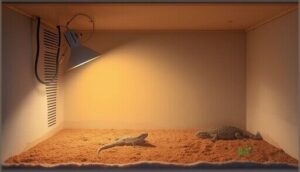
Getting UVB placement right from day one prevents stress and wasted time. Start by mounting your fixture 12 to 18 inches above the basking zone—closer risks overheating, farther cuts effectiveness. Use reflectors to spread coverage across thermal gradients.
Secure wiring away from heat sources and substrates, check ventilation systems for airflow, and confirm enclosure security before powering on. Proper lighting placement drives breeding behavior without compromising electrical safety.
Monitoring UVB Intensity and Duration
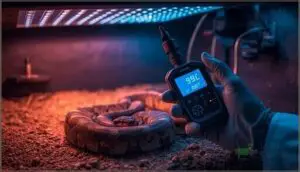
Precision separates guesswork from repeatable breeding wins. Use a calibrated UVB meter at basking height to confirm irradiance falls between 0.3 and 1.0 mW/cm²—anything over 2.0 triggers stress. Log readings weekly, align your lighting cycles to a consistent 10–12 hour photoperiod, and pair UVB kit output with temperature peaks.
Duration control and intensity monitoring aren’t optional—they’re your safety protocols for success.
| Measurement Point | Target UVB Range | Check Frequency |
|---|---|---|
| Basking Surface | 0.3–1.0 mW/cm² | Weekly |
| Snake Head Height | 0.3–1.0 mW/cm² | Weekly |
| Ambient Zone |