This site is supported by our readers. We may earn a commission, at no cost to you, if you purchase through links.

Watch a sidewinder rattlesnake cross loose desert sand, and you’ll swear it’s moving sideways—because it is. Two points of its body touch down at any moment, the rest arched clear of sand hot enough to cook flesh in seconds. That’s not a malfunction. It’s precision engineering built by millions of years of selection pressure.
Snakes lack limbs, yet they’ve solved locomotion problems engineers still struggle to replicate in robotics. Some crawl in near-silence at speeds under an inch per second, perfect for ambush hunting. Others grip branches twenty meters up without losing tension for a moment.
Learning to read these unusual snake movement patterns tells you plenty—about species, terrain, even a snake’s health. What looks strange at first glance often turns out to be nature’s most efficient answer to a hard problem.
Table Of Contents
- Key Takeaways
- What Are Unusual Snake Movement Patterns?
- Main Types of Unusual Snake Locomotion
- How Habitat Shapes Snake Movement
- Snake Species Known for Unique Movement
- Why Snake Movement Patterns Matter
- Frequently Asked Questions (FAQs)
- What are the 4 snake movements?
- What are the 5 modes of locomotion for snakes?
- What does snake wobble look like?
- Why do snakes move zigzag?
- Can snakes move backward or in reverse?
- Do injured snakes develop alternative movement patterns?
- How do aquatic snakes swim differently underwater?
- What movement do snakes use when climbing trees?
- Do baby snakes move differently than adults?
- Do baby snakes move differently than adult snakes?
- Conclusion
Key Takeaways
- Snakes use five distinct locomotion modes—lateral undulation, sidewinding, concertina movement, rectilinear crawling, and gliding—each matched to a specific terrain challenge like loose sand, tight burrows, or open canopy gaps.
- Sidewinding lets desert snakes like the sidewinder rattlesnake minimize sand contact and heat exposure while achieving strong traction and surprising speed on loose dunes.
- Sudden or irregular changes in a snake’s normal gait, such as jerky bends, dragging, or erratic pauses, often signal injury, illness, stress, or dehydration and warrant veterinary attention.
- Studying snake locomotion mechanics is directly informing robotics and conservation technology, helping engineers design machines that navigate rubble, sand, and dense terrain better than wheeled systems.
What Are Unusual Snake Movement Patterns?
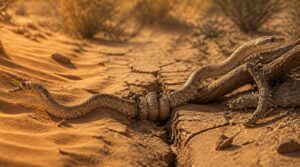
Most people picture snakes gliding in one smooth line, but that’s only part of the story. When sand shifts, tunnels narrow, or branches fall away, snakes switch tactics fast, and each one tells you something about how they survive. Here’s a look at the main patterns you’ll want to recognize.
Take sidewinding, for instance—that sideways J-shaped motion desert species use to keep from sinking, explained well in this breakdown of how snakes move across desert sand.
Normal Versus Unusual Movement
Watch a snake glide across flat ground, and you’ll notice a steady rhythm: even curves, consistent scale contact, predictable standard. That’s your normal motion standard.
Unusual movement breaks that pattern:
- Jerky, asymmetrical body bends
- Sudden gait transitions mid-crawl
- Dragging or unresponsive sections
- Loss of coordinated muscle waves
- Erratic pauses without cause
These aberrant locomotion signs matter—they’re often your first clue something’s wrong.
Why Snakes Move Differently
Why does a snake abandon its default crawl? Usually, it’s substrate friction, predator pressure, or sheer body mass forcing a switch.
| Gait | Trigger | Mechanism |
|---|---|---|
| Sidewinding | Loose sand | Diagonal loops cut slippage |
| Concertina | Tight burrows | Anchored bends |
| Rectilinear | Heavy body | Ventral scale friction |
Energy efficiency and evolutionary adaptation shape each choice—muscles adapt, or the snake stays stuck. Lateral undulation allows snakes to generate propulsive waves through coordinated muscle activity along their vertebral column. Lateral undulation mechanics involve precise activation of hundreds of muscles to create S-shaped waves that push against environmental irregularities for forward motion.
Movement, Habitat, and Survival
Every gait you’ve just read about carries a survival price tag. Energy expenditure trade-offs dictate the choice: concertina burns far more fuel than lateral undulation, so snakes reserve it for tight corridors where nothing else works.
The payoff shows up in predator evasion efficiency, better microhabitat prey access, smarter dispersal corridor optimization, and real thermal stress reduction—sidewinding, for instance, keeps hot sand contact brief.
When Movement Signals Trouble
Not all deviation from lateral undulation, concertina movement, or sidewinding signals danger—but some patterns demand a closer look. Gait analysis matters here: irregular pacing, tremors, or favoring one side often reflect pain indicators or injury.
Sudden hesitation during rectilinear locomotion, sluggish gliding, or erratic mobility changes can point to lameness assessment needs, stress response, dehydration, or infection. When in doubt, consult a reptile vet.
Main Types of Unusual Snake Locomotion
Snakes don’t rely on just one way of getting around, and once you know what to look for, each style tells its own story. From loose sand to tight burrows to open branches, the terrain dictates the technique every time. Here are the five movement patterns you’re most likely to spot in the wild or in captivity.
If a snake ever slips out of sight indoors, its instinct to seek warm, dark hiding spots explains why tracking down a lost snake in your house takes patience and know-how.
Sidewinding on Loose Sand
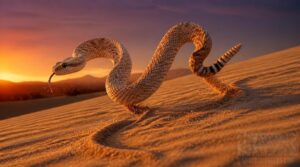
Picture a snake pouring sideways across a dune, touching down only twice at once. That’s sidewinding, built for loose hot sand.
- Two contact points anchor propulsion
- Body arches, avoiding heat absorption
- Grain interaction stays shallow, preventing sinking
- Contact sequencing shifts as slopes steepen
This desert adaptation maximizes sand traction efficiency while trimming energy costs—proof that survival favors smart substrate interaction over brute strength.
Concertina Movement in Tight Spaces
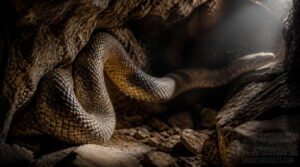
Squeeze into a burrow or rock crevice and lateral undulation stops working fast. That’s where concertina movement takes over.
Your snake presses bends against tunnel wall anchoring, forming static anchor points, then extends its head forward before pulling the rear up. Friction-based progression and tight body curvature control make this narrow channel navigation possible—though it burns far more energy than the smoother bridging motion used elsewhere, thanks to constant muscular contraction against the substrate.
Rectilinear Crawling in Heavy Snakes
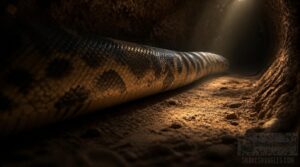
When a boa needs silence more than speed, it switches to rectilinear crawling—belly scale mechanics doing all the work.
Ventral muscles lift small skin patches, pull forward, then anchor via static friction. No lateral bends.
- Speeds: 0.01–0.06 m/s
- Near-silent, ideal for ambush
- Best on flat, uniform ground
This heavy-bodied locomotion favors pythons and boas moving through tunnels where stealth matters more than pace.
Arboreal Bridging and Climbing

Ever watch a snake cross a gap without touching the ground? That’s arboreal adaptation in action.
Tree climbers combine rectilinear grip with concertina bends, gripping tree trunks and branches using controlled muscle tension. Branch stability control prevents sagging mid-crossing.
Canopy corridors—5 to 20 meters wide—let snakes bridge fragmented forest sections, using tapered approaches and three-point contact for safe, quiet canopy movement.
Gliding in Flying Snakes
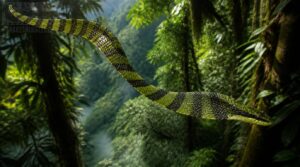
A snake that jumps out of a tree and flattens itself into a wing—that’s Chrysopelea paradisi, the Banded Flying Snake. It launches with a J-loop takeoff, flattens its ribs into an airfoil, and undulates horizontally and vertically, phase-shifted 90 degrees.
A flying snake launches from branches, flattens into an airfoil, and undulates in phase-shifted waves to glide through the air
This aerial undulation stabilizes flight, boosting glide distance and control across canopy corridors—true snake aerodynamics at work, with lift-to-drag ratios near 2.7.
How Habitat Shapes Snake Movement

No gait works everywhere, and habitat is what decides which one a snake reaches for. Sand, bark, stone, and water each demand a different kind of grip, balance, and muscle timing. Here’s how five common environments shape the way snakes get from point A to point B.
Desert Sand and Heat
Desert sand can hit 80°C by midday—hot enough to injure tissue in seconds. That’s why Diurnal Sand Heating drives sidewinding: minimal ground contact reduces thermal exposure and cuts substrate friction on shifting grains.
Key survival factors:
- Sand Temperature Effects on tissue
- Wind-Driven Sand Transport altering grip
- Heat-Induced Dune Shift timing
- Thermal Grain Behavior affecting traction
- Thermal regulation windows for activity
Trees, Branches, and Gaps
Trees demand a different toolkit than sand ever does. Arboreal snakes rely on concertina locomotion and lateral undulation together, gripping bark as they climb. Crossing gaps between limbs means bridging without sagging—branch gliding helps here.
Crown shyness creates canopy light gaps, and branch structure plus gap regrowth shape microclimate gaps, giving snakes shifting light patterns and footholds along their route.
Burrows, Rocks, and Tunnels
Underground, snakes trade climbing grip for subterranean locomotion—mostly concertina and rectilinear crawling. Tunnel Width Adaptation matters: snug passages let belly scales anchor via substrate friction. Rock Hardness Effects shape burrow entrance design—sandstone yields networked tunnels, granite limits complexity. Soil composition impact and clay stability determine collapse risk. In tight spaces, snakes forgo lateral undulation entirely, relying on fossorial adaptations for serpentine locomotion through cramped, unpredictable terrain.
Water and Wet Substrates
Rock and clay tunnels are one thing—wet substrates throw a whole new variable into the mix. Water contact angle determines whether moisture spreads evenly or beads up, changing grip instantly.
Capillary moisture movement softens soil, while wet soil compaction can trap or collapse burrows.
Snakes shift between lateral undulation, concertina, and rectilinear crawling as substrate temperature regulation and moisture absorption alter traction underfoot.
Captive Enclosure Surfaces
Give a captive snake the wrong flooring, and you’ll watch lateral undulation turn clumsy fast. Match substrate texture to species: rough surfaces aid climbers, sand invites sidewinding.
- Epoxy floors: easy cleaning, poor grip for burrowers
- Heated mats: support thermal regulation and rectilinear crawling
- Naturalistic blends: encourage digging, mimic wild concertina movement
- Grooved panels: help arboreal climbers grip safely
Snake Species Known for Unique Movement

Some snakes have turned unusual movement into a signature trait, and knowing their names helps you spot the pattern behind the motion.
Each species on this list solves a different problem—sand, height, or bulk—with its own mechanical answer.
Here’s a closer look at five snakes whose movement sets them apart.
Sidewinder Rattlesnakes
Watch a sidewinder rattlesnake move, and you’ll see Sand Grip engineered to a high degree—only two body sections touch ground at once, generating Ground Reaction Forces that push, not drag. This beats Lateral Undulation on loose dunes, hitting speeds near 18 mph.
Between Prey Strikes, Crotalus cerastes returns to favored Resting Sites, coiling motionless until heat or hunger calls it back into that signature J-shaped stride.
Flying Snakes
Genus Chrysopelea, the paradise tree snake among them, launches from canopy branches using a J-shaped launch technique, then flattens its ribs outward—rib splaying—into an airfoil cross section.
Aerial undulation creates lift and steers midflight through serpentine paths across forest aerial corridors, covering 10–30 meters. Midflight steering adjustments via lateral waves make it the only limbless glider alive.
Ball Pythons
Ball pythons trade speed for stealth, relying mostly on rectilinear locomotion—that slow, straight-line crawl—to stalk rodents silently at night.
Their stocky build favors this gait over sidewinding or gliding. When stressed, they curl defensively rather than flee fast.
Good husbandry (88-92°F warm zones, 50-60% humidity) helps normal movement, healthy shedding, and reliable feeding response during handling.
Boa Constrictors
Ten to 13 feet of muscle doesn’t sidewind—it coils, crushes, and creeps.
Boas favor rectilinear locomotion for stalking, switching to concertina locomotion when climbing or squeezing through brush. Coiling mechanics power both constriction and feeding behavior patterns.
- Thick, muscular body pressed flat against bark
- Slow, deliberate belly-scale crawling
- Sudden coiling strike on unsuspecting prey
- Powerful loops wrapped around a branch
Growth rate factors and shedding frequency shift with size and reproductive cycles.
Corn Snakes
Nothing exotic here—lateral undulation is a corn snake’s bread and butter, that classic S-curve slither across leaf litter and enclosure substrate alike.
Cornered, though, they’ll pivot to concertina movement or rectilinear crawling. No sidewinding needed; open habitat doesn’t demand it.
Watch their gait during feeding or handling—it tells you plenty about shedding readiness, breeding behavior, and general health.
Why Snake Movement Patterns Matter
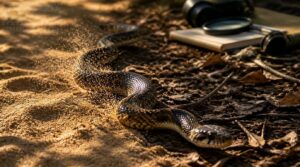
Understanding how a snake moves isn’t just academic curiosity—it’s practical knowledge with real stakes. Whether you’re a keeper, a researcher, or just a curious observer, these movement patterns tell you something useful every time. Here’s what paying attention to gait can actually reveal.
Spotting Possible Health Issues
A snake that suddenly abandons its usual lateral undulation for stiff, dragging rectilinear crawling might be sick, not just tired. Watch for:
- Reluctance to sidewind or use concertina movement
- Lopsided or uneven body tracking
- Weak gliding attempts that fall short
- Labored, jerky transitions between gaits
- Refusal to climb or bridge branches
When to seek help: persistent gait changes paired with lethargy warrant a vet exam.
Safer Handling and Care
Once you know a healthy gait from a stressed one, handling gets safer for both of you.
Reduce grip force—snakes using lateral undulation or sidewinding need open space, not restraint. For concertina movers in tight enclosures, support the full body to prevent strain.
| Technique | Purpose |
|---|---|
| Two-handed support | Prevents dragging/injury |
| Inspect enclosure surfaces | Ensures secure rectilinear traction |
Species Identification Clues
Watching how a snake moves across terrain gives you as much identification data as color patterns do. Movement style narrows species fast: sidewinding points to desert dwellers, concertina movement suggests tight rocky crevices, rectilinear locomotion signals heavy-bodied ambush predators, and gliding marks flying snakes.
- Behavior and habitat clues together
- Scale texture and body shape
- Color and pattern layout
- Geographic range overlap
Robotics and Conservation Research
Engineers borrow snake gaits to build machines that outperform wheeled robots on messy terrain. Sidewinding and concertina locomotion inspire designs for rubble, sand, and dense brush where wheels fail.
These robots now support robotic habitat monitoring, conservation drone surveys, and automated species tracking — collecting wildlife data in places biologists can’t easily reach, aiding robotic restoration assistance efforts using lateral undulation and rectilinear locomotion as movement blueprints.
Frequently Asked Questions (FAQs)
What are the 4 snake movements?
Ironic, isn’t it — a limbless animal masters four distinct gaits. Lateral undulation, sidewinding, concertina movement, and rectilinear locomotion each solve different terrain puzzles, trading speed for control depending on friction, obstacles, and gait change factors.
What are the 5 modes of locomotion for snakes?
Five distinct gaits define snake movement: lateral undulation for open ground, sidewinding across desert sand, concertina movement through tunnels, rectilinear locomotion in heavy-bodied species, and gliding via airfoil body-flattening—each suited to specific terrain, speed, and energy demands.
What does snake wobble look like?
Picture a head tilt motion rippling into oscillatory neck motions, a subtle body sway pattern, and quick microadjustments for balance — distinct from sidewinding, concertina movement, gliding, or rectilinear locomotion, this substrate grip check keeps your snake steady on shifting ground.
Why do snakes move zigzag?
Zigzag paths boost traction mechanics on loose ground, letting angled body segments grip rather than slip. This staggered gait improves energy efficiency, aids surface adaptation, and adds predator evasion—unpredictable curves make you a harder target to intercept mid-strike.
Can snakes move backward or in reverse?
Yes, snakes can retreat, reverse, and back away when needed. They rely on reverse lateral undulation, backward rectilinear progression, or reversed concertina locomotion.
Though backward locomotion efficiency drops sharply—substrate grip factors and scale orientation make forward movement the easier, faster choice.
Do injured snakes develop alternative movement patterns?
Absolutely — injured snakes show real injury gait shifts, favoring concertina locomotion or shallower lateral undulation. Speed can drop 20–60%, while compensatory locomotion and shifting muscle activation patterns help redistribute pressure, easing strain during recovery stages until fuller mobility returns.
How do aquatic snakes swim differently underwater?
Underwater, snakes trade sand-gripping for water-pushing: full-body lateral undulation drives them forward while a tail rudder adds thrust and steering. Keeled scales grip water molecules, and sleek, wave-like body motion delivers surprising hydrodynamic efficiency through open water.
What movement do snakes use when climbing trees?
Picture a rope with muscles, gripping bark instead of slipping past it. Tree-climbing snakes rely on concertina locomotion and scale friction, anchoring loops against the trunk while pulling their hind end forward to ascend steadily.
This push-and-pull rhythm even lets some species defy gravity on flat surfaces, a surprising feat explored in how snakes manage to climb smooth vertical walls.
Do baby snakes move differently than adults?
Hatchling locomotion favors rapid, low-amplitude strikes over adult power. Neonates mix undulation, sidewinding, and concertina bouts, adapting quickly to substrate.
Early motor coordination is jerky but effective—juveniles improve grip and rhythm over months as muscles and neural pathways mature.
Do baby snakes move differently than adult snakes?
Yes — neonatal locomotion patterns rely on tighter coils and rapid acceleration bursts rather than smooth lateral undulation. Hatchlings pause often, using quick S-shaped escapes, while juvenile gait development gradually favors efficient, longer strides suited for habitat selection and arboreal hunting.
Conclusion
A snake’s body is a sentence written in muscle, and every bend spells out survival. Once you learn to read unusual snake movement patterns, you stop seeing oddity and start seeing engineering—sidewinding, concertina crawling, bridging, all solutions refined over millions of years.
Watch closely, and a snake’s gait reveals its species, its habitat, sometimes its health. That’s not strange behavior. That’s the best answer evolution could write, tested for millennia and never once revised.