This site is supported by our readers. We may earn a commission, at no cost to you, if you purchase through links.

Managing temperatures across six snake enclosures taught me this lesson fast: one thermometer per tank isn’t enough when you’re running thermal gradients from 75°F to 95°F. A ball python’s cool side shouldn’t match a corn snake’s basking spot, yet without accurate monitoring, these zones blur together.
Digital thermometers with remote probes solved this problem by letting me track hot spots, ambient temperatures, and humidity levels without opening every enclosure twice daily. The right thermometer setup prevents metabolic issues from improper heating and catches equipment failures before your snakes show stress symptoms.
Snake thermometers for multiple terrariums need accuracy within one degree, long probe cables, and displays you can read from across the room.
Table Of Contents
- Best Snake Thermometers for Multiple Terrariums
- 1. Reptile Thermometer Humidity Gauge
- 2. Mini Digital Hygrometer Thermometer
- 3. Paizoo Reptile Thermometer Hygrometer
- 4. Oasirep Reptile Thermometer Hygrometer
- 5. Digital Reptile Thermometer Hygrometer
- 6. Repti Zoo Reptile Thermometer Hygrometer Gauge
- 7. SunGrow Reptile Thermometer Hygrometer
- 8. Weewooday Reptile Thermometer Hygrometer
- 9. Repti Zoo Digital Thermometer Hygrometer
- 10. Reptispa Digital Thermometer Hygrometer
- Key Features to Look for in Multi-Tank Thermometers
- Benefits of Using Thermometers in Multiple Terrariums
- Digital Vs. Analog Thermometers for Terrariums
- Setting Up Thermometers Across Multiple Enclosures
- Tips for Accurate Temperature and Humidity Monitoring
- Buying Guide: Choosing for Multi-Tank Needs
- Common Mistakes to Avoid With Multi-Tank Thermometers
- Frequently Asked Questions (FAQs)
- Conclusion
Best Snake Thermometers for Multiple Terrariums
Monitoring temperature and humidity across multiple snake enclosures requires reliable instruments that deliver consistent readings.
Digital thermometers and hygrometers designed for reptile habitats help you track conditions in real-time and catch fluctuations before they stress your snake.
The following thermometers offer accurate measurements and practical features for multi-tank setups. Each product includes dual-function gauges that track both temperature and humidity in your terrariums.
For ball python owners seeking reliable monitoring tools, these reptile thermometers for ball pythons provide the precision needed to maintain optimal enclosure conditions.
1. Reptile Thermometer Humidity Gauge
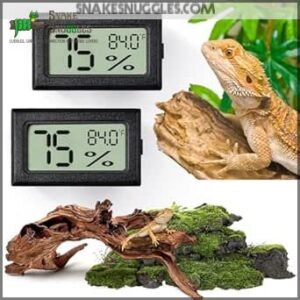
The Vodolo Reptile Thermometer Humidity Gauge offers a high-precision measurement chip with 0.9°F accuracy for monitoring temperature and humidity in snake enclosures. This digital thermometer features an easy-to-read LED screen and simple switching between Fahrenheit and Celsius.
Pairing accurate readings with proper cold weather snake feeding strategies helps maintain optimal enclosure conditions year-round.
You’ll find the cordless design with double-sided adhesive allows quick installation across multiple terrariums. The built-in humidity sensors support thorough environmental monitoring for reptile health.
Battery-powered operation provides reliable temperature control without cables. The water-resistant construction protects against typical terrarium moisture, though direct water spray should be avoided for ideal thermometer calibration longevity.
| Best For | Reptile owners who need affordable, easy-to-install temperature and humidity monitoring for terrariums, vivariums, or breeding setups. |
|---|---|
| Display Type | Digital LED |
| Power Source | Battery |
| Temperature Accuracy | ±0.9°F |
| Humidity Measurement | Yes |
| Installation Method | Double-sided adhesive |
| Unit Conversion | ℉/℃ switching |
| Additional Features |
|
- High accuracy (0.9°F) helps you maintain precise environmental conditions for reptile health
- Cordless adhesive design makes it easy to install and reposition in multiple enclosures
- Clear LED display is readable even in dim lighting, and switches easily between Fahrenheit and Celsius
- Not waterproof—only water-resistant, so it can’t handle direct spray or high-moisture environments
- Some users report inaccurate readings or calibration issues over time
- Adhesive may lose grip in humid conditions, causing the unit to fall off surfaces
2. Mini Digital Hygrometer Thermometer
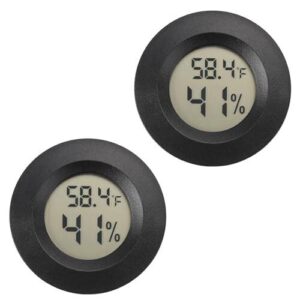
Compact mini hygrometer thermometers deliver dual temperature and humidity readings on a single LCD display, making them ideal for tracking conditions across multiple snake enclosures. You’ll appreciate the ±1°F temperature accuracy and ±2-3% humidity precision for routine terrarium monitoring.
Many reptile thermometers for tropical snakes combine both sensors into wireless units that transmit readings to a central hub for easier monitoring.
These units usually measure around 2.6 by 2.2 inches with simple button-cell power lasting several months. Digital displays update every 10 seconds, and most models switch between Fahrenheit and Celsius. Low per-unit cost under $20 lets you deploy separate devices in each terrarium for independent microclimate tracking without breaking your budget.
| Best For | Reptile keepers who need affordable, accurate monitoring for multiple terrariums without complicated setup or wireless features. |
|---|---|
| Display Type | Digital LCD |
| Power Source | Battery (LR44) |
| Temperature Accuracy | ±1°F |
| Humidity Measurement | Yes (±3%RH) |
| Installation Method | Sticky pads |
| Unit Conversion | ℉/℃ conversion |
| Additional Features |
|
- Dual temperature and humidity readings on one compact display let you check both conditions at a glance every 10 seconds
- Low cost under $20 per unit makes it easy to place a separate monitor in each enclosure for independent tracking
- Simple button-cell power lasts months without needing outlets or complex battery changes
- Small LCD screens around 0.3–0.75 inches can be hard to read if you have vision issues or view from a distance
- No wireless connectivity means you’ll need to physically check each terrarium instead of monitoring remotely
- Not waterproof, so you’ll need to keep sensors away from direct spray zones and heavy moisture areas
3. Paizoo Reptile Thermometer Hygrometer
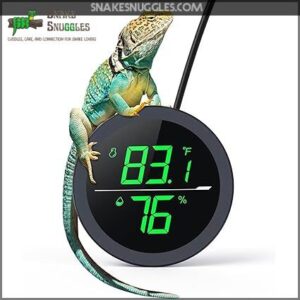
Paizoo offers a USB-powered 2-in-1 unit with an acrylic HD LED display that stands out for its continuous power supply and bright backlit numerals visible across your reptile room. The PAIZOO Reptile LED Thermometer delivers electronic temperature and humidity measurements through a compact 2.56-inch design.
You can mount each unit with included 3M adhesive tape for terrarium temperature control. The corded design requires USB outlets near your enclosures. Some users report humidity sensor reliability issues and adhesive failure in high-moisture environments, so calibration checks remain important for maintaining accurate reptile health monitoring.
| Best For | Reptile owners who need a budget-friendly monitor with a bright, easy-to-read display and have a USB outlet near their tank. |
|---|---|
| Display Type | Digital LED |
| Power Source | USB |
| Temperature Accuracy | High precision |
| Humidity Measurement | Yes |
| Installation Method | 3M tape/USB mount |
| Unit Conversion | Standard display |
| Additional Features |
|
- Bright HD LED display with backlight makes readings visible from across the room, day or night
- Continuous USB power means no battery changes or dead displays at critical times
- Compact 2.56-inch design with included 3M tape makes installation simple in any enclosure
- Humidity readings can be unreliable and may require frequent calibration checks
- Corded USB design limits placement options and requires an outlet nearby
- Adhesive backing may fail in high-humidity environments, causing the unit to fall
4. Oasirep Reptile Thermometer Hygrometer
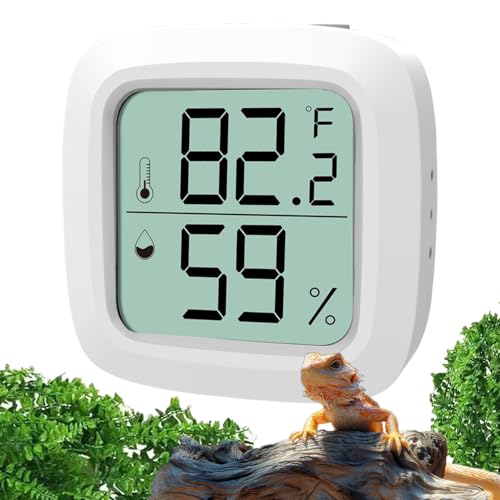
Oasirep Reptile Thermometer and Hygrometer provides battery-powered monitoring with a CR2032 coin cell offering 12-month battery efficiency between replacements. You’ll find display clarity adequate through the white ABS housing with bold LCD numerals readable at a glance.
The unit measures temperature within ±1.8°F and humidity within ±5%RH for terrarium temperature control. Mounting options include double-sided adhesive for interior glass surfaces. The device isn’t waterproof, so you’ll need to position your reptile digital thermometer away from misting zones.
Sensor calibration checks remain necessary given the stated accuracy tolerances for reliable reptile thermometer performance.
| Best For | Reptile owners who need an affordable, easy-to-read monitor for basic temperature and humidity tracking in terrariums, incubation boxes, or small animal habitats. |
|---|---|
| Display Type | Digital LCD |
| Power Source | Battery (CR2032) |
| Temperature Accuracy | ±1.8°F |
| Humidity Measurement | Yes (±5%RH) |
| Installation Method | Adhesive pad |
| Unit Conversion | ℉/℃ switch |
| Additional Features |
|
- Long 12-month battery life means you won’t be changing batteries constantly
- Large LCD display with bold numbers makes it easy to check conditions from across the room
- Simple installation with included adhesive pad—no tools or complicated setup required
- Not waterproof, so you have to keep it away from misting systems or water bowls
- Temperature accuracy of ±1.8°F and humidity accuracy of ±5%RH means readings can be off by a noticeable amount
- Double-sided adhesive can be tricky to reposition if you don’t get the placement right the first time
5. Digital Reptile Thermometer Hygrometer
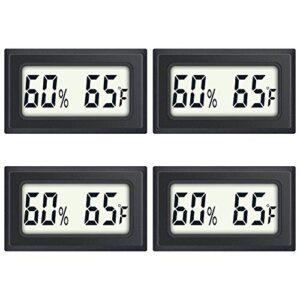
AikTryee’s 4-pack configuration delivers temperature precision within ±2°F alongside humidity tracking at ±2%RH accuracy across multiple enclosures. You’ll install each thermometer hygrometer combo using double-sided tape or through the 1.14-inch embedded opening designed for terrarium ventilation screens.
The digital displays show clear LCD readings without external probes, making these reptile digital thermometers suitable for basic humidity control needs. Battery life extends to 8 months per unit. The plastic housing measures 2.82 ounces, keeping weight minimal for various mounting locations in your snake setups.
| Best For | Reptile owners who need affordable temperature and humidity monitoring across multiple enclosures without needing lab-grade precision. |
|---|---|
| Display Type | Digital LCD |
| Power Source | Battery |
| Temperature Accuracy | ±2°F |
| Humidity Measurement | Yes (±2%RH) |
| Installation Method | Embedded/tape |
| Unit Conversion | Standard display |
| Additional Features |
|
- Four units included means you can monitor multiple tanks or different zones in larger enclosures at once
- Simple installation with tape or built-in mounting options that work with standard terrarium screens
- Eight-month battery life means less frequent maintenance and replacement hassle
- Temperature readings can vary between units, so you might get slightly different numbers even in the same spot
- Some units may stop working properly in cold conditions or have finicky battery compartments
- The ±2°F accuracy isn’t tight enough for species that need very precise temperature control
6. Repti Zoo Reptile Thermometer Hygrometer Gauge
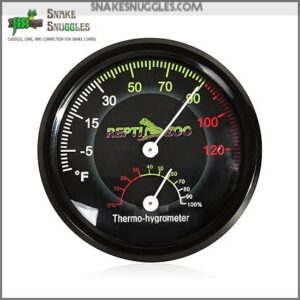
Repti Zoo’s analog gauge eliminates battery concerns through its bimetallic coil mechanism that reads temperature ranges from 20°F to 120°F and humidity levels between 0% and 100% RH. You’ll mount this thermometer hygrometer using the adhesive backing included with each 3.14-inch unit. The color-coded segments provide quick visual reference for humidity control without digital readouts.
While some keepers question sensor accuracy compared to reptile digital thermometer options, this REPTI ZOO analog hygrometer caters to budget-conscious setups where basic temperature fluctuations monitoring aids reptile health across multiple enclosures. Regular thermometer calibration improves reliability for terrarium maintenance routines.
For those managing several habitats, a guide to reptile thermometers for multiple tanks can help you decide whether analog or digital options suit your needs.
| Best For | Budget-conscious reptile owners who need basic temperature and humidity monitoring across multiple enclosures and prefer maintenance-free analog gauges over digital options. |
|---|---|
| Display Type | Analog |
| Power Source | None Required |
| Temperature Accuracy | Analog scale |
| Humidity Measurement | Yes |
| Installation Method | Sticky pad |
| Unit Conversion | Analog only |
| Additional Features |
|
- No batteries needed—the bimetallic coil mechanism works indefinitely without power or replacements
- Color-coded segments make it easy to check conditions at a glance, even from across the room
- Simple adhesive mounting lets you set it up quickly in vivariums, brooders, or any reptile habitat
- Accuracy concerns compared to digital thermometers, so it may not suit reptiles with strict environmental needs
- Doesn’t include removable mounting options like velcro, making repositioning difficult
- Lacks the precision of thermal guns or high-end digital gauges for sensitive species
7. SunGrow Reptile Thermometer Hygrometer
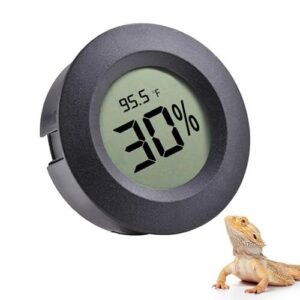
The SunGrow Reptile Hygrometer combines dual analog dials in a compact 1.8-inch round housing that you’ll secure inside terrariums using adhesive backing. This thermometer hygrometer tracks temperature and humidity simultaneously through color-coded zones that simplify humidity control for reptile health monitoring across multiple enclosures.
Device durability suffers from reported battery failures within two weeks and internal corrosion issues. While the reptile digital thermometer alternatives offer greater accuracy, this analog reptile thermometer caters to budget setups where basic temperature monitoring aids terrarium maintenance routines despite requiring frequent thermometer calibration checks.
| Best For | Budget-conscious reptile owners who need basic environmental monitoring in small enclosures and don’t mind frequent battery replacements or occasional accuracy checks against other devices. |
|---|---|
| Display Type | Digital |
| Power Source | Battery (LR44) |
| Temperature Accuracy | Fast updates |
| Humidity Measurement | Yes (1% resolution) |
| Installation Method | Compact placement |
| Unit Conversion | ℉/℃ double-click |
| Additional Features |
|
- Dual analog dials let you check both temperature and humidity at a glance through color-coded zones, making routine terrarium checks faster across multiple setups
- Compact 1.8-inch round design mounts inside enclosures with adhesive backing, saving floor space in smaller habitats while reading conditions at animal level
- No external wires or probes means less clutter and no entanglement risk for climbing or burrowing reptiles
- Battery life reportedly lasts only about two weeks, requiring frequent replacements that add ongoing cost and maintenance effort
- Durability issues include internal corrosion and potential adhesive failure in high-humidity environments, limiting long-term reliability
- Lacks manufacturer accuracy specifications and calibration options, so you’ll need to cross-check readings with digital probes for critical husbandry decisions
8. Weewooday Reptile Thermometer Hygrometer
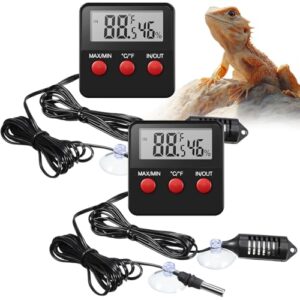
You’ll find the Weewooday Reptile Thermometer Hygrometer in packs of 2 or 4 digital units with 1.5-meter probes for flexible temperature monitoring across separate enclosures. The LCD display shows simultaneous temperature and humidity readings with ±1°F temperature accuracy and ±2% humidity tolerance that support basic reptile health tracking.
This reptile digital thermometer runs on AAA batteries for continuous sensor accuracy checks in standard terrarium setups. While thermometer calibration becomes necessary due to unit-to-unit variability, the 63mm compact design with magnetic mounting manages routine humidity control tasks without permanent installation requirements.
| Best For | Reptile keepers who need an affordable monitoring solution for multiple terrariums and don’t mind checking calibration between units. |
|---|---|
| Display Type | Digital LCD |
| Power Source | Battery (AAA) |
| Temperature Accuracy | Digital probe |
| Humidity Measurement | Yes (10-95%RH) |
| Installation Method | Clip/magnetic |
| Unit Conversion | ℉/℃ range |
| Additional Features |
|
- Dual-probe design with 1.5-meter cables lets you monitor temperature and humidity at different spots in your enclosure
- Memory function tracks max and min readings so you can catch temperature swings even when you’re not watching
- Magnetic backing and clip bracket make it easy to mount inside or outside glass terrariums without adhesive
- Accuracy varies between units, so you’ll need to cross-check readings or calibrate manually
- No backlight means you can’t read the display in dim conditions or at night
- Suction cups don’t hold well, so you’ll rely mostly on the magnetic mount or clip
9. Repti Zoo Digital Thermometer Hygrometer
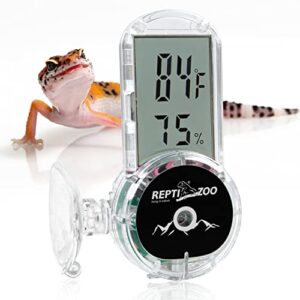
The REPTI ZOO SH135 stands out with its upgraded 4-sided mounting system that lets you position the 4.33-inch unit anywhere on your terrarium glass without wrestling with weak suction cups. You’ll get precise reptile monitoring through the digital display’s large LCD screen that switches between ℉ and ℃ for temperature sensors tracking across multiple enclosures.
This reptile digital thermometer runs on included batteries with extended life for continuous humidity control measurements. However, thermometer calibration checks matter since some units show accuracy variations in multi-tank reptile thermometer applications.
| Best For | Reptile owners who need an affordable way to monitor temperature and humidity across multiple terrariums with flexible mounting options. |
|---|---|
| Display Type | Digital LCD |
| Power Source | Battery |
| Temperature Accuracy | Digital display |
| Humidity Measurement | Yes |
| Installation Method | 4-sided mounting |
| Unit Conversion | ℉/℃ switch |
| Additional Features |
|
- Four-sided mounting system gives you installation flexibility beyond typical suction cups
- Large LCD screen makes it easy to check readings at a glance from across the room
- Includes backup battery so you won’t lose monitoring during power swaps
- Suction cups can lose grip and cause the unit to fall into the enclosure
- Display can be hard to read in low light conditions
- Accuracy issues reported by some users, so you may need to verify readings
10. Reptispa Digital Thermometer Hygrometer
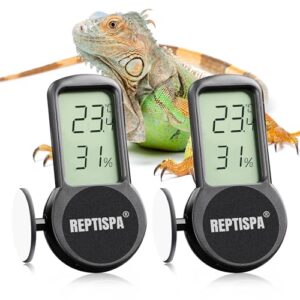
Reptispa’s PALI016-2 delivers real-time readings every 10 seconds across two compact units, making it practical for keepers monitoring multiple snake enclosures without switching between devices.
The digital thermometer hygrometer tracks temperature regulation from -4 to 140°F and humidity control from 10% to 99%RH with sensor accuracy within ±1.8°F and ±5%RH. You’ll appreciate the 360° angle adjustment for ideal probe placement, though some users report the digital displays can appear dim in bright lighting.
Thermometer calibration checks help confirm readings match your other reptile digital thermometer units.
| Best For | Reptile owners who need affordable dual monitors to track temperature and humidity across multiple enclosures without constantly moving a single device. |
|---|---|
| Display Type | Digital LCD |
| Power Source | Battery |
| Temperature Accuracy | ±1.8°F |
| Humidity Measurement | Yes (±5%RH) |
| Installation Method | 360° adjustment |
| Unit Conversion | ℉/℃ display |
| Additional Features |
|
- Two units included for monitoring separate tanks simultaneously
- Wide measurement range handles most common reptile habitat needs (-4 to 140°F, 10-99% humidity)
- 360° adjustable angle lets you position the display for easy viewing from different angles
- Display can be hard to read in bright lighting conditions
- Some users report slower response times when humidity levels change quickly
- May need calibration checks against other devices since accuracy can vary slightly
Key Features to Look for in Multi-Tank Thermometers
When you’re managing multiple snake enclosures, the right thermometer can mean the difference between guesswork and real control over your setup.
Not all devices handle multi-tank needs equally well, and certain features matter more than others when you’re monitoring several habitats at once. Here are the key specs and capabilities you should prioritize before making a purchase.
Temperature Accuracy and Reliability
Accuracy separates a functional thermometer from one that quietly lets your snakes drift into dangerous temperature zones.
For more details about safe usage and device limitations, read this review on the ReptiliaCare Digital Infrared Thermometer.
Digital models usually hold tighter accuracy standards than analog versions. Look for units with ±1°F tolerance. Quality sensors resist drift over time, reducing the need for frequent calibration methods and reliability testing.
Dual Temperature and Humidity Sensors
Tracking both temperature and humidity in one device cuts down on clutter and gives you a complete picture of each enclosure’s microclimate. Accurate readings are essential for maintaining optimal reptile conditions.
Dual monitoring systems with separate temperature probes and humidity sensors provide better accuracy than single-sensor models. Digital vs analog thermometers matter less than proper sensor calibration and humidity control features.
- Dual probe thermometers track basking and cool zones simultaneously
- Built-in humidity monitoring for reptiles eliminates separate hygrometers
- Accuracy testing ensures reliable thermometer performance across multiple tanks
Display Readability and Size
You can’t monitor your terrariums effectively if you’re squinting at tiny numbers from across the room. Large LCD screens with high display clarity let you check readings at a glance during daily habitat inspections. Font styles and viewing angles affect readability in different lighting conditions.
Digital thermometer models with color options and clear font styles outperform analog versions for multi-enclosure setups. Thermometer accuracy and reliability matter, but unreadable displays defeat the purpose of precise sensors.
| Feature | Small Display | Large Display |
|---|---|---|
| Screen Size | Under 2 inches | 2.5-3.5 inches |
| Reading Distance | 3-5 feet maximum | 10-15 feet comfortable |
| Glare Issues | High in bright rooms | Reduced with backlit options |
| Multi-tank Monitoring | Requires close approach | Efficient walk-through checks |
Probe Placement and Cable Length
Proper probe placement captures thermal gradients that matter most for snake health. Position one sensor at the basking spot and another at the cool end to track the full temperature gradient across each enclosure.
Cable length determines whether you can route probes from a centralized thermostat to all tanks without tension or unsafe bends, especially in rack systems where probe accuracy depends on secure, strain-free positioning.
Power Source and Battery Life
Battery-powered thermometers let you monitor tanks anywhere without hunting for outlets, but wired units eliminate the hassle of dead sensors during critical heating cycles. Power consumption affects how often you’ll swap AAA batteries in digital thermometers, while energy efficiency extends runtime in remote monitoring setups where reptile thermometer accuracy and reliability depend on consistent voltage.
- Battery types range from disposable AAA to rechargeable lithium cells
- Power consumption directly impacts replacement frequency in multi-tank systems
- Energy efficiency features preserve charge during continuous terrarium monitoring
- Charging systems offer USB or solar options for backup power
- Backup options prevent data loss when primary power fails
Benefits of Using Thermometers in Multiple Terrariums
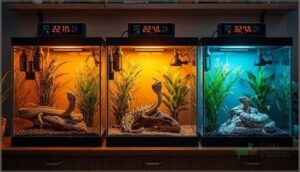
Running multiple terrariums means you’re juggling temperature gradients, basking spots, and ambient zones across several enclosures at once.
Thermometers give you the data you need to catch problems before they affect your snakes’ health. Here’s how reliable temperature monitoring makes managing multiple habitats more efficient and safer for your animals.
Maintaining Consistent Temperature Zones
Snakes don’t regulate their own body heat, so your thermometers become their lifeline to survival. Temperature gradients across each enclosure let you create proper heat mapping zones.
Thermometers are your snakes’ lifeline because they can’t regulate their own body heat—proper heat mapping zones depend on accurate temperature gradients across each enclosure
Your reptile thermometer tracks ambient monitoring data while climate control systems maintain thermal cycling patterns. Zone control becomes manageable when you’re using accurate thermostat readings.
Heat management across multiple tanks means each species gets exactly what it needs.
Preventing Overheating and Cold Spots
Thermal gradients break down when probe placement misses basking hotspots or hidden cold zones. Your thermostat won’t fix what it can’t detect, which is why redundant temperature accuracy checks matter.
- Heat source outputs exceeding 32°C risk neurological damage in ball pythons
- Buried probes record false readings and allow undetected hotspots
- Temperature control systems need verification after any bulb change
- Cold spots from poor air circulation impair digestion
- Heat management requires handheld infrared spot checks across surfaces
Your reptile thermometer catches failures before safety features activate.
Enhancing Snake Health and Well-being
Misread temperature conditions don’t just compromise comfort—they disrupt metabolic processes that govern shedding cycles, immune response, and reproductive viability. Your reptile digital thermometer tracks thermal gradients that directly affect snake nutrition absorption rates.
Temperature control systems maintaining 28-30°C enhance digestive enzyme activity. Health monitoring through habitat lighting and humidity management for reptiles prevents respiratory infections.
Terrarium maintenance and design choices impact reptile behavior patterns you can’t observe without accurate data.
Streamlining Daily Habitat Checks
Digital displays consolidate multi-tank readings into a single morning glance, eliminating the guesswork that once consumed your pre-work routine. Automation systems with thermostats reduce daily checks from 15 minutes to under 3.
You’ll spot humidity management for reptiles deviations before they escalate into respiratory crises. Temperature control alerts flag equipment failures while you’re still able to intervene, protecting reptile health across every terrarium without redundant probe inspections.
Digital Vs. Analog Thermometers for Terrariums
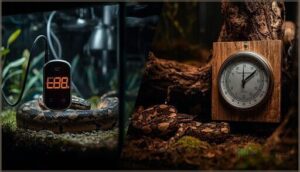
Digital thermometers give you precise readings with LCD displays and external probes, while analog models rely on basic dial mechanisms that need no batteries.
Each type has trade-offs in accuracy, convenience, and long-term reliability that matter when you’re monitoring multiple snake enclosures. Here’s what you need to know about both options before you decide which works best for your setup.
Pros and Cons of Digital Models
LCD screens and electronic sensors have transformed reptile care, but they come with trade-offs you need to understand. Digital thermometers deliver high temperature accuracy and precise sensor calibration. The display options make readings clear from several feet away. Power efficiency varies by model, so battery life becomes vital with multiple setups.
| Feature | Advantage | Limitation |
|---|---|---|
| Digital Accuracy | ±0.1°F precision | Sensor drift over time |
| User Interface | Backlit LCD displays | Requires batteries |
| Thermometer Accuracy | Real-time updates | Higher initial cost |
Pros and Cons of Analog Models
Mechanical dial gauges offer cost benefits and mechanical reliability you won’t find in electronics. Most analog thermometers run without batteries and tolerate humidity well. However, calibration issues plague these units—some read 5°F to 7°F off baseline, with extreme errors reaching 40°F under high heat.
Readability limits emerge from coarse tick spacing, and you’ll sacrifice the temperature accuracy digital probes deliver.
| Aspect | Strength | Weakness |
|---|---|---|
| Analog Accuracy | Continuous visual needle | ±5–7°F typical drift |
| Cost Benefits | $2–5 per unit | Manual recalibration needed |
| Mechanical Reliability | No circuit boards | Limited decimal resolution |
| Readability Limits | At-a-glance checks | Condensation obscures face |
Suitability for Multi-Enclosure Setups
When you’re juggling five or more terrariums, analog units quickly become a liability because checking each dial individually eats up time and increases the odds you’ll miss a dangerous temperature spike. Digital models with remote monitoring consolidate data from multiple tanks and pair with thermostat integration systems.
This enclosure design approach streamlines sensor calibration and facilitates precise temperature gradient control across your multi-tank setup.
| Feature | Digital Multi-Enclosure | Analog Multi-Tank |
|---|---|---|
| Centralized Monitoring | Yes, via hub or app | No, manual checks required |
| Thermostat Selection Guide Compatibility | Direct integration options | Separate controller needed |
| Temperature Gradient Tracking | Probe-based precision | Visual estimation only |
| Terrarium Heating Options Support | Automated response | Manual adjustment |
| Reptile Thermometer Efficiency | High for multi-enclosure | Low, repetitive checks |
Setting Up Thermometers Across Multiple Enclosures
Setting up thermometers across multiple enclosures requires careful planning to guarantee accurate readings in each habitat. You’ll need to think about where probes go, how devices mount to different tank types, and how to keep equipment from transferring contaminants between your snakes.
Here’s what you need to know about placement, mounting, and hygiene when monitoring multiple terrariums.
Ideal Probe Placement Strategies
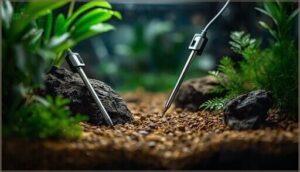
Probe placement is the backbone of accurate temperature monitoring in your terrarium, ensuring each zone stays safe and comfortable for your snakes.
For best results:
- Position probes at snake level for precise readings.
- Angle sensors to improve airflow and thermal gradient detection.
- Calibrate regularly for accuracy enhancement, supporting humidity management and temperature stability with your reptile thermometer or thermostat.
Mounting Options for Various Terrarium Types
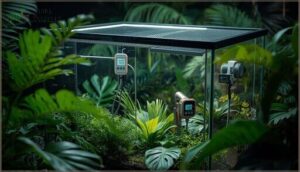
Once you’ve got your probes placed just right, it’s time to look at how mounting choices can make your thermometer setup fit any terrarium style you’ve got. Wall mounting works great for glass terrariums, while tank clips suit mesh lids. Adhesive strips and suction cups offer flexibility.
Here’s a quick table for Terrarium Placement options:
| Mounting Method | Best For |
|---|---|
| Wall Mounting | Glass Terrarium |
| Tank Clips | Mesh Lid |
| Adhesive Strips | Plastic Terrarium |
| Suction Cups | Smooth Surfaces |
| Equipment Brackets | Reptile Thermostats |
Avoiding Cross-Contamination Between Tanks
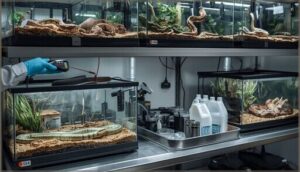
Across multi-enclosure setups, cross-contamination can sneak in like an uninvited guest. To keep pathogens at bay, you’ll want strict Sanitation Protocols and clear Equipment Isolation. Biosecurity Measures matter.
Here’s a practical checklist:
- Assign dedicated Reptile Thermometer and Hygrometer per enclosure
- Store tools separately
- Follow Cleaning Schedules
- Use gloves
- Practice thorough Hygiene Practices
Tips for Accurate Temperature and Humidity Monitoring

Getting reliable readings starts with a few smart habits. You want your sensors working accurately and consistently across every tank.
Here’s what to keep in mind for keeping temperature and humidity on track.
Cleaning and Maintenance Best Practices
Think of your thermometer like a trusted field tool—regular cleaning and routine checks keep it sharp and reliable for every enclosure. Wipe probes gently, calibrate sensors as needed, and sanitize devices to prevent buildup. Organize cables to avoid tangles.
Inspect equipment during reptile enclosure maintenance. Good reptile care and maintenance means keeping terrarium tools ready for accurate readings in all animal enclosures.
Monitoring for Sensor Malfunctions
Peace of mind comes from knowing your sensors are working as intended, catching glitches before they disrupt your snakes’ environment. For thorough habitat monitoring, keep these steps in mind:
- Schedule regular Sensor Calibration.
- Watch for Fault Detection or Error Messages.
- Test Alarm Systems monthly.
- Use Diagnostic Tools with your thermostat.
- Check Reptile Thermometer Reviews for reliability.
Buying Guide: Choosing for Multi-Tank Needs

Choosing thermometers for several snake tanks means looking at more than just the basics. You want to match features to your setup and avoid headaches down the road.
Here’s what to keep in mind as you compare your options for multi-tank monitoring.
Number of Monitoring Zones
Every terrarium is its own microclimate, so it’s smart to ask how many zones your thermometer can track before you commit.
Zone Control Systems let you monitor temperature gradients across MultiEnclosure setups. Multi Tank Management depends on Monitoring Capacity and precise Sensor Placement.
Remote Monitoring helps you spot habitat issues early.
| Monitoring Zones | Ideal Use Case |
|---|---|
| 1-2 | Small setups |
| 3+ | MultiEnclosure |
Compatibility With Heating and Humidity Equipment
Finding a thermometer that plays well with your heat mats and humidity gear is the backbone of a stable terrarium setup. You want effortless Equipment Integration with Heat Source Options and Humidity Control Systems.
Smart Sensors connect with your Thermostat or Hygrometer for precise Temperature Regulation. This facilitates effective Reptile Habitat Management and Environmental Control, keeping every enclosure balanced and safe for your snakes.
Automation and Smart Features
Imagine tracking every terrarium’s climate from your phone. Smart Sensors and Wi-Fi Connectivity let you set Automated Alerts and view conditions with Cloud Monitoring.
Remote Control and Smart Thermostat Technology—like PID Control or Dimming Thermostat options—mean you won’t miss a temperature spike. Smart Thermostats offer real-time data logging, app dashboards, and scheduling to mimic natural cycles across tanks.
Budget and Warranty Considerations
Smart features come at a price, so you’ll need to weigh upfront costs against long-term protection and support. Cost Analysis and Budget Planning help you prioritize. Compare warranties, discount availability, and your specific needs.
- REPTI ZOO Pro Thermometer offers solid Warranty Options
- Reptile Digital Thermometer 2Pack provides budget-friendly redundancy
- PAIZOO Reptile LED Thermometer balances features and price
- Vodolo 2Pack Humidity Thermometers suits multi-tank setups
- REPTI ZOO Dual Gauges combines value with reliability
Common Mistakes to Avoid With Multi-Tank Thermometers

Even experienced reptile keepers make simple errors that compromise temperature monitoring across multiple enclosures.
These mistakes can lead to inaccurate readings, equipment failure, or health risks for your snakes. Here are the most common pitfalls you need to watch out for when managing thermometers in multi-tank setups.
Overlooking Probe Placement
If you’ve ever placed a probe too close to a heat lamp or buried it under substrate, you already know how wildly inaccurate your readings can become.
Your reptile digital thermometer needs strategic placement strategies to capture true ambient temperature across terrariums.
Position probes mid-level between basking zones and cool spots.
Cable management and mounting options help you secure sensors without substrate interference, maintaining sensor accuracy your thermostat depends on.
Ignoring Calibration Schedules
Even proper probe placement won’t help if sensor drift quietly erodes your instrument accuracy. Digital thermometers and hygrometers naturally drift beyond their ±1°F and ±3–5% RH specs when you skip calibration schedules. Reptile care demands rechecking every 6 to 12 months to catch measurement uncertainty before temperature fluctuations stress your animals.
- Each uncalibrated unit in multi-tank setups drifts differently, breaking cross-terrarium comparisons
- Calibration errors mask true basking zone overheating or chronic cold stress in terrariums
- Skipping checks allows correctable thermostat and thermometer bias to persist undetected
Using Incompatible Devices
Mixing heat mats rated at 150 watts with thermostats capped at 100 watts creates fire risks that calibration can’t fix.
Device interference occurs when you pair incompatible thermostats and thermometers across terrariums, overloading circuits and damaging equipment.
Compatibility issues with your reptile thermostat generate user errors that put your snakes at risk. Always verify wattage limits and temperature probe specifications before connecting heating elements to avoid safety risks.
Neglecting Regular Maintenance
Dust buildup on thermometer probes skews your temperature readings by 3-5 degrees, turning accurate monitoring into guesswork. Sensor drift accelerates when you skip monthly calibration errors checks across your terrarium equipment and supplies.
Neglect consequences include device failure during critical breeding cycles. Environmental monitoring for reptiles demands weekly cleaning protocols and strict maintenance schedules. Your reptile enclosure maintenance routine protects against faulty data that compromises tank maintenance and reptile care and maintenance standards.
Frequently Asked Questions (FAQs)
Can one thermometer monitor multiple terrariums simultaneously?
Most single-probe thermometers can’t watch several terrariums at once. You’ll need wireless sensor tech or multi-zone control systems—devices with simultaneous readings from multiple probes—to monitor each enclosure accurately through remote monitoring and proper thermometer calibration.
How often should thermometer probes be replaced?
Replace thermometer probes every 12 to 18 months or when accuracy checks reveal drift beyond acceptable ranges.
Regular sensor calibration and maintenance schedules help guarantee reliable temperature and hygrometer readings for superior reptile care.
Do wireless thermometers work well for snake habitats?
Don’t judge a book by its cover—wireless thermometers offer strong accuracy and remote alerts for snake habitats, but thick glass may weaken signals, and battery life matters when monitoring thermal gradients across multiple reptile enclosures.
What temperature range is ideal for different snake species?
Temperature requirements vary by species. Ball pythons need 78-80°F cool side and 88-92°F basking spots.
Corn snakes prefer slightly cooler ranges at 75-82°F. Temperature gradients support reptile metabolism and thermal cycles essential for snake habitat wellness.
Are infrared thermometers accurate for terrarium monitoring?
Infrared thermometers read surface temperatures within roughly ±1 °C on matte substrates, but emissivity effects, distance errors, and reflective glass can skew readings—they’re best for basking-spot checks, not ambient air monitoring.
Conclusion
Multi-tank monitoring makes temperature management manageable when you’re balancing basking zones and cool retreats across multiple enclosures.
The snake thermometers for multiple terrariums you choose determine whether you catch heating failures before they affect your animals or discover problems during a necropsy. Probe placement beats guesswork every time.
Calibration schedules prevent false readings that mimic proper conditions while your snakes slowly cook or chill. Your monitoring system either works silently in the background or fails loudly through sick reptiles.