This site is supported by our readers. We may earn a commission, at no cost to you, if you purchase through links.
You spot a slim snake gliding along a pond’s edge and call it a garter snake. Fair guess, but you might be wrong. Ribbon snakes and garter snakes share the same family tree, same three stripes, even the same nervous energy when cornered, which trips up beginners and seasoned hikers alike.
Get closer, though, and the differences hold up every time. One species clings to water’s edge like it can’t survive without it. The other roams gardens, forests, and rocky hillsides without a second thought.
Knowing ribbon snake vs garter snake traits down to tail length and stripe placement turns guesswork into confident identification, whether you’re wading through marsh grass or checking your backyard.
Table Of Contents
- Key Takeaways
- Ribbon Snake Vs Garter Snake: Body Shape and Size
- Stripe Patterns and Identification Markers
- Habitat Preferences and Geographic Range
- Diet and Hunting Behavior
- Temperament, Handling, and Captive Care
- Frequently Asked Questions (FAQs)
- What is the difference between a garter snake and a ribbon snake?
- Is a ribbon snake harmless?
- How to identify a ribbon snake?
- What can be mistaken for a garter snake?
- How do ribbon and garter snakes reproduce?
- What are common predators of these snakes?
- Can ribbon and garter snakes coexist in the same habitat?
- How do seasonal changes affect these snakes’ behavior?
- What are the challenges in captive breeding of these species?
- What do ribbon snakes and garter snakes eat?
- Conclusion
Key Takeaways
- Ribbon snakes are slender with clean, crisp stripes and stick close to water, while garter snakes are stockier with checkered patterns and roam almost anywhere.
- Oddly enough, garter snakes have proportionally longer tails than ribbon snakes, even though ribbon snakes are the better swimmers overall.
- Their diets reflect their habitats: ribbon snakes hunt fish, frogs, and tadpoles in the water, while garter snakes eat worms, slugs, and small rodents on land.
- Temperament sets them apart too, since garter snakes tend to be docile and easy to handle, while ribbon snakes are skittish and quick to flee.
Ribbon Snake Vs Garter Snake: Body Shape and Size
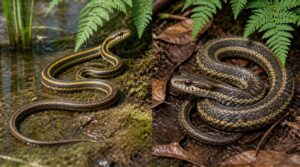
At first glance, ribbon snakes and garter snakes can look like close cousins, and honestly, they are. But once you know what to look for, their body shape gives them away fast. Here’s what sets them apart, feature by feature.
Beyond stripes and tails, diet is another point where these snakes diverge, so if you’re curious whether any snake skips meat entirely, check out this breakdown of whether a vegetarian snake could ever exist.
Slender Versus Stocky Builds
Picture a pencil next to a thumb, that’s your body shape divide here. Slender build ribbon snakes show longer necks and lean muscle across a lengthy torso, while stocky build garter snakes carry broader shoulders, denser muscle, and a stouter frame.
Like a pencil beside a thumb, the slender ribbon snake and the stocky, broad-shouldered garter snake reveal their differences at a glance
| Trait | Ribbon Snake | Garter Snake |
|---|---|---|
| Torso | Long, lean | Short, thick |
| Shoulders | Narrow | Broad |
| Muscle | Elongated | Dense |
Tail Length Proportions
That lean build carries down to the tail, but the split gets tricky here.
Garter snakes actually flaunt the longer tail, running 20-25% of body length, while ribbon snakes sit at 15-22%. Odd, right? Ribbon snakes still swim harder.
| Trait | Ribbon Snake | Garter Snake |
|---|---|---|
| Tail Ratio | 15-22% | 20-25% |
| Habitat Fit | Aquatic | Terrestrial |
Head and Neck Shape
Look at the head where it meets the body, and the differences jump out fast.
Ribbon snakes show a narrow neck region, with a continuous slope from skull to shoulders — no distinct break at all.
Garter snakes carry a triangular head profile, sitting noticeably higher than the body, giving that stockier, less sleek look their whole body structure suggests.
| Trait | Ribbon Snake | Garter Snake |
|---|---|---|
| Head Shape | Slender, tapered | Broader, triangular |
| Neck Slope | Continuous | Distinct break |
| Bulk | Less bulbous | Noticeably chunkier |
Typical Adult Length
That head shape carries straight down the body — length tells the same story.
Ribbon snakes stretch 36 to 54 inches, some western populations nearing four and a half feet, while garters usually stop between 18 and 40 inches.
| Species | Typical Length | Notable Extreme |
|---|---|---|
| Ribbon Snake | 36–54 in | ~4.5 ft |
| Garter Snake | 18–40 in | Under 3 ft |
Regional genetics and habitat quality drive size variation, but that body-to-tail ratio keeps ribbons looking longer, leaner, always.
If you’re still unsure, this detailed guide to telling garter and garden snakes apart breaks down the subtler markings that separate ribbon snakes from their stockier cousins.
Stripe Patterns and Identification Markers
If body shape didn’t convince you, the stripes will seal the deal. Once you know what to look for, these patterns turn a tricky ID into an easy one. Here’s exactly where to look and what sets these two apart.
Clean Versus Checkered Stripes

Stripe contrast clarity is your fastest clue here.
Ribbon snakes wear three crisp yellow or cream stripes with sharp edge definition and consistent color start to finish.
Garter snakes show checkered patterns instead, alternating light and dark scales with rougher color consistency. That grid-like texture, sometimes flecked with distinctive white spots, makes visual identification easy once you know what "clean" really looks like.
Lateral Stripe Scale Rows

Counting scale rows gives you a precise way to confirm what your eyes suspect.
Ribbon snakes carry their longitudinal stripes on rows three and four, while garter snakes shift them to rows two and three, each running across five to seven ridged, keeled scales at midbody. Ribbon snake stripes stay smooth and continuous edge to edge; garter stripes often show wavier borders and thin near the tail.
Upper Lip Markings
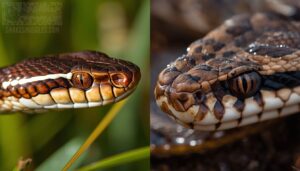
A snake’s face tells you almost as much as its back. Ribbon snakes wear a clean, unbroken pale line along the upper lip, while garter snakes show darker marks with lighter edges, breaking up the face for contrast.
Health and shedding affect sharpness, dulling under stress but brightening afterward. That crisp lip line, paired with the white stripe below it, is a dead giveaway.
Color Variation

Color isn’t fixed—it shifts with light, season, and zip code. Ribbon snakes lean bright olive with high saturation yellow stripes; garter snakes range tan to dark brown, sometimes reddish as juveniles.
- Hue intensity fades in shade, brightens in sun
- Geographic color shifts appear coast to mountains
- Iridescent scale sheen shows faintly after shedding
- Seasonal tone variation peaks in spring
This reflects phenotypic variation influenced by environmental conditions phenotypic variation
Shared Keeled Scales

Run a finger down either snake’s back and you’ll feel it: a ridged scale texture, not smooth skin. Both belong to the Thamnophis genus, sharing keeled scales that cut glare and boost grip on wet logs or dry trails.
| Trait | Function | Shared By |
|---|---|---|
| Ridge | Reduces glare | Both species |
| Texture | Improves grip | Both species |
| Keel height | Varies by habitat | Adaptation trait |
Habitat Preferences and Geographic Range

Where a snake chooses to live tells you almost as much as its stripes do. One species sticks close to water like it’s tethered there, while the other wanders into backyards, forests, and everywhere in between. Let’s look at what sets their home turf apart.
Ribbon Snake Wetland Dependency
Take a Ribbon Snake away from water for long, and it struggles. This species needs wetland edge foraging grounds—shallow marshes, pond margins, wet meadows—to hunt tadpoles and small fish.
Four things matter most:
- Shallow water prey access
- Vegetation cover importance
- Water level fluctuations
- Connectivity corridors between wetlands
Habitat degradation threatens this dependency, making habitat restoration in wetland-rich regions essential for survival.
Garter Snake Habitat Adaptability
Garter Snakes don’t need water nearby to thrive. Their habitat adaptability covers forests, meadows, gardens, and rocky hillsides alike.
Wide moisture tolerance range and sharp urban survival skills let them exploit microhabitat selection—sunny basking spots near shaded cover—even amid habitat fragmentation where Ribbon Snakes couldn’t survive.
Eastern Ribbon Snake Range
That freedom to wander is exactly what the Eastern ribbon snake, Thamnophis sauritus, can’t afford. Its geographic range hugs Atlantic coastal country from New York down to Florida, then reaches inland toward the Mississippi River.
Why the tight leash? Wetland edge habitats and riparian corridors dictate everything—these snakes track seasonal flooding patterns, shifting activity as shorelines rise and fall.
Widespread Garter Snake Range
Now stretch that map coast to coast, and you’ll see why the widespread garter snake range dwarfs its cousin’s. It spans southern Canada to northern Costa Rica.
- 25+ U.S. states, multiple provinces
- Genetic diversity regions across territory
- Seasonal population peaks in summer
- Winter severity impact on numbers
- Agricultural margin expansion via irrigation
Riparian corridor protection keeps this reach sustainable, wetland loss aside.
Urban Habitat Tolerance
Cities complicate things. Ribbon snakes stick close to rivers and streams cutting through suburbs, needing emergent vegetation for cover along drainage ditches.
Garter snakes shrug off pavement, thriving in stormwater ponds and grassy swales. Both bask on sunlit concrete near water, but ribbon snakes retreat fast—reducing risky human interaction while exploiting greenway corridors for urban prey access.
Diet and Hunting Behavior

What a snake eats says a lot about where it feels most at home. Ribbon snakes and garter snakes both hunt for a living, but they’ve picked very different menus and methods. Here’s how their eating habits stack up against each other.
Fish, Frogs, and Tadpoles
Picture a Ribbon Snake gliding along a pond’s edge, snapping up prey without ever leaving the water. That’s its whole game.
- Small fish
- Frogs
- Tadpoles (in early metamorphosis stages, still tied to aquatic habitats)
- Water bugs
- Occasional salamander larvae
Ribbon Snakes favor aquatic prey hunting almost exclusively, showing strong fish consumption patterns. Since tadpoles need standing water to survive, this diet keeps them locked to wetlands.
Worms, Slugs, and Rodents
Wander away from water and a Garter Snake barely notices, since worms and slugs make up a huge chunk of its land-based diet. Earthworms pack solid nutrition, while slugs (shell-less mollusks leaving slime trails) offer easy, slow-moving meals. Small rodents round things out too.
| Prey Type | Garter Snake Preference |
|---|---|
| Earthworms | High |
| Slugs | High |
| Rodents | Moderate |
Aquatic Versus Terrestrial Hunting
Since these two snakes share a genus but not a hunting style, their prey detection methods diverge fast:
- Ribbon Snakes lean on vibration and waterborne cues
- Garter Snakes track movement across leaf litter
- Both use forked tongues for chemical sampling
That split reflects real habitat partitioning — aquatic ambush versus terrestrial chase, each shaped by dietary specialization.
Seasonal Prey Flexibility
Menus change with the seasons, and both snakes adjust fast. Ribbon Snakes shift toward frogs during spring migrations, then fish as summer water rises. Garter Snakes lean on earthworms and insect larvae come fall.
| Season | Ribbon Snake | Garter Snake |
|---|---|---|
| Spring | Frogs | Small mammals |
| Fall | Fish | Earthworms |
Coastal populations favor aquatic prey; inland ones mix both, showing true dietary flexibility.
Temperament, Handling, and Captive Care

How a snake acts around you matters just as much as how it looks. Ribbon snakes and garter snakes handle stress, water, and enclosure life in noticeably different ways. Here’s what you should know before bringing either one home.
If you’re leaning toward something less common, Children’s pythons as pets are worth a look, though they demand steady heat and careful humidity.
Skittish Versus Docile Temperaments
Ever notice how some snakes bolt while others just… watch you? That’s temperament at work. Garter snakes are generally docile and tolerant of handling, moving slowly with steady curiosity. Ribbon snakes run skittish, flattening their bodies and darting off when startled.
Handling tolerance differs too: garters recover fast from brief disturbances, while ribbons need gradual, short sessions to build trust.
Swimming Escape Behavior
Water is where things get dramatic. Ribbon snakes use lateral undulation escape, hitting open water in under two seconds through vegetation-guided paths. Garter snakes rise head-first, swimming straight for cover. Both rely on tail flick propulsion and surface submersion patterns, but ribbons dive deeper into wetland ecosystems, while garters favor downstream escape strategy—reflecting a body to tail ratio built for different predator-prey relationships.
Handling Tolerance
Once out of the water, temperament flips the script. Garter snakes tend to be more docile, tolerating gentle contact with less fuss, while ribbons stay skittish and need shorter sessions.
- Support the body, chest to tail
- Keep sessions to 5–10 minutes
- Move slowly during removal
- Watch for gaping or hissing
- Pause if stress signs appear
Water Area Requirements
Set up the tank right, and stress drops fast. Ribbons need shallow water with dense vegetation; garters tolerate deeper pools. Both want clean, low-turbidity water.
| Species | Water Depth | Vegetation |
|---|---|---|
| Ribbon | Shallow | Dense |
| Garter | Deep OK | Moderate |
Multiple water features across the enclosure mimic wetland habitats these snakes call home.
Secure Enclosure Needs
Both species are escape artists, so latch security matters as much as tank size. Use tight-fitting lids, reinforced frame joints, and gap-free ventilation grilles—garters push against seams, ribbons dart at any crack.
Pair enclosure stability with accessible cleaning, and keep temperature regulation, humidity control, and substrate selection consistent. A wobbly, poorly sealed tank undoes every other care effort you’ve made.
Frequently Asked Questions (FAQs)
What is the difference between a garter snake and a ribbon snake?
Look at build, stripes, and lifestyle: Ribbon Snakes stay slender with clean striping and unmarked lips, sticking close to water.
Garter Snakes run stockier, show checkered scalation patterns and lip markings, and roam varied habitats with broader dietary preferences.
Is a ribbon snake harmless?
Yes, entirely — a nonvenomous species with low bite risk. No fangs, no venom toxicity, just a fast swimmer that flees rather than fights, making human interaction safety high if you handle it gently.
How to identify a ribbon snake?
Check for body slenderness, a longer tail (about a third of total length), narrow head, and three crisp longitudinal stripes with clean lip scales—no checkered pattern.
That combo, slender build plus clean stripes, is your surest Ribbon Snake giveaway over a Garter Snake.
What can be mistaken for a garter snake?
A hundred different snakes could fool you at a glance! Color confusion and pattern mimicry cause most mix-ups—Ribbon Snakes, watersnakes, even young racers.
When a Northern Watersnake puts on its defensive act, that dramatic flattening and hissing is exactly the kind of bluff explained in these 5 snakes that look similar to copperheads.
Head shape similarity and shared habitat overlap near wetlands make quick IDs tricky, especially as habitat degradation blurs typical habitat preferences.
How do ribbon and garter snakes reproduce?
Both species emerge from brumation ready for spring mating, using courtship chases and pheromone cues. They’re ovoviviparous, storing sperm until conditions suit development, then giving birth to 4-27 independent live young by summer’s end.
What are common predators of these snakes?
Feathered foes find these snakes fast: owls and hawks strike from above, using sharp aerial vision to spot movement. Herons ambush at water’s edge, while foxes and larger snakes pick off vulnerable juveniles on the ground.
Can ribbon and garter snakes coexist in the same habitat?
Yes, and it happens often. Wetland edges give both species room to work: ribbon snakes hug the water hunting fish and frogs, while garter snakes range further inland, so microhabitat partitioning keeps competition low and coexistence steady.
How do seasonal changes affect these snakes’ behavior?
Think of it as an internal clock ticking beneath the scales. Winter dormancy slows everything down, then spring warmth flips the switch: basking increases, mating season begins, and foraging ramps up as prey grows plentiful again.
What are the challenges in captive breeding of these species?
Captive breeding gets tricky fast: breeding pair compatibility is unpredictable, seasonal cues are hard to replicate, and ribbon snakes’ humidity and dietary needs demand precision garter snakes simply don’t require, straining genetic diversity management in small colonies.
What do ribbon snakes and garter snakes eat?
One’s basically fishing every meal, the other’s raiding the garden buffet. Ribbon snakes snatch fish, frogs, and tadpoles along shorelines, while garter snakes gulp down earthworms, slugs, and even small rodents inland.
Conclusion
A ribbon snake at the water’s edge is like a fisherman who never strays from the shore, while a garter snake wanders like a drifter comfortable in any yard or field. That’s the heart of ribbon snake vs garter snake 5 main differences: one tied to water, one built for anywhere.
Check the tail, count the scale rows, look at the lip marks. Trust those details, and you’ll never mistake one slender traveler for the other again.