This site is supported by our readers. We may earn a commission, at no cost to you, if you purchase through links.

Forty snakes in, your grip starts telling the truth. The hook that felt fine on enclosure three now aches in your wrist by enclosure thirty, and one sloppy scoop near a short-tempered constrictor turns a routine check into a trip to urgent care.
Big collections punish bad gear fast. Handling volume like that means wear happens daily, not occasionally, and a hook built for a single pet snake buckles under that kind of repetition.
The right snake hooks for large collections aren’t about one perfect tool. They’re about matching shaft length, grip, and material to each snake and task, so your hands hold up as long as your collection does.
Table Of Contents
- Key Takeaways
- 7 Best Snake Hooks for Large Collections
- Choosing High-Volume Snake Handling Tools
- Best Hook Sizes for Collection Tasks
- Ergonomic Features for Daily Handling
- Maintaining Hooks Across Large Collections
- Frequently Asked Questions (FAQs)
- What do professionals use to catch snakes?
- What snake is worth $100,000?
- What to use instead of a snake hook?
- What is the best snake hook?
- How many snake hooks should a facility own?
- Can snake hooks be used on venomous species?
- Whats the average lifespan of a snake hook?
- Are titanium hooks better than steel alternatives?
- How do I train new staff on hook use?
- Conclusion
Key Takeaways
- Large collections wear down hooks fast, so you need tools built for daily repetition instead of occasional use, matched to shaft length, grip, and material for each snake and task.
- Weight and balance matter more than total steel, since fatigue sets in after 2-3 hours and tools with 60-70% of their mass at the handle keep your wrist working longer.
- Facilities should stock multiple hook sizes and both hooks and tongs, since hatchlings, routine checks, and heavy-bodied adults each demand different lengths, widths, and grip styles.
- Regular cleaning, damage inspection, and a replacement schedule keep your gear safe, since cracks over 1/4 inch or worn latches turn a routine tool into a real risk.
7 Best Snake Hooks for Large Collections
Running a large collection means your hooks earn their keep every single day. You need tools built for repetition, not just the occasional rescue. Here are seven that hold up when the workload never really stops.
Before picking favorites, it helps to understand how snake hooks and tongs differ in purpose and handling so you choose the right tool for each task.
1. DocSeward Copperhead Snake Hook 43 Inch
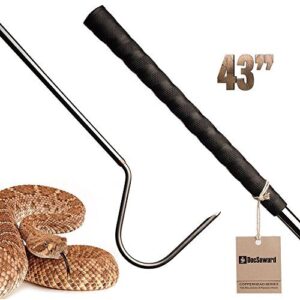
Forty-three inches of high strength steel, built for snakes that outgrow smaller tools. The welded handle junction resists loosening under force, while the forged head keeps a stable grip without crushing the snake’s body.
That extra length matters. It keeps your hands at a safer working distance, which counts for a lot once you’re moving something six or seven feet long. Corrosion resistant finish, easy cleanup after enclosure work — this one’s built for daily field use, not just weekend handling.
| Best For | Reptile handlers and outdoor professionals who need a durable, lightweight tool for safely catching, controlling, or moving snakes between 3 and 9 feet long. |
|---|---|
| Material | Stainless steel |
| Grip Type | Rubber grip |
| Length | 43 inches |
| Weight | 8 ounces |
| Adjustable | No |
| Hook Tip | Smooth steel |
| Additional Features |
|
- Copper ferrule and stainless steel hook combine for a strong, well-balanced build
- Lightweight at just 8 ounces, making it easy to maneuver during extended use
- Rubber grip offers a secure, comfortable hold, with an optional two-handed grip for extra control
- Not intended for handling venomous snakes without proper training
- Doesn’t retract or collapse, so it’s less convenient for compact storage or travel
- Rubber grip can degrade over time with heavy UV exposure
2. Gzlozak Snake Hook Set Stainless Steel
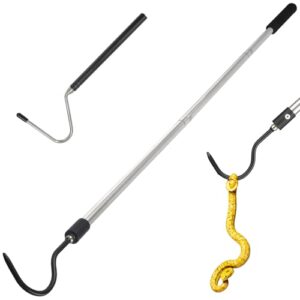
Where the Copperhead earns its keep in the field, the Gzlozak set is built for the back room. Four sections disassemble for storage, so you’re not fighting for wall space when you’ve got a dozen tools to rack.
Stainless steel holds up against enclosure fluids and daily washdowns. The welded hook joint stays rigid under load, and that gelatinous tip keeps skittish feeders from getting nicked during routine handling. Eight pounds capacity covers most mid-sized collection work.
| Best For | Reptile keepers managing multiple enclosures who need a durable, storage-friendly hook for daily handling and washdown routines. |
|---|---|
| Material | Stainless steel |
| Grip Type | Foam grip |
| Length | 7.9-65 inches |
| Weight | 1.08 lbs |
| Adjustable | Yes |
| Hook Tip | Gel-coated |
| Additional Features |
|
- Stainless steel construction stands up to enclosure fluids and frequent cleaning
- Four-section disassembly makes it easy to store without hogging wall space
- Gelatinous hook tip protects skittish or delicate snakes during routine handling
- Rubber hook coating may wear down over time with heavy use or UV exposure
- Sections can loosen with repeated assembly and disassembly
- Even at its shortest length, it may be too long for tight indoor spaces
3. Stainless Steel Retractable Snake Hook 61 Inch
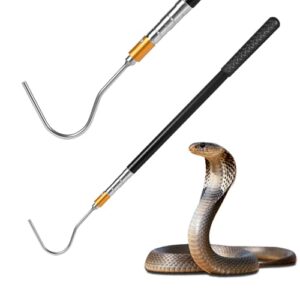
Racking tools is one thing, but reaching into a deep enclosure without crowding the snake is another problem entirely. This hook solves it with a telescoping shaft from 16 to 61 inches, locking at four points so you get exact reach without wrestling a full-length pole in tight spaces.
Stainless steel resists rust from cleaners and bodily fluids, holding up through repeated disassembly. The rubber handle keeps grip steady on wet mornings. Some users file down rough tips first.
| Best For | Reptile keepers and outdoor enthusiasts who need a safe, adjustable way to handle snakes during cleaning, relocation, or fieldwork. |
|---|---|
| Material | Stainless steel |
| Grip Type | Rubber handle |
| Length | 16-61 inches |
| Weight | 6.7 ounces |
| Adjustable | Yes |
| Hook Tip | Steel tip |
| Additional Features |
|
- Telescoping design (16–61 inches) with four locking points allows precise reach in tight or deep enclosures
- Stainless steel construction resists rust and holds up to repeated cleaning and disassembly
- Rubber handle provides a secure, non-slip grip even in wet conditions
- Some units arrive with rough hook tips that need filing before use
- Telescoping mechanism may wear out or fail with heavy or particularly active snakes
- Extension and retraction can feel stiff at first, sometimes requiring lubrication or handle reattachment
4. Ruyarxnm Carbon Snake Hook Tongs
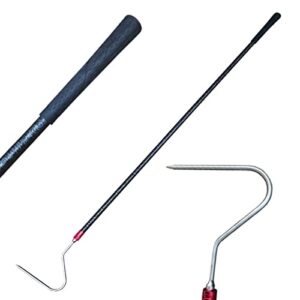
Retractable poles solve reach, but weight matters too, especially if you’re lifting mid to large snakes all shift. That’s where carbon fiber earns its keep.
The shaft stays rigid under load while shaving ounces off your grip, paired with a stainless steel hook tip that shrugs off rust from cleaning chemicals and enclosure humidity.
Compatible with standard 1/4 to 3/8 inch hook fittings, so replacements won’t leave you hunting for parts. The rubberized, textured grip holds firm even with gloves on.
| Best For | Reptile keepers and handlers who need a lightweight, durable tool for safely capturing and relocating snakes up to 9 lbs, including species like ball pythons, garter snakes, and copperheads. |
|---|---|
| Material | Carbon fiber/steel |
| Grip Type | Rubber grip |
| Length | 48 inches |
| Weight | 6.4 ounces |
| Adjustable | No |
| Hook Tip | Duckbill steel |
| Additional Features |
|
- Carbon fiber shaft keeps the tool lightweight (just 6.4 oz) while staying rigid and sturdy during use
- Stainless steel duckbill hook resists rust and holds up well against cleaning chemicals and humidity
- Rubber ergonomic grip stays comfortable and non-slip, even during extended handling sessions
- Hook tip ships sharp and may need filing or extra covering before it’s safe for animal use
- Included rubber hose only protects the tip, not the entire hook
- Not suitable for constrictor snakes longer than 7 feet, despite the 9 lb weight rating
5. Wamlet Adjustable Snake Hook Tongs
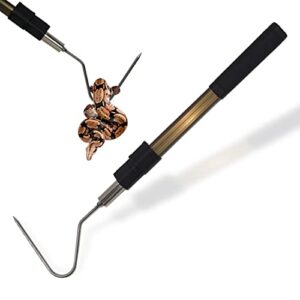
One tool, two jobs: crawl into a hatchling tub, then stretch out for the big enclosure across the room. The telescoping shaft runs 22.75 to 41.6 inches, locked in place with a push-button collar so it won’t slip mid-lift.
That extra reach matters once your snake outgrows the tub, since figuring out how much space your snake’s enclosure actually needs makes all the difference for long-term comfort.
Stainless steel hook meets aluminum alloy pole, rounded at the tip so nothing digs into scales. At 13.1 ounces, your wrist won’t tire by enclosure twenty. Skip it for anything over 8 pounds, though.
| Best For | Reptile keepers and field herpetologists who need a safe, adjustable way to handle medium to large snakes like ball pythons, copperheads, and rattlesnakes. |
|---|---|
| Material | Aluminum/steel |
| Grip Type | Rubber grip |
| Length | 22.75-41.6 inches |
| Weight | 13.1 ounces |
| Adjustable | Yes |
| Hook Tip | Rounded tip |
| Additional Features |
|
- Telescoping length from 22.75" to 41.6" adapts easily to hatchling tubs or full-size enclosures
- Rounded stainless steel hook protects snakes from injury during handling
- Lightweight at 13.1 ounces, reducing wrist fatigue during extended use
- Not suitable for snakes over 8 pounds
- Less effective grip on very small or slender snake species
- Requires manual locking, with no automatic length retention
6. Pink Reptile Hook 18.5 Inch Rubber Handle
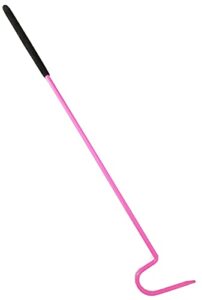
Eighteen and a half inches puts this hook squarely in mid-range territory, built for hognose snakes, kingsnakes, and small ball pythons rather than heavy-bodied adults.
The rubber handle stays grippy even when your hands are sweaty or wet from cleaning enclosures. A textured surface and slight end flare keep it from sliding during maneuvers.
Its polished metal shaft resists corrosion and won’t snag on tank furniture. Skip it for larger, aggressive snakes — reviewers note bending under real weight.
| Best For | Owners of hognose snakes, kingsnakes, and small ball pythons who want a lightweight, easy-to-grip hook for everyday handling. |
|---|---|
| Material | Stainless steel |
| Grip Type | Rubber handle |
| Length | 18.5 inches |
| Weight | N/A |
| Adjustable | No |
| Hook Tip | Polished steel |
| Additional Features |
|
- Rubber handle offers a secure, non-slip grip even with wet or sweaty hands
- Polished metal shaft resists corrosion and glides smoothly past tank furniture
- Lightweight build reduces wrist strain during extended handling sessions
- Not sturdy enough for larger or heavy-bodied ball pythons
- Some buyers reported receiving the wrong color or a bent, misshapen hook
- Can bend or become unstable when used with heavy or aggressive reptiles
7. IC ICLOVER Snake Tong and Hook Set
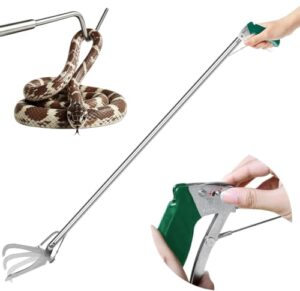
When your collection spans multiple species, one tool that does two jobs earns its shelf space. The 52-inch tong pairs a serrated wide jaw with a 39.3-inch hook collapsing to 11.4 inches for storage.
Auto-lock and non-slip grip keep control steady during transfers. Built from 19mm stainless steel, it holds up under daily use.
Stick to snakes under 2 pounds. The included repair kit helps, but cable sleeves aren’t reusable, so plan replacements ahead.
| Best For | Reptile keepers and small-scale hobbyists who handle multiple non-venomous species and need one versatile, compact tool for safe, at-a-distance snake handling. |
|---|---|
| Material | Stainless steel |
| Grip Type | Rubber handle |
| Length | 11.4-39.3 inches |
| Weight | 2.14 lbs |
| Adjustable | Yes |
| Hook Tip | Serrated jaw |
| Additional Features |
|
- Dual-purpose design combines a secure serrated-jaw tong with a collapsible hook, covering more handling needs in one tool
- Auto-lock mechanism and non-slip rubber handle provide steady, controlled grip during transfers
- Durable 19mm stainless steel construction stands up to regular, daily use
- Only suitable for snakes under 2 pounds, ruling out larger or heavier reptiles
- Lock mechanism can loosen over time, requiring periodic tightening to stay reliable
- Repair kit’s cable sleeves aren’t reusable, so long-term fixes mean sourcing extra parts
Choosing High-Volume Snake Handling Tools

Running a large collection changes what you need from a hook. The right tool depends on your snakes, your space, and how many enclosures you’re working through each day. Here’s what to weigh before you pick your next hook.
Collection Size and Species
Big rooms full of snakes need more than one hook size. Species diversity means hatchlings and heavy-bodied adults both need proper tools.
Grab the Maxi Pinner Hook for bulk work, an XL Python Hook BLUE or XXL Python Hook BLUE for giants, and keep 40 Snake Handling Tongs Wide Jaws on hand.
Match tools to what’s actually in your enclosures.
Hook Versus Tong Designs
Hooks and tongs solve different problems. Hooks cradle and lift; tongs grip and control.
- Curved hook ends cradle with minimal pressure
- Opposing tong jaws grip snake bodies firmly
- Needle-sharp tong tips limit tissue contact
- Notched hooks guide heads toward the shaft
- Wrist-neutral tong grips improve capture precision
For large collections, stock both. Hooks suit routine moves; tongs suit close-quarters handling precision.
Fixed Versus Retractable Shafts
One shaft moves, the other doesn’t—that single difference changes everything about control.
| Shaft Type | Best For |
|---|---|
| Fixed | Predictable force, easy cleaning |
| Retractable | Awkward enclosures, adjustable reach |
| Both | Corrosion-resistant finishes |
The Professional Snake Hook Standard Hook stays rigid. A Collapsible Field Hook slides and locks. Fixed shafts resist grime; retractable ones need locking-mechanism checks and lubrication at sliding joints.
Weight and Daily Workload
Grip a hook for six hours straight and you’ll feel every gram. Tools run 0.2 to 1.2 kg; the Redline Science 18 Ultralight Snake Hook stays light, while longer models like the Collapsible Field Hook add 150-400g.
Fatigue sets in after 2-3 hours. Balance point design matters more than total weight—aim for 60-70% mass at the handle.
Facility and Field Use
Balance point matters less once you leave the building. In the field, a Collapsible Tongs setup beats a rigid Double Snake Hook for pack space.
Facility work rewards fixed shafts near color-coded pathways and intake quarantine zones.
Wide corridor transfer favors longer XL Python Hook designs.
Match your herpetology field supplies to where you’ll actually stand.
Best Hook Sizes for Collection Tasks
One size never covers a whole collection. Different snakes at different stages need different lengths and widths in your hand. Here’s how to match the hook to the task.
Short Hooks for Hatchlings

When your snake is barely bigger than a pencil, size matters more than strength. Reach for a Mini Pinner Hook or the Mini Snake Hook 24" — short, light, and easy to control for stress-free hooking.
- the fragile curve of a hatchling’s spine
- the flinch of a startled newborn
- the calm of a steady, practiced hand
Smooth stainless tips protect delicate scales during gentle handling.
Medium Hooks for Routine Care
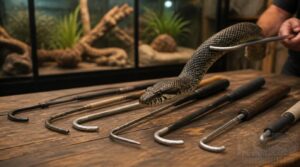
Once your snake graduates past hatchling status, you need a hook with more reach and confidence behind it. The O’Shea Snake Hook Medium Standard or Medium Narrow controls routine checks without spooking your animal.
| Hook | Length | Best For |
|---|---|---|
| O’Shea Medium | 40-55" | Daily checks |
| Python Medium | 40-55" | Larger bodies |
| Professional Narrow | 40-55" | Precision work |
Smooth, rounded tips glide along scales, minimizing strike risk during probing.
Long Hooks for Larger Snakes
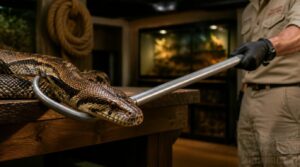
Big-bodied pythons and boas need distance, not just reach. The XL Python Hook and O’Shea Snake Hook Long Standard Hook give you 47 to 60 inches, keeping strikes away from your hands.
Length isn’t the whole story though. Reinforced aluminum shafts resist bending under heavy coils, while the Professional Snake Hook Narrow Hook adds precision for guiding without crowding the head. Considering hook design and functionality is essential for safe and effective handling of large constrictors.
Wide Hooks for Heavy Bodies

Thick-bodied constrictors need more than length; they need pressure distribution across the whole hook.
- Curved jaw design cradles the coil
- Reinforced joints resist bending
- Weight ratings above 2.5kg
- Wide jaws prevent slipping
The XL Python Hook and O’Shea Snake Hook Long Narrow Hook give solid body support, while the Professional Snake Hook Narrow Hook’s titanium hook holds up under repeated heavy lifts.
Multiple Sizes Per Facility

One hook never covers a whole collection. Facilities running dozens of enclosures keep at least five sizes on hand, from the 24 Snake Hook for hatchlings to the 38 Snake Hook and Professional Field Hook for adults.
| Task | Recommended Size |
|---|---|
| Hatchling checks | 24 Snake Hook |
| Routine handling | 38 Snake Hook |
| Adult transfers | Professional Field Hook |
| Field work | Collapsible Tongs40 |
| Heavy-bodied moves | Collapsible Tongs52 |
Size-based labeling and rotation protocols keep cross-enclosure sizing accurate daily.
Ergonomic Features for Daily Handling

Your hands take a beating when you’re working through a hundred enclosures in a day. The right hook shouldn’t fight you back, it should feel like an extension of your arm. Here’s what separates a tool that helps from one that just adds to the strain.
A good hook shouldn’t fight you back—it should feel like an extension of your arm
Textured Non-slip Rubber Grips
Sweat happens fast during a full-day sweep of enclosures, and that’s exactly where textured non-slip rubber grips earn their keep. Diamond and crosshatch patterns boost friction by up to 35%, holding steady even at 20% moisture.
Built for professional herpetology gear standards, these grips resist cracking past 10,000 flex cycles. Wipe clean with soap and water—no fuss, no slipping.
Wrist-friendly Contoured Handles
Your wrist takes the real hit after hour three of enclosure sweeps. Ergonomic grip design with off-axis contours keeps wrist alignment neutral, cutting flexion strain during pulls.
Contours spread pressure across your palm instead of one hot spot, so fatigue reduction actually holds up.
- Neutral wrist posture during retrieval
- Multi-point pressure distribution
- Comfort grip fit across hand sizes
That’s what separates casual hooks from a real professional herpetology kit.
Secure Flared Handle Bases
Ever set a hook down mid-task and watched it roll off the bench? A flared handle base fixes that fast, widening contact for real stability.
That flare also backs your grip security, keeping wrist alignment steady through fast retrievals. Even gloved or damp hands stay anchored, no slipping mid-transfer.
Reliable tool orientation retention matters in a professional herpetology kit.
Lightweight Balanced Construction
A flared base keeps your grip locked, but weight decides how long you last through a full round of enclosures. Balanced weight distribution and centered shaft alignment cut torque with every reach.
- Uniform material density
- Ergonomic grip positioning
- Corrosion-resistant shaft
- Low torque design
Lightweight balanced construction, engineered for control, designed with safety in mind, adaptable for daily handling.
Color-coded Collection Tools
Balance gets you through the round. Color gets you through it without grabbing the wrong tool. Red, yellow, and green codes mark risk level at a glance, baked onto shafts so alcohol wipes and bleach won’t fade them.
Molded grips add tactile recognition in dim rooms. Worn codes get logged and swapped during routine maintenance tracking, keeping your reptile handling equipment sharp.
Maintaining Hooks Across Large Collections
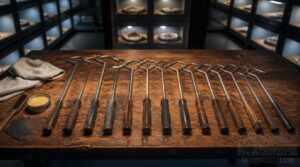
A big collection means your hooks work overtime, and that wear adds up fast. Staying on top of upkeep protects both your snakes and your hands. Here’s what keeping dozens of hooks in fighting shape actually looks like.
Cleaning Between Snake Enclosures
Because pathogens outlast their host, your snake handling gear needs a full reset between rooms. Swap substrate, wipe walls with reptile-safe disinfectant, then rinse clean. Sanitize dishes on their own schedule. Let everything dry before the next snake goes in.
- Fresh substrate, every enclosure
- Rinsed, disinfected walls
- Fully dried surfaces before reentry
Preventing Cross-contamination
A clean hook still carries risk if it moves straight from one enclosure to the next. Pair your Glove Change Protocol with a Dedicated Transfer Container so nothing touches skin twice.
Respect Disinfectant Contact Time fully, not just a quick spray.
Store gear with a consistent Tool Storage Method, and let color-coded reptile handling tools keep each enclosure’s equipment separate.
Inspecting Hooks for Damage
Run your thumb along every hook before it touches a snake. Crack inspection catches trouble early; anything over 1/4 inch means retirement, no exceptions.
Check throat wear, neck deformation, and latch testing at attachment points. A wobbly latch or bent neck isn’t cosmetic, it’s a failure waiting to happen. Log each finding.
Organizing Tools by Purpose
When your hooks pile up in one bin, function grouping saves your shift. Sort by task: capture hooks, transfer hooks, restraint tongs, each in its own zone.
Set up workflow zones near enclosures matching daily routines. Add storage labeling with size and species tags. Accessibility layout matters too, keep frequently grabbed gear within easy reach, not buried under rarely used field herpetology equipment.
Planning Replacement and Backups
Worn tips fail fast under daily use. Build a backup planning schedule, swap tools yearly, and keep a spare parts inventory of tips, grips, and shafts.
Set a replacement timeline with quarterly checkpoints. Run quality assurance checks on every new hook before it touches a venomous snake. Data-driven stock tracking keeps your reptile safety gear ready, not reactive.
Frequently Asked Questions (FAQs)
What do professionals use to catch snakes?
You’ll rely on long snake hooks and heavy duty tongs for distance and grip. Retractable or fixed shafts, wide jaws, and rubber padded grips round out your capture equipment for safe, controlled handling.
What snake is worth $100,000?
Like fine art at auction, rare morphs command wild sums.
Among the most expensive venomous snakes, premium specimens with proven genetic lineage value reach $100,000, especially prized in tightly regulated high-end collector markets for rare albino morphs.
What to use instead of a snake hook?
Reach for snake tongs for mid-body grip, a drag bag for transport, or a soft net to scoop small snakes. Reinforced gloves and a stocked toolbox round out safer, nonlethal capture methods for daily handling.
What is the best snake hook?
A blacksmith trusts one hammer above the rest, shaped to his hand alone. Your best snake hook balances hook shape, reach, and grip comfort—think O’Shea Snake Hook Long Standard, stainless steel, matched to your collection’s daily demands.
How many snake hooks should a facility own?
Plan on six to twelve hooks, matched to enclosure count and technician shifts. Keep varieties on hand—fixed, retractable, tongs—plus emergency backups. Redundancy matters: if one’s being cleaned, your stock level shouldn’t leave anyone reaching for nothing.
Can snake hooks be used on venomous species?
A trusted hook works like a bodyguard between you and danger. Yes—safe distance handling and strike prevention technique make venomous work possible, but only with proper training, protective barriers, and steady, practiced calm.
Whats the average lifespan of a snake hook?
Expect 5 to 7 years with regular care. A corrosion-resistant shaft, like stainless steel or heavy duty aluminum, pushes that toward 10 years. Daily use, poor drying, and skipped inspections shorten it fast, so build replacement planning into your routine.
Are titanium hooks better than steel alternatives?
A keeper handling 80 pythons daily switched to titanium and noticed less wrist strain by week’s end.
Titanium Snake Hook designs win on weight advantage and fatigue performance, though a Stainless Steel Snake Hook still resists corrosion and holds up under heavy loads.
How do I train new staff on hook use?
Start with an onboarding checklist, then move to trainer demonstration on live setups. Follow with mentor-guided practice at a 1-to-3 ratio, a safety briefing on gear and escape prevention, and a five-task skills assessment.
Conclusion
The lighter your hook feels, the safer your hands stay. That’s the paradox behind every great tool here: less strain always builds more control.
The lighter your hook feels, the safer your hands stay. That’s the paradox behind every great tool here: less strain always builds more control. The best snake hooks for large collections aren’t measured in inches or steel grade. They’re measured in the wrist that still works at snake sixty, the grip that never slips at enclosure ninety. Choose right once, and your hands outlast the collection.