This site is supported by our readers. We may earn a commission, at no cost to you, if you purchase through links.
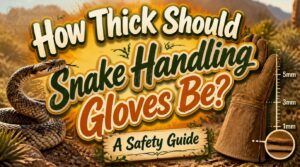
A copperhead bit through a leather glove I trusted for years. Fangs found a seam, not the palm. That taught me thickness alone won’t save your hand—placement and material matter just as much.
Most handlers assume thicker means safer, so they buy stiff, bulky gloves and lose their grip. That’s backwards. The right thickness depends on where the leather sits on your hand, what snake you’re working, and how those fangs move once they strike.
Get this balance wrong, and you’re either exposed or clumsy. Get it right, and your hands stay protected without losing the feel you need to work safely.
Table Of Contents
- Key Takeaways
- How Thick Should Snake Handling Gloves Be
- Match Glove Thickness to Snake Risk
- How Fangs Penetrate Thick Gloves
- Best Materials for Puncture Resistance
- Construction Features Affecting Protection
- Balance Glove Thickness and Dexterity
- Choose Proper Glove Length
- Top 5 Snake Handling Glove Options
- Inspect Gloves Before Every Handling
- Frequently Asked Questions (FAQs)
- Can a copperhead bite through gloves?
- Are 6 mil or 8 mil gloves thicker?
- Can I wear gloves to handle my snake?
- What material can rattlesnakes not bite through?
- How often should snake handling gloves be replaced?
- Can snake gloves be washed or cleaned safely?
- Do gloves protect against non-venomous snake bites too?
- Are leather gloves better than synthetic alternatives overall?
- Conclusion
Key Takeaways
- Glove thickness isn’t one-size-fits-all—you need 4-5mm at the palms for puncture resistance, but only 1-2mm at the fingers so you don’t lose the dexterity that keeps you safe.
- No glove is truly bite-proof, since fang length, strike angle, and worn seams can all let a bite through no matter how thick your leather is.
- Match your gloves to the snake you’re handling: thin gloves work fine for small nonvenomous pets, while large constrictors need reinforced padding and venomous species demand full safety protocols on top of gear.
- Inspect your gloves before every session, checking seams, leather condition, and moisture damage, since worn or wet leather punctures far more easily than gear in good shape.
How Thick Should Snake Handling Gloves Be
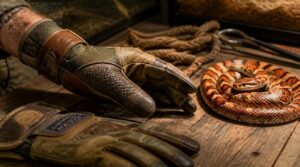
Thickness isn’t a single number. It shifts across your hand, and it shifts with the snake you’re handling. Here’s what actually matters, zone by zone.
As the snake redistributes its weight across your palms and forearms, you’ll need to keep adjusting your grip, and this guide on supporting snake weight while holding your pet breaks down exactly how.
4–5 Millimeters for Reinforced Zones
Four to five millimeters. That’s the sweet spot for palms and finger bases, where fangs strike most. This range delivers real puncture resistance without turning your hand into a brick.
Builders achieve it through layered impact absorption—a hard outer shell over ductile backing—plus seam reinforcement techniques that stop stitch holes from becoming weak points during a strike.
1–2 Millimeters for Flexible Fingers
Your palm’s protected. Your fingers need something else entirely.
Drop to 1 to 2 millimeters here, and you get near-bare-hand sensitivity for hook and tong control. Thin zones demand tougher outer layers plus joint reinforcement to survive flexing fatigue. Full-grain leather or Kevlar-lined panels hold puncture resistance without killing dexterity. That’s the tradeoff: precision now, backed by 4 to 5mm armor nearby. The thickness of a standard U.S. penny is approximately 2mm in inches.
10–12 Ounce Leather Benchmark
So how do you talk leather weight with a supplier? Ounces, not millimeters.
10 ounce leather runs about 4.0mm thick, 12 ounce nears 4.5mm. That’s the sweet spot for gauntlets: dense grain, real puncture resistance, still workable for stitching and edge finishing. Go full-grain here. Split hides thin out fast and fail where you need them most.
Thickness Varies by Hand Zone
One weight doesn’t fit the whole hand. Palm reinforcement zones run heaviest, built for crush and puncture resistance. Fingers stay thin for dexterity.
Knuckle protection layers add just enough padding without stiffening bend. Thumb base padding guards a high-strike point.
Wrist flexibility needs keep cuffs mobile. Double-layer palms in full-grain leather resist impact fatigue better than single sheets ever will.
No Thickness is Bite-Proof
Nobody wants to hear it, but no glove stops every bite. Fang penetration depends on force, angle, and material fatigue working together against you.
Puncture depth varies strike to strike. Fresh fangs from recent replacement cycles bite deeper than worn ones.
- Seam vulnerability at stitch lines
- Micro-tears in worn leather
- Weak points where materials meet
- Repeated strikes causing fatigue
- Moisture weakening fibers over time
Even Kevlar-lined or chainmail gloves reduce risk, not eliminate it.
Match Glove Thickness to Snake Risk

Not every snake needs the same glove. A corn snake and a Gaboon viper live in completely different risk categories. Here’s how to match your protection to what you’re actually handling.
Small Nonvenomous Pet Snakes
Ball pythons, corn snakes, garter snakes—these guys rarely need heavy armor. Thin leather gloves, even light gardening gloves, handle most nips fine since bites feel like a pinprick, not a puncture threat.
Focus on gentle handling technique instead: support the whole body, move slow, and watch for stress signals. Dexterity matters more than thickness here.
Large Constrictors Need Extra Padding
Reticulated pythons and boas hit different. Crushing force, not venom, is the threat.
You need double-layer palms in full-grain leather, reinforced knuckle zones, and shock-absorbing padding at contact points. Moisture-resistant treatments keep leather from softening mid-handling.
Skip Kevlar-lined gloves here—overkill for teeth, not fangs. Contoured fit with reinforced seams lets you grip coils without the glove sliding.
Venomous Snakes Require Professional Protocols
Gloves alone won’t save you here. Venomous work demands controlled handling environments, trained backup, and real emergency response protocols—not just thick leather.
- Facility safety audits catching gaps before they bite
- Antivenom administration training for staff on-site
- Incident reporting systems tracking every close call
Kevlar-lined gloves rated ANSI cut level A4 help, but protocol is what keeps fang penetration from becoming a funeral.
Long Fangs Exceed Glove Protection
Some fangs simply outsize your gear. Gaboon vipers carry fangs 5-7 cm long — past the protection threshold most gloves offer. Fang length correlation matters: longer fangs find gaps at cuffs and seams, no matter how reinforced. Even kevlar-lined gloves rated A4 can’t guarantee coverage against fang tip pressure driving that deep. Reinforced seams help, but they’re not invincible.
Defensive Behavior Raises Bite Risk
A cornered snake doesn’t think — it reacts. Threat assessment triggers rapid jaw closure the instant a snake feels trapped, and no glove thickness changes that math. Watch for coiling, head jerks, or hissing; these are warnings before a strike.
Proximal threat states turn defensive posture into a full bite fast. Species defensiveness varies widely, so know your animal before you glove up.
How Fangs Penetrate Thick Gloves
Thick leather looks tough. It isn’t always enough. Here’s exactly how a fang finds its way through.
Thick leather looks tough, but a determined fang always finds its way through
Fang Length and Sharpness
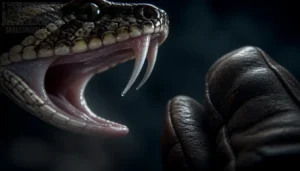
Two centimeters doesn’t sound like much. But pair that length with a needle-sharp tip, and you’ve got a tool built to find gaps in your gloves.
Fang length varies widely by species and even individual snakes. Longer fangs reach deeper tissue. Shorter ones strike faster. Wear rounds the tip over time, but shedding cycles restore sharpness, keeping fang tip pressure dangerously consistent strike after strike.
Concentrated Bite Pressure

Sharp tips do more than tear skin. They act as force concentration points, taking a snake’s full bite force and driving it into a pinpoint area — spiking pressure exactly where your glove is thinnest.
Bite force simulation studies confirm this:
- Fang tip pressure rivals hypodermic needles
- Small contact patches defeat thick padding
- Peak pressure management matters more than raw force
Sustained Bites and Chewing
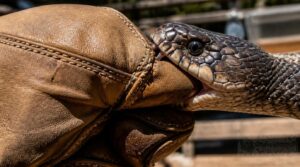
A single strike isn’t the real danger. Sustained chewing is, especially when a stressed snake gnaws seams instead of releasing.
Repeated jaw pressure fatigues material, prying stitch gaps open over seconds. That’s why reinforced seams and double-layer palms matter — hard-soft pairing slows tearing better than raw thickness alone during a prolonged, defensive bite.
Recurved Teeth Grip Material
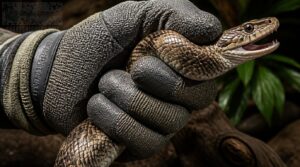
Not every threat comes from hollow fangs. Nonvenomous species rely on recurved teeth, curved backward for grip rather than injection, and gloves need different armor here.
Curved tooth contact demands flexibility — rigid shells crack. Look for grip material flexibility with reinforced fiber inclusion, plus pressure distribution texture and moisture resistant coating to handle repeated, twisting bite mechanics without failing.
Venom Enters Through Small Punctures

Here’s what should scare you: it doesn’t take a full bite to poison you. A few millimeters of broken skin opens venom capillary movement straight toward blood vessels.
Seam allowance exposure at stitch lines creates exactly that risk — micro puncture points venom exploits fast. Absorption speeds up near capillaries, so inspect gloves after every strike, no exceptions.
Best Materials for Puncture Resistance

Not all materials handle a strike the same way. Some spread the force out, some stop the fang cold, and some do both. Here are five options worth knowing before you buy your next pair.
Thick Full-Grain Leather
Not all hides fight back the same way. Full-grain leather keeps its natural fiber network intact, giving fangs no weak seam to exploit. Thick leather in the 10-12 ounce range resists tearing far better than corrected grain.
Pairing that heavy leather with an underlying padded layer adds another buffer, and this guide to snake-bite-resistant fabric materials breaks down which combinations hold up best.
Break-in flexibility improves with wear, and a patina builds from hand oils, adding durability without sacrificing bite resistance.
Double-Layered Leather Construction
Two hides beat one. Doublelayer palms spread fang pressure across a wider surface than fullgrain leather alone, boosting impact distribution and wear longevity.
- Stronger layer bonding strength at stress points
- Better moisture barrier design between hides
- Reduced seam vulnerability from overlapping edges
- Improved abrasion resistance on contact zones
- Some flexibility trade-off, but worth it
Bulkier? Sure. But these leather gloves earn their keep as serious protective equipment.
Kevlar-Lined Protective Gloves
Fibers over fangs. Kevlar-lined gloves add 0.5-1.5mm of puncture depth without the bulk of double-layer palms, with knuckle reinforcement thickest where strikes land hardest.
The Kevlar weave pattern grips scales while preserving tactile sensitivity at your fingertips. It withstands 1000+ flex cycle durability ratings and holds firm across wide temperature resistance ranges — cold mornings, hot enclosures, doesn’t matter.
Reinforced Composite Materials
Layered engineering beats brute thickness. Composite panels borrow from aerospace: carbon fiber strength meets resin matrix adhesion, distributing bite force sideways.
- 40-60% fiber volume fraction
- Impact resistance testing under Charpy standards
- Thermal expansion control for hot enclosures
- Outperforms plain reinforced leather padding
- Complements double leather reinforced padding
Material fatigue testing confirms these puncture resistant materials outlast single-layer designs against repeated strikes.
Chainmail Puncture Protection
Chainmail turns fang tips into a math problem: penetrate enough steel rings, or don’t. Weave density and ring overlap design decide the outcome.
| Feature | Function | Benefit |
|---|---|---|
| Tight weave | Blocks gaps | Fewer entry points |
| Padding | Absorbs force | Multiple bite resistance |
| Alloy mail | Adds strength | Lasting durability |
Pair with maintenance protocols—rust checks, ring inspection—or protection fails.
Construction Features Affecting Protection

Thickness alone won’t save you. How the glove is built matters just as much as what it’s made from. Here’s what to check before you trust one near a strike zone.
Reinforced Seams and Stitching
Where two panels meet, you’ve got a weak spot. Stitch holes cut through fibers, so seam reinforcement techniques matter more than raw leather thickness.
- Radial stitching pulls stress away from fingertips
- 12-14 stitches per inch in palm patches
- Triple stitch lines back up critical zones
Nylon thread holds strength even after sweat exposure. Glove durability testing catches weak seams before a snake does.
Layered Palms and Fingers
Good stitching only holds if the layers underneath pull their weight. Palm Layer Connection pairs thick leather with a Kevlar-lined inner shell — sandwich construction that spreads bite force wide.
Finger Layer Flex trims that down for grip. Double Leather Reinforced Padding suits your palm center; Reinforced Leather Padding elsewhere. Layer Maintenance Protocols: check for delamination often. Hybrid Protective Layers give responsive layer behavior under a real strike.
Protected Material Interfaces
Where leather meets Kevlar, trouble hides. Interface bonding needs flexible adhesives that won’t crack under repeated flexion — brittle glue cracks, gaps open.
Moisture transfer matters too: trapped sweat breeds wet leather vulnerability and dermatitis alike. Add thermal cycling, and mismatched layers delaminate. Abrasion coatings at knuckles slow that degradation, buying you seasons before punctures start where they shouldn’t.
Secure Cuff Closures
Delaminated interfaces mean nothing if the cuff itself fails. A locking mechanism design beats friction alone, and you should manage it with one hand operation while your other hand controls the snake.
Buckles hold tension through moisture and oils better than Velcro over time. Run a closure durability test regularly — snag-free, wet or muddy, every time.
Proper Fit Prevents Shifting
A loose glove is a liability. Fit beats thickness when a strike comes fast.
- Palm Snug Fit for proper grip
- Back Hand Looseness for movement
- Knuckle Individualized Thickness cuts bulk
- Wrist Tension Control stops ride-up
- Finger Joint Flexibility preserves dexterity
Thick leather or Kevlar-lined gloves mean nothing if they shift mid-handle, exposing skin right when you need coverage most.
Balance Glove Thickness and Dexterity

Thick isn’t always better. Too much padding kills your feel for the snake, and that’s a problem. Here’s how to strike the right balance between protection and control.
Thinner Flexible Finger Panels
Fingers do the thinking. Keep them at 1 to 2 millimeters, and you’ll feel muscle shifts before a strike happens. Thicker material here kills that early warning system.
Snake handling gloves built this way trade some puncture resistance for control, but that’s the point. Even Kevlar panels get thinned at the fingertips, since dexterity keeps your grip honest during strike response.
Reinforced Hand Protection Zones
Knuckles take the brunt of a strike. That’s why the back of your hand needs double-stitch reinforcement over the metacarpals, absorbing impact before fangs reach skin.
Good gloves pair metacarpal padding with zonal flex design, keeping knuckles mobile. Layered composite build—leather over Kevlar—builds impact fatigue resistance, so reinforced leather padding won’t crack under repeated bites.
Tapered Thickness Designs
One glove, five thickness zones. That’s the logic behind gradual thickness change — thick leather over the forearm, tapering down through adaptive flex zones at the knuckles, ending thin at the fingertips.
Zone specific layering and material gradient blending build an ergonomic taper profile, so Kevlar-lined gloves protect without stiffening your grip. Good bite resistance evaluation always weighs this dexterity tradeoff.
Grip Control and Sensitivity
Can you feel a snake shift its weight before it strikes? That’s fingerpad friction patterns at work, and thick leather kills it dead.
Your nervous system needs real tactile input for grip force adaptation. Kevlar-lined gloves over 3mm blunt that signal fast. Sensory-motor connection suffers, pressure distribution balance goes sideways, and handling gloves become a liability, not protection. That tactile sensitivity tradeoff is real — respect it.
Avoid Oversized Stiff Gloves
Bigger isn’t safer. Oversized gloves bunch at the palm, killing glove flexibility and handling when a snake shifts fast.
Bulk doesn’t equal protection. Stiff, ill-fitted leather traps your fingers mid-grip, wrecking glove dexterity tradeoffs you can’t afford. Run a glove flexibility assessment before every session: proper fit, snug sizing, full range of motion. User comfort and fit customization aren’t luxuries here.
Choose Proper Glove Length
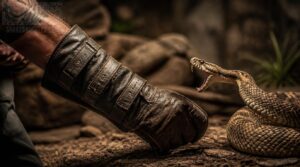
Thickness only protects what it covers. A short cuff leaves your wrist and forearm open to a strike, no matter how tough the palm is. Here’s what proper glove length actually looks like.
Gauntlet-Style Forearm Coverage
Wrists aren’t the finish line. Gauntlet-style coverage extends past the wrist using a cylindrical sleeve design, guarding the lower arm where strikes often land.
Expect outer forearm reinforcement for abrasion and impact, paired with inner forearm flexibility so you can still bend and grip.
Pre-curved shell benefits reduce stiffness, while an adjustable cuff closure seals out debris during handling.
Cuffs Beyond Strike Range
That gauntlet sleeve only works if the cuff itself outlasts a strike. Cuff Length Extension keeps material past bite range, so a snake can’t slide between glove and skin.
Look for Slip Prevention Design, Adjustable Cuff Fasteners, and Layered Cuff Construction for real protective gear.
A Tear Release Feature helps if contamination happens during a snake bite.
Secure Wrist and Arm Fit
A loose cuff undoes all that length. An Adjustable Strap System locks forearm fit within 5-10mm, while dual-density Wrist Support Padding cushions the inner wrist without dulling grip.
Balance Cuff Tension Balance against blood flow, run a Fit Verification Protocol — two fingers under the cuff — and confirm Movement Compatibility with a quick wrist twist before you handle anything venomous.
Coverage Without Restricted Movement
Length only matters if the glove still moves with you. Snug gauntlet-style coverage shouldn’t lock your wrist or bulk up your palm.
- Weight balanced design prevents fatigue
- Thumb index flexibility for quick grips
- Pre-shaped finger curvature cuts strain
- Palm bulk reduction aids dexterity
- Adaptive strike tolerance without stiffness
Run a glove flexibility assessment before every session — proper glove fit means protection and control coexist.
Longer Gloves for Larger Snakes
Bigger snake, longer reach. A reticulated python or large boa demands gauntlet-style coverage past the elbow, since body mass adds crushing force beyond simple bite risk.
Run active strike testing during your snake species risk assessment — coverage gaps show up fast. Pair layered arm protection with Kevlar-lined gloves for real impact force dispersion, and inspect gloves after strikes for hidden material degradation.
Top 5 Snake Handling Glove Options
Knowing the specs is one thing. Finding gloves that actually deliver them is another. Here are five options worth your attention, each built with different snakes and situations in mind.
1. XuYelora Animal Handling Gloves Snake Hook
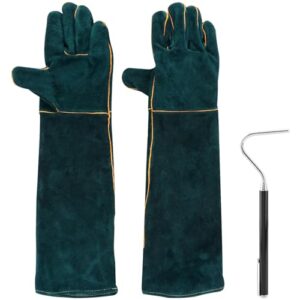
Thickened cowhide, built for bite and abrasion resistance. That’s the heart of the XuYelora set, extending 23 inches to cover forearm as well as hand.
Reinforced seams help prevent early blowouts under heavy use. The bundled retractable hook uses a duckbill head, letting you lift or steady snakes with minimal skin contact.
Fits either hand, which matters when you’re working fast. Wipe clean, dry fully, and check seams often. That’s basic upkeep, not extra credit.
| Best For | Veterinarians, groomers, animal control workers, and reptile handlers who need reliable bite and puncture protection during hands-on animal work. |
|---|---|
| Material | Top-grain cowhide |
| Length | 23.6 inches |
| Color | Black |
| Animal Protection | Dogs, cats, reptiles, snakes |
| Multi-Use Tasks | Welding, gardening, camping, fireplace |
| Sizing | One-size-fits-all |
| Additional Features |
|
- Top-grain cowhide with double-layer reinforcement guards against bites, scratches, and punctures from a range of animals
- Extended 23.6 inch length shields the forearm, not just the hand, for added coverage during handling
- Includes a 40 inch collapsible stainless steel snake hook for safer, low-contact handling
- One-size-fits-all fit may feel too loose or too tight for very small or very large hands
- Black finish tends to show dirt and wear more easily over time
- Leather requires regular cleaning and drying to maintain its protective qualities
2. Surfante Animal Handling Gloves Snake Hook
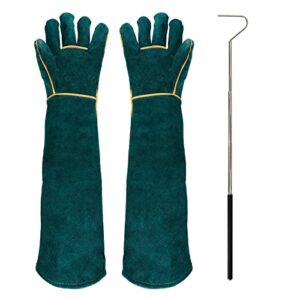
Full grain leather up front, moisture wicking lining inside. Surfante builds this glove for hands that sweat through a long handling session.
The gauntlet extends over the wrist, and dense fingertip stitching holds up against repeated hook use. Extra padding on the back of the hand absorbs strike impact.
A Velcro strap locks in fit. Grip holds even wet, and the leather stays pliable down to freezing, so cold mornings don’t stiffen your control.
| Best For | Anyone who regularly handles snakes, reptiles, or bite-prone pets and needs sturdy, protective gloves for both animal handling and rugged household tasks like welding or gardening. |
|---|---|
| Material | Thickened cowhide |
| Length | 23 inches |
| Color | Green |
| Animal Protection | Cats, dogs, hawks, snakes, chinchillas |
| Multi-Use Tasks | Welding, grilling, gardening, camping |
| Sizing | One size medium |
| Additional Features |
|
- Thickened cowhide construction resists bites, scratches, heat, and fire
- Long 23-inch sleeves with 8.6-inch width give extended arm coverage
- Retractable stainless steel snake hook adds safe handling versatility
- Hook may bend or break when handling larger, heavier snakes
- Only available in one size (medium), which may not fit bigger arms or hands
- Gloves can feel stiff at first and need a break-in period for full dexterity
3. Tylulikaty Animal Handling Gloves 23 Inch

Twenty-three inches of coverage, wrist to forearm, with Kevlar reinforced leather doing the heavy lifting against punctures. Tylulikaty treats the leather for abrasion resistance, so claws and teeth don’t chew through the surface over time.
Reinforced palm and finger zones target high-risk contact areas, while a soft inner lining keeps your wrist comfortable through long handling sessions. The ambidextrous, adjustable fit works either hand. Just know some users report small-animal punctures, like puppy bites, slipping through.
| Best For | Handlers working with dogs, cats, reptiles, birds, or falconry who need durable, ambidextrous protection for repeated animal handling tasks. |
|---|---|
| Material | Kevlar reinforced leather |
| Length | 23.62 inches |
| Color | Not specified |
| Animal Protection | Dogs, cats, reptiles, birds |
| Multi-Use Tasks | Not specified |
| Sizing | Adjustable ambidextrous |
| Additional Features |
|
- Kevlar reinforced leather offers strong protection and grip
- Smooth leather exterior resists scratches from claws and nails
- Adjustable ambidextrous design fits either hand comfortably
- Some users report punctures from small animals like puppies
- Thick insulation can cause excessive sweating and soggy interiors
- Not machine washable and difficult to turn inside out for drying
4. Uzhika Animal Handling Protective Gloves
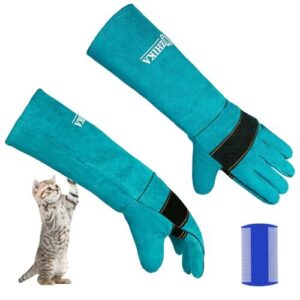
Seventeen point seven inches, and every inch works. Uzhika builds its heavy cowhide with a double layer palm, the spot most bites actually land. Reinforced stitching holds up under strain, and a secure cuff stops the glove from creeping mid-grab.
Smooth finger zones keep your grip honest. Best suited for small to medium reptiles and certain birds, not heavy-duty venomous work. Breathable lining grips sweat on long sessions, so your hands stay dry, not distracted.
| Best For | Veterinary staff, groomers, and animal trainers who need reliable, extended protection when handling cats, dogs, rabbits, parrots, and similar animals. |
|---|---|
| Material | Leather |
| Length | 23.6 inches |
| Color | Blue |
| Animal Protection | Cats, dogs, rabbits, parrots |
| Multi-Use Tasks | Welding, gardening, camping, fireplace |
| Sizing | Large size |
| Additional Features |
|
- 23.6-inch length shields the full forearm and arm from scratches and bites
- Puncture and cut-resistant leather with reinforced stitching holds up under repeated strain
- Adjustable, seam-protected cuffs help prevent bite penetration at the wrist
- Bulky fit can make fine motor tasks like nail trimming harder to manage
- New leather may have a strong odor that needs airing out before first use
- Larger sizing may not fit smaller hands securely
5. Thorn Resistant Leather Gauntlet Gloves
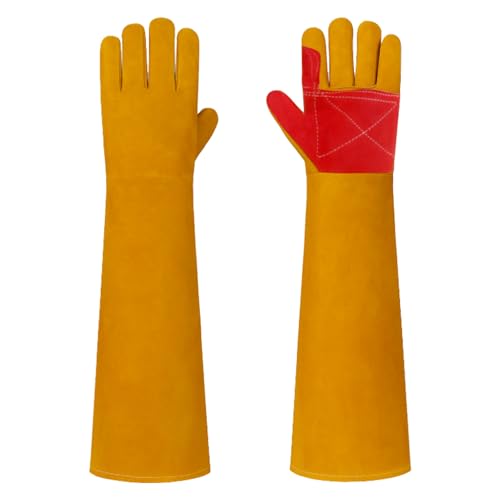
Twenty-three point six inches of coverage, built for forearm-heavy work. LURMMUE’s 1.5 mm split cowhide won’t stop fangs, but the cotton lining cuts heat and thorn snag on the gardening end.
Reinforced palm and back use double-layer leather, tough enough for BBQ tools or a defensive tabby. One-size loose fit works for layering over sleeves. Skip this pair for venomous handling entirely. It’s built for scratches and bristle, not bite force.
| Best For | Gardeners, BBQ users, and pet owners who need thick, forearm-length protection from thorns, sparks, and light bites rather than fine-motor precision work. |
|---|---|
| Material | Split cowhide leather |
| Length | 23.6 inches |
| Color | Green |
| Animal Protection | Cats, dogs, birds |
| Multi-Use Tasks | Welding, gardening, fireplace, BBQ |
| Sizing | One-size loose fit |
| Additional Features |
|
- Extra-long 23.6 inch gauntlet design shields the entire forearm
- Double-layer leather palm and back stand up to tough garden or fireplace tasks
- Cotton lining adds comfort while resisting heat and thorn snags
- Not fireproof, so direct flame contact should be avoided
- Loose one-size fit can feel bulky and limit dexterity for smaller hands
- Not rated for venomous animals or species with strong, sharp teeth
Inspect Gloves Before Every Handling
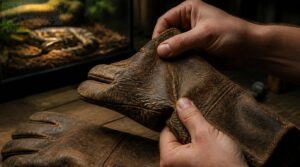
Thick leather won’t save you if it’s already compromised. Gloves take a beating with every handling session, and damage isn’t always obvious at a glance. Here’s exactly what to check before you reach into that enclosure.
Check the stitching, flex the fingers, and hold the material up to light—then brush up on ethical snake handling practices to recognize the behavioral cues that tell you when even sound gloves aren’t enough protection.
Once you’ve inspected your gloves, pair that with a post-feeding handling schedule based on meal size so you’re not risking a regurgitation on top of a worn-out glove.
Check Seams for Weakness
Run a seam visual inspection before every handling session. Check for fraying, loose threads, or gaps that let two layers separate under flex.
Then move to stress point testing: pull gently at finger joints and palm seams, watching for give beyond 2mm. Log findings in your durability rating system.
- Frayed edges
- Needle holes
- Uneven stitch spacing
Replace Worn or Stretched Leather
Seams passed inspection? Good. Now check the hide itself.
Worn or stretched leather punctures far easier than stiff, new material — fiber deformation thins the barrier fast.
| Sign | Action |
|---|---|
| Thinning/shiny patches | Full replacement |
| Localized wear | Patch reinforcement |
| Cracking seams | Seam repair, waxed thread |
Match replacement thickness to original specs, then condition after installing new panels before your next handling session.
Dry Gloves After Moisture Exposure
Wet leather is weak leather. Fiber strength drops fast when soaked, so air dry completely before storage.
- Damp cuffs still holding moisture
- Stiff, cracking palm leather
- Musty odor lingering in the lining
Check seams for dampness, then apply leather conditioning within 24 hours. Add charcoal for odor control. Store dry, cool, away from sunlight.
Watch for Strike Damage
Dry gloves need one more check: strike damage. Look for cracks on outer leather, edge fraying on reinforced zones, and micro-tears along seams.
Run your impact zone inspection after every handling session. Track wear patterns over time—strike pattern analysis reveals which spots take repeated hits, guiding when material degradation demands retirement over patching.
Respond Immediately to Punctures
Feel a puncture? Freeze first. Stop Movement Protocol means securing the snake before anything else.
Next: pressure, water, dressing.
- Stop and secure the snake
- Apply pressure to the wound
- Rinse and dress the puncture
- Watch for swelling or redness
- Seek medical care if symptoms worsen
Keep an emergency kit stocked. Even Kevlar-lined or gauntlet-style gloves can fail—your bite response speed matters more than gear alone.
Frequently Asked Questions (FAQs)
Can a copperhead bite through gloves?
Yes, it can. Yes, it does. Yes, it happens more than handlers admit.
Copperhead fang penetration exploits glove seam integrity, letting venom seepage pathways reach skin even when leather looks untouched and no puncture proof gear seems bite proof against a determined strike.
Are 6 mil or 8 mil gloves thicker?
Eight mil wins. That’s roughly 33% more material than six mil, converting to better puncture resistance on snake handling gloves.
Six mil flexes better for dexterity vs protection trade-offs.
Choose based on species risk, not just mil-to-millimeter math alone.
Can I wear gloves to handle my snake?
Absolutely, but match the glove to the snake. Small nonvenomous pets need light, flexible snake handling gloves; large or venomous species demand gauntlet-style coverage and strict handling safety protocols — gloves alone never guarantee bite proof protection.
What material can rattlesnakes not bite through?
Armor isn’t armor unless it holds." Stainless steel mesh stands closest to true snake bite protection, distributing fang force outright. Dense leather barriers and Kevlar-lined gloves help too, but nothing’s fully bite proof against a determined strike.
How often should snake handling gloves be replaced?
Six to twelve months with regular use. Inspect after every strike, retire at first puncture or thinning, and cut that window to six months for humid or high-risk handling routines.
Can snake gloves be washed or cleaned safely?
Dirty gloves invite bacteria; clean gloves invite trust. Rinse with lukewarm water, mild detergent. Skip bleach. Air dry, then condition leather afterward. Wet material weakens fast, so dry thoroughly before storing.
Do gloves protect against non-venomous snake bites too?
Yes. Snake Handling Gloves spread bite pressure across thick leather, cutting puncture depth from nonvenomous snakes. Watch seam vulnerability and moisture weakening, though—both cut protection fast, even with good hardsoft pairing between palm and fingers.
Are leather gloves better than synthetic alternatives overall?
Not always. Leather wins on durability and moisture resistance; Kevlar-lined gloves and puncture-resistant fabrics beat it on maintenance and cost. Your call depends on tactile sensitivity needs versus long-term wear.
Conclusion
Buy the thickest gloves on the shelf, strap them on like knight’s armor, and feel invincible—right up until fangs find that one seam you never bothered to check. That’s the joke stiff leather plays on lazy handlers.
The honest answer to how thick should snake handling gloves be isn’t one number; it’s zone-by-zone judgment: reinforced palms, flexible fingers, snug cuffs. Build that habit, inspect often, and your hands earn something armor alone can’t buy: real trust.