This site is supported by our readers. We may earn a commission, at no cost to you, if you purchase through links.

A snake’s spine holds over 200 vertebrae, each one a small joint that can strain under uneven pressure. Pick one up wrong, and you won’t see the damage right away. You’ll feel it instead, in a tense body and a sudden defensive strike.
That’s why supporting snake weight while holding matters more than most new handlers realize. It’s not about grip strength. It’s about distributing weight the way water finds its own level, evenly, without pressure points.
Get this right, and your snake relaxes into your hands like it’s settling onto a branch. Here’s how to build that trust, one hold at a time.
Table Of Contents
- Key Takeaways
- Why Full-Body Support Protects Snakes
- How to Lift a Snake Safely
- Supporting Snake Weight While Holding
- Adjust Support by Snake Size
- Weight-Support Mistakes to Avoid
- Frequently Asked Questions (FAQs)
- What not to do when holding a snake?
- Can snakes enjoy being held?
- How to make snakes more comfortable with being held?
- What is the best way to restrain a snake?
- How long can a snake handling session safely last?
- What environmental temperature works best for handling snakes?
- Should snakes be handled right after eating?
- What body signs show a snake feels stressed?
- Conclusion
Key Takeaways
- Always support at least a third of your snake’s body with both hands, keeping an even S-shaped curve instead of letting any section dangle.
- Use open, relaxed palms rather than a tight grip or squeeze—tension in your hands teaches the snake to coil defensively against you.
- Never lift or carry a snake by the head or tail, since both act as levers that can strain or injure the spine.
- Match your support style to the snake’s size, from cradling a hatchling’s whole body to using both forearms (and sometimes a second handler) for large, heavy-bodied snakes like boas.
Why Full-Body Support Protects Snakes
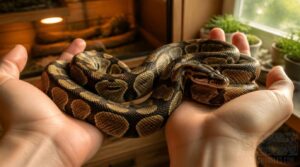
A snake’s spine wasn’t built to hang unsupported in mid-air. Every choice you make with your hands affects how safe and calm your snake feels. Here’s what full-body support actually does for your snake’s body and trust in you.
Supporting your snake at multiple points along its body, rather than letting sections dangle, is one of the core boa snake handling techniques that builds lasting trust between you two.
Preventing Spinal Strain
A snake’s spine has no rib cage locking it in place, so unsupported sections sag and twist under their own weight.
That’s why neutral spine alignment matters so much during every lift.
- Support the midsection first
- Use symmetric hand placement
- Lift at 2–3 cm per second
- Watch for muscle rippling
- Adjust within 10 seconds of tension
Proper technique here cuts spinal strain incidents by 70%.
Reducing Defensive Gripping
Tension breeds tension. When your grip tightens, the snake reads it as threat and coils harder to protect itself.
A tight grip teaches a snake to fear you, coiling harder against the very threat it feels in your hands
| Technique | Action | Effect |
|---|---|---|
| Grip pressure | Light, constant contact | Reduces coiling |
| Wrist alignment | Keep neutral | Prevents stiffness |
| Movement | Minimize adjustments | Builds trust |
A relaxed grip with open palms tells the snake it’s safe, cutting defensive gripping fast.
Keeping Muscles Relaxed
A relaxed grip only works if your own muscles stay loose too. Slow, diaphragmatic breathing keeps your shoulders and forearms from guarding.
Pair that with easy posture adjustments and gentle weight distribution across two points of support.
This mindful movement, not stiff bracing, keeps both of you calm, pliable, and ready for longer holds without fatigue.
Building Handling Trust
Once your own body settles, the snake feels it too. Every calm hold adds to a consistent handling routine, building trust and confidence session after session.
Understanding your corn snake’s unique personality traits helps you tailor each handling session to what actually puts your snake at ease.
- Predictable support signals safety
- Gentle touch reduces defensive coiling
- Calm handling approach lowers stress hormones
- Positive reinforcement pairs handling with ease
A confident keeper, offering steady body support techniques, becomes someone the snake learns to trust.
How to Lift a Snake Safely
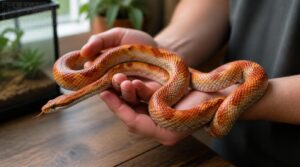
Lifting a snake isn’t just about picking it up—it’s about doing it in a way that keeps the spine safe and the snake calm. Every movement, from your first approach to how you position your hands, matters more than you’d think. Here’s exactly how to get it right, step by step.
Handling your snake gently before feeding time also builds trust, and this baby ball python feeding guide walks you through what to expect at mealtime.
Approach With Calm Movements
Rushing in startles a snake before you even touch it. Slow, deliberate steps signal safety, not threat.
Keep your breathing steady. A quiet environment and calm energy tell the snake it can trust you. Predictable movement, not sudden reaches, keeps its center of gravity stable and sets up a secure grip with both hands.
Position Both Hands Underneath
Slide both hands under the snake’s belly, palms up, in an openhanded grip. Keep wrists level with your forearms and fingers loose and spaced.
Elbows stay tucked, forming a shallow forearm V that cradles the ventral surface. This hand placement technique sets up even support before you lift. This approach mirrors principles of adaptive stiffness control seen in complex prosthetic systemsadaptive stiffness control.
Lift The Midsection Evenly
Now comes the lift itself. Raise both hands together, in one steady motion, so the midsection comes up level, not tilted.
Even pressure distribution matters here — one side lifting faster creates a hotspot the snake will brace against. Watch for symmetrical hand placement throughout. This balanced weight lift keeps the spine aligned and the snake calm against your palms.
Maintain a Natural S-shape
Picture a gentle letter S running from head to tail — that’s the shape you’re aiming for. This natural S curve spreads weight across three spinal bends instead of one strained point, easing vertebrae load and keeping muscle tension low.
Check your palms often. If the body sags or straightens, adjust hand spacing to restore that balanced, relaxed curve.
Avoid Head or Tail Lifting
Grabbing the head or tail feels natural, but it’s the fastest way to cause harm. Both points act as levers, straining vertebrae and risking spinal injury.
Keep both hands under the midsection instead, supporting weight evenly along the curve. Let the head rest freely, tail trailing loose. That’s how you keep muscle strain low and handler safety high.
Supporting Snake Weight While Holding
Once you’ve lifted the snake, the real work is keeping that support steady. Weight distribution isn’t a one-time move—it shifts as the snake moves, so your hands and arms need to adjust with it. Here’s what proper support looks like in practice.
Support One-third of Body
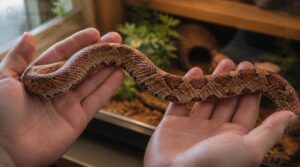
One-third is your magic number. Support at least a third of the snake’s body length with both hands, cradling the ventral surface at multiple contact points.
This keeps the spine’s natural S-shape intact and stops sagging. Skip this rule, and you’ll feel the snake tense up, gripping defensively instead of trusting your hold.
Use Open Palms
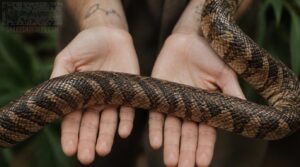
Flat palms beat cupped fingers every time. Open palm technique spreads pressure across a wider surface, so no single point of scale or muscle bears the load.
You’ll feel tension the instant it builds—that tactile feedback lets you adjust before the snake does it for you. Keep wrists straight, fingers relaxed, and let gentle lifting flow naturally into your next hold.
Add Forearm Support
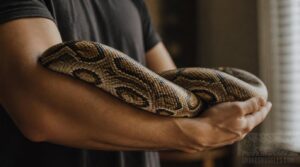
Long holds tire your arms fast, especially with heavier-bodied snakes. Rest your forearm along the snake’s length for fatigue reduction during extended support.
This isn’t about gear—it’s your own arm acting as a cradle. Keep elbows tucked, wrists straight for natural wrist alignment, and movements slow and deliberate. Good posture stabilization here keeps both hands steady, supporting the snake’s body comfortably until you’re ready to balance the tail base.
Balance The Tail Base
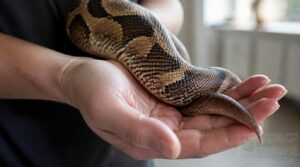
With your arm cradling the body, shift focus to the back end. The tail base needs its own support, not an afterthought.
Tail base alignment keeps your palms level with the head-to-tail line, preventing weight shift and awkward sag.
- Cup the tail base with an open palm
- Keep contact pressure control light, never squeezed
- Watch for wriggling and rebalance immediately
- Adjust your stance rather than twisting
- Support one-third of body weight here
Reposition Without Twisting

Once the tail base is set, keep that stable base while shifting position. Move in slow, short increments—never a quick pivot.
Keep both hands broad, with head tail supported nearby. Reassess your grip after each shift. Rotate your whole body, not the spine, so the snake glides like honey, not twisted rope.
Adjust Support by Snake Size

No two snakes need the exact same grip. A hatchling fits in your palm, while a six-foot boa asks for your whole arm and maybe a friend’s help too. Here’s how your support should change as the snake gets bigger.
Hatchlings and Juvenile Snakes
A hatchling’s whole body barely fills two hands, so gentle lifting matters more here than muscle. Support the full length at once—never just the middle.
Juvenile handling stays brief, five minutes or less, since young snakes show more defensive gripping. Watch for shedding cycles and recent feeding frequency before you pick one up at all.
Adult Corn Snakes
Most adult corn snakes reach 4 to 5 feet, calm enough for two-handed support along the midsection. Their easygoing temperament means slow, deliberate movements keep them settled.
Feed adults every 10 to 14 days, and body alignment stays natural when weight spreads across multiple contact points. With good care, they’ll thrive 12 to 15 years, sometimes longer.
Heavy-bodied Ball Pythons
Picture a snake shaped like a fire hose: that’s your ball python. At 3.5-5 feet, with a 2-3 inch midsection, gentle lifting needs full palm contact, not pinching. Support the body evenly, mind feeding schedule management, and watch body condition—obesity strains organs.
Keep humidity steady, wait 48 hours post-feeding, and use secure enclosures.
Large Boa Constrictors
Now you’re holding real weight. Boas run 10-13 feet and can top 60 pounds, so support the body across both forearms, not just your hands.
Use slow deliberate movements and spread loops evenly to prevent spinal injury. Keep enclosures secure and warm (75-85°F), since stressed, chilled boas grip harder and fight your grip.
Using a Second Handler
Two sets of hands beat one when a snake’s weight gets serious. Your partner slides in at the midsection, mirroring your grip symmetrically as you lift together.
Agree on a stop command before you start. Verbal cues time the transfer, and both handlers stay still once the snake rebalances, so nothing twists or slips.
Weight-Support Mistakes to Avoid

Even good intentions can turn into bad habits once a snake’s weight is in your hands. Small missteps here don’t just feel awkward, they can strain muscles and shake your snake’s trust in you. Here are the mistakes worth watching for, so you can catch them before they become routine.
Letting Body Sections Dangle
Ever watch a snake’s tail droop mid-lift? That’s an unsupported span, and it strains muscles fast.
Gaps trigger tension and defensive gripping, risking spinal strain. Uneven support even disrupts breathing.
Keep your palms flowing under every section, nose to tail. Continuous body support builds trust and keeps handling calm, controlled, and genuinely safe.
Gripping One Body Section
Gaps aren’t the only problem. Locking onto just the midsection and letting the rest hang is its own mistake.
One-section gripping skips midline alignment and blocks breathing allowance. Your snake needs full body support, not a single anchor point.
Use the palm pressure technique across the whole length. Frequent grip adjustment keeps every section held, calm, and genuinely secure.
Squeezing to Prevent Movement
A squirming snake tempts you to clamp down harder, but that’s backwards. Grip force reduction matters more than tightening.
- Escalating squeeze restricts circulation maintenance
- Creates painful pressure points
- Raises your own joint stress
- Masks distress signal awareness
- Fatigues hands fast
Supporting the body fully replaces squeezing, keeping stress reduction and escape prevention intact through gentle handling instead.
Allowing Unsupported Shoulder Loops
Once your grip is gentle, don’t let loops sag off your shoulders unsupported. That gap invites shoulder strain risk and uneven joint load distribution through your deltoids and rotator cuff.
You’ll also lose tactile feedback, making slips more likely. Drape loops across your forearms instead—it keeps body support even, spares central grip effort, and lets natural movement continue undisturbed.
Moving Before Rebalancing Weight
Shoulder loops sorted, don’t rush the next move. Weight shift timing matters—rebalance hands before repositioning, or you’ll get sudden shifts.
Quick checklist before moving:
- Confirm both hands support their sections
- Check tail base contact
- Breathe, stay calm
- Scan for sagging loops
- Then shift, slow and steady
Load rebalancing first, movement second—that’s the whole trick to smooth handling technique.
Frequently Asked Questions (FAQs)
What not to do when holding a snake?
Never lift by the head or tail, squeeze the body, or leave sections dangling. Skip supporting the whole body, and you’ll trigger defensive gripping. Watch for stress signs like hissing, and always keep the enclosure secure.
Can snakes enjoy being held?
Not in the way we feel joy, but yes—snakes can settle into genuine comfort. Steady breathing, loose muscles, and slow movement signal trust building. It’s less affection, more predictable routine easing them into calm tolerance.
How to make snakes more comfortable with being held?
Think of trust as a slow-growing vine, not a switch you flip. Build it with gentle handling, a calm room, and short sessions—reading tongue flicks and posture tells you when your snake feels safe.
What is the best way to restrain a snake?
Good restraint means gentle, even contact, not force. Cradle the body along its length, read behavioral cues like tense coiling, and use snake hooks or gloves when needed to keep both you and the snake calm and secure.
How long can a snake handling session safely last?
Keep sessions under 15 minutes for most adults, five to ten for hatchlings. Wait 48 hours after feeding. Watch for stress response and stop early if defensive behavior appears, building trust over time.
What environmental temperature works best for handling snakes?
Getting the temp right isn’t just hot air—it’s the whole "scale" of good handling. Aim for 75-85°F with a warm basking spot near 90-95°F, keeping humidity around 50-60% for calm, confident snakes.
Should snakes be handled right after eating?
No. Wait 48 to 72 hours after a meal before handling, since digestion slows movement and raises regurgitation risk. Watch for throat bulging or restlessness, support enclosure conditions, and save gentle handling for once digestion visibly completes.
What body signs show a snake feels stressed?
The body never lies. Watch for rapid breathing, gaping jaws, and tongue flicking that stops cold. A snake coiled tightly with rigid muscle tension is bracing, not resting—clear signs its stress response has kicked in.
Conclusion
Picture a coiled body flowing across your palms like a slow river finding its banks. That’s the feeling you’re after.
Supporting snake weight while holding isn’t a rule for rulebooks, it’s the difference between a snake that trusts your hands and one that fights them. Keep your palms open, your movements calm, your support even. Do that, and every lift becomes a quiet conversation between you and your snake, muscle to palm, trust building one hold at a time.