This site is supported by our readers. We may earn a commission, at no cost to you, if you purchase through links.

A rattlesnake strike covers roughly 18 inches in under 70 milliseconds—faster than most people can blink. That margin for error vanishes completely when your hands are the closest thing to those fangs. Fieldwork doesn’t forgive hesitation, and it won’t forgive the wrong gear either.
The right snake handling gloves for field research do more than stop a bite. They stabilize your grip on wet scales, protect your forearms from coiling pressure, and let you work with enough dexterity to actually do your job. What separates a reliable pair from a liability comes down to materials, fit, and how each glove performs under real field conditions.
Table Of Contents
- Key Takeaways
- Top 6 Snake Handling Gloves
- Field Research Glove Requirements
- Bite Resistance and Safety Standards
- Best Glove Materials
- Length and Forearm Coverage
- Dexterity, Grip, and Control
- Fit and Comfort Factors
- Choosing Gloves by Field Task
- Cleaning and Replacement Tips
- Frequently Asked Questions (FAQs)
- What gloves are used in experiments?
- What gloves are good for handling snakes?
- Should you wear gloves when handling snakes?
- Will Kevlar gloves protect from snake bite?
- What gloves do Tier 1 operators use?
- Are snake handling gloves legal in all regions?
- Can these gloves protect against insect stings too?
- Do gloves work in wet or rainy conditions?
- Whats the average lifespan of quality snake gloves?
- Can gloves protect against multiple snake bites?
- Conclusion
Key Takeaways
- Forearm coverage matters as much as hand protection — most field injuries happen at the gap between glove and sleeve, so look for 21–24 inch gauntlet styles.
- Kevlar stitching and double leather padding aren’t just marketing terms — they’re the two features that determine whether a glove holds up after repeated bites and rough terrain.
- Dexterity and protection don’t have to trade off — slim-profile fingertips and articulated joint design let you work with control without sacrificing your bite barrier.
- No glove lasts forever — check seams and padding after every session, and replace at the first sign of cracking, fraying, or shifted padding before your next field encounter.
Top 6 Snake Handling Gloves
Not every glove holds up when a King Cobra decides it doesn’t want to cooperate. These six options were chosen for real field conditions — thick cover, wet hands, and fast-moving snakes. Here’s what made the cut.
Some of these picks, like the ones covered in this guide to snake bite proof gloves for venomous snake protection, rely on thick leather and layered construction rather than reptile-specific design — and still hold up.
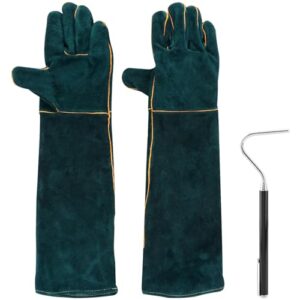
1. Animal Handling Gloves and Snake Hook
This combo gives you more than just gloves. The Animal Handling Gloves and Snake Hook set pairs reinforced double-layer cowhide with a stainless steel hook, so you can reposition a snake before it gets within striking distance.
The gloves measure 60 x 14 cm — enough to cover your forearms. The included hook features a duckbill head that lifts without pinching.
Together, they’re built for confident, controlled handling in the field.
| Best For | Anyone who regularly handles reptiles, birds, or unpredictable animals — from backyard hobbyists to vets and animal control pros. |
|---|---|
| Primary Material | Cowhide & cotton |
| Total Length | 23.6 inches (60 cm) |
| Bite Resistance | Yes |
| Palm Reinforcement | Double-layer cowhide |
| Interior Lining | Breathable cotton |
| Forearm Coverage | Extended design, 60 cm total |
| Additional Features |
|
- Double-layer cowhide holds up against bites, punctures, and heat without falling apart after a few uses
- The included snake hook lets you reposition an animal before your hands ever get close
- Breathable cotton lining keeps things comfortable during longer sessions
- The thick material makes delicate, precise movements harder — don’t expect surgeon-level dexterity
- There’s a noted discrepancy between the hook length listed in the specs and what the product title suggests
- At 60 cm, the gloves run long, which might feel bulky for smaller hands
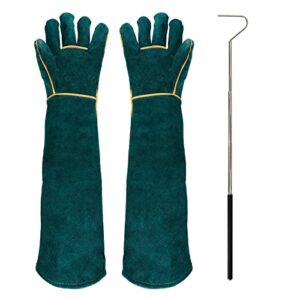
2. Long Leather Animal Handling Welding Gloves
The Long Leather Animal Handling Welding Gloves step up where basic gloves fall short. Built from 1.2mm shoulder split cowhide, they handle abrasion and puncture resistance well. Kevlar stitching holds seams under real pressure. At 23.6 inches long, they cover your forearms — exactly what you need when a strike comes fast.
The adjustable cuffs lock the fit in place. Double leather padding protects your palms and finger backs without killing your grip.
| Best For | Anyone who works with animals, welds, or deals with thorny, sharp, or unpredictable materials and needs serious hand and forearm protection. |
|---|---|
| Primary Material | Top grain cowhide leather |
| Total Length | 23.6 inches |
| Bite Resistance | Yes |
| Palm Reinforcement | Double leather finger palms & backs |
| Interior Lining | Not specified |
| Forearm Coverage | Extended forearm, 23.6 in |
| Additional Features |
|
- Kevlar stitching and double leather padding mean these gloves can actually take a beating — bites, scratches, heat, you name it.
- At nearly two feet long, they cover your forearms, which most gloves completely ignore.
- Adjustable cuffs keep them snug so they don’t slip when things get rough.
- The thick leather makes fine motor tasks — like picking up small objects — pretty awkward.
- They’ll feel stiff right out of the box and need some break-in time.
- Sizing can be a little hit or miss since measurements are done by hand.
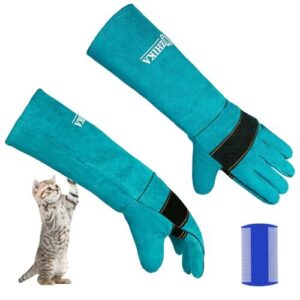
3. RAPICCA Reinforced Leather Animal Handling Gloves
The RAPICCA gloves take a slightly different approach. At 16 inches total with a 7.5-inch sleeve, they’re shorter than the previous pair — but don’t let that fool you.
The double leather finger padding covers bites and scratches well, and Kevlar-reinforced stitching holds under pressure. An insulated cotton lining keeps your hands comfortable during long handling sessions.
These are a solid pick for veterinary work, grooming, or animal control where bulk matters less than reliable, consistent protection.
| Best For | Vets, groomers, and animal control pros who need reliable bite and scratch protection without obsessing over sleeve length. |
|---|---|
| Primary Material | Cowhide split leather |
| Total Length | 16 inches |
| Bite Resistance | Yes |
| Palm Reinforcement | Double leather reinforced palms & backs |
| Interior Lining | Insulated cotton |
| Forearm Coverage | 7.5-inch sleeve |
| Additional Features |
|
- Double leather finger padding holds up well against bites and scratches
- Insulated cotton lining keeps hands comfortable during longer sessions
- Handles a solid range of tasks — animal handling, grilling, gardening, you name it
- Bulky build makes fine motor tasks tricky
- One-size fit can feel oversized on smaller hands
- Not fully bite-proof, so proper handling tools are still a must
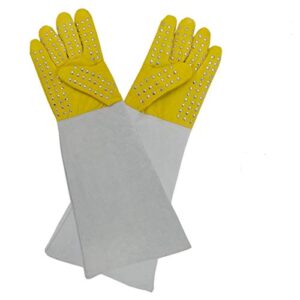
4. Long Gauntlet Split Cowhide Leather Gloves
If the RAPICCA gloves felt a bit short for your needs, these fill that gap. The long gauntlet cuff extends past the wrist and up the forearm — exactly where surprise strikes tend to land.
Built from split cowhide leather, they’re tough enough for rugged terrain and reinforced at the seams where wear hits hardest. An adjustable closure keeps debris out and the fit secure.
You get solid protection without sacrificing too much feel.
| Best For | Anyone who needs serious forearm coverage during welding, open-fire cooking, or wrangling animals that like to scratch. |
|---|---|
| Primary Material | Top grain & shoulder split cowhide |
| Total Length | 22 inches |
| Bite Resistance | Yes |
| Palm Reinforcement | Double leather padding on palms & backs |
| Interior Lining | Soft inner lining |
| Forearm Coverage | 12.5-inch sleeve |
| Additional Features |
|
- Extends well up the forearm — covers the spots most gloves completely ignore
- Split cowhide holds up to heat, sparks, and rough handling without falling apart
- Works across a surprising range of tasks, from the forge to the fireplace to the garden
- Thick leather means your hands will get warm fast, especially in longer sessions
- Not the right pick if you’re dealing with a dog that can really bite down hard
- Dexterity takes a hit — fine motor work is going to feel clunky
5. Long Sleeve Animal Handling Gloves
These gloves are built for handlers who need full forearm coverage. At 60 x 18 cm (23.7 x 7.09 inches), they extend well past the wrist — a real advantage when reaching into enclosures.
The faux cowhide and velvet construction balances protection with comfort. They’re suitable for cats, dogs, birds, and reptiles. However, user reports conflict on bite defense strength, so pair these with solid technique. They work best for scratch and grip control, not aggressive venomous species.
| Best For | Vets, groomers, and animal control staff who need reliable forearm coverage during everyday handling and grooming tasks. |
|---|---|
| Primary Material | Cowhide leather |
| Total Length | 23 inches |
| Bite Resistance | Yes |
| Palm Reinforcement | Thickened cowhide construction |
| Interior Lining | Not specified |
| Forearm Coverage | 23-inch extended sleeve |
| Additional Features |
|
- Extra-long 60 cm cuffs shield your wrist and forearm — great for reaching into cages or enclosures
- Faux cowhide and velvet construction keeps things comfortable during longer handling sessions
- Works across a wide range of animals, from cats and dogs to birds and reptiles
- Bite protection is hit or miss — user reviews are all over the place on this one
- Sizing runs large, so those with slimmer arms may find the fit a bit loose
- Not a good pick for aggressive animals or anything venomous
6. Leather Animal Handling Bite Proof Gloves
Leather construction meets bite-proof engineering in this final pick. Top grain and shoulder split cowhide combine to hit 1.2 mm thickness, giving you a serious barrier against fangs and claws. At 23.6 inches, the sleeves cover well past your elbow.
The integrated palm protection and finger guards in these professional snake handling gloves for veterinarians further reduce fatigue and puncture risk during extended sessions.
Double leather patches reinforce the palms and fingers — exactly where bites land hardest. Kevlar stitching holds the seams tight under pressure. If you’re handling aggressive reptiles in the field, these gloves don’t cut corners.
| Best For | Anyone who regularly handles aggressive animals — whether you’re a vet, wildlife handler, or reptile enthusiast who needs serious bite and scratch protection. |
|---|---|
| Primary Material | Kevlar-reinforced leather |
| Total Length | 23.62 inches |
| Bite Resistance | Yes |
| Palm Reinforcement | Kevlar-reinforced leather |
| Interior Lining | Soft interior lining |
| Forearm Coverage | 23.62-inch extended design |
| Additional Features |
|
- Double-reinforced leather on the palms and fingers holds up where bites and scratches hit hardest
- Long 23.6-inch sleeves cover your forearms, so there’s no gap between glove and sleeve
- Handles serious heat up to 662°F, making them useful well beyond animal handling
- All that protection comes at the cost of dexterity — fine motor tasks get tricky
- Fresh cowhide can smell pretty strong out of the box and needs time to air out
- Sizing isn’t one-size-fits-all, so you’ll want to check the measurements before buying
Field Research Glove Requirements
Not every glove cuts it when you’re kneeling in the brush with a King Cobra at arm’s reach. Field research demands more than basic protection — it demands gear that works with you, not against you. Here’s what to look for before you ever reach into the grass.
Venomous Snake Handling Risks
Venomous snake handling carries real, life-altering stakes. A single bite can trigger rapid envenomation symptoms — swelling, paralysis, or respiratory failure — within hours. That’s why your risk assessment checklist matters before every field task.
One venomous bite can trigger paralysis or respiratory failure within hours — never skip your pre-field risk assessment
Confirm antivenom availability at the nearest facility, map your emergency transport route, and never skip your snake handling gloves. Your rapid response protocol starts before you reach for the snake.
Proper training in identifying pit vipers is essential for field safety.
Nonvenomous Bite Protection
Don’t underestimate a nonvenomous bite — it still breaks skin and invites infection. Nonvenomous Bite Defense starts with understanding what you’re up against:
- Layered impact absorption distributes puncture pressure across hardened leather
- Kevlar stitching holds seams under repeated stress
- A secure wrist seal blocks snake heads from entering the cuff
- Grip under pressure keeps control during sudden movement
After any bite, post bite care matters immediately.
Rugged Terrain Durability
Field terrain is unforgiving — sharp rocks, thorny brush, and rough bark all test your gloves constantly.
Heavy-duty cowhide leather resists abrasion up to 35 percent longer than standard hides. Kevlar-reinforced stitching cuts seam failures by 60 percent. Material layering with aramid fibers and HDPE distributes impact without adding bulk, keeping your gloves intact through a full day of rugged fieldwork.
Wet Scale Grip Control
Wet scales are slippery — and that’s where many handlers lose control fast.
Hydrophobic palm coatings and moisture channel design pull water away from contact zones, keeping grip firm. Water repellent texture with raised ridges boosts the grip friction enhancement you need on smooth, wet scales. A wicking layer integration inside your snake handling gloves preserves tactile sensitivity and dexterity throughout reinforced leather padding.
Long Wear Comfort
Grip isn’t the only thing that wears you down — hours inside stiff gloves do too.
Moisture wicking linings pull sweat away, while breathable sponge interiors prevent heat buildup during long surveys.
Flexible stretch panels adapt to your hand shape over time. Break-in comfort improves with use, and strategic padding zones cushion your palms without sacrificing dexterity or tactile sensitivity.
Bite Resistance and Safety Standards
Not all gloves are built the same, and in snake handling, that difference really matters. Knowing how bite resistance is measured helps you choose gear you can actually trust. Here’s what the key safety standards mean for your protection in the field.
Puncture Resistance Ratings
Not all gloves are equal when fang pressure is on the line. Puncture resistance ratings tell you exactly how much force a glove can absorb before something gets through.
For snake handling gloves, look for compliance with ASTM F2992 benchmarks — these tests measure the precise penetration threshold reinforced leather padding must withstand to qualify as bite proof for herpetology tools and field use.
ANSI/ISEA 105 Basics
ANSI/ISEA 105 is the go-to rating scale for cut-resistant and protective gloves in the U.S. It scores gloves from A1 to A9 based on cut and puncture resistance, with higher numbers meaning tougher protection.
For snake-handling gloves, durability and dexterity both factor in — a glove that stops fangs but cripples your grip isn’t field-ready.
ASTM F2992 Testing
ASTM F2992 goes a step further than ANSI/ISEA 105. It uses a standardized test methodology to measure how well cut-resistant materials hold up under controlled lab conditions. Samples go through rigorous lab validation before any certification process is complete.
For snake handling gloves, that means your bite-proof, puncture-resistant claims are backed by repeatable data — not just marketing.
Fang Penetration Limits
Even a King Cobra’s fang delivers serious snake fang pressure — enough to punch through low-grade materials instantly. That’s why maximum penetration depth matters.
Quality snake bite proof gloves use layered construction to stop fangs before they reach skin. Fang barrier efficacy depends on combined layer thickness limits. Penetration test results confirm that thicker, multi-layer designs reliably block venomous snakes.
Scratch and Claw Defense
Snakes aren’t your only concern in the field. Birds scratch. Cats claw. Even small reptiles rake skin fast.
That’s why scratch-resistant materials and reinforced leather padding matter beyond bite protection alone. Seam reinforcement and finger guard design keep vulnerable joints covered. Good puncture-resistant, anti-scratch gloves handle the full range of threats your hands face.
Best Glove Materials
The material a glove is made from determines whether it holds up or falls apart in the field. Not every material withstands fang pressure, rough terrain, and long wear equally well. Here’s what the best snake handling gloves are actually built from.
Heavy-duty Cowhide Leather
Cowhide leather is the backbone of any reliable pair of snake handling gloves. Heavy-duty cowhide offers serious abrasion resistance — it holds up when you’re pushing through brush or rocky terrain.
The grain texture grips naturally, even on wet scales. Leather does need a short break-in process, but once it molds to your hands, the fit and protection are hard to beat.
Kevlar-reinforced Stitching
The stitching holding your gloves together matters more than most people think. Kevlar-reinforced stitching increases thread tensile strength by up to 70 percent over standard nylon, and it distributes bite force along the seam instead of concentrating it at one point.
Here’s what that means in practice:
- Thread tensile strength stays intact through 2,000+ flex cycles
- Seam load distribution prevents localized tearing during sudden snags
- Heat-resistant stitching holds firm up to 400°C — no meltdown under pressure
- Abrasion resistance keeps seams together across rough terrain contact
- Flex cycle durability retains over 85% original strength after heavy field use
That’s bite proof reinforced stitching you can actually trust.
Aramid Fiber Layers
Aramid fiber layers are the hidden backbone of serious snake handling gloves. They deliver strong tensile strength without adding bulk — letting you move freely while a physical barrier absorbs fang pressure before it reaches skin.
Impact absorption happens at the fiber level, spreading force across multiple plies. The result is bite resistant protection that holds up through countless field encounters.
HDPE Protective Barriers
HDPE protective barriers are the unsung armor inside bite-proof gloves. This thermoplastic polymer layer resists punctures with force ratings up to 4,000 N — serious protection when a large constrictor locks on. It provides chemical resistance against oils and organic residue from field environments.
It’s also recyclable, making your personal protective equipment a responsible choice too.
Double Leather Padding
While HDPE withstands raw puncture force, double leather padding takes over where rigid barriers leave off. Two leather layers sandwich a foam core, spreading bite impact across a wider area. Padding thickness ranges from 2 to 6mm, balancing protection with flexibility. This keeps your snake handling gloves bite proof without turning your hands stiff.
- Distributes impact force across the palm
- Sheds moisture through smooth outer leather
- Traps air pockets for basic heat regulation
- Flexes naturally without losing stiffness at impact zones
Length and Forearm Coverage
When a snake strikes, it doesn’t aim for your palm — it goes for your wrist, your forearm, anywhere the glove ends. That gap between sleeve and skin is where most field injuries actually happen. Here’s what to look for when coverage length is the difference between a close call and a real one.
Extended Gauntlet Sleeves
A good pair of snake handling gloves is only half the story.
The gauntlet sleeve is where real forearm protection starts. Extended sleeves add 6 to 10 inches of arm coverage beyond the glove edge. That extra barrier matters when a large colubrid lunges further than expected. Long cuffs keep you covered without slowing you down.
Wrist Bite Protection
The wrist is where most handlers get caught off guard. A Radial Artery Guard shields the inner forearm where veins sit close to the surface. The Gauntlet Cuff Seal closes the gap between sleeve and glove, blocking scuff bites at the junction.
- Impact Layer Design disperses fang force across a wider area
- Thumb Pocket Protection covers peri-wrist soft tissue often left exposed
- Moisture Barrier Integration keeps grip secure during wet field handling
- Elasticated wrists reduce gaps that invite contact with skin
21 to 24-inch Gloves
Once wrist coverage is solid, the next question is how far up your arm that protection travels.
21 to 24-inch snake handling gloves extend well past the wrist onto the lower forearm — exactly where scaly tail strikes and friction burns tend to land. That extra length isn’t excess; it’s your real safety margin when a venomous snake moves faster than expected.
Cuff Closure Security
Length means nothing if the glove slips the moment a snake wraps its tail around your forearm.
Adjustable cuffs keep that from happening. A well-designed closure system — tested to hold above 50 Newtons of tensile load — locks the glove firmly in place under real strike force. Corrosion resistant hardware and a proven water immersion seal guarantee it performs in wet, muddy field conditions too.
- Stays sealed when brush catches your sleeve
- Resists loosening during active restraint
- Sheds moisture without compromising the lock
- Holds firm after repeated abrasion against rough terrain
That’s the difference between forearm protection that works and gear that just looks the part.
Velcro Versus Buckle Cuffs
Choosing between Velcro and buckle cuffs comes down to your field conditions.
Velcro cuffs let you adjust on the fly — quick to tighten, easy to release. Cold hands? Velcro wins — no fine motor skills needed.
Buckle closures grip harder and won’t loosen during active restraint. In wet or muddy terrain, buckles hold better.
Dexterity, Grip, and Control
Protection matters, but so does control — a stiff glove that limits your movement can make a safe catch go sideways fast. When you’re working with live snakes, your grip and finger awareness are just as critical as the leather between you and the fangs. Here’s what to look for in a glove that keeps you both protected and in command.
Articulated Finger Design
Your fingers do most of the work in snake handling — and stiff gloves can make that dangerous. Articulated finger design solves this by mimicking natural joint movement. Each finger follows a defined joint rotation axis, allowing flexion at the MCP, PIP, and DIP joints. Mechanical stop limits prevent overextension, protecting your tendons without sacrificing control.
- Independent joint movement improves grip precision
- Cable actuation systems translate force into smooth, coordinated bends
- Fingertip flexion range accommodates both pinching and whole-hand grips
- Sensor integration design feeds real-time position data back for tighter control
These features let you safely restrain venomous snakes with bite-resistant protective gear, without losing feel.
Slim-profile Fingertips
Slim fingertips are where control actually lives. Snake handling gloves with slim-profile fingertips reduce finger width by up to 25 percent, giving you near-native dexterity for precise restraint.
Tactile sensitivity stays intact thanks to 40–60 durometer hardness at the tips. Micro-texturing improves wet grip on slippery scales. Flexible seam reinforcement and two-ply leather keep these tips bite resistant without bulk.
Textured Palm Surfaces
Your palm is your first point of contact — and texture is what keeps that contact honest.
Micro texture patterns on snake handling gloves create tiny friction points that lock onto wet, slippery scales. In rainy field conditions, those patterns channel moisture away, maintaining grip without extra force.
Three things textured palms do for you:
- Wet surface traction stays reliable even on oily or waterlogged scales
- Tactile sensory feedback sharpens, helping you feel pressure shifts during restraint
- Texture wear resistance ensures grip performance holds after hundreds of handling cycles
For bite resistant protective handwear used on venomous snakes, palm comfort design matters too — fine textures reduce palm fatigue during extended dexterity work.
Handling Hooks and Bags
Gloves protect your hands — but the right tools protect your workflow.
Swivel hook rotation keeps bag straps from twisting during transfers, reducing strain on your hands and shoulders. Pair your bite-proof gloves with hooks rated for load capacity ratings above your actual gear weight, ideally using a 2x safety margin factor for durability in demanding field conditions.
Safe Restraint Technique
Good tools only get you so far — your technique is what keeps you safe.
Stand shoulder-width apart, keep the snake at mid-chest height, and let a hook manage the head before your hands move in. Rotate your body, not your wrist. A relaxed, controlled grip reduces injury risk for both you and the animal. Always assess first. Move second.
Fit and Comfort Factors
A glove that fits well is one you’ll actually wear—and wear correctly. Poor sizing leads to slippage, fatigue, and slower reaction times in the field. Here’s what to look for when sizing up comfort and fit.
Accurate Hand Sizing
Getting the right fit starts before you ever pick up a snake.
- Measure palm length from wrist crease to middle fingertip
- Wrap tape for hand circumference at the widest point
- Fit to your dominant hand — it’s usually larger
- Measure in the late afternoon for accurate sizing
- Use 3D scan sizing for unusual hand shapes
Don’t trust "one size fits all" snake handling gloves. A loose glove shifts during restraint, leaving gaps where it matters most. Adjustable cuffs help, but proper hand protection starts with accurate measurements.
Snug but Flexible Fit
Once you’ve nailed your measurements, the next question is how the glove actually feels on your hand.
Snug but flexible fit means the glove hugs your hand without squeezing your joints. It should move when you move. Think of it like a second skin — close enough for dexterity and control, loose enough to flex.
| Fit Feature | What It Does | Why It Matters |
|---|---|---|
| Stretch Zone Design | Expands at knuckles during grip | Prevents tearing on fast grabs |
| Palm Contour | Shapes to your palm’s curve | Improves tactile feedback |
| Knuckle Flexibility | Allows full finger articulation | Keeps dexterity intact |
| Wrist Support | Stabilizes the cuff during restraint | Reduces glove migration |
| Adaptive Padding | Shifts with hand movement | Maintains bite resistance without bulk |
Your snake handling gloves should stay put through extended sessions. Adjustable cuffs help lock everything in place without pinching. That stability matters most when you’re mid-restraint and can’t afford a shift in your hand protection.
Breathable Sponge Lining
A snug fit only works if your hands stay cool and dry. That’s where the breathable sponge lining earns its place.
- Open cell structure circulates air during extended wear
- Pore connectivity moves sweat away from skin fast
- Hydrophilic wicking draws moisture outward continuously
- Compression set resistance preserves airflow even after hours of gripping
Quick drying performance keeps your snake handling gloves field-ready throughout the day.
Denim Interior Comfort
Denim lining mightn’t be the first thing you check, but it shapes how long you can work comfortably.
A soft brushed lining reduces friction against your skin during extended holds. The mid weight denim base prevents chafing without adding bulk. Flatlock seam finish eliminates pressure points, so your animal handling gloves won’t fight you mid-task.
Heat and Sweat Management
Working in summer heat turns good gloves into a sweat trap fast.
That’s why moisture wicking liners pull sweat away before it pools. Ventilated gauntlet designs use micro perforations to push air through during movement. Phase change materials stabilize temperature during intense handling sessions.
Your snake bite proof gloves should breathe — not bake.
Choosing Gloves by Field Task
Not every field task calls for the same glove. The right choice depends on what you’re doing — surveying, relocating, or working with venomous species. Here’s how to match your gloves to the job.
Survey and Relocation Work
Survey and relocation work puts you in unfamiliar terrain with real hazards at every step. Before you move a single snake, your site assessment criteria shape every decision — from access route survey findings to environmental impact evaluation notes.
- Snake bite proof gloves with puncture resistance keep your hands safe during surprise encounters
- Stakeholder coordination prevents access conflicts before field crews arrive
- Dexterity matters when bagging venomous species under pressure
- Reptile handling gloves must allow secure grip on unpredictable animals
Good logistics planning means your venomous snake protection gear is staged and ready — not buried in a pack.
Veterinary Field Exams
A veterinary field exam isn’t just a quick look — it’s a structured process where every step matters. Animal identification and stress monitoring come first. Then you move to restraint planning before any hands-on contact.
Your snake-bite-proof gloves keep you protected while you check vitals and complete field documentation. Puncture-resistant, bite-resistance gloves with dexterity give you control without slowing the exam down.
Venomous Species Protocols
Venomous species demand a different mindset entirely. Species identification comes first — knowing whether you’re dealing with a King Cobra or Black Mamba shapes every decision after. Your punctureproof gloves with aramid fiber layers are non-negotiable here.
After contact, immobilize the affected limb, keep it at heart level, and arrange emergency transport to a facility stocked with antivenom.
Juvenile Snake Handling
Juveniles aren’t just small adults — they stress faster and bite more defensively. Your snake bite proof gloves still matter here, even with tiny fangs. Puncture resistant material and solid dexterity let you support the whole body gently.
- Wait one week post-acquisition before first contact
- Keep handling sessions to three to five minutes
- Watch for snake stress signals like tight coiling or tail flicks
- Use gentle support techniques — open palms, never pinching
- Build a consistent handling routine to reduce startle responses
Backup Tools Required
Good snake management doesn’t stop at your gloves. Pack a portable power bank, rugged multi-tool, and spare mechanics gloves for quick field swaps.
Add silicone spray maintenance to protect leather, a compact first aid kit for bites, and a collapsible snake hook for safer distance control. Your snakeproof boots and snake bite proof clothing complete the picture.
Cleaning and Replacement Tips
Good gloves don’t last forever, but the right care routine can stretch their life considerably. After every field session, a few simple steps keep leather supple, seams tight, and protection reliable. Here’s what you need to know to maintain your gloves — and when to walk away and replace them.
Post-field Residue Removal
Rinsing your gloves right after fieldwork keeps leather in good shape and extends their protection.
- Start with a cold water rinse to flush surface soil
- Use a brush to dislodge caked dirt without abrading leather
- Pat dry with a microfiber towel to lift residue cleanly
- Move to a shade drying area with good airflow
Always run a quick residue inspection along seams before storing.
Mild Soap Cleaning
Once the initial rinse is done, mild soap is your next line of defense. Choose a formula with gentle surfactants like cocamidopropyl betaine and a near-neutral pH — these clean effectively without breaking down leather fibers. An allergen-free formula protects both your skin and your gloves’ bite resistance.
Work the soap in with soft circular strokes, then rinse until no residue remains.
Air-drying Leather Safely
After rinsing, never rush the drying process. Hang your animal handling gloves on a breathable rack in a cool, ventilated area — away from direct sunlight. Aim for 40 to 60 percent humidity to prevent stiffness.
Once fully dry, apply a thin layer of leather conditioner to restore oils and maintain bite resistance in the reinforced leather.
Seam and Padding Inspection
Once your gloves are dry, run a Stitch Consistency Check along every seam. Look for fraying thread, uneven spacing, or puckering — any of these weaken bite resistance.
Then perform a Padding Density Test:
- Press firmly across the palm and fingers
- Check that double leather padding doesn’t shift or bunch
- Confirm layer adhesion shows no peeling under pressure
Replacement Warning Signs
Even a small snag can cost you dearly in the field. Replace your gloves when you spot fading seam threads, shifting padding, or cracked leather — these compromise puncture and bite resistance fast.
Post a high-contrast replacement sign (yellow on black works best) near your gear station. A bold pictogram with "use protective gear" keeps the reminder impossible to miss.
Frequently Asked Questions (FAQs)
What gloves are used in experiments?
In lab settings, bite-resistant animal handling gloves undergo puncture resistance trials and standard compliance testing. Researchers use reinforced cowhide designs rated under ANSI/ISEA 105 and ASTM F2992 to evaluate fang penetration limits and durability performance.
What gloves are good for handling snakes?
It’s funny how the right gear finds you right before you need it most. Reinforced leather gloves with puncture resistance and a secure fit protect your hands during venomous and nonvenomous snake work.
Should you wear gloves when handling snakes?
Yes, you should. Nonvenomous bites still puncture skin and risk infection. With venomous snakes, a bite can kill. Animal handling gloves give you a critical layer of defense when it matters most.
Will Kevlar gloves protect from snake bite?
Kevlar gloves reduce bite risk noticeably, but they’re not snakeproof. Fiber distribution efficiency spreads fang force across layers. Still, long fangs can breach edges. Layer thickness and leather padding matter most.
What gloves do Tier 1 operators use?
Tier 1 operators — military and elite wildlife units — rely on heavy-duty cowhide gloves with Kevlar stitching, aramid fiber layers, and snug cuff closures. These meet strict ANSI/ISEA 105 standards for bite and puncture resistance.
Are snake handling gloves legal in all regions?
No, they’re not. Snake handling laws vary by region. Some US states ban it outright. Germany regulates by ownership rules. Always check local permits before handling venomous species.
Can these gloves protect against insect stings too?
These gloves do offer meaningful sting protection. Their thick cowhide and aramid fiber layers block most bee and wasp stingers. Extended gauntlets seal exposed forearms. Proper fit eliminates gaps where insects sneak through.
Do gloves work in wet or rainy conditions?
Yes, wet condition performance varies by glove. Textured palms and moisture-reactive finishes maintain grip on slick scales. Elastic cuff seals keep rain out. Quick-drying liners restore control fast.
Whats the average lifespan of quality snake gloves?
Quality snakeproof gloves usually last 6 to 24 months. With regular conditioning and proper storage, leather-based models push closer to two years. Heavy use or wet conditions cut that down fast.
Can gloves protect against multiple snake bites?
Like armor with a crack, no glove stays perfect after repeated strikes. Double leather padding resists bites, but multiple impacts degrade protection. Treat every encounter as if your gloves are compromised.
Conclusion
The best fieldwork always happens at the edge of risk—where your gear either holds or it doesn’t. Choosing the right snake handling gloves for field research isn’t just a precaution; it’s the decision that keeps you returning safely to the field season after season.
Match your gloves to the task, inspect the seams regularly, and never trust worn gear with a fresh snake. Your hands are your most essential research tools. Protect them well.
- https://my.clevelandclinic.org/health/diseases/15647-snake-bites
- https://www.msdmanuals.com/professional/injuries-poisoning/bites-and-stings/snakebites?ruleredirectid=742
- https://blogs.cdc.gov/niosh-science-blog/2019/07/09/snakes/
- https://www.learnaboutcritters.org/irresponsible-handling/
- https://www.dw.com/en/german-state-plans-dangerous-pet-law-after-cobra-escape/a-50339458