This site is supported by our readers. We may earn a commission, at no cost to you, if you purchase through links.

Grab the wrong tool during a routine transfer, and a calm corn snake can turn into a thrashing mess in seconds. Every zookeeper learns this lesson early: the hook in your hand matters as much as the technique behind it. A stainless steel shaft that flexes under a six-foot bullsnake, or a grip that slips when your hands sweat mid-exam, can turn a five-minute task into a safety incident.
That’s why choosing the right snake hooks for zookeepers isn’t a minor detail. It’s the difference between confident, controlled handling and a scramble you’ll remember for weeks. From collapsible models built for tight transport crates to telescopic hooks that reach deep into naturalistic enclosures, the right pick depends on your species, your space, and your daily routine.
Table Of Contents
- Key Takeaways
- 10 Best Snake Hooks for Zookeepers
- 1. Portable Collapsible Stainless Steel Snake Hook
- 2. Aquaneat Extendable Stainless Steel Snake Hook
- 3. Bytcew Telescopic Snake Hook
- 4. DocSeward Copperhead Snake Hook 43 Inch
- 5. JIHAQUA Stainless Steel Snake Hook
- 6. Stainless Steel Retractable Snake Hook 26 Inch
- 7. Zoo Med Deluxe Collapsible Snake Hook
- 8. Mabor Stainless Steel Extendable Snake Hook
- 9. Yorikyas Telescopic Snake Hook Tool
- 10. Gzlozak Retractable Snake Hook 35-66 Inch
- Quick Snake Hook Comparison
- Choose The Right Hook Length
- Match Hook Designs to Tasks
- Evaluate Materials and Durability
- Snake Hook Uses for Zookeepers
- Use Snake Hooks Safely
- Follow Legal and Ethical Standards
- Select Your Professional Snake Hook
- Frequently Asked Questions (FAQs)
- What to use instead of a snake hook?
- What do zookeepers feed snakes?
- What is the purpose of a snake hook?
- What snake is worth $100,000?
- Who manufactures the most trusted snake hooks worldwide?
- Can you get custom snake hooks for specific needs?
- Are collapsible hooks reliable for daily zoo operations?
- Who can zookeepers call for hook selection advice?
- Conclusion
Key Takeaways
- Picking the right snake hook depends on matching length, material, and design to your specific snake species and workspace, since no single tool handles every situation well.
- Stainless steel hooks resist corrosion better than aluminum in humid reptile rooms, while aluminum stays lighter and easier on your wrist during long shifts.
- Proper technique matters as much as the tool itself, so always support the snake’s body and avoid gripping near the head to prevent injury and stress.
- Facility protocols, staff training, and local wildlife regulations aren’t optional extras, they’re the foundation that keeps both handlers and animals safe and legally protected.
10 Best Snake Hooks for Zookeepers
Every zookeeper knows a good snake hook can make or break a safe transfer, so picking the right one matters more than most people realize.
Before you buy one, it’s worth browsing this guide to choosing the best snake hooks for outdoor encounters, which breaks down handle length, hook shape, and material tradeoffs.
You’ll find a mix of collapsible, telescopic, and fixed-length designs here, each built for different enclosures and species.
Take a look at these ten options to see which one fits your daily routine best.
1. Portable Collapsible Stainless Steel Snake Hook
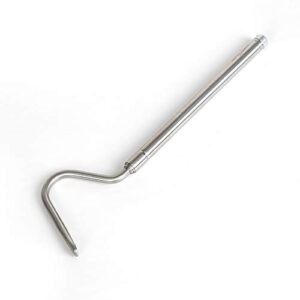
When pocket space matters as much as reach, this hook earns its spot as your grab-and-go option. It collapses to just 7.8 inches yet extends to 23.6 inches, giving you real versatility without the bulk.
Stainless steel construction resists rust in humid enclosures, and at 0.09 kg, you’ll barely notice it’s there. The flat, rounded tip controls small, non-venomous snakes gently.
Rated for reptiles up to 2.2 lb, it’s best suited for lighter-duty tasks, not heavy field work.
| Best For | Reptile hobbyists and professionals who need a compact, travel-friendly tool for safely handling small, non-venomous snakes during terrarium maintenance or fieldwork. |
|---|---|
| Material | Stainless steel |
| Collapsible Design | Yes |
| Grip Type | Flat rounded tip |
| Weight | 0.09 kg |
| Extended Length | 23.6 in |
| Corrosion Resistance | Yes |
| Additional Features |
|
- Collapses down to 7.8 inches, making it easy to carry in a pocket or bag
- Lightweight stainless steel build (0.09 kg) resists corrosion even in humid enclosures
- Flat, rounded tip allows gentle, safe handling of small snakes and reptiles
- Not designed for venomous species or heavy-duty field herping
- Limited holding strength, so it may struggle with larger or stronger snakes
- Hook can reclose under pressure, requiring extra care during use
2. Aquaneat Extendable Stainless Steel Snake Hook
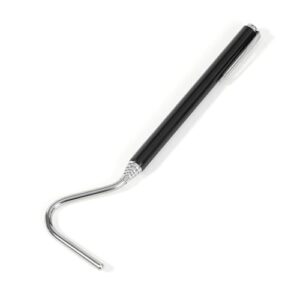
If that first pick was your grab-and-go option, this one’s built for keepers who need serious reach. The Aquaneat extends from 7 to 26 inches, with a round-headed hook that limits skin abrasion on your reptile.
Rust-resistant stainless steel holds up in humid rooms, and at 1.76 ounces, it won’t tire your wrist. Note: some keepers report flimsiness under moderate force, so stick to smaller, non-venomous species rather than heavy-bodied ones.
| Best For | Reptile keepers who need extra reach for handling smaller, non-venomous snakes safely from a distance. |
|---|---|
| Material | Stainless steel |
| Collapsible Design | Yes |
| Grip Type | Non-slip handle |
| Weight | 1.76 oz |
| Extended Length | 26 in |
| Corrosion Resistance | Yes |
| Additional Features |
|
- Extends up to 26 inches for safe handling distance
- Lightweight at 1.76 ounces, reducing hand and wrist fatigue
- Round-headed hook design helps minimize skin damage to the snake
- Some users report flimsiness or weakness under moderate force
- Not suitable for large, heavy-bodied, or venomous snakes
- Smaller handle size may limit grip and control for users with larger hands
3. Bytcew Telescopic Snake Hook
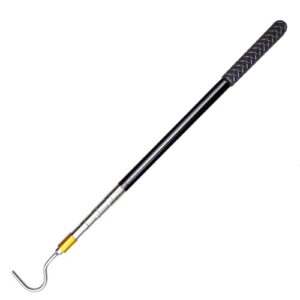
Need something between those two extremes? The Bytcew closes down to 22 inches and stretches to 46, with collet-style locking notches that stop rotation mid-task.
The hook head is shaped to reduce snagging, guiding snakes out of tight enclosure gaps without a fight. Stainless steel keeps things balanced for single-hand use, cutting fatigue during long shifts.
A non-slip handle rounds it out, giving you steady control whether you’re working a quick transfer or a longer field check.
| Best For | Reptile enthusiasts and field workers who need a lightweight, portable tool for safely handling and relocating small snakes. |
|---|---|
| Material | Stainless steel |
| Collapsible Design | Yes |
| Grip Type | Rubber handle |
| Weight | 5.6 oz |
| Extended Length | 61 in |
| Corrosion Resistance | Yes |
| Additional Features |
|
- Rivet-reinforced head keeps the hook securely attached, even under tension
- Five-section telescopic design adjusts from 16 to 61 inches for different reach needs
- Lightweight stainless steel build with a non-slip rubber grip for easy one-handed use
- Maximum load capacity of just 2 pounds means it’s unsuitable for larger or heavier snakes
- Hook size may be too small to securely handle bigger reptiles
- Can bend under its own weight when fully extended
4. DocSeward Copperhead Snake Hook 43 Inch
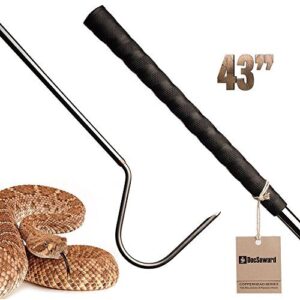
If you want something built to stay in the field for years, the Copperhead is worth a look. Its stainless steel shaft with copper ferrule cuts weight without sacrificing strength, keeping balance steady across the full 43-inch length.
The textured rubber grip, backed by knurling, holds firm even with sweaty hands. At 3 to 9 feet, it controls most yard and woodland snakes with ease, no adjustment period required.
| Best For | Anyone who handles snakes regularly, whether it’s in the backyard, on wooded trails, or during general reptile work, and wants a tool solid enough to hold up over years of use. |
|---|---|
| Material | Stainless steel |
| Collapsible Design | No |
| Grip Type | Rubber grip |
| Weight | 8 oz |
| Extended Length | 43 in |
| Corrosion Resistance | Yes |
| Additional Features |
|
- Copper ferrule and stainless steel construction balance weight with real durability
- Lightweight at just 8 ounces, making it easy to maneuver during extended use
- Textured rubber grip provides secure handling, even two-handed when extra control is needed
- Not intended for venomous snake handling without proper training
- Rubber grip may wear down over time with heavy UV exposure
- Doesn’t retract or collapse, so it takes up more space in storage or transport
5. JIHAQUA Stainless Steel Snake Hook
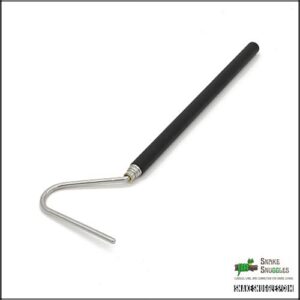
When humidity is a constant in your reptile room, corrosion resistance stops being optional. The JIHAQUA earns its spot with a stainless steel shaft built to shrug off moisture, paired with a smooth finish that won’t snag on substrate or enclosure decor.
Extending to 39 inches, it locks solid once deployed, so drift isn’t a concern mid-capture. The non-slip grip keeps control steady, and the hook head engages bodies firmly without pinching, a small detail that matters more than you’d think.
| Best For | Reptile keepers who need a corrosion-resistant tool for safely handling small to medium snakes in humid enclosures. |
|---|---|
| Material | Stainless steel |
| Collapsible Design | Yes |
| Grip Type | Rubber grip |
| Weight | 3.84 oz |
| Extended Length | 39 in |
| Corrosion Resistance | Yes |
| Additional Features |
|
- Stainless steel shaft resists corrosion and stays smooth against substrate and decor
- Extends to 39 inches and locks securely in place for stable, drift-free handling
- Lightweight at 3.84 ounces, making it easy to use for extended periods
- Grip has been reported as flimsy and may need reinforcement over time
- Can bend or break under moderate force, especially when pulling heavier objects
- Not ideal for larger or stronger reptile species that need more heavy-duty support
6. Stainless Steel Retractable Snake Hook 26 Inch
Compact and unassuming, this hook packs real value into a lightweight frame. At just 2.08 ounces, it’s built from corrosion-resistant stainless steel, extending to 26 inches for handling small to medium snakes.
The rubber grip aids control, though some keepers note it can loosen under stress. Skip heavy-bodied species here; this hook shines for routine transfers and shelf retrievals in tight enclosure spaces where a bulkier tool just gets in the way.
| Best For | Reptile keepers who need a lightweight, portable tool for safely handling small to medium snakes and grabbing items from tight or hard-to-reach spots. |
|---|---|
| Material | Stainless steel |
| Collapsible Design | Yes |
| Grip Type | Rubber grip |
| Weight | 2.08 oz |
| Extended Length | 26 in |
| Corrosion Resistance | Yes |
| Additional Features |
|
- Retractable design makes it compact and easy to store or carry
- Stainless steel construction resists corrosion and holds up over time
- Rubber grip helps with handling and control during use
- Grip can loosen or separate with repeated stress
- Not built for large or powerful reptiles
- A few users have reported bending or breaking early on with moderate force
7. Zoo Med Deluxe Collapsible Snake Hook
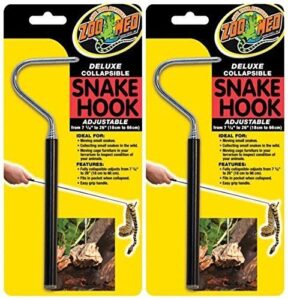
When storage space is tight, this hook earns its keep by collapsing from 26 inches down to about 7.25 inches, tucking neatly into a bag or truck console. Built from stainless steel rather than aluminum, it resists rust in humid reptile rooms where lesser tools corrode fast.
Locking connector joints keep the shaft rigid once extended, and the textured grip cuts down on slippage. It’s a dependable pick for keepers juggling multiple enclosures throughout the day.
For anyone new to reptile care, mastering how to pick up a corn snake safely pairs well with a reliable hook for stress-free handling.
| Best For | This hook is best for reptile keepers who handle small to medium non-venomous snakes and want a lightweight, portable tool for cage inspections and gentle handling. |
|---|---|
| Material | Plastic |
| Collapsible Design | Yes |
| Grip Type | Standard |
| Weight | 3.52 oz |
| Extended Length | 26 in |
| Corrosion Resistance | N/A |
| Additional Features |
|
- Adjustable length from 7-1/4 to 26 inches suits a variety of tasks and snake sizes
- Collapsible design makes it easy to store in a bag, pocket, or vehicle
- Comes two to a pack, so you always have a backup on hand
- Not designed for use with venomous reptiles
- Lightweight plastic construction can flex or break under heavier loads
- Limited durability for snakes over roughly 150g, including adult pythons or boas
8. Mabor Stainless Steel Extendable Snake Hook
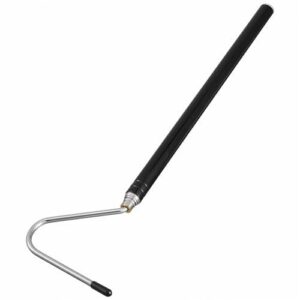
A duckbill-shaped head sets the Mabor apart, spreading pressure across the snake’s body instead of pinching one spot. The stainless steel shaft resists corrosion in humid enclosures, and reinforced tip junctions hold up against repeated use on rough substrates.
The knurled grip stays secure even with sweaty palms, while the telescoping shaft locks at multiple settings for enclosures of different depths. Smooth surface finishes mean it won’t snag your gloves during a routine transfer.
| Best For | Reptile owners and keepers who need a gentle, reliable way to handle small to medium snakes like pythons and boas during routine transfers or enclosure maintenance. |
|---|---|
| Material | Stainless steel |
| Collapsible Design | Yes |
| Grip Type | Locking mechanism |
| Weight | 65.3 g |
| Extended Length | 40.9 in |
| Corrosion Resistance | Yes |
| Additional Features |
|
- Smooth rounded tip and duckbill-shaped head prevent injury by spreading pressure evenly across the snake’s body
- Adjustable length from 11.6 to 40.9 inches with a secure locking mechanism makes it versatile for different enclosure depths
- Lightweight at just 65.3g and collapses down to 11.6 inches, making it easy to store or carry along
- Can feel flimsy under lateral pressure when fully extended
- Not suitable for large or heavy-bodied snakes due to limited strength
- Lacks a rubber tip, which some users prefer for added grip or protection
9. Yorikyas Telescopic Snake Hook Tool
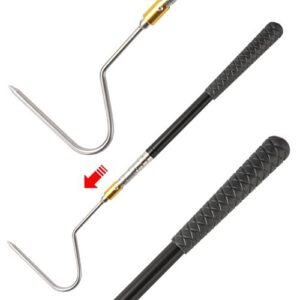
Built for zoo settings, the Yorikyas telescopic hook extends to about 46 inches for safe distance during transfers, then collapses to 22 inches for storage in field bags or vehicle compartments.
The twist-lock mechanism holds your chosen length securely, so it won’t slip mid-procedure. Aluminum and stainless construction keeps things lightweight without sacrificing rigidity, and the knurled grip fights slippage when your hands are sweaty. The tip’s shallow curve cradles snakes gently, minimizing pressure points during veterinary exams.
| Best For | Reptile owners, hikers, and campers who need a lightweight, portable tool for safely catching or moving snakes at a distance. |
|---|---|
| Material | Stainless steel |
| Collapsible Design | Yes |
| Grip Type | Rubber grip |
| Weight | 0.22 kg |
| Extended Length | 64 in |
| Corrosion Resistance | Yes |
| Additional Features |
|
- Extends from 21.6" to 64", offering flexible reach for different situations
- Collapsible and lightweight (0.22 kg) design makes it easy to carry while hiking or camping
- Soft rubber grip handle provides comfortable, secure handling
- Locking mechanism may fail under impact or stress, leading to twisting at the joint
- Some users report denting or deformation from minor impacts
- Not built for heavy-duty or repeated industrial use, best suited for occasional handling
10. Gzlozak Retractable Snake Hook 35-66 Inch
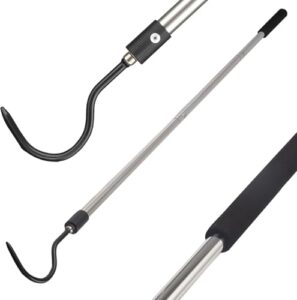
Rounding out this list, the Gzlozak retractable hook covers the widest reach range here, adjusting from 35 to 66 inches to suit everything from cage checks to safer distance work with medium and large snakes.
Its thickened stainless steel shaft stays rigid at full extension, while the non-slip foam grip keeps control steady in wet, sweaty conditions. At 15.2 ounces, it’s light enough for one-handed use, and the rubber-coated hook tip protects snakes during transfer.
| Best For | Reptile keepers and outdoor enthusiasts who need adjustable, safe-distance handling for medium to large snakes. |
|---|---|
| Material | Stainless steel |
| Collapsible Design | Yes |
| Grip Type | Non-slip foam grip |
| Weight | 15.2 oz |
| Extended Length | 66 in |
| Corrosion Resistance | Yes |
| Additional Features |
|
- Extendable range from 35 to 66 inches suits both close-up and long-distance handling
- Non-slip foam grip keeps control secure even in wet or sweaty conditions
- Rubber-coated hook tip protects snakes from injury during handling and transfer
- Assembly/disassembly needed to adjust length can be a hassle for frequent use
- Extended length may be excessive for small indoor enclosures or close-range tasks
- Built specifically for snake handling, so it’s not ideal for other heavy-duty gripping jobs
Quick Snake Hook Comparison
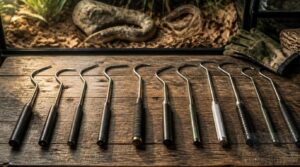
Picking the right snake hook comes down to a handful of practical factors, not just brand names. You’ll want to weigh reach, grip, weight, and price against how you actually work day to day. Here’s a side-by-side look at what separates these ten hooks from each other.
Reach and Collapsed Length
Eighteen inches to sixty-six: that’s the swing you get from a good Telescoping Snake Hook, giving field deployment speed when seconds matter.
| Reach | Collapsed |
|---|---|
| 66" | 26" |
| 40" (Standard Hook) | fixed |
| Double models | varies |
| Collapsible | shortest |
| Custom | by request |
Compact storage and length adjustment precision matter as much as maximum reach for daily zoo work.
Hook Width and Control
Reach gets snakes at a distance, but width impact control decides what happens once you’ve made contact. Wider mouths spread grip stability balance across the body; narrow profiles give precision narrow access in tight enclosures.
| Width | Best For |
|---|---|
| Wide | Steady lifts |
| Narrow | Field herping precision |
| Double | Confined-space control |
Standard Hook and Collapsible models often offer customizable engagement options for material surface interaction.
Weight and Shaft Strength
A hook’s shaft tells you how it’ll hold up under a thrashing snake. Steel keeps tensile strength above 500 MPa, while a thick-wall anodized aluminum shaft stays lightweight without sacrificing stiffness.
| Material | Weight | Strength |
|---|---|---|
| Steel | Heavier | Very High |
| Aluminum | Light | Moderate |
| Titanium 14/250 | Light | High |
Balanced weight near the grip eases wrist strain during long shifts.
Price and Overall Value
Weight buys comfort, but price determines what stays in your budget long-term. Cost vs durability matters most here: a $30 aluminum hook saves cash upfront, while $80+ stainless steel pays off through fewer replacements.
| Tier | Average Price | Average Rating |
|---|---|---|
| Entry | $20-35 | 4.2 |
| Midrange | $40-65 | 4.6 |
| Premium | $70-100+ | 4.8 |
Durable construction with solid warranty coverage often beats chasing the lowest sticker price. Evaluating long-term value through benefit relative cost ensures smarter purchasing decisions.
Ratings and Review Patterns
Star counts only tell half the story, so smart buyers dig into the pattern behind them. Across 11,977 customer reviews on comparable hooks, the average rating sits near 4.8, with verified purchases carrying the most weight and helpfulness votes clustering around real field use.
| Signal | What It Reveals |
|---|---|
| Rating spikes | Post-sale or update boost |
| Verified badge | Trust and authenticity |
Choose The Right Hook Length
Length isn’t just a spec on a box, it’s what stands between smooth handling and a stressful mistake. The right hook gives you control at one enclosure and falls short at another, so matching size to the job matters more than most keepers realize. Here’s how to think through length before you grab the nearest hook off the wall.
Short Hooks for Tight Enclosures
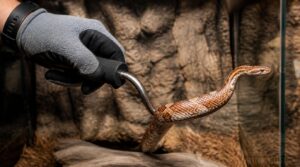
Tight enclosures demand precision control, not brute reach. Short hooks run 6 to 12 inches with a compact curved tip, thin shaft, and ergonomic grip design that won’t snag hides or substrate.
Foam grips and lightweight durable shafts keep one-handed handling steady. Stainless steel resists corrosion from bowls and cleaning agents, protecting enclosure safety during everyday routine care.
Long Hooks for Safer Distance

Six feet of daylight between you and a defensive snake changes everything. Long hooks run 43 to 66 inches, giving real safety distance benefits while guiding animals into transport containers.
Weight distribution keeps wrist fatigue low during extended holds. Grip stability matters most here—training builds the muscle memory that makes extended reach handling second nature, whether you’re running a Midwest facility or working narrow, mini-hook spaces.
Sizing by Snake Length
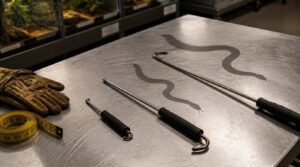
Guessing a hook length rarely ends well—match it to actual snake size instead.
- Small snakes (under 30 cm): mini hooks
- Medium snakes (30–150 cm): the STD-HK40 works for most Midwest collection needs
- Large snakes (over 150 cm): longer, sturdier shafts
- Narrow enclosures: slim-profile hooks regardless of length
- Juveniles: reassess sizing often as growth changes handling needs
Accurate species data helps smarter tool selection every time.
Capacity for Larger Snakes

A big-bodied constrictor can coil past 1.0 inch thick and exert real force, so your hook needs weight support and force resistance built in.
Look for a thick-wall anodized aluminum shaft rated near 20 pounds, like the Bushmaster Hook or Poly Gabonna Hook.
Pair it with enclosure space and two-person handling to cut stress and keep control steady.
Balancing Reach and Control
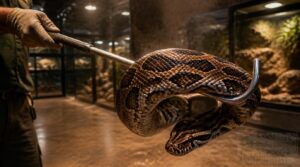
Reach without control just means you’ll drop the snake farther away. Ideal hook length balances both: enough distance for safety, enough power for narrow tip precision.
The STDHK40 nails this ratio.
- Adjustable reach control for shifting spaces
- Weight distribution balance for steady lifts
- Handle grip security during transfers
Dana Savorelli recommends testing feel before buying — good reptile tools should feel like an extension of your arm.
Match Hook Designs to Tasks
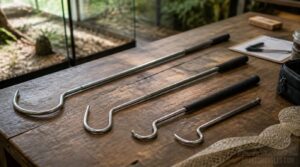
Length is only half the equation; the hook’s design determines whether it actually fits the job in front of you. A hook built for hauling gear across the yard won’t serve you well during a delicate exam, and vice versa. Here’s how each design pairs with the tasks you’ll face most often.
Collapsible Hooks for Transport
Field days rarely go as planned, so collapsible hooks earn their keep by folding under 12 inches for easy stowage. One-hand deployment matters when you’re managing a hide box and a snake at once.
| Feature | Benefit |
|---|---|
| Locking mechanism | Prevents mid-use collapse |
| Aerospace aluminum | Durable, lightweight |
| Quick fold | Setup under 15 seconds |
| Solvent wipe-down | Fights corrosion |
Telescopic Hooks for Variable Reach
Once folded down, telescopic hooks take over where compact storage leaves off, stretching from roughly 20 inches to a full 60–100 inch reach depending on the model.
Locking collars stop drift mid-task, while reinforced inner tubes resist bending under load. Textured grips keep control steady, and quick-release retraction makes variable reach genuinely practical for daily herping work.
Double Hooks for Added Stability
Two hooks beat one when a snake decides to twist mid-transfer. Dual-point control spreads the load across both sides of the body, cutting slippage risk that single hooks can’t match.
Why keepers reach for double hooks:
- Smoother restraint during vet exams
- Steadier grip on active or heavy-bodied snakes
- Durable construction that resists bending under torque
- Confidence handling enclosure transfers without sudden shifts
Mini Hooks for Confined Spaces
Double hooks add stability, but sometimes the enclosure itself is the challenge. That’s where mini hooks shine, offering tight enclosure access and gentle scale guidance in glass-fronted tanks.
Under 8 inches, these lightweight reptile tools reduce fatigue while supporting precise animal relocation. Stainless steel builds handle humid environment durability, keeping this compact tool use reliable for daily, safe-distance handling.
Narrow Hooks for Precise Access
When a snake tucks into a rock crevice, you need more finesse than force. Narrow hooks bring that micro maneuverability, with tips 6-8mm wide for true precision tip angle work.
The tapered, flexible shaft slips past clutter for genuine crevice access technique and minimal disturbance handling—professional herpetology essentials every zookeeper’s snake hook sizing guide should include.
Evaluate Materials and Durability
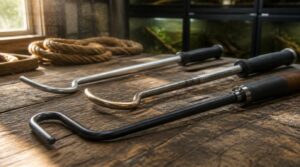
The hook you choose has to hold up to daily use, so material matters as much as length or design. A well-built shaft can mean the difference between a tool that lasts for years and one that bends under pressure at the wrong moment. Here’s what to look for when you’re weighing your options.
For accurate readings and smarter placement, this guide to digital thermometers for hatchlings explains what works in real enclosures.
Aluminum Versus Stainless Steel
Pick up an aluminum hook and a steel one back to back, and the difference hits you immediately: aluminum runs about one-third the weight, easing fatigue during long shifts.
Steel wins on raw strength for heavier snakes.
Aluminum’s machinability makes ergonomic curves easier to shape.
Anodized aluminum shafts resist scratching well, though steel still edges it out for professional-grade toughness.
Corrosion Resistance in Humid Habitats
Because reptile rooms run humid by design, your hook’s finish takes a beating fast, especially past 60% relative humidity. Look for:
- Anodized aluminum or chromium oxide-coated steel
- Zinc alloy protection against galvanic corrosion
- Marine atmosphere coatings for coastal facilities
Titanium alloy strength holds up best long-term. Regular surface cleaning techniques matter too, since humidity corrosion models show contaminants accelerate pitting fast.
Shaft Rigidity and Flex
Ever felt a hook wobble mid-lift and wonder if it’ll hold? That’s bending stiffness at work. A solid Flex Profile keeps torsional resistance high, so the shaft resists twisting when you engage cover objects.
Material modulus matters here: a thick wall anodized inside and out aluminum shaft outperforms cheap tubing, while titanium alloy strength rivals golf shafts for vibration damping and equipment longevity. Hook strength testing confirms it.
Grip Materials and Ergonomics
Your hands do the real work, so grip quality matters as much as shaft strength. Rubber grip comfort and TPE grips cut hand fatigue reduction during long shifts, staying tacky even sweaty. Contoured, symmetrical ergonomic handle design fits either hand naturally.
Look for vibration dampening benefits and secondary grip zones for lightweight handling—small features that add real safety grip enhancement and user comfort in handling.
Cleaning and Storage Requirements
A clean hook is a hook that lasts. After every use, wipe the shaft with disinfectant, dry fully, and store on a wall rack, not a chemical shelf.
If your facility keeps supplies near cleaning agents, follow proper chemical container labels and shelf organization plans, and keep hooks away from acids or solvents entirely.
Anodized aluminum resists corrosion best for daily-use gear.
Snake Hook Uses for Zookeepers

A good snake hook earns its keep across your whole workday, not just one task. From daily transfers to unplanned catches outside the enclosure, you’ll reach for it more often than you might expect. Here’s where this tool really proves its worth.
Routine Enclosure Transfers
Moving a snake between enclosures isn’t a grab-and-go job.
Transfer timing coordination between keepers keeps stress low, while a quick path hazard inspection clears cables and deep substrate. Match origin and destination temperatures first, keep a contingency escape route ready, and watch for gaping or rapid tongue flicking afterward.
Quality snake hooks make this routine transfer smooth and genuinely safe.
Veterinary Exams and Procedures
Once a snake settles onto the exam table, your hook becomes part of the medical team. It steadies patients during pre-exam assessment, guides safe positioning for anesthesia protocols, and eases handling for ultrasound imaging or blood collection.
Reptile veterinary care leans on:
- Gentle repositioning during vitals
- Controlled restraint pre-sedation
- Support during imaging
- Calm post-procedure monitoring
Field Herping and Surveys
Out in the field, your hook earns its keep differently than it does in a clinic setting. Visual Encounter Surveys and Cover Object Placement both demand safe distance handling, while Road Cruising Methods, eDNA Sampling, and Nighttime Torch Surveys round out a solid herpetology toolkit.
| Method | Tool Role | Timing |
|---|---|---|
| Visual Encounter | Guides approach | Daylight |
| Cover Object | Lifts safely | Sunny spots |
| Torch Survey | Extends reach | Nighttime |
Flipping Cover Objects Safely
Boards, tin, and rock piles hide snakes, so grip technique matters as much as the survey itself. Keep two hands steady, wrists aligned, and lift slowly in small motions.
Check lighting conditions before you tip anything, clear the workspace of bystanders, and wear cut-resistant gloves. Good weight distribution and a snake hook prevent slips during safe handling.
Emergency Animal Control
When a call comes in about a loose python, your Rapid Response Protocols kick in fast, and Incident Command Systems keep field teams organized on scene.
Snake hooks pair with:
- Animal Transport Crates
- Full PPE requirements
- Community evacuation plans
Zookeepers rely on these wildlife control devices for calm, injury-free capture during public emergencies.
Use Snake Hooks Safely

Owning a good hook is only half the job, because how you use it determines whether your snake stays calm or gets hurt. Proper technique protects your animal’s spine, keeps your hands out of striking range, and builds the kind of trust that makes future handling easier.
Here’s what you need to know before you pick that hook up.
Safe Lifting and Body Support
Good lifting habits protect your back as much as any hook protects your hands. Use the Stable Stance Technique, feet shoulder-width apart, then apply Knee Bending Mechanics before gripping.
| Step | Action | Why |
|---|---|---|
| 1 | Stable stance | Balance |
| 2 | Bend knees | Reduce strain |
| 3 | Smooth lift | Control |
Smooth Lift Motion and Team Lifting Coordination keep professional herpetology safe.
Preventing Falls and Injuries
Since a startled snake can shift weight fast, keep your footing and surroundings under control at all times. Wear non-slip footwear, clear the enclosure of clutter, and check handrail placement on nearby steps.
Balance training routines build the stability your legs need mid-lift. Pair that strength with reliable snake safety equipment, and every professional herpetology task stays firmly in your hands, not on the floor.
Avoiding Head and Neck Restraint
Your snake’s neck is off-limits, period. Gripping behind the head chokes, so let your hook create safe distance handling instead.
Never grip a snake behind the head—let the hook create safe distance instead
- Neutral head positioning
- Zero neck pressure
- Constant breathing checks
Non-contact restraint with quality snake hooks keeps airways clear and eyes on respiration throughout every procedure. Reliable snake safety equipment turns risky animal restraint techniques into routine, professional herping practice.
When Tongs Are More Appropriate
A hook isn’t always the right tool. For venomous species safety, snake tongs give firmer precision grip control and true extended reach handling, ideal for large or thrashing animals. They allow one-handed operation during exams and support strict hygiene sterilization protocols. Any solid herpetology equipment kit for professional snake relocation includes both.
Follow Legal and Ethical Standards

Owning a good snake hook is only half the job, since where and how you use it matters just as much.
Every facility runs on rules, and every jurisdiction has its own take on wildlife handling, so knowing the boundaries keeps you and the animals protected.
Here’s what you need to have squared away before that hook ever leaves the wall.
Facility Protocols and Staff Training
A well-run reptile facility runs on routine, not luck. Standardized entry procedures guide every transfer, while annual training drills and risk assessment workshops keep skills sharp for professional snake relocation.
- PPE compliance checks
- Documented competencies
- Emergency bite drills
- Quarantine protocols
Documentation record keeping tracks it all, proving proper training isn’t optional—it’s the backbone of safety and protection with every wildlife safety gear.
Local Wildlife Handling Regulations
Training only gets you so far—regulations decide what’s legal in the first place. Rules vary by state, but expect a Permit Application Process, annual Inspection Compliance Audits, and strict Handler Certification Requirements.
Agencies also enforce Record Keeping Requirements and Public Access Restrictions at demonstrations. In some jurisdictions, snake handling illegal without proper licensing, so check local wildlife management tools and animal welfare practices before any snake relocation safety work with professional herping gear.
Venomous Species Permit Requirements
Working with venomous species pushes you past general certification and into a full Permit Application Process, with Reliability Evidence Requirements, Hazard-Based Housing Standards, and Fee and Documentation steps.
State Permit Variations mean Hamburg’s rules won’t match another state’s, so verify locally before adding venomous snake management to your professional herping gear routine, alongside snake handling hooks built for bite prevention.
Public and Animal Welfare
Permits aside, your facility’s reputation rides on how the public sees animal care. Public Funding often backs welfare upgrades, while Welfare Standards, Transparency Reporting, and Community Education build trust.
- Confident, well-fed snakes
- Clean, secure enclosures
- Calm, practiced handlers
- Visible bite prevention protocols
- Honest Stakeholder Collaboration
Quality snake handling hooks and professional reptile handling show visitors you know the safest place to grab a snake.
Incident Reporting and Bite Plans
Confidence is great, but a solid bite response plan still matters. Complete the incident form within 24 hours, noting species, location, and personnel.
| Step | Action |
|---|---|
| 1 | Immobilize, isolate, notify medical staff |
| 2 | Alert safety officer within 1 hour |
| 3 | Document chronology and witnesses |
| 4 | Review within 72 hours |
Quality snake handling hooks reduce risk, but preparedness protects everyone.
Select Your Professional Snake Hook
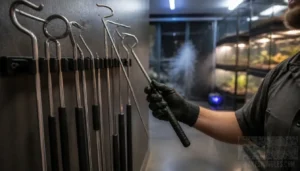
Picking the right hook isn’t about grabbing whatever’s cheapest or closest on the shelf, it’s about matching the tool to your actual work. You’ll want to weigh species, budget, and backup support before committing to one setup. Here’s what to think through as you build out your own toolkit.
Match Tools to Snake Species
No single hook fits every snake. A Species Specific Hook approach matters: venomous species need reinforced tips and longer reach, while non-venomous tools can be lighter. Match body shape to hook geometry, and weigh length snake ratio for proper support.
Snake species identification isn’t optional here; it drives real snake species compatibility and safer handling every time.
Balance Budget and Reliability
Cheap hooks cost you twice. A Lifecycle Cost Analysis shows quality tools cut downtime over five years, and bulk purchasing trims 12-18% off per-unit price. Look for:
- Standardized parts strategy
- Stainless or titanium 14 250 thick hooks
- Warranty coverage terms
- Maintenance cycle planning
- Animal Equipment by Stoney’s professional grade tools
Reliable snake handling hooks aren’t an expense — they’re insurance.
Check Warranty and Support
A warranty tells you how much a maker trusts its own steel. Look for 12 to 24 month coverage, easy claim steps, and real support access before buying. Regional policies and reviews (like 165 ratings averaging 4.8) reveal reliability. For handling equipment maintenance and warranty questions, contact Stoney today at 281-299-6171.
| Warranty Feature | What to Verify |
|---|---|
| Coverage length | 12–24 months |
| Claim process | RA number required |
| Extended options | Up to 5 years |
| Regional service | Local center access |
| Support type | Phone/email response |
Consider Custom Sizing Options
Off-the-rack hooks don’t always fit oddly shaped enclosures. That’s why custom snake hooks matter, offering 15 different lengths from 24 to 52 inches beyond the Standard Snake Hook.
This snake hook sizing guide covers custom length selection, adjustable shaft benefits, and custom head options.
Material choice impact affects grip and weight, while solid fit guarantee policies protect your investment when precise measurements matter most.
Build a Multi-hook Toolkit
Why settle for one hook when your job demands ten different tasks a day? Modular Hook Selection covering 20 to 66 inches keeps you ready for anything.
- Confidence walking into any enclosure
- Relief knowing gear won’t fail mid-task
- Pride in a professional herpetology gear setup
Compact Storage Solutions and corrosion resistant materials round out a toolkit built for real zoo keeper tools, not guesswork.
Frequently Asked Questions (FAQs)
What to use instead of a snake hook?
Don’t get hooked on just one tool. Snake tongs offer scissor-grip control without piercing skin, while heavy-duty gloves, sturdy bags, and long-handled grabbers with locking jaws round out a solid professional toolkit.
What do zookeepers feed snakes?
Most keepers rely on frozen-thawed prey like mice, rats, or chicks, matched to species-specific diets. Proper prey size selection and safe snake handling matter just as much as your snake hook during routine captive snake care.
What is the purpose of a snake hook?
Think of it as a handshake with distance built in. A snake hook gives you non-contact handling, supporting weight, guiding movement, and keeping snake handlers safely clear of strikes during everyday reptile handling tasks.
What snake is worth $100,000?
The green tree python tops six-figure snake sales, with rare morphs hitting $100,000 through standout color pattern, proven breeding genetics, and strong collector market demand—reptile keeper supplies alone won’t get you there; rarity and pedigree drive the price.
Who manufactures the most trusted snake hooks worldwide?
Trust in this trade is earned one careful lift at a time. Animal Equipment by Stoney, REPTI ZOO, and AQUANEAT lead through manufacturer reputation, professional endorsements, and consistent quality standards, making their Standard Snake Hook a globally trusted choice among zookeepers.
Can you get custom snake hooks for specific needs?
Yes. Beyond the Standard Snake Hook, makers offer Custom Length Options (up to 15 different lengths), Species Specific Design, and Material Customization like the Poly Viper Hook, plus ergonomic grip and collapsible custom builds for specialized snake handling tools.
Are collapsible hooks reliable for daily zoo operations?
For light-duty tasks, yes.
Field reliability testing shows collapsible hooks handle nonvenomous species well, but weight distribution and durability under stress favor a fixed-length or Standard Snake Hook for heavier reptile handling tools and daily snake capture devices.
Who can zookeepers call for hook selection advice?
You’ve got a small army of experts on speed dial. Ring the Zoo Vet Consultation line, the ASIH Technical Advisor, or a manufacturer’s support line—DocSeward and JIHAQUA both help herpetologist supplies buyers pick the right professional wildlife tools.
Conclusion
One moment of hesitation is all it takes for a calm snake to become a handful. That’s the reality every keeper faces, and it’s why your equipment choice can’t be an afterthought.
The right snake hooks for zookeepers turn uncertain moments into routine ones, giving you confident control whether you’re clearing an enclosure or supporting a vet exam.
Choose wisely, maintain your tools, and trust the process. Your hands, and your animals, will thank you.