This site is supported by our readers. We may earn a commission, at no cost to you, if you purchase through links.
Your ball python doesn’t technically need UVB lighting to survive—but survival and thriving aren’t the same thing. For decades, keepers raised these snakes in complete darkness between feedings, unaware that low-level UVB exposure triggers vitamin D3 synthesis and improves calcium metabolism even in crepuscular species.
Recent veterinary research shows ball pythons with access to appropriate UVB lighting display more natural behaviors, stronger immune responses, and better long-term skeletal health than those kept without it. The challenge isn’t whether to provide UVB anymore—it’s selecting the right system for your setup. Choosing between T5 linear tubes, compact bulbs, and emerging LED options requires understanding intensity levels, fixture placement, and replacement schedules that match your python’s biological needs.
Table Of Contents
Key Takeaways
- Ball pythons don’t require UVB to survive, but recent veterinary research shows that low-intensity UVB exposure (targeting UVI 2.0–3.0) improves calcium metabolism, immune response, skeletal health, and natural behaviors compared to snakes kept in complete darkness.
- T5 HO linear tubes with reflectors outperform compact bulbs by delivering consistent UVB coverage across larger enclosures for 9–12 months, while compact bulbs require replacement every 6–8 months and produce uneven coverage with higher heat output.
- Proper UVB setup requires mounting the fixture 10–18 inches above the basking zone on the warm end, creating a gradient from UVI 0 in hides to UVI 2–3 at basking height, and using a digital timer for consistent 12-hour photoperiods that support circadian rhythm.
- UVB bulbs must be replaced every 10–12 months (6–8 months for compacts) even when still glowing because invisible UVB output degrades after roughly 3,500 hours, leaving your snake without the vitamin D3 synthesis needed for calcium absorption and bone health.
Best UVB Lighting Systems for Ball Pythons
Choosing the right UVB lighting system starts with understanding what your ball python actually needs. You want a fixture that delivers low-intensity UVB consistently across the enclosure without creating hot spots or uneven coverage.
Ball pythons fall into a different category than many other snakes, so check out this guide on snake lighting needs by species to see where they actually sit on the UVB spectrum.
Here are four reliable options that balance performance, safety, and ease of setup.
For snakes that love to dig, choosing the right substrate for burrowing species can make a huge difference in keeping them comfortable and active.
1. Repti Zoo Reptile UVB Lighting Kit
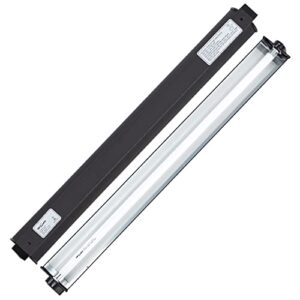
The Repti Zoo Reptile UVB Lighting Kit delivers a 5.0 UVB output specifically engineered for ball python calcium metabolism and vitamin D3 synthesis. You’ll receive a 24-watt T5 HO fixture with a curved, polished reflector that maximizes UVB delivery to your python’s basking zone.
The kit features ETL certification, protective end caps, and a detachable power cable with an integrated switch for straightforward lighting setup. At 22.63 inches, it fits standard 24-inch enclosures perfectly, though quality control issues and a relatively short power cable warrant consideration in your reptile care planning.
| Best For | Ball python owners with 24-inch enclosures who need a reliable UVB source to support calcium absorption and natural behaviors, as long as they’re prepared to monitor the unit for potential quality issues. |
|---|---|
| Primary Use | Reptile Enclosure |
| Brand | REPTI ZOO |
| Material | Tempered Glass/Aluminum |
| Target Animals | Reptiles/Amphibians |
| Weight | Not Specified |
| Color | Black/Clear |
| Additional Features |
|
- Energy-efficient T5 HO ballast with curved reflector design maximizes UVB coverage across your python’s basking area
- ETL-certified fixture includes everything needed for setup, from the Rainforest 5.0 UVB bulb to the detachable power cable with on/off switch
- Low-profile design fits easily inside vivariums or mounts over mesh tops without taking up excessive space
- Quality control problems reported by multiple users, including units that burn out, melt, or fail within weeks to months of use
- Short power cable (3-4 feet) limits placement flexibility and may require extension cords for many setups
- Higher price point compared to competitors, especially concerning given the reliability issues some customers experienced
2. Hygger Reptile UVB Light Bulb
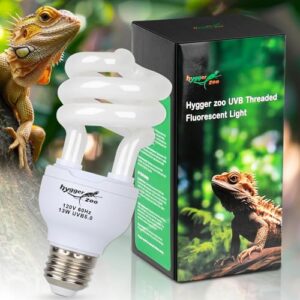
If you’re weighing Hygger Products for your Ball Python care, their UVB bulbs offer a stable UVB spectrum and energy-saving LED technology. The compact quartz design fits shallow domes, and the aluminum housing aids lighting safety by reducing heat buildup.
These features align well with ball python morph lighting needs, where gentle UVB exposure supports vitamin D3 production without overheating delicate environments.
Position the bulb 8–15 inches above your snake’s basking zone for ideal UVB lighting. Always leave a shaded retreat to prevent overexposure. With a lifespan of 8–12 months, regular replacement ensures consistent reptile lighting and healthy vitamin D3 synthesis.
| Best For | Ball python owners who want a compact UVB bulb with strong UVA/UVB output that fits shallow light domes and supports vitamin D3 synthesis. |
|---|---|
| Primary Use | Veterinary Disinfectant |
| Brand | Rescue |
| Material | Liquid |
| Target Animals | All Pets |
| Weight | 2.09 pounds |
| Color | Odorless |
| Additional Features |
|
- High-quality quartz construction provides evenly distributed UVB spectrum that mimics natural sunlight
- Compact size works well with shallow domes and positions easily 8–15 inches above basking zones
- Energy-efficient design with strong UVA and UVB output for healthy calcium absorption
- Bulb needs replacement every 8–12 months even if it still lights up, adding ongoing costs
- Some users report bulbs burning out faster than expected or not working properly
- Effectiveness decreases over time, so you might not notice it’s stopped working until it’s too late
3. Zoo Med Desert UVB Lighting Kit
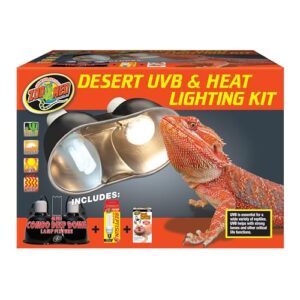
Zoo Med’s Desert UVB Lighting Kit pairs a Mini Combo Deep Dome fixture with a 75-watt basking spot lamp and a 13-watt ReptiSun 10.0 compact bulb—kit components engineered for desert species. That 10.0 UVB output exceeds typical Ball Python recommendations, so you’ll want to mount it 12–18 inches away or above mesh to dial UVI down to 2.0–3.0.
The fixture design delivers focused basking performance and adequate UVB lighting in one unit, but consider a lower-intensity T5 tube for more natural reptile lighting if your enclosure allows.
| Best For | Keepers of desert species like bearded dragons and uromastyx who need high UVB output and intense basking heat in a compact dual-lamp setup. |
|---|---|
| Primary Use | Ready-to-Use Disinfectant |
| Brand | REScue |
| Material | Liquid |
| Target Animals | All Animals |
| Weight | 2.09 pounds |
| Color | Clear |
| Additional Features |
|
- Combines basking heat and UVB in one fixture with independent switches for each lamp
- Strong 10.0 UVB output works well for desert reptiles that need higher UV exposure
- Compact design fits smaller enclosures while providing focused heat and light zones
- UVB intensity may be too strong for Ball Pythons and other low-UV species without careful positioning
- Compact fluorescent bulbs tend to wear out faster than tube-style alternatives
- Some users report quality control issues with sockets shorting out or failing prematurely
4. Reptispa T5 UVB Lighting Kit
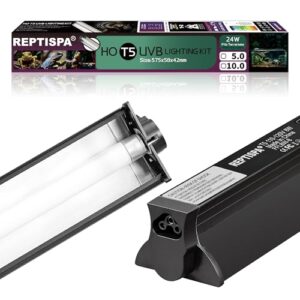
For spacious enclosures spanning 24 to 48 inches, the Reptispa Kit delivers targeted T5 HO performance with its Tropical 5.0 bulb—providing exactly the low-intensity UVB output Ball Python care demands. You’ll get 5 percent UVB and 30 percent UVA alongside a curved aluminum reflector that boosts UVB penetration by 30 percent, creating ideal gradients at 12 inches.
The electronic ballast ensures stable illumination, while detachable cables and mounting brackets simplify installation. Choose from 24W, 39W, or 54W wattages to match your enclosure length, and pair it with timers for consistent reptile lighting schedules.
Although UVB isn’t required, it can support healthy ball python care by improving activity patterns and overall wellbeing.
| Best For | Keepers with 24- to 48-inch enclosures who need reliable, low-intensity UVB for Ball Pythons and similar species that don’t require high UVB levels. |
|---|---|
| Primary Use | Temperature Gun |
| Brand | Etekcity |
| Material | ABS Plastic |
| Target Animals | Not for Humans |
| Weight | 5.6 ounces |
| Color | Yellow/Black |
| Additional Features |
|
- Aluminum reflector boosts UVB output by 30%, creating proper gradients without multiple fixtures
- All-in-one design with built-in electronic ballast removes the hassle of buying separate components
- Multiple wattage options (24W, 39W, 54W) let you match the fixture to your enclosure size
- Bulb lifespan of only 6–12 months means you’ll need regular replacements
- Replacement bulbs can be pricey and harder to find compared to more common brands
- Gets hot during use, so you need to keep it at least 12 inches from your pet to avoid burns
Choosing The Right UVB Bulb
Not all UVB bulbs deliver the same results for your ball python. The right choice depends on bulb type, intensity level, and brand reliability—factors that directly affect your snake’s health and behavior.
Let’s break down the key differences so you can pick the best option for your setup.
T5 HO Linear Fluorescent Vs. Compact UVB Bulbs
Choosing between T5 HO and compact UVB bulbs shapes your ball python’s lighting durability and fixture design. T5 HO linear fluorescent tubes deliver exceptional bulb efficiency with stronger UVB spectrum coverage across larger enclosures, maintaining consistent full spectrum lighting for 9-12 months.
While ball pythons don’t require UVB, environmental enrichment strategies for boas often incorporate full-spectrum lighting to promote natural behaviors and activity cycles.
Compact UVB bulbs offer:
- Lower initial cost with standard screw-in sockets
- Focused UVB lighting in smaller spaces
- Higher heat emission requiring closer monitoring
T5 HO systems provide better reptile lighting performance overall. Consider the when selecting lighting for your enclosure.
Selecting The Proper UVB Intensity
Target a UV index of 2.0–3.0 at your ball python’s basking zones to support vitamin D3 synthesis without overwhelming your snake. UVB measurement isn’t about bulb percentages alone—distance transforms intensity levels dramatically. A 5% UVB bulb mounted 12 inches away delivers different exposure than the same bulb at 8 inches, so measure the actual UV index at the basking spot using a UVB meter.
| UVB Bulb Type | Recommended Mounting Distance |
|---|---|
| 5% T5 HO | 10–12 inches above basking spot |
| 2.5% T5 HO | 6–8 inches above basking spot |
| Compact 5% | 8–10 inches above basking spot |
Create UVB gradients across your enclosure by positioning full spectrum lighting to cover the warm end, allowing your python to self-regulate exposure. Lighting cycles don’t affect intensity levels, but they do influence how long your snake receives UVB daily—stick to 12 hours on, 12 off. Don’t assume higher wattage equals stronger UVB lighting; fixture design, reflectors, and screen mesh all alter the final UV index reaching your snake. Keep in mind that consistent support both reptiles and are also essential for overall health in other species.
Recommended Brands for Ball Python UVB
Stick with manufacturers whose UVB technology delivers consistent output over the bulb’s lifespan—your ball python’s health depends on predictable UV exposure.
Here’s your brand comparison for reliable reptile lighting systems:
- Arcadia ProT5 kits pair T5 HO linear bulbs with curved reflectors, delivering even Ferguson Zone 1–2 UVB across enclosures at 12-inch basking distances.
- Zoo Med ReptiSun T5 HO bulbs offer moderate, reliable output in dedicated high-output hoods with polished reflectors.
- Budget alternatives like Repti Zoo require UV index meters to verify safe snake health outcomes due to inconsistent performance between individual UVB bulbs.
Setting Up UVB Lighting in Enclosures
Getting your UVB fixture installed correctly isn’t complicated, but you need to nail a few key details to keep your ball python safe and healthy. Proper placement prevents burns while ensuring adequate exposure, and you’ll want to coordinate your UVB with your heat source rather than treating them as separate systems.
Let’s walk through the essential setup steps that’ll give your snake the lighting gradient it needs.
Optimal Placement and Fixture Selection
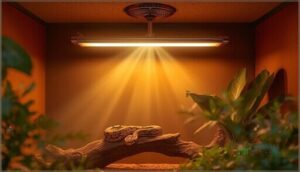
Mount your UVB fixture along the warm side ceiling where your ball python naturally basks under its primary heat source. T5 HO linear fixtures with built-in reflectors double usable output compared to bare bulbs, making them ideal for taller PVC enclosures.
Position the tube parallel to enclosure length for consistent coverage. Ceiling mounting mimics natural overhead sunlight while preventing sideways glare that discourages basking behavior.
Creating a UVB Gradient
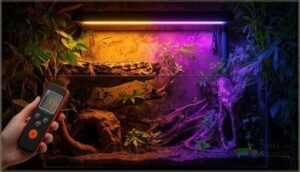
A proper gradient means your snake selects its own UVB dose, moving from UVI 0 in deep hides to roughly UVI 2–3 at basking height. Position your lighting fixture 10–18 inches above surfaces to control intensity, then anchor the low end with solid hides placed away from the tube.
- UVB gradient mapping with a Solarmeter confirms readings at snake-back height across all climbing levels and floor zones
- Shade creation using dense plants, cork rounds, and background panels breaks up light into dappled-transition areas between full exposure and zero UVB
- Reflectors usage behind T5 HO tubes strengthens the gradient by directing a brighter beam downward while keeping side corners dimmer for natural photoperiod variation
Regular gradient maintenance and re-measuring after décor changes prevent accidental hot spots in your UVB lighting setup.
Integrating UVB With Heating Elements
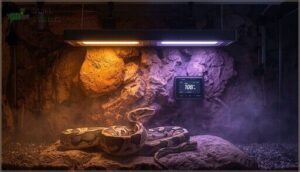
Linking your UVB lighting with heating elements transforms separate fixtures into one unified basking zone. Position your halogen flood and T5 HO tube over the same warm end so thermal gradients and UVB exposure overlap, letting your snake thermoregulate and synthesize vitamin D3 simultaneously.
A thermostat controls heat sources independently while the UVB tube runs on its own lighting cycle for precise temperature control.
Using Timers for Day/Night Cycles
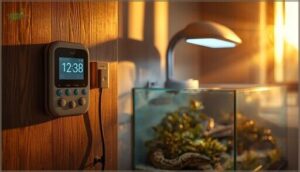
Automating your UVB lighting schedule with a digital timer locks in the 12-hour photoperiod your ball python needs for stable circadian rhythm and metabolic health. Set the cycle to match natural dawn and dusk—lights on at 7 a.m., off at 7 p.m.—so photoperiod management stays consistent even when you’re away.
Three timer settings that simplify lighting control:
- 12-hour on/off cycles mimicking natural day-night patterns for ideal circadian rhythm support
- Seasonal adjustments extending summer daylight to 12.5 hours, reducing winter to 11.75 hours
- Independent UVB and heat schedules so your thermal gradient runs separately from photoperiod automation
Maintaining and Replacing UVB Lighting
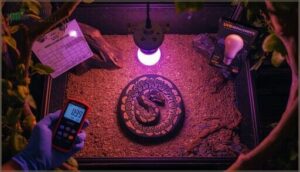
Your UVB bulb won’t last forever, even if it still glows bright.
The invisible UVB output degrades over time, leaving your ball python without the vitamin D3 support it needs.
Here’s what you need to know about keeping your lighting effective and safe.
How Often to Replace UVB Bulbs
You’ll need to replace your UVB bulbs every 10 to 12 months to maintain effective UVB lighting for ball python health.
T5 high output tubes last longer than compact fluorescents, which require bulb replacement every 6 to 8 months. Track your lighting cycles by noting installation dates on each fixture—most bulbs degrade after roughly 3,500 hours, even when they still produce visible light.
Signs of UVB Degradation
Knowing when to swap out your UVB lighting isn’t guesswork. Watch for dimming effects—if your bulb looks less bright at startup, UVB output has likely dropped 30 to 50 percent.
Flicker signs and unusually warm fixtures signal failing ballasts that compromise UV index delivery. These heat issues mean replacement needs have arrived, even if visible light persists.
Cleaning and Safety Tips
Beyond spotting worn bulbs, proper fixture maintenance and electrical safety protect both you and your ball python. Regular cleaning prevents UVB output losses while smart handling avoids skin burns and fire hazards.
- Wipe fixture surfaces every 1 to 2 weeks with dry microfiber cloth to maintain stable UV levels
- Unplug and cool UVB bulbs for 15 minutes before handling to prevent burns and glass shattering
- Route cords outside the enclosure so your snake can’t coil around or chew insulation
- Turn off UVB lighting during cleaning to reduce close-range eye exposure for both you and your python
- Install manufacturer-approved guards over T5 tubes to prevent direct contact burns while allowing beneficial UVB through
Health Benefits of UVB for Ball Pythons
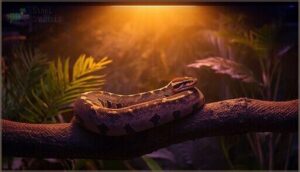
UVB lighting does more for your ball python than you might think. It enhances critical physiological processes like vitamin D3 production and calcium metabolism, while also influencing behavior and stress response.
Let’s clear up what UVB actually does—and what it doesn’t—so you can make informed decisions about your snake’s lighting setup.
Vitamin D3 Synthesis and Calcium Absorption
UVB exposure triggers a notable chain reaction in your ball python’s skin. When UVB photons strike 7-dehydrocholesterol, they create previtamin D3, which heat converts into active vitamin D3.
UVB photons trigger a chain reaction in your ball python’s skin, converting 7-dehydrocholesterol into active vitamin D3
This hormone supercharges calcium metabolism by stimulating calbindin production in the gut, dramatically improving calcium absorption. Without adequate UVB lighting, your snake can’t build strong bones—setting the stage for metabolic bone disease.
Impact on Behavior and Stress Levels
Proper photoperiod unlocks striking changes in reptile behavior and psychology. Your ball python’s circadian rhythm depends on consistent environmental cues—UVB lighting paired with a 12-hour day-night cycle reduces chronic stress and encourages natural basking, exploration, and feeding responses.
This behavioral enrichment transforms lethargic snakes into confident, alert individuals. When you offer appropriate UVB, you’re supporting animal welfare through measurable improvements in animal health and wellness.
Common Misconceptions About UVB Needs
Many keepers believe their ball python doesn’t need UVB lighting because it survives on rodents alone, yet dietary vitamin D3 works best alongside sensible UVB exposure.
You’ll avoid lighting safety pitfalls by choosing low-intensity fixtures that support circadian rhythm and natural snake behavior—not desert-strength bulbs that risk eye damage—while debunking UVB myths and promoting long-term reptile health.
Frequently Asked Questions (FAQs)
Can ball pythons survive without UVB lighting?
Yes, your ball python can survive without UVB lighting if you provide calcium and vitamin D3 supplements through diet, though some individuals may benefit from low-intensity UVB for natural behavior.
Do UVB bulbs increase electricity costs significantly?
Running a 40-watt UVB fixture 12 hours daily costs roughly 15 cents per day—about $50 monthly—so energy costs stay minimal.
While UVB output promotes calcium metabolism and lighting optimization in your ball python enclosure.
What UVB strength suits hatchling ball pythons?
Hatchling ball pythons thrive with low-intensity UVB lighting targeting 5 to 0 µW/cm² at the basking zone—measured using a UV index meter—to support vitamin D3 synthesis without risking stress or eye irritation.
Should UVB stay on during nighttime hours?
Think of UVB like morning coffee—it’s meant for daylight hours only.
Turn UVB off at night to preserve your ball python’s circadian rhythm and prevent stress, maintaining a proper 12-hour photoperiod with consistent lighting cycles.
Do albino ball pythons need different UVB?
Albino ball pythons need lower UVB intensity due to melanin impact on sensitivity factors.
They require 2–5% UVB with lighting gradients to prevent visual stress, supporting circadian rhythm and photoperiod without overwhelming their photoperiod-sensitive eyes.
Conclusion
Think of UVB as preventive medicine—your ball python won’t send distress signals until deficiency becomes disease. Installing proper uvb lighting systems for ball pythons isn’t about fixing problems; it’s about preventing them entirely.
You’ve learned the equipment, placement protocols, and maintenance schedules that separate adequate care from exceptional husbandry. Now measure your fixture distance, set your timer, and replace bulbs before they fail. Your python’s skeletal integrity depends on invisible wavelengths you’ll never see working.