This site is supported by our readers. We may earn a commission, at no cost to you, if you purchase through links.

Your desert snake’s survival depends on heat lamps that replicate the scorching basking rocks of its native habitat. Too cool, and digestion stalls. Too hot, and you risk burns or fatal overheating. Desert species like California kingsnakes and rosy boas need basking zones between 90-95°F, while species from cooler microclimates require different ranges entirely.
The wrong bulb type—ceramic versus halogen versus infrared—can create dangerous cold spots or eliminate the thermal gradient your snake needs to thermoregulate. Choosing heat lamps for desert snakes requires matching wattage, emission spectrum, and placement to your specific species’ metabolic demands. The right setup transforms a glass box into a functional desert ecosystem.
Table Of Contents
- Key Takeaways
- Best Heat Lamp Types for Desert Snakes
- Matching Heat Lamps to Snake Species
- Creating The Ideal Desert Snake Enclosure
- Key Safety Tips for Heat Lamp Use
- Top Heat Lamp Products for Desert Snakes
- Maximizing Desert Snake Health With Proper Heating
- Frequently Asked Questions (FAQs)
- Are heat lamps good for snakes?
- Should I leave my snakes heat lamp on all day?
- How often should heat lamp bulbs be replaced?
- Can multiple heat lamps be used together safely?
- What wattage heat lamp does my snake need?
- Do heat lamps affect nighttime temperature drops?
- Should heat lamps run on timers or continuously?
- Conclusion
Key Takeaways
- Desert snakes require species-specific basking temperatures between 88-105°F, with ball pythons needing 88-92°F and some desert species reaching 90-100°F—getting this wrong stalls digestion or causes fatal burns.
- Different heat lamp types serve distinct purposes: incandescent bulbs mimic natural sunlight for daytime basking, ceramic heat emitters provide 24-hour warmth without light, and halogen bulbs deliver intense focused heat for high-temperature zones.
- Thermostats aren’t optional safety equipment—they’re your primary defense against overheating, and proper placement requires positioning the probe at your snake’s active zone (not directly under the lamp) while maintaining bulb distances of 8-18 inches depending on type.
- Creating a functional thermal gradient means positioning your heat source on one end to establish 85-95°F basking zones and 70-80°F cool retreats, allowing your snake to self-regulate just like it would in its natural desert habitat.
Best Heat Lamp Types for Desert Snakes
Desert snakes need specific heat sources to maintain their body temperature and stay healthy. Different bulb types offer unique benefits, from daytime basking to nighttime warmth without disrupting sleep.
If you’re exploring broader warmth solutions beyond bulbs, a quality heating pad designed for snakes can provide steady belly heat that complements overhead lighting.
Here’s what works best for creating the right thermal environment in your snake’s enclosure.
Incandescent Bulbs for Natural Infrared
Incandescent bulbs produce visible light alongside infrared radiation, mimicking desert sunlight your snake needs for basking. These reptile heat bulbs deliver natural spectrum output that aids thermoregulation better than ceramic heat emitters.
You’ll establish ideal temperatures with a 60 to 75 watt bulb positioned over the basking zone. Expect bulb longevity of 6 to 12 months depending on daily use and proper heat distribution across your setup.
Using a thermostat is important to prevent overheating, as highlighted in the.
Ceramic Heat Emitters for Focused Warmth
While incandescent bulbs excel during daylight, ceramic heat emitters deliver steady infrared warmth without visible light—perfect for nighttime heating. You’ll maintain a reliable thermal gradient with these reptile heat lamp fixtures while your snake rests undisturbed. Ceramic heat efficiency shines in 24-hour setups, with focused heat benefits directly beneath the emitter.
Position your ceramic emitter over the basking zone following proper emitter placement tips and heat emitter materials guidelines for ceramic emitter safety.
Halogen Bulbs for High-Temperature Basking
When your desert snake needs intense warmth fast, halogen bulbs deliver powerful infrared output that raises basking spots to ideal levels.
These reptile heat lamps generate 60 to 100 watts of focused heat distribution, quickly warming substrate and creating a precise thermal gradient.
You’ll maintain basking zone temperatures around 95 to 105°F with careful bulb wattage selection and temperature control through thermostats.
Infrared Lamps for Deep Penetration
You’ll get advanced thermal control with infrared lamps that focus heat on specific basking spots while delivering deep penetration into reptile skin. These reptile heat lamps emit infrared radiation without excessive visible light, maintaining target temperatures in a defined zone.
Position your heat lamp 8 to 12 inches above substrate for ideal heat distribution, then monitor with a thermostat to keep basking areas stable.
Deep Heat Projectors for Nighttime Heating
Deep heat projectors deliver long-wave infrared radiation across broader zones without disrupting your snake’s sleep cycle. You’ll maintain thermal stability overnight while ceramic heat emitters provide focused warmth. These infrared projectors operate at higher wattages to support thermal gradients in larger desert setups:
- Mount securely with protective guards to prevent contact burns
- Pair with thermostats for precise nighttime heating control
- Use 80-watt models for medium enclosures, 50-watt for smaller habitats
- Position 10 to 14 inches above basking rocks
- Combine with secondary heat sources for complete desert lighting
Matching Heat Lamps to Snake Species
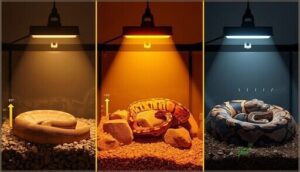
Not all desert snakes need the same heat setup. Ball pythons thrive with different basking temperatures than corn snakes, and larger species bring their own challenges.
Let’s match the right heat lamp to your snake’s specific needs.
Ball Python Basking and Temperature Needs
Your ball python thrives when its basking spot reaches 88 to 92°F. Use a halogen heat lamp positioned to create a clear thermal gradient, allowing the snake to move between warm and cool zones. Monitor the basking surface with an infrared thermometer—never exceed 95°F.
At night, gradually drop temperatures to 72 to 78°F for natural cycles. Proper enclosure setup and temperature control are explained in this helpful ball python care guide.
| Zone | Day Temperature | Night Temperature |
|---|---|---|
| Basking spot | 88–92°F | Off or dimmed |
| Warm side | 80–85°F | 75–78°F |
| Cool side | 75–80°F | 72–75°F |
Corn Snake Lighting and UVB Requirements
Your corn snake benefits from UVB lighting in captivity to support vitamin D synthesis and calcium metabolism. Choose a 5.0 to 10.0 UVB bulb and mount it 12 to 18 inches above the basking spot, creating a thermal gradient with infrared heat sources. Provide a 12-hour lighting cycle and shade retreats. Replace UVB bulbs every 6 to 12 months to maintain consistent reptile lighting output.
Heating Solutions for Large Desert Species
Large desert species need powerful reptile heat lamps that create broad thermal gradients across spacious enclosures. Use halogen bulbs or ceramic heat emitters to maintain basking hotspots of 90 to 105°F while keeping cooler zones around 75 to 85°F.
Multiple fixtures guarantee proper heat distribution and mimic desert climate conditions.
Position infrared heat sources 8 to 12 inches above basking areas to encourage natural reptile behavior without overheating.
Species-Specific Temperature Ranges
You’ll need to match your heat lamp to your snake’s thermal limits—temperature zones differ wildly between species. Ball pythons require basking spots around 88 to 95°F with ambient zones at 78 to 84°F, while corn snakes prefer 84 to 90°F for basking.
If you notice any of these warning signs, the guide on recognizing when your snake’s heat lamp is too hot can help you troubleshoot before temperatures cause lasting stress.
Desert species often need infrared heat reaching 90 to 100°F to replicate their natural habitat and maintain proper heat gradients throughout your reptile enclosure.
Creating The Ideal Desert Snake Enclosure
Getting your desert snake’s enclosure right means thinking beyond just the heat lamp itself. The size of your setup, what you put on the floor, and how you arrange everything directly affects whether your snake stays warm, comfortable, and healthy.
Let’s break down the four critical factors that’ll help you create an enclosure that actually works.
Enclosure Size and Material Considerations
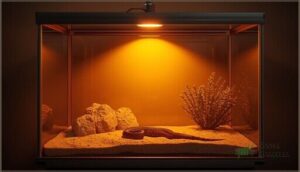
Your enclosure’s size and material shape how well your heat lamp performs. Think of it as the foundation of temperature control—miss this step, and you’ll chase hotspots forever.
- Enclosure Depth: Provide 1.5 to 2 times the heat source footprint to prevent wall scorching and allow proper thermal zones.
- Material Selection: Glass transmits radiant heat effectively but traps humidity; aluminum frames tolerate high temperatures without warping.
- Insulation Types: Reflective interiors distribute warmth evenly while insulated walls maintain basking temperatures with lower wattage bulbs.
Substrate Effects on Heat Distribution
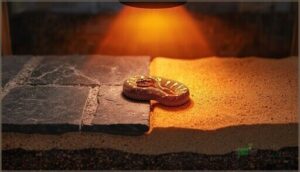
After sizing your enclosure, choose substrate wisely—it controls heat distribution. Tile and slate show high thermal conductivity, spreading infrared heat evenly for steady temperature control.
Sand and coconut fiber offer better heat retention through moisture levels, while depth affects radiant heating patterns. Light substrates reflect heat sources upward; dark ones absorb it.
Match substrate to your reptile’s desert origin and your heat lamp wattage for consistent basking zones.
Establishing a Thermal Gradient
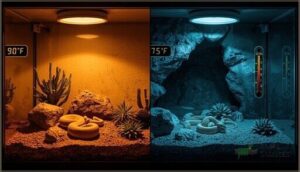
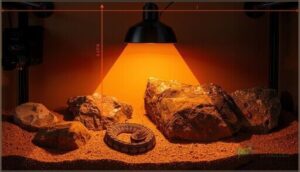
Now position your heat lamp on one end to build a thermal gradient—the temperature slope desert snakes need. Gradient creation puts basking zones at 85–95°F and cooler retreats at 70–80°F.
Thermal mapping with multiple thermometers confirms heat distribution across the enclosure. This temperature control mimics natural desert conditions, letting your reptile self-regulate through infrared heat and active thermal regulation.
Proper Placement of Heat Lamps and Thermostats
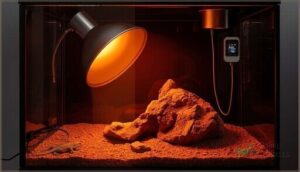
Once your gradient exists, mount that heat lamp directly above the basking spot—8 to 12 inches from the surface. Use a reflector dome to focus infrared heat precisely where your reptile needs it. Then secure the thermostat probe on the warm side, just above the substrate, never underneath the bulb.
- Calibrate your thermostat using a secondary thermometer at the basking surface for accurate temperature control
- Adjust lamp distance if your basking spot exceeds 110°F or drops below 90°F
- Keep the thermostat body outside the enclosure to prevent tampering and maintain heat lamp safety
Key Safety Tips for Heat Lamp Use
Heat lamps keep your desert snake healthy, but they can cause serious problems if you don’t use them correctly. Burns, fires, and temperature swings happen more often than most keepers realize.
Heat lamps protect desert snakes, but improper use causes burns, fires, and dangerous temperature swings more often than keepers expect
Let’s walk through the essential safety measures that’ll protect both you and your snake.
Preventing Overheating With Thermostats
A thermostat isn’t optional—it’s your first line of defense against runaway heat. Digital models with overheat protection cut power automatically when temperatures exceed safe limits, usually within 1–2°F of your setpoint.
Place heat sensors at your snake’s active zone, not directly under the lamp, for accurate temperature control.
Smart thermostats with temperature ramping let you mimic natural desert cycles while keeping infrared heat stable and safe.
Using Lamp Guards and Secure Mounting
After the thermostat comes physical protection.
Lamp guards and rock-solid mounting prevent disaster. Use metal guards rated for your bulb’s wattage to shield your snake from burns and keep bulbs intact if bumped.
Secure clamps or purpose-built brackets lock heat sources in place, preventing dangerous drops into the snake habitat.
Check mounting hardware every 3–6 months for corrosion or loosening to maintain safe heat dissipation.
Safe Bulb Distance and Positioning
Beyond guards and mounts, distance makes or breaks your heat lamp setup. Place bulbs 12 to 18 inches above the basking spot to deliver focused warmth without scorching scales.
Proper mounting heights create smooth thermal gradients while maintaining safety margins across your reptile lighting system.
- Incandescent bulbs: 15 inches minimum to prevent hot spots on skin
- Ceramic heat emitters: 8 to 12 inches for even heat distribution
- Infrared lamps: 14 to 24 inches to balance penetration and safety
- Deep heat projectors: 18 to 24 inches for stable nighttime warmth
- Clamp lamps: 10 to 12 inches above basking rocks for consistent temperature control
Regular Maintenance and Inspection
Vigilance keeps your heat lamp system running safely year-round. Inspect fixtures weekly for loose sockets and cracked housings, then test your thermostat monthly to confirm it holds temperature control within +/- 2°F.
Replace incandescent and halogen bulbs every 6 months to maintain consistent output.
Clean reflectors biweekly and record basking temperatures for two weeks to establish reliable thermal audits supporting ideal reptile care.
Top Heat Lamp Products for Desert Snakes
You need equipment that delivers consistent heat without compromising your snake’s safety.
The products below have earned their reputation through real-world performance in desert snake setups. Each option meets specific heating needs, from basic basking bulbs to specialized ceramic emitters.
1. Exo Terra Reptile Dome Light Fixture
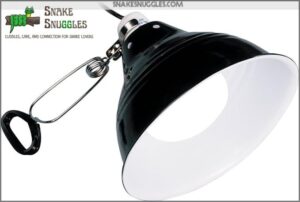
You’ll want a fixture that withstands desert heat without flinching. The Exo Terra Reptile Dome delivers exactly that with its aluminum reflector and heat-resistant ceramic socket rated up to 160W.
The extended reflector increases light, UVA, and UVB output while keeping bulbs safely recessed from enclosure surfaces. It works with incandescent, halogen, and compact fluorescent bulbs—giving you flexibility as your snake’s needs change.
The 6-foot power cord with an on/off switch makes daily operation straightforward and convenient.
| Best For | Reptile owners who need a durable, high-wattage dome fixture that handles extreme heat while providing flexible bulb options for desert species. |
|---|---|
| Wattage | 150W |
| Light Type | Incandescent |
| Material | Aluminum/Porcelain |
| Socket Type | Porcelain |
| Heat Source | Yes |
| Special Feature | Energy Efficient |
| Additional Features |
|
- Aluminum and porcelain construction handles high temperatures up to 160W without breaking down
- Extended reflector maximizes light and UV output while keeping bulbs safely recessed from enclosure walls
- Works with multiple bulb types (incandescent, halogen, compact fluorescent) so you can adjust as your reptile’s needs change
- Gets extremely hot during operation, requiring careful handling and placement
- Clamp design can be tricky to adjust and secure properly
- Higher price point compared to basic dome fixtures on the market
2. Fluker’s Reptile Daylight Bulb
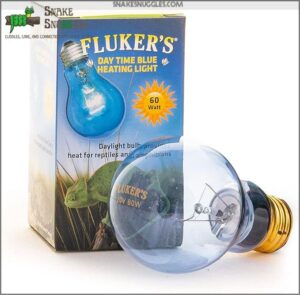
Fluker’s 60W Neodymium Daylight Bulb simulates natural desert sunlight while delivering focused infrared heat for your snake’s basking zone. The neodymium glass enhances color clarity inside the enclosure—you’ll see your snake’s patterns in sharper detail.
It produces radiant heat through infrared light and provides UVA rays to stimulate normal feeding behavior. Available in 60, 75, 100, and 150 watts, you can match the wattage to your enclosure’s size. Pair it with a thermostat to prevent overheating and maintain consistent basking temperatures.
| Best For | Snake owners who need a reliable daytime heat source that enhances enclosure visibility while encouraging natural basking and feeding behaviors. |
|---|---|
| Wattage | 60W |
| Light Type | Incandescent |
| Material | Standard Bulb |
| Socket Type | Standard |
| Heat Source | Yes |
| Special Feature | UVA Rays |
| Additional Features |
|
- Produces radiant infrared heat and UVA rays that stimulate healthy feeding patterns in snakes
- Neodymium glass enhances color clarity so you can see your snake’s markings more vividly
- Multiple wattage options (60-150W) let you match heat output to your specific enclosure size
- Some users report the bulb burns out after only a few months of use
- Packaging may not protect the bulb adequately during shipping, leading to arrival damage
- Requires a thermostat for safe operation to prevent overheating your snake’s enclosure
3. Fluker Repta Clamp Lamp
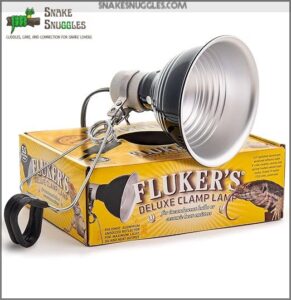
The Fluker Repta Clamp Lamp is a heavy-duty aluminum dome that mounts anywhere on your terrarium. It accepts up to 75 watts and works with incandescent bulbs, ceramic heat emitters, and compact fluorescents.
The safety clamp grips the rim securely, while the swivel head directs heat exactly where you need it. Available in 5.5, 8.5, and 10 inch sizes, you’ll find one that fits your setup. The built-in on/off switch saves wear on your bulbs between heating cycles.
| Best For | Reptile owners who need a reliable, adjustable heat source that works with different bulb types and securely clamps to tank edges. |
|---|---|
| Wattage | 75W |
| Light Type | Fluorescent |
| Material | Aluminum/Plastic |
| Socket Type | Ceramic |
| Heat Source | Yes |
| Special Feature | Safety Clamp |
| Additional Features |
|
- Heavy-duty aluminum construction with a ceramic socket that handles incandescent, ceramic heat emitters, and compact fluorescent bulbs up to 75 watts
- Safety clamp and swivel head let you position heat exactly where your reptile needs it without worrying about the fixture slipping
- Available in three sizes (5.5″, 8.5″, and 10″) so you can match the dome to your tank size and heating requirements
- Gets very hot during use, especially with higher wattage bulbs, so you need to be careful about placement and what it touches
- Some buyers received damaged products due to poor packaging
- Limited to 75 watts maximum, so if you need more heat you’ll have to upgrade to a larger, deeper dome fixture
4. Philips Heat Lamp Bulb
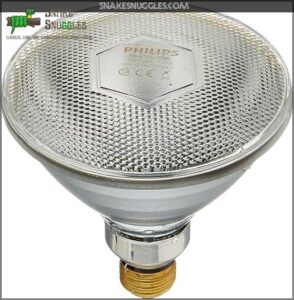
Philips heat lamp bulbs deliver reliable infrared warmth in both 175W and 250W options. The red infrared variant reduces glare during nighttime heating while maintaining steady output for ball pythons and corn snakes alike.
You’ll get several thousand hours of use from each bulb, and the medium screw base fits standard heat lamp fixtures you already own. The narrow filament concentrates heat downward into your basking zone, and when paired with a thermostat, you’ll maintain precise temperatures without constant adjustment.
Check bulbs monthly for cracks or darkening.
| Best For | Reptile owners who need a dependable heat source for small to medium enclosures and want a bulb that works with standard fixtures. |
|---|---|
| Wattage | 175W |
| Light Type | Incandescent |
| Material | Hard Glass |
| Socket Type | Medium SKT |
| Heat Source | Yes |
| Special Feature | Infrared Tech |
| Additional Features |
|
- Infrared technology provides consistent warmth without excessive light, making it ideal for nighttime heating
- Long lifespan of up to 5,000 hours means fewer replacements and better value over time
- Universal medium screw base fits most standard heat lamp fixtures without special adapters
- Some users report shorter lifespans of only 2-3 months, which contradicts the advertised durability
- Glass construction is fragile and requires careful handling to avoid breakage
- May automatically shut off if left on too long, which can disrupt heating schedules for reptiles
5. Fluker’s Ceramic Heat Emitter
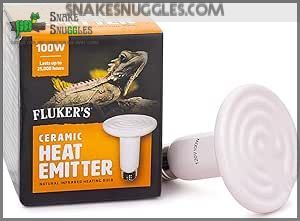
Ceramic heat emitters run 24 hours without blinding your snake with light. Fluker’s 100W model radiates infrared warmth from a large flat surface, creating an even basking zone at one end of your enclosure. You’ll need a ceramic socket fixture—standard bulb bases can’t handle the sustained heat.
This emitter lasts up to 25,000 hours because there’s no filament to burn out. Pair it with a thermostat to dial in your target temps, and keep it a safe distance from glass to prevent heat damage.
| Best For | Snake owners who need round-the-clock heat without disrupting their pet’s day-night cycle with visible light. |
|---|---|
| Wattage | 100W |
| Light Type | Ceramic Heat |
| Material | Ceramic |
| Socket Type | Standard |
| Heat Source | Yes |
| Special Feature | Non-Light Emitting |
| Additional Features |
|
- Runs 24/7 without producing light, so it won’t mess with your snake’s natural sleep patterns
- Lasts up to 25,000 hours since there’s no filament to wear out
- Creates an even heat spread across the basking area thanks to the large ceramic surface
- You’ll need to buy a ceramic socket fixture separately—regular lamp bases can’t handle the heat
- Gets extremely hot to the touch, so placement and handling require extra caution
- Might give off a noticeable smell during the first few hours of use
6. Exo Terra Wire Light Fixture
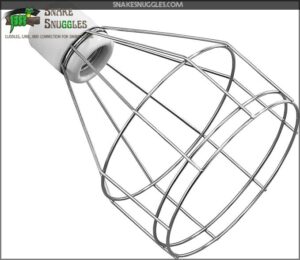
The Exo Terra Wire Light pairs a heat-resistant porcelain socket with a protective wire guard to prevent burns and heat buildup. You can mount it with an Exo Terra Light Bracket above your terrarium, creating targeted heat zones without stressing your enclosure glass.
It accommodates up to 150 watts, so you’re covered whether you’re running a halogen basking spot or a ceramic emitter. The modular design lets you combine multiple fixtures for custom thermal gradients across larger setups.
| Best For | Reptile owners who need a versatile, heat-safe lighting solution that works with multiple bulb types and can be mounted above the terrarium for targeted heating. |
|---|---|
| Wattage | 150W |
| Light Type | Multiple Compatible |
| Material | Porcelain |
| Socket Type | Porcelain |
| Heat Source | Yes |
| Special Feature | Wire Guard |
| Additional Features |
|
- Heat-resistant porcelain socket with wire guard prevents burns and handles up to 150W bulbs including ceramic heaters and halogen spots
- Flexible mounting options—use with Exo Terra Light Bracket or standalone to create custom heat gradients
- Compatible with multiple bulb types so you can switch between ceramic emitters, mercury vapor, and standard incandescent as needed
- Wire cage may be oversized for some heat emitters, leaving extra space
- Plastic cord grommet can become brittle and break down over time
- Build quality issues reported at hinge and nut connection points, may need occasional tightening
7. Zacro Reptile Heat Lamp
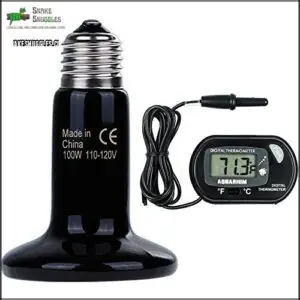
If you prefer a no-light option that won’t disturb nocturnal species, the Zacro Reptile Heat Lamp delivers focused warmth through its flat-faced ceramic emitter. You’ll find it in 60W, 100W, and 150W variants—pick the wattage that matches your enclosure volume and species needs.
The included digital thermometer helps you dial in precise temperatures from 10 to 40 cm away. Just make sure you pair it with a ceramic E27 socket to prevent melting under sustained heat.
| Best For | Reptile owners who need consistent 24-hour heat without visible light, especially for nocturnal species or multi-zone heating setups. |
|---|---|
| Wattage | 100W |
| Light Type | Ceramic Heat |
| Material | Ceramic |
| Socket Type | E27 |
| Heat Source | Yes |
| Special Feature | Digital Thermometer |
| Additional Features |
|
- Flat-faced ceramic design radiates heat efficiently without disrupting day/night cycles
- Comes with a digital thermometer so you can monitor temperatures right out of the box
- Available in three wattages (60W, 100W, 150W) to match different enclosure sizes
- Requires a ceramic E27 socket specifically—standard sockets can melt or fail under the heat
- Gets extremely hot during operation, making placement and handling tricky
- May overheat smaller tanks if you don’t dial in the distance correctly (needs 10-40 cm clearance)
Maximizing Desert Snake Health With Proper Heating
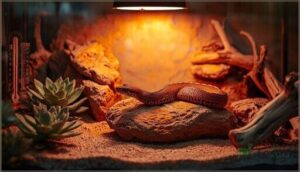
Getting the temperature right isn’t just about comfort—it’s about keeping your desert snake alive and thriving. Proper heating directly impacts digestion, stress levels, and whether your snake behaves like it would in the wild.
Let’s break down exactly how the right heat lamp setup fosters your snake’s long-term health.
Supporting Digestion and Activity Levels
Your desert snake’s digestion relies on precise thermal regulation from a quality heat lamp. Infrared radiation from ceramic heat emitters penetrates deep tissue, supporting metabolic processes that break down meals efficiently.
A thermostat maintains digestive health by preventing temperature swings that slow gut motility.
These activity boosters create environmental balance, encouraging exploration and feeding cycles while your reptile basks at ideal temperatures.
Reducing Stress With Stable Temperatures
Thermal comfort anchors your desert snake’s stress reduction strategy through consistent heat lamp regulation. Temperature control with a reliable thermostat prevents cortisol spikes that disrupt feeding and basking rhythms.
Environmental stability directly fosters calm behavior:
- Heat cycling matches natural desert patterns, easing transitions between day and night
- Ceramic heat emitters deliver steady warmth without light-driven stress
- Gradient zones let your snake self-regulate without forced exposure
- Monitored basking spots (88–92°F) reduce defensive aggression
- Regular bulb checks maintain predictable snake habitat conditions
Mimicking Natural Desert Sunlight
Full-spectrum bulbs recreate desert sun simulation by delivering 5000–6500 Kelvin color temperatures that match midday brightness. Your heat lamp should emit infrared wavelengths around 780–1400 nanometers for comfortable basking warmth.
Photoperiod control through 12–14 hour natural light cycles maintains seasonal rhythms, while UVB lighting for reptiles and ceramic heat emitters establish thermal gradients that mirror wild conditions without overexposure.
Monitoring and Adjusting Heat and Humidity
Climate monitoring isn’t a one-and-done setup—you’ll need to track and tweak conditions weekly. Install at least two temperature control sensors: one near the basking zone and another by the retreat area to verify your heat lamp creates proper heat distribution.
- Set your thermostat for 28–30°C basking and 20–25°C cool zones
- Position humidity levels gauges away from direct infrared radiation sources
- Calibrate sensors every 3–6 months to maintain accuracy
- Document daily readings to catch drift before it harms your snake
Frequently Asked Questions (FAQs)
Are heat lamps good for snakes?
Yes, heat lamps are excellent for snakes. They deliver infrared radiation that aids digestion, activity, and thermal comfort.
Ceramic heat emitters and halogen bulbs create safe basking zones when paired with thermostats for reptile wellness.
Should I leave my snakes heat lamp on all day?
Most reptile experts recommend turning your snake’s heat lamp off at night to mirror natural day-night cycles.
Use a thermostat for temperature control during heat duration, supporting healthy snake behavior and proper heat lighting schedules.
How often should heat lamp bulbs be replaced?
Replace reptile heat bulbs every six to nine months because heat output drops before burnout.
Ceramic heat emitters last roughly a year, while UVB bulbs need changing every six to twelve months due to UVB degradation.
Can multiple heat lamps be used together safely?
Most reptile fires trace back to tangled multi-lamp systems, yet you can safely run several heat lamps together by spacing them 12–18 inches apart, using a thermostat, and securing fixtures to prevent hot spots or tipping.
What wattage heat lamp does my snake need?
Most snakes need 60 to 100 watt heat lamps for small to medium enclosures. Use a thermostat to control basking temps—wattage alone won’t prevent overheating or maintain proper thermal requirements.
Do heat lamps affect nighttime temperature drops?
Heat lamps and temperature control directly influence nighttime drops in your enclosure. Ceramic heat emitters and deep heat projectors maintain thermal gradients during heat cycling, while thermostats prevent overheating and support natural desert climate patterns essential for snake behavior.
Should heat lamps run on timers or continuously?
Which matters more: matching nature’s rhythm or your snake’s actual needs? Timer settings create a 12-on-12-off heat cycle, while continuous operation with thermostat thermal control maintains precision. Energy efficiency favors scheduled lamp scheduling for most desert reptile care.
Conclusion
Your snake’s life hangs in the balance when temperatures drift outside its species-specific range. Desert snakes don’t adapt to poor heating; they decline slowly until organ systems fail. Get the temperature right from day one.
The seven heat lamps for desert snakes reviewed here give you precise control over basking zones, thermal gradients, and nighttime heating—tools that separate thriving reptiles from stressed ones. Match wattage to enclosure size, install thermostats without exception, and monitor daily.