This site is supported by our readers. We may earn a commission, at no cost to you, if you purchase through links.

Most snakes don’t just prefer warmth—they’re engineered for it.
A warm humid environment snake, like the green tree python or emerald tree boa, operates within thermal and moisture thresholds so precise that a 10°F drop or a humidity swing below 60% can derail a shed cycle, suppress appetite, or trigger respiratory stress.
These animals evolved inside layered rainforest ecosystems where canopy shade, leaf litter, and riparian corridors hold temperature and vapor pressure in near-perfect equilibrium year‑round.
Replicating that balance in captivity demands more than a heat lamp and a water bowl—it demands understanding what these environments actually do at a biological level.
Table Of Contents
- Key Takeaways
- What is a Warm Humid Environment for Snakes?
- Snake Species That Thrive in Warm Humid Conditions
- Essential Habitat Requirements for Warm Humid Snakes
- Setting Up a Warm Humid Snake Enclosure
- Health and Behavior in Warm Humid Environments
- Frequently Asked Questions (FAQs)
- What snakes like high humidity?
- Do snakes like humid places?
- Do snake plants do well in humid environments?
- How long do warm humid snakes typically live?
- Can warm humid snakes coexist with other reptiles?
- What do rainforest snakes eat in the wild?
- Are warm humid snakes safe for beginner owners?
- How do humidity needs change as snakes age?
- Conclusion
Key Takeaways
- Warm humid snakes like ball pythons and green tree pythons need tightly controlled conditions — 75–95°F thermal gradients and 60–90% humidity — because even a 10°F drop can derail shedding, digestion, and immunity.
- Your substrate and misting setup do more work than any single piece of equipment: coconut coir, cypress mulch, and timed misting cycles (twice daily, 1–2 minutes) are what actually hold stable humidity between checks.
- Your snake’s behavior is a direct readout of enclosure health — glass surfing, open-mouth breathing, or hiding beyond 20 hours daily mean temperature or humidity is off and needs immediate correction.
- Humidity needs shift across a snake’s entire life, from 80–90% for eggs down to species-specific adult baselines, so set it and forget it is never a safe approach to long-term care.
What is a Warm Humid Environment for Snakes?
Not every snake thrives in the same conditions — and for warm, humid species, getting the environment right isn’t optional.
For species like the Savu python, nailing those parameters from day one makes all the difference — the Savu python care sheet breaks down exactly what that looks like in practice.
These snakes evolved in some of the most climate-specific places on Earth, where temperature and moisture work together like a finely tuned system.
Here’s what defines that environment and why it matters for keeping your snake healthy.
Defining Warm and Humid Climates
Warm, humid climates aren’t just hot and wet — they’re precisely calibrated systems. Köppen Af zones, for example, maintain temperatures between 27–32°C daily, with humidity averaging 75–90% year‑round. Vapor pressure levels hold steady near 2,500–3,000 N/m², while the diurnal thermal gradient stays narrow — just 5–10°C swing. Rainfall distribution hits 2,000–5,000 mm annually. Understanding these numbers transforms how you approach temperature and humidity control.
These zones are located near the equator, extending to about 15° north and south.
- Biotemperature range: 16–24°C sustained year-round
- Humidity control target: 75–90% relative humidity
- Moisture management: even rainfall with no dry months
- Warm climates support tropical species through stable vapor pressure
Natural Habitats of Warm Humid Snakes
precise climate numbers point directly to where these snakes actually live. Tropical rainforests are the blueprint — layered ecosystems where canopy microhabitats stay perpetually warm and dripping, leaf litter ecology creates cool, damp retreats below, and riparian corridors along streams offer dense cover.
Burrow refuges buffer snakes against surface shifts, while seasonal moisture cycles keep humidity requirements consistently met throughout the year. These snakes are also found throughout the tropical rainforest distribution near the Equator.
Key Environmental Factors (Temperature, Humidity)
Two factors run everything in a snake’s world: temperature and humidity. Get these wrong, and nothing else matters.
Thermal gradient design means your enclosure spans 85–95°F on the warm side down to 75–80°F on the cool end — that’s microclimate zoning in practice. Pair that with ideal humidity levels between 60–80%, and you’ve built the foundation your snake’s metabolism, shedding, and digestion actually depend on.
Snake Species That Thrive in Warm Humid Conditions

Not every snake is built for the same world — and the ones that call tropical regions home have very specific needs.
Matching the right species to the right conditions is where successful husbandry begins.
Here are the snakes most commonly associated with warm, humid environments, broken down by habitat and moisture requirements.
Popular Pet Snakes From Tropical Regions
Three tropical species dominate the pet trade for good reason:
Each thrives under specific conditions, so understanding how humidity and temperature work together for tropical snakes is key to keeping them healthy long-term.
- Ball pythons — calm, manageable at 3–5 feet, and available in endless morph variety through selective breeding.
- Brazilian rainbow boas — stunning iridescent scales, though breeding challenges and strict humidity control (70–90%) make them intermediate‑level.
- Green tree pythons — arboreal showpieces demanding precise temperature regulation and environmental enrichment for long‑term snake health.
Notable Wild Species in Rainforests and Jungles
Jungle ecosystems reveal snakes in their rawest form — shaped by millions of years of adaptation.
| Species | Key Trait |
|---|---|
| Green Anaconda | Aquatic Giant Snakes; top predator |
| Emerald Tree Boa | Arboreal Adaptations; branch ambush hunter |
| Gaboon Viper | Camouflage Patterns; highest Venom Potency |
| Reticulated Python | Dietary Roles; largest tropical species |
| Fer-de-lance | Forest floor; pit-sensing predator |
These wild architects of tropical rainforest ecosystems define what ideal snake habitat preferences look like.
Species-Specific Humidity Requirements
Each species draws the line differently.
Ball pythons demand 60–80% during the day, spiking to nearly 100% at night — humidity‑driven metabolism doesn’t negotiate.
Green tree pythons settle at 40–70%, while reticulated pythons need a steady 65–85%.
Kingsnakes tolerate 40–60%, and Kenyan sand boas rely on moist burrow substrates more than ambient air.
Humidity monitoring devices and hygrostats make species‑specific humidity needs manageable — not guesswork.
Essential Habitat Requirements for Warm Humid Snakes

Getting the habitat right isn’t optional — it’s the foundation of your snake’s health.
Warm humid species have specific thresholds for temperature, moisture, substrate, and shelter that need to work together, not in isolation.
Here’s what each of those requirements actually looks like in practice.
Temperature Ranges for Optimal Health
Temperature is everything for a warm humid snake — get it wrong, and digestion, immunity, and shedding all suffer.
Thermal gradient design means giving your snake a warm side around 88–92°F and a cool side near 75–80°F.
Basking zone calibration keeps surfaces under 95°F to prevent burns.
Nighttime cooling strategies allow safe drops to 70–78°F, supporting natural thermoregulation without stress.
Maintaining Proper Humidity Levels
Humidity control is where most keepers stumble — and it’s fixable once you understand the system.
- Mist Timing: Run automated cycles 1–2 minutes, twice daily, targeting 70–80% ideal humidity levels.
- Hygrometer Calibration: Position probes mid-enclosure for accurate humidity monitoring — not near heat sources.
- Ventilation Strategies: Cover 80% of screen lids while keeping bottom vents open.
- Mold Prevention: Spot-clean daily; run fans post-misting. A humid hide with damp sphagnum moss manages localized humidity requirements without over-saturating everything.
Substrate Choices for Moisture Retention
Your substrate choice is the foundation of humidity retention — get it wrong and everything else fights uphill. Coconut coir holds moisture precisely and resists mold. Cypress mulch releases water slowly, sustaining ambient humidity control between mistings. Pack damp sphagnum moss into hides for localized moisture hygiene.
For serious setups, a layered bioactive system with drainage media and organic topsoil controls moisture without waterlogging — giving your snake real substrate options that mirror nature.
Shelter and Enclosure Design
Your enclosure environment is where every variable either works for you or against you. Get the structure right, and humidity control, thermal gradient, and enrichment practically manage themselves.
- Enclosure Materials: Use PVC or sealed wood — they resist warping under constant moisture.
- Escape‑Proof Locks: Latch or key every door seam; snakes find gaps you won’t.
- Ventilation Placement: Lower vents cool-side, upper vents warm-side — convection does the rest.
- Substrate Sealing: Silicone all interior seams before introducing moisture or animals.
Setting Up a Warm Humid Snake Enclosure
Getting the enclosure right is where good intentions either prove themselves or fall apart. Every element—heat, humidity, airflow, substrate—has to work together like a living system, not a checklist.
Here’s what you need to set it all up properly.
Heating Methods and Equipment
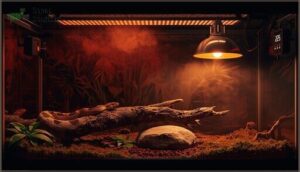
Heating your snake’s world correctly starts with choosing the correct tools.
Under Tank Mats deliver belly warmth through conduction — ideal for smaller setups. Ceramic Emitters maintain nighttime heat without disrupting sleep cycles. Radiant Panels spread gentle overhead warmth across the enclosure. Basking Lamps create the focused hot zone your snake needs.
Always pair every external heat source with the right Thermostat Types to maintain a stable thermal gradient.
Humidity Control Tools and Techniques

Once your heat sources are dialed in, managing moisture is your next priority. Automated Misting systems deliver short, timed bursts that stabilize humidity without waterlogging the substrate. Pair them with Fogger Controllers for precision. Build your setup around four core tools:
- Humidity Hide Design with damp sphagnum moss
- Substrate Drainage Systems for vertical moisture gradients
- Hygrometers for humidity monitoring and management
- Ventilation Balance to prevent mold
Monitoring and Adjusting Environmental Conditions
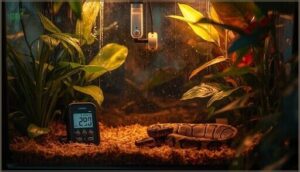
Once humidity control is locked in, consistent environmental monitoring is what separates a thriving snake from a struggling one.
Place your humidity probe mid‑enclosure at substrate level — proper humidity probe placement catches what your snake actually experiences.
Run thermostat proportional control to prevent temperature swings.
Data logging frequency every few minutes reveals hidden overnight drops.
Seasonal gradient tweaks and regular sensor calibration keep conditions accurate year‑round.
Preventing Mold and Excess Moisture Issues
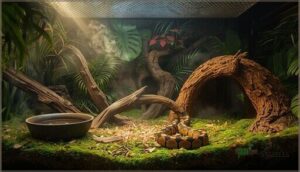
Mold doesn’t wait — it moves in the moment, ventilation design fails and moisture sits still.
Position your water bowl away from the warm end to limit evaporation, and let your mold-resistant substrate dry slightly between mistings.
A bioactive clean-up crew of springtails manages surface decay.
Your cleaning disinfection routine does the rest, keeping enclosure humidity balanced without inviting the problems that follow when moisture management slips.
Health and Behavior in Warm Humid Environments

Getting the enclosure right is only half the battle.
How your snake actually reacts to that environment — through its skin, behavior, and seasonal rhythms — tells you whether it’s truly thriving. Here’s what to watch for and how to stay ahead of the most common issues.
Effects of Humidity on Shedding and Skin Health
Shedding is your snake’s report card — and humidity writes the grade. Keep enclosure moisture between 50–70% (tropical species need 70–90%), and you’ll avoid dysecdysis prevention failures like stuck patches and eye cap shedding issues.
Poor humidity gradient design invites scale rot management headaches fast.
- Clean, single-piece sheds signal correct moisture levels
- Retained eye caps appear when air stays too dry
- Damp substrates trigger blister-like scale rot lesions
- Humid hides support shedding frequency factors naturally
- Digital hygrometers track moisture and humidity requirements accurately
Common Health Problems and Prevention
Warm, humid enclosures breed more than comfort — they breed opportunity for disease.
Respiratory infections develop when stale, damp air overwhelms your snake’s airways. Scale rot follows constantly wet substrate. Mouth rot takes hold when stress weakens immunity. Parasite infestations thrive in unsanitary conditions.
Counter all of it with daily spot-cleaning, correct humidity requirements, and routine vet fecal checks.
Obesity management matters too — overfed, sedentary snakes deteriorate faster than most keepers expect.
Behavioral Signs of Environmental Stress
Your snake’s behavior is a language — learn to read it. Glass surfing, excessive hiding, and restlessness pacing all signal that temperature regulation or humidity requirements are off. Defensive posture and rapid breathing demand immediate action.
Your snake’s behavior is a language — glass surfing, excessive hiding, and rapid breathing demand immediate action
Watch for these stressors for snakes:
- Nose rubbing against glass nightly
- Hiding beyond 20+ hours daily
- Open-mouth breathing lasting 30+ minutes
Seasonal Care Adjustments
Seasons don’t stop at your enclosure walls. Seasonal temperature shifts demand thermostat recalibration at least twice yearly — keeping daytime warmth at 80–85°F while allowing night drops to 70–75°F.
Humidity cycle management means misting more in dry winters, less in humid summers.
Adjust lighting duration adjustments to 10–12 hours seasonally.
Watch feeding frequency changes closely — appetite naturally dips in cooler months.
Frequently Asked Questions (FAQs)
What snakes like high humidity?
Tropical species like ball pythons, rainbow boas, and green tree pythons thrive at 60–90% enclosure humidity. Their species-specific humidity needs mirror rainforest origins — where moisture drives healthy shedding and skin integrity.
Do snakes like humid places?
Most snakes do prefer humid places — many species actively seek out moist microhabitats where humidity stays above 60 percent.
It’s hardwired into their biology, driving microhabitat selection and keeping shedding, hydration, and skin health on track.
Do snake plants do well in humid environments?
Yes, but with limits. Snake plants handle moderate humidity well, thanks to their thick water-retention leaf structure.
Keep levels under 60 percent — beyond that, root aeration suffers and fungal resistance breaks down fast.
How long do warm humid snakes typically live?
With proper care, ball pythons and boas generally live 20–30 years in captivity—often outliving their wild counterparts, where predators, parasites, and inconsistent conditions cut lifespans considerably.
Can warm humid snakes coexist with other reptiles?
Cohabitation rarely works. Habitat compatibility breaks down fast — humidity requirements clash, temperature competition stresses both animals, and predation dynamics make smaller reptiles vulnerable. Disease risk alone should stop you.
What do rainforest snakes eat in the wild?
Rainforest snakes eat mammal prey, bird prey, amphibian prey, and invertebrate prey depending on size and hunting strategies.
Tropical environments offer frogs, rodents, birds, and insects year-round, shaping diverse snake nutrition needs.
Are warm humid snakes safe for beginner owners?
Some snakes forgive beginner mistakes — others don’t.
Humidity Control in Snake Enclosures, Snake Health Monitoring, and Enclosure Setup for Snakes demand consistency.
Ball pythons offer the gentlest entry point into Snake Ownership Basics.
How do humidity needs change as snakes age?
Humidity needs shift at every life stage. Eggs need 80–90%, hatchlings 70–80%, juveniles 60–70%, and adults settle into species baselines. Senior hydration becomes trickier as aging skin sheds less efficiently.
Conclusion
Mastering the needs of a warm humid environment snake isn’t just responsible ownership—it’s the art of becoming a silent architect of a living ecosystem.
Every degree you dial in, every misting cycle you time, every substrate layer you choose becomes part of a chain that keeps your animal thriving at its biological best.
Get that chain right, and you won’t just own a snake. You’ll understand one.