This site is supported by our readers. We may earn a commission, at no cost to you, if you purchase through links.

snake tipping its water bowl at midnight is a rite of passage for most reptile owners—and a soggy substrate headache nobody wants to deal with twice.
When kids are involved, that bowl needs to do more than hold water. It has to be safe to handle, easy to scrub, and stable enough to survive a curious corn snake or a restless ball python.
The right snake water dishes for kids with pet snakes balance all three without making daily care feel like a chore. These four picks cover the full range of what actually works.
Table Of Contents
- Key Takeaways
- Top 4 Snake Water Dishes
- Safe Materials for Kids
- Right Size and Stability
- Cleaning and Water Care
- Frequently Asked Questions (FAQs)
- What can I use as a water bowl for a snake?
- How big should my snakes water dish be?
- What is the friendliest snake to keep as a pet?
- Can snakes drink too much water daily?
- What water temperature do pet snakes prefer?
- Should water bowls be elevated or ground-level?
- How do snakes signal they need more water?
- Conclusion
Key Takeaways
- The safest snake water dishes for kids are made from food‑grade resin, BPA‑free plastic, or ceramic — all non‑toxic, easy to scrub, and stable enough that an active snake won’t tip them over.
- Match the bowl depth to your snake’s size: under 2 feet needs just 1 inch of water, while a ball python or boa needs 2–3 inches to soak properly.
- Fresh water every single day is non‑negotiable — warm enclosures breed bacteria fast, and cloudy water or a slimy bowl means it’s already overdue for a change.
- The best kid‑friendly dish comes down to three things: a wide, weighted base that won’t tip, a smooth interior that wipes clean in seconds, and the right size for your specific snake.
Top 4 Snake Water Dishes
Finding the right water dish doesn’t have to be complicated. These four options cover different snake sizes, budgets, and setups — so there’s a good fit for most kids starting out.
If you want to dig deeper into what actually works, this guide to snake water dishes for bioactive setups breaks down the key features worth looking for.
Here’s what made the cut.
1. Exo Terra Large Reptile Water Bowl
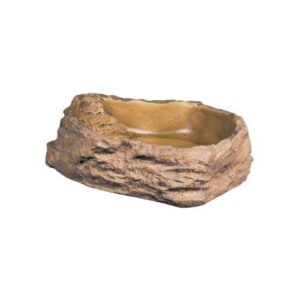
The Exo Terra Large Reptile Water Bowl is a solid first pick for families. It’s made from food-grade resin, so it’s non-toxic and safe for kids to handle.
The smooth interior wipes clean fast — no scrubbing required. It’s also heavy enough that your snake won’t tip it mid-crawl.
The shallow basin works well for drinking and light soaking. Just watch the depth if you’re housing a smaller juvenile snake alongside a larger one.
| Best For | Reptile and amphibian owners with medium to large species like ball pythons, tortoises, or tree frogs who want a stable, easy-to-clean water source. |
|---|---|
| Material | Food-grade resin |
| Interior Surface | Smooth, non-porous |
| Tip Resistance | Heavy, thick build |
| Exterior Style | Natural rock finish |
| Dual Use | Water dish |
| Dimensions (LxWxH) | 8.7×6.7×2 in |
| Additional Features |
|
- The smooth interior means cleaning takes seconds — no scrubbing, no buildup.
- Heavy enough to stay put even when your reptile is digging around or moving through the enclosure.
- Built-in safety ramp helps smaller critters climb out safely so they don’t get stuck.
- Actual dimensions may not match what’s listed, so double-check before buying.
- Too deep for very small or young reptiles who might struggle to reach the surface.
- Rigid plastic means it won’t fit into oddly shaped enclosures or tight corners.
2. Reptizoo Large Terrarium Water Bowl
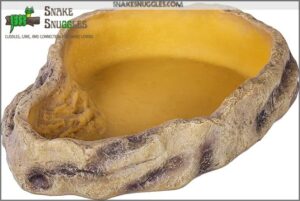
If you want something sturdier, the Reptizoo Large Terrarium Water Bowl steps things up. It’s built from polyresin — durable, non-porous, and easy to rinse clean.
The wide 28 cm footprint makes tipping unlikely, even with an active corn snake pushing against it. Kids can refill it without wrestling with a slippery bowl.
The rock-textured exterior looks natural inside any enclosure, and the smooth interior resists bacterial buildup. At roughly 1.5–2 liters capacity, it accommodates adult snakes without constant refills.
| Best For | Owners of adult reptiles like bearded dragons or corn snakes who want a heavy-duty, tip-resistant water dish that looks great in a naturalistic setup. |
|---|---|
| Material | Food-grade resin |
| Interior Surface | Smooth, non-porous |
| Tip Resistance | Heavy, stable |
| Exterior Style | Natural rock finish |
| Dual Use | Water dish |
| Dimensions (LxWxH) | 9.7x10x2.5 in |
| Additional Features |
|
- Super stable at 3.3 lbs — active snakes and lizards won’t knock it over
- Smooth interior makes cleaning quick and easy, no scrubbing required
- The soil-tone finish blends right into bioactive or naturalistic terrariums
- Only comes in one color, so it won’t work if you’re going for a slate or lighter look
- That same weight that keeps it stable makes it easy to drop and hurt yourself
- At 11 × 8 inches, it’s too bulky for smaller or tightly arranged enclosures
3. RunXF Extra Large Simulation Rock Bowl
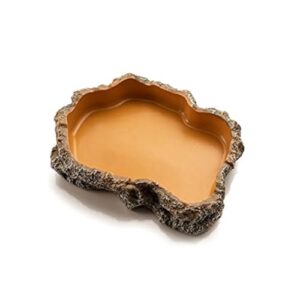
The RunXF Extra Large Simulation Rock Bowl takes stability a step further. At 9 × 6.7 × 2 inches and 13.4 oz, it’s solid enough that even a curious ball python won’t flip it.
The resin exterior mimics real rock — no synthetic look here.
Inside, the surface is smooth, so wiping it down takes seconds.
It’s BPA-free and dishwasher-safe on a gentle cycle.
Rinse it thoroughly before first use to clear any manufacturing dust.
Choosing a non-porous reptile water dish makes that first rinse even more worthwhile, since glazed or glass surfaces stay cleaner much longer.
| Best For | Medium to large reptiles like ball pythons, bearded dragons, and iguanas that need a stable, easy-to-clean feeding and water dish. |
|---|---|
| Material | Resin |
| Interior Surface | Smooth |
| Tip Resistance | Low center of gravity |
| Exterior Style | Soil-like texture |
| Dual Use | Water or feeder |
| Dimensions (LxWxH) | 11x8x2.4 in |
| Additional Features |
|
- Rock texture looks natural in any terrarium setup
- Smooth interior wipes clean in seconds
- Heavy enough that active reptiles won’t tip it over
- May run small for very large reptiles despite the "extra large" label
- Color description is inconsistent — listed as yellow but shown as brown in some photos
- Needs a thorough rinse before first use to remove manufacturing dust
4. Penn Plax Fossil Rock Food Water Dish
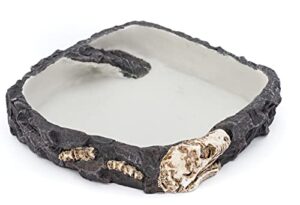
Another solid pick is the Penn Plax Fossil Rock Food Water Dish. It measures 7 × 7 × 1.5 inches and weighs 1.32 lbs — heavy enough to stay put when your snake pushes against it.
The fossil-rock texture looks great in any naturalistic setup, and the smooth interior wipes clean fast.
It works as both a food and water dish, which is handy. Just note the 1.5-inch depth isn’t deep enough for soaking — drinking only.
| Best For | Snake and reptile owners who want a natural-looking dish that doubles as both a food and water bowl without taking up extra enclosure space. |
|---|---|
| Material | Resin |
| Interior Surface | Smooth, non-porous |
| Tip Resistance | High-density base |
| Exterior Style | Simulated rock texture |
| Dual Use | Water and food bowl |
| Dimensions (LxWxH) | 9.06×6.69×1.97 in |
| Additional Features |
|
- The fossil-rock look fits right into a naturalistic setup — it actually looks like it belongs there.
- Heavy enough at 1.32 lbs that even pushy feeders won’t knock it over.
- Cleans up quickly — just rinse, wipe, and you’re done.
- At 1.5 inches deep, it’s not going to work as a soak dish — water only.
- Active or escape-prone reptiles might try to climb over the edges, so keep an eye on them.
- The resin can chip or fade if you use harsh cleaners or handle it roughly over time.
Safe Materials for Kids
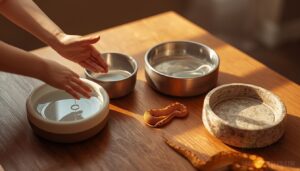
When kids help care for a snake, the bowl they use matters more than you’d think. Not every material is safe near little hands — or inside a reptile enclosure.
The bowl your child uses to care for a snake matters more than most parents realize
what to look for before you buy.
Food-grade Resin and HDPE Options
Food-grade resin and HDPE are two of the safest choices for kid-friendly pet care. Both materials pass strict regulatory compliance standards — meaning no BPA, phthalates, or toxic pigments.
Their nonporous materials resist bacterial buildup and wipe clean fast.
HDPE also brings impact resistance and thermal tolerance, so it won’t crack or warp.
Safe materials plus easy cleaning? That’s a win.
For more details, see the FDA-approved food-grade HDPE specifications.
Ceramic Versus Stainless Steel Bowls
Both ceramic and stainless steel bowls shine in kid-friendly pet care — but they trade off differently.
Ceramic wins on Aesthetic Options and Heat Retention, keeping water stable longer.
Stainless steel takes the lead in Durability Comparison: no cracking when dropped.
It’s lighter too, so Weight Impact stays low for small hands.
Both feature nonporous materials, easy to clean surfaces, and weighted base designs that resist tipping.
BPA-free and Non-toxic Choices
When kids are involved, material safety isn’t optional — it’s the starting point. Look for nontoxic resin or food-grade plastic marked with Phthalate-Free Labels and BPA-free claims.
Polypropylene Benefits include natural chemical resistance and durability through repeated washings.
Silicone Coatings add a safe, stain-resistant layer.
Glass Non-porosity and Lead-Free Glazes on ceramic make both solid kid-friendly pet care choices built on safe materials.
Non-porous Surfaces That Resist Bacteria
Non-porous surfaces are your first real defense against bacteria. Smooth resin and polymer bowls with biocide additives resist biofilm buildup — even after dozens of washes.
Some feature nano-texture surfaces or hydrophobic coatings that cause water to bead right off.
Silane-treated glass and copper antimicrobial surfaces take it further, cutting microbial attachment substantially.
For kid-friendly pet care, that kind of passive protection matters.
Dishwasher-safe Picks for Easy Cleanup
Dishwasher duty shouldn’t be complicated. The best picks — Exo Terra, Reptizoo, and RunXF bowls — handle standard cycles with ease, resisting heat up to 120°C without warping.
Their nonporous surfaces stay sealed after repeated washes, so material longevity isn’t a concern. Cycle compatibility is built in.
For kid-friendly pet care, that means less scrubbing and more time enjoying your snake.
Right Size and Stability
Size and stability matter more than most people expect with snake water dishes. The wrong bowl tips easily, floods the enclosure, or leaves your snake unable to soak properly.
Here’s what to look for before you buy.
Matching Bowl Depth to Snake Size
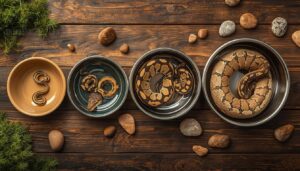
Not every snake drinks the same way — and the wrong bowl depth can be risky. Use this simple Depth Scaling Guide to match dish size and depth to your snake’s length:
- Under 2 ft: 1-inch depth for safe drinking
- 2–3 ft: 1.5–2 inches for partial soaking
- 3–4 ft: 2–3 inches, Growth-Adjusted Depth for shedding support
- 4+ ft: 3–4 inches with wider diameter
Think of it as a Length-Depth Ratio — longer snake, deeper dish.
Wide Bases That Prevent Tipping
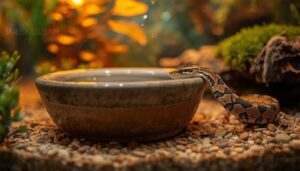
Depth gives your snake safe access to water — but a bowl that tips undoes all of that.
Wide bases increase Footprint Area, keeping the dish planted when your snake pushes against it.
Rounded Base Shape distributes weight evenly, while Non-skid Pads and Base Friction grip slippery terrarium floors.
These anti-tip design features and stability features to prevent tipping make kid-friendly pet care much easier.
Weighted Designs for Active Enclosures
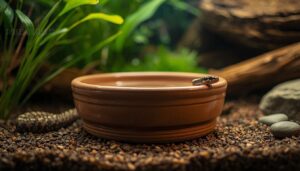
A wide base helps — but weighted bases go further. Built-in mass distribution lowers the center of gravity so active snakes can’t knock the dish over.
Ballast placement shifts the heaviest point toward the bottom, adding vibration damping when kids bump the enclosure. Some bowls even feature adjustable weight inserts.
That’s stability you can actually count on.
Spill-resistant Shapes for Curious Kids
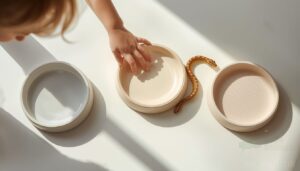
Stability doesn’t stop at the bowl’s base. Shape matters just as much — especially with kids around.
Look for these kid-friendly pet care features:
- Curved Edge Design — guides water back to center when bumped, cutting splashes quickly
- Recessed Inner Basin — a small inner lip traps minor spills before they spread
- Textured Underside Grip — locks onto smooth surfaces so curious hands can’t send it sliding
A low profile footprint with a wide mouth depth keeps refilling simple. Anti-tip design features and a stable base round out the package — easy to clean, nonporous, and genuinely hard to knock over.
Species-specific Needs for Larger Snakes
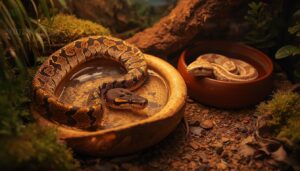
Bigger snakes need bigger bowls — and not just for drinking.
A ball python or boa needs a dish deep enough to soak in fully. That’s where species-specific water requirements come in.
| Species | Bowl Size | Depth |
|---|---|---|
| Ball Python | 9×6 in | 2 in |
| Boa Constrictor | 10×7 in | 2.5 in |
| Corn Snake | 6×4 in | 1.5 in |
| King Snake | 7×5 in | 1.5 in |
| Carpet Python | 9×6 in | 2 in |
Large capacity, nonporous resin water bowls support humidity regulation and health monitoring — and stability features prevent tipping and drowning for both your snake and kid-friendly pet care routines.
Cleaning and Water Care
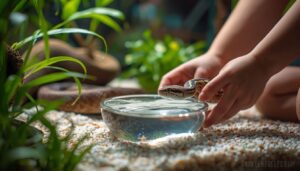
Keeping your snake’s water clean is just as important as picking the right bowl. Dirty water can cause health problems fast — and kids especially need simple, clear routines to follow.
A quick refresh every two days keeps bacteria at bay — standing water dish options for snakes can help you choose a bowl that’s easy for kids to clean and refill.
Here’s what you need to know to keep things fresh and safe.
How Often to Change Snake Water
Fresh water every day — that’s the baseline. Daily Water Change keeps bacteria from taking hold, especially in warm enclosures where things get slimy fast.
- Change water daily, or immediately after soiling
- During Shedding Season, increase changes to support hydration
- High Humidity Impact means faster bacterial growth — check more often
- Watch Behavioral Indicators: a snake avoiding its bowl signals water trouble
Spotting Slime, Odor, and Cloudy Water
Slimy buildup is your first red flag. Biofilm Identification starts with a slick film clinging to the bowl’s interior — clear, white, or faintly discolored.
Odor indicators, like musty or rotten-egg smells, confirm bacterial contamination.
Cloudy water causes range from minerals to microbes. Use Visual Water Clues and simple Water Quality Tests: stir the bowl. If cloudiness stays, it’s time for easy cleaning.
Dechlorinating Tap Water Safely
Tap water often carries chlorine, chloramines, and heavy metals — none of which are safe for your snake.
Here are three reliable ways to handle it:
- Boiling Method – Removes free chlorine but won’t eliminate chloramines.
- Activated Carbon filters – Great for daily use; add Vitamin C Neutralization for misting systems.
- Dechlorination tablets – Simple, precise, and perfect for kid‑friendly pet care routines.
Always monitor water quality with test strips.
Weekly Deep Cleaning Routines
Once a week, give every bowl a proper scrub — not just a rinse.
Soak bowls in warm, soapy water for five minutes, then apply a hydrogen peroxide dilution (1 part 3% peroxide to 10 parts water). Rinse completely. Run dishwasher-safe bowls through a full dishwasher sanitization cycle. Don’t skip terrarium corner scrubbing — biofilm hides there. Always air-dry bowls fully before refilling.
| Step | Method | Why It Matters |
|---|---|---|
| Soak | Warm water + dish soap, 5 min | Loosens slime and mineral buildup |
| Sanitize | Hydrogen peroxide dilution, rinse well | Kills bacteria without harsh chemicals |
| Machine wash | Dishwasher sanitization cycle | Consistent high-heat disinfection |
| Dry | Air-dry bowls completely | Prevents mold between uses |
| Disinfect surfaces | Weekly disinfectant rotation on surrounding areas | Stops cross-contamination |
This weekly disinfectant rotation keeps bacterial prevention consistent and water quality monitoring straightforward — easy cleaning and maintenance of reptile water bowls doesn’t have to feel overwhelming.
Preventing Bacterial Buildup in Bowls
Bacteria don’t need much — just moisture, warmth, and time. Stay ahead of it with these habits:
- Use dedicated bowls per enclosure and scrub with reptile-safe brushes — brush hygiene matters more than you’d think.
- Choose nonporous material benefits like food-grade plastic or ceramic; sanitizer types such as diluted hydrogen peroxide work without harming your snake.
- Control water temperature and always air-dry completely — drying methods prevent the moisture bacteria thrive on.
Frequently Asked Questions (FAQs)
What can I use as a water bowl for a snake?
You can use food-grade resin, HDPE plastic, ceramic, or stainless steel bowls.
Each offers safe materials, easy cleaning, and stability features to prevent tipping — all budget options that work well for kid-friendly pet care.
How big should my snakes water dish be?
Think of it like a bathtub — your snake needs room to stretch and soak.
Choose a bowl with at least 5× your snake’s body length ratio in diameter, with a stable base.
What is the friendliest snake to keep as a pet?
Corn snakes top the list for calm temperament, low aggression, and gentle handling. Ball pythons are another beginner-friendly pick — small adult size, easy to manage, and rarely fussy.
If you’re unsure whether a snake in your yard is a corn snake or a copperhead, this corn snake species guide shows how to spot the difference.
Rounding out the trio, kingsnakes bring bold color patterns and a hardy, low-maintenance nature that suits new keepers just as well — see this guide to gentle, toothless pet snakes for how they compare.
Can snakes drink too much water daily?
Overhydration is rare in snakes, but possible.
Watch for swelling indicators like facial puffiness or excessive soaking. These may signal electrolyte imbalance.
Daily hydration monitoring keeps your snake safe and shedding smoothly.
What water temperature do pet snakes prefer?
Most pet snakes prefer lukewarm water — around 84 to 87°F. That sweet spot meets reptile hydration needs without causing thermal stress.
When in doubt, if it feels warm (not hot) to your wrist, it’s just right.
Should water bowls be elevated or ground-level?
Ground-level bowls win for most setups — easier access, better stability mechanics, and simpler cleanup.
Elevated options help with spill prevention, but only if the mount is secure and kid visibility stays clear.
How do snakes signal they need more water?
Your snake tells you when it’s thirsty — you just have to know the signs. Watch for tongue flicking near water, sunken eyes, shedding delays, or lethargy. These signal dehydration fast.
Beyond drinking from a bowl, snakes can also soak up moisture through their skin — check out this guide on how snakes absorb and drink water to understand their unique hydration habits.
Conclusion
You don’t need a fancy setup to get this right. The best snake water dishes for kids with pet snakes are the ones your child can actually manage—fill, clean, and replace without your help every time.
Stable base, smooth surface, right size for the snake. That’s the whole formula.
Pick one dish that fits those three points, build the cleaning habit early, and the midnight spill becomes a rare exception instead of a weekly frustration.